
IRW-110 · Lesson 4 of 12 · 23 min
Power tools, torches and grinders
▶ Video coming soon A video version of this lesson is on the way.
On the Wednesday afternoon of his first week, Shay rode up in a boom lift with Nate Okonkwo, the bolt-up lead, to watch him run bolts on the second-floor beams. Nate carried a cordless high-torque impact wrench, a shear wrench for tension-control bolts and a bag of bolts. Down on the ground, Marco was cutting a bad clip angle off a beam with an oxy-fuel torch, with a fire watch beside him. "Power tools make this job faster," Nate said, "and they hurt people faster too." This lesson covers the power tools that ironworkers use most: impact and shear wrenches, magnetic drills, grinders, and oxy-fuel and plasma cutting. The general tools course (TRD-104) covered power tool basics, grinders and powder-actuated tools; this lesson concentrates on their use on steel.
Impact wrenches
Impact wrenches run nuts on and snug bolts quickly. They deliver torque in rapid blows, so they can turn a nut that a steady push could not without twisting the operator's arm. Ironworkers use pneumatic impacts, which run on compressed air from a compressor and are still common for large bolts, and cordless high-torque electric impacts, which have taken over much of the work on smaller bolts. Both come in sizes by drive square and output.
An impact wrench is not a calibrated tightening tool. The torque it delivers changes with air pressure, battery charge, hose length, socket fit and the condition of the threads. Bolt-up crews use impacts to snug bolts, bringing the plies of a connection into firm contact, and then tighten pretensioned bolts by a recognized method such as turn-of-nut, tension-control bolts, direct tension indicators or calibrated wrench, covered in IRW-210. Never assume a bolt is tight because the impact stopped turning it.
- Use impact-rated sockets only. Ordinary chrome sockets can shatter under impact.
- Keep hands clear of the socket and the steel; an impact that grabs can spin or kick.
- On pneumatic tools, use whip checks at hose couplings and shut off the air before disconnecting.
- Tether the tool at height; a cordless impact weighs 2 to 4 kg.
Shear wrenches and tension-control bolts
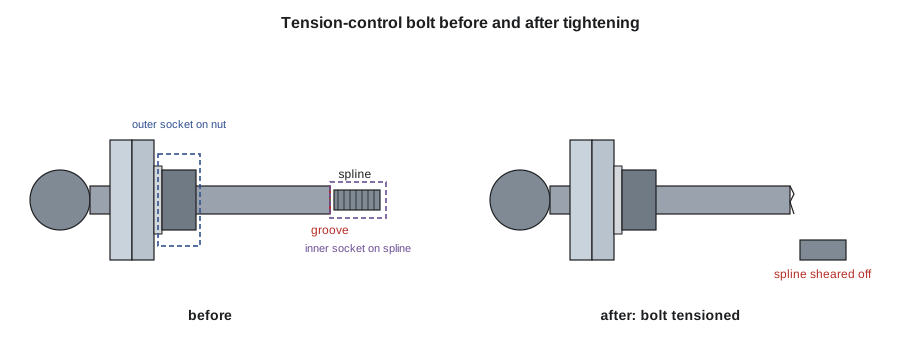
A tension-control (TC) bolt, often called a twist-off bolt, has a splined tip on the threaded end. A shear wrench grips the nut with an outer socket and the spline with an inner socket and turns them against each other. When the bolt reaches its installed tension, the spline shears off at a groove, and the end drops into the tool. The broken spline shows that the bolt was tightened by the tool; it does not by itself prove that the bolt reached the right tension if the bolts were stored badly or the threads were dry. Inspection of tension-control bolts is covered in IRW-210.
Shear wrenches are heavy and powerful. Hold them with both hands, keep the reaction arm or the tool body clear of fingers, and empty the spline ejector into a bucket, not over the side. Spent splines are small steel slugs; dropped from height they hurt.
Magnetic drills
Magnetic drills (mag drills) clamp to steel with an electromagnet and drill holes with twist drills or annular cutters, which cut a ring and leave a solid slug. Ironworkers use them to drill holes that were missed in the shop or must be added in the field, always with the engineer's approval when the holes affect a structural member. The main hazard is the magnet letting go. If the power fails, the cord is pulled or the steel is painted, rusty, thin or curved, the magnet may not hold, and the drill can spin around the cutter or fall.
- Use the safety strap or chain on every mag drill, wrapped around the member, especially when drilling overhead or on a vertical face.
- Clean the steel under the base; mill scale, paint and spatter cut the holding force.
- Check the minimum steel thickness for the magnet; thin plate does not hold well.
- Keep the cord out of the cutter and protected from edges; secure it so its weight does not pull on the drill.
- Use cutting fluid, clear chips with a brush or hook, never by hand, and watch for the slug ejecting at the end of the cut.
Grinders
Angle grinders are everywhere on a steel job: cleaning welds, removing mill scale, cutting bolts, bevelling and trimming. They are also one of the most common causes of hand, face and eye injuries. A grinder wheel spins at very high speed, and a wheel that breaks throws pieces at the speed of its rim. The rules come from the wheel maker, the tool maker and the safety codes, and they are the same everywhere:
- The maximum operating speed marked on the wheel must be at least the no-load speed marked on the grinder.
- Use the wheel type and size the grinder and its guard are made for. Never remove the guard, and never put a larger wheel on a smaller grinder.
- Use cut-off wheels only with a guard designed for cutting, and never grind with the side of a cut-off wheel.
- Inspect wheels before mounting; discard any that are cracked, chipped, wet, dropped or past their expiry date.
- After mounting a new wheel, run the grinder for about a minute at full speed with the guard on and nobody in line with the wheel.
- Hold the grinder with both hands, with the side handle fitted, and keep the cord or battery clear.
- Wear safety glasses and a face shield, hearing protection and gloves; keep sparks away from people, hoses and combustibles.
Worked problem
Checking a wheel against a grinder
Nate's cordless grinder is marked 125 mm and 11,000 r/min. Two wheels are in the gang box: a 125 mm Type 27 grinding wheel marked 12,250 r/min, 80 m/s and a 180 mm wheel marked 8,500 r/min. Which wheel may be used, and what is the rim speed of the correct wheel at the grinder's full speed?
Show solution
- Rule: wheel rating must be at least the grinder speed.
- 125 mm wheel: 12,250 ≥ 11,000, so it may be used if it fits the guard.
- 180 mm wheel: too large for the grinder and its guard, and 8,500 < 11,000. Do not use it.
- Rim speed: π × 0.125 m × 11,000 ÷ 60 ≈ 72 m/s.
Answer: Only the 125 mm wheel. At full speed its rim moves at about 72 m/s, about 260 km/h; a fragment from a broken wheel leaves at that speed.
Oxy-fuel cutting
Oxy-fuel cutting is a basic ironworker skill. A cutting torch preheats steel with a flame of fuel gas and oxygen until it glows, then a jet of pure oxygen burns through the hot steel and blows the molten oxide out of the cut. Ironworkers use acetylene or propane as the fuel gas. The welding courses (WLD-110) teach cutting technique; this lesson covers the safety rules that every ironworker must know before handling the equipment.
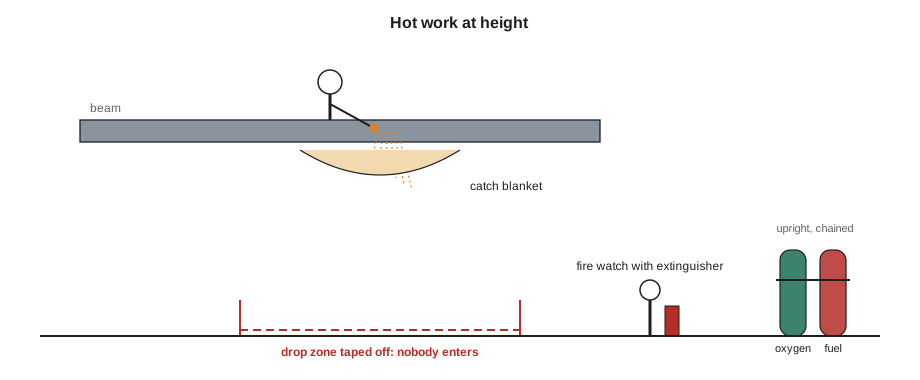
- Cylinders: store, move and use them upright, secured with a chain or strap so they cannot fall. Keep valve caps on when the regulators are off. Never use a cylinder as a roller or a support.
Separation: store oxygen cylinders apart from fuel gas cylinders when they are not in use, either by a safe distance or by a fire-resistant barrier, as the construction regulation and the Ontario Fire Code require. Crossbeam's yard keeps them in separate caged racks.
- Regulators and hoses: check for damage, use flashback arrestors at the regulators and check valves at the torch, and leak-test connections with an approved solution, never a flame.
- Lighting: use a striker, never a lighter or matches, and open the fuel valve first as the torch instructions say.
- Oxygen is not air. Never use it to blow off clothes or dust, run tools or ventilate a space; it makes clothing and grease burn violently.
- Acetylene: never draw it from the cylinder at more than about 1/7 of the cylinder's contents per hour, as the gas supplier specifies, and never use it above 103 kPa.
On steel, the main hazard of cutting is what falls: slag, sparks and cut-off pieces drop onto workers, materials, hoses and anything that can burn below. Hot work at height needs a hot work permit on most sites, fire-resistant blankets or catch pans under the work, a fire watch with an extinguisher who stays for the time the site rules require after the work ends, and a check that nobody is in the drop zone. The cut-off piece must be tied off or supported so it does not fall.
Plasma cutting
Plasma cutters use an electric arc and compressed air or gas to cut steel. They cut cleanly, with less heat than a torch, and need no fuel gas, but they bring electrical hazards and very bright arc light. Ground the work properly, keep the torch and cables in good condition, and wear eye protection with the right shade. Sparks and molten metal still fall, so the same hot work precautions apply.
Electrical safety for power tools
Cords, extension cords and tools must be in good condition, with ground pins in place, and temporary power on construction projects must be protected by ground fault circuit interrupters where the regulation requires. Cordless tools avoid cords but bring battery hazards: use the maker's charger, keep damaged batteries out of service, and do not leave batteries in hot trucks.
On steel, the whole structure is a conductor. A damaged cord that touches the steel can energize the frame, and a worker holding steel and a faulty tool is part of the circuit. Inspect cords before every shift and route them away from sharp edges, pinch points and the path of loads.
Powder-actuated tools and stud welding on deck
Decking crews fasten metal deck to the steel with welds, screws or powder-actuated fasteners, as the drawings specify, and they install shear studs that make the concrete slab act with the beams. Powder-actuated tools fire a pin into the steel with a small explosive charge. They are covered in the general tools course: only trained and authorized operators use them, with the right charge and pin for the steel, never on steel too thin or too hard for the fastener, and never pointed at anyone. A pin that does not hold can pass through thin material or ricochet.
Shear studs are welded through the deck to the beam with a stud welding gun and a large power supply. The process uses very high current for a fraction of a second, and it brings the usual arc welding hazards: arc flash, spatter, burns and electrical shock, with heavy cables across the deck that are a tripping hazard. Studs are tested by bending a sample of them as the inspection requirements say. Stud welding and the welding of deck are covered in the welding courses and in IRW-210.
Air arcing and gouging
Air carbon arc gouging uses a carbon electrode and a jet of compressed air to remove metal: cutting out a bad weld, back-gouging a joint or removing a lug. It is extremely loud, often well above 110 dBA, throws molten metal several metres and produces heavy fume. It needs hearing protection, a face shield over welding eye protection, flame-resistant clothing, fire watch and a wide controlled zone. Like all hot work at height, it needs the slag to be caught or the area below cleared.
Inspecting power tools before use
Every power tool gets a quick check before use: the case is not cracked, guards are in place and work, switches work and return to off, cords and plugs are sound with ground pins in place, hoses and couplings are tight with whip checks fitted, batteries are not swollen or damaged, and the tool has a current inspection tag if the employer uses them. A tool that fails the check is tagged out of service and returned for repair. Never tape a switch on, bypass a guard or remove a ground pin to make a tool work.
Worked problem
Running time for a cordless impact
Nate's cordless impact uses a battery rated 18 V and 8.0 Ah. The maker says the tool draws an average of about 25 A when running nuts down, and Nate's crew runs it about 15 seconds per bolt. Roughly how many bolts can he snug on one charge, if he uses 80 in 100 of the battery's capacity?
Show solution
- Usable charge: 8.0 × 0.80 = 6.4 Ah.
- Running time: 6.4 Ah ÷ 25 A = 0.256 hours, or about 15.4 minutes.
- In seconds: 0.256 × 3,600 ≈ 922 seconds.
- Bolts: 922 ÷ 15 ≈ 61 bolts.
Answer: About 60 bolts. Nate carries two spare batteries up in the lift so he does not have to come down to change them.
Common mistakes
MistakeUsing an ordinary chrome socket on an impact wrench.
InsteadUse impact-rated sockets only.
MistakeTreating a stalled impact wrench as proof a bolt is tight.
InsteadSnug with the impact, then tighten by a recognized method.
MistakeDrilling with a mag drill without the safety strap.
InsteadWrap the safety strap or chain around the member on every setup.
MistakePutting a wheel rated below the grinder's speed on the grinder.
InsteadThe wheel rating must be at least the grinder's no-load speed.
MistakeCutting at height with nobody watching below.
InsteadUse a catch blanket, keep the drop zone clear and post a fire watch.
MistakeUsing oxygen to blow dust off clothing.
InsteadNever use oxygen as compressed air; it makes clothing burn violently.
Summary and key terms
- Impact wrenches snug bolts; final tightening uses a recognized method.
- Shear wrenches tighten tension-control bolts until the spline twists off.
- Mag drills need clean steel of enough thickness and a safety strap on every setup.
- Grinder wheels must be rated for at least the grinder's speed, the right size and type, and guarded.
- Oxy-fuel cylinders stay upright and secured, oxygen and fuel are stored apart, and flashback arrestors are used.
- Hot work at height needs slag control, a clear drop zone and a fire watch.
- Impact wrench
- A power wrench that delivers torque in rapid blows.
- Tension-control bolt
- A bolt with a splined tip that twists off when the installed tension is reached.
- Shear wrench
- A tool that tightens tension-control bolts by turning the nut against the spline.
- Annular cutter
- A hollow drill bit that cuts a ring and leaves a slug.
- Magnetic drill
- A drill that holds to steel with an electromagnet.
- Flashback arrestor
- A device that stops a flame travelling back into the hose and regulator.
- Fire watch
- A trained worker who watches for fire during and after hot work.
Practice problems
Work each problem on paper first, then reveal the answer to check.
Why is an impact wrench not used for final tightening of pretensioned bolts?
Show answer
Its output varies with air, battery and fit; it is not calibrated.
What shows that a tension-control bolt has been tightened by the tool?
Show answer
The splined tip has sheared off.
A grinder is marked 11,000 r/min. May a wheel marked 8,500 r/min be used on it?
Show answer
No; the wheel rating must be at least the grinder speed.
Name three precautions for cutting at height.
Show answer
Hot work permit; catch blanket or pan; clear drop zone; fire watch; tie off the cut piece.
Why must mag drills have a safety strap?
Show answer
The magnet can release if power fails or the steel is dirty, thin or curved.
Lesson quiz · 5 questions
Score 60% or more to complete this lesson.
Create a free account to save your progress, take quizzes and earn a certificate.