
IRW-110 · Lesson 2 of 12 · 21 min
A short history of ironwork
▶ Video coming soon A video version of this lesson is on the way.
On the rainy Wednesday of his first week, Shay spent the morning in the site trailer while the crew waited for the wind to drop. Andy pulled a battered photograph from his wallet: a group of men sitting on a beam high above a city, lunch pails on their knees, no harness or net in sight. "Everybody's seen that one," he said. "Here's what they don't tell you. A lot of men like that never got old." He spent the next hour telling him where the trade came from. This lesson follows his story, because the tools, the language and the safety rules of ironwork all make more sense once you know how the trade grew.
From cast iron to wrought iron
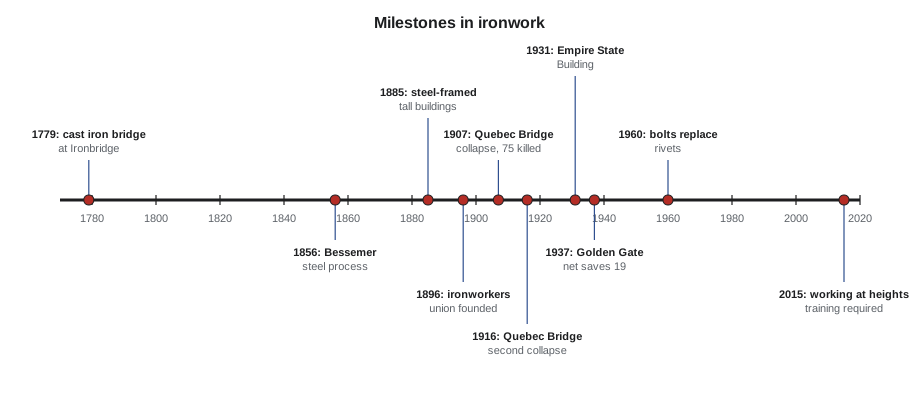
Metal was used in building for centuries as cramps, ties and nails, but iron as the main structure of a building or bridge is only about 250 years old. The first large iron bridge was built in 1779 over the River Severn in England, at a place now called Ironbridge. It was made of cast iron: iron melted and poured into moulds. Cast iron is very strong in compression, when it is squeezed, but weak and brittle in tension, when it is pulled, and it can crack without warning. Early iron bridges and building frames were shaped as arches and columns to keep the iron in compression.
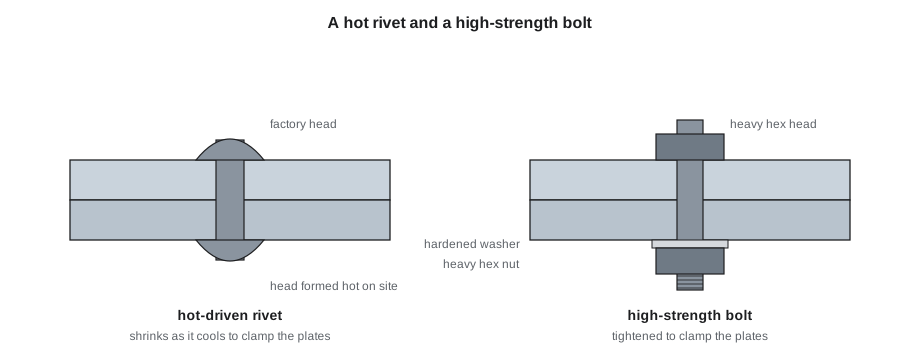
Wrought iron came next. It is iron worked by hammering and rolling, with very little carbon, and it is tough and strong in tension. In the middle of the 1800s, rolled wrought iron beams, plates and angles made it possible to build long bridges and taller buildings. These pieces were joined with hot rivets: a rivet was heated until it glowed, thrown up to the riveting gang, pushed through matching holes and hammered over while hot. As it cooled it shrank and clamped the pieces together. Riveting gangs were a feature of the trade for nearly a hundred years.
The steel age
Steel is iron with a controlled amount of carbon. It combines the strength of cast iron in compression with the toughness of wrought iron in tension, and it can be made in large quantities. The Bessemer process, patented in 1856, and the open-hearth process that followed made steel cheap enough to build with. By the 1880s, engineers in Chicago and New York were putting up buildings carried by a frame of iron and steel columns and beams, with the outside walls hung on the frame instead of holding up the floors. The skyscraper was born, and with it the modern structural ironworker.
Bridges grew too. The Brooklyn Bridge, finished in 1883, used steel wire for its main cables. Railway bridges spanned rivers and gorges across North America. Every one of these structures was erected by gangs who rigged the pieces with derricks and gin poles, climbed the steel, and drove rivets by hand at height. There were few rules and almost no fall protection. Deaths were common enough that some contractors expected to lose one worker for every few floors of a tall building or every few hundred feet of a big bridge.
Hamilton grew with steel. The Steel Company of Canada (Stelco) was formed in 1910 and Dominion Foundries and Steel (Dofasco) in 1912, and for most of the next century Hamilton was Canada's steel city. The mills along the bay made plate, sheet and structural shapes, and ironworkers built and rebuilt the mills themselves.
The Mohawk ironworkers
One of the best-known stories in the trade began in 1886, when the Dominion Bridge Company built a railway bridge across the St. Lawrence River near Montreal, on land of the Mohawk community of Kahnawake. The company hired Mohawk men as labourers, and they soon proved to be skilled and fearless riveters and connectors on the high steel. Over the following decades, Mohawk ironworkers from Kahnawake and Akwesasne worked on bridges and skyscrapers across Canada and the United States, from the Quebec Bridge to the Empire State Building and the World Trade Center. Many families have sent ironworkers onto the steel for four or five generations, and Mohawk ironworkers remain an important part of the trade.
The story is sometimes told as if the Mohawk men simply did not fear heights. Mohawk ironworkers themselves have said that is not so: they felt the same fear as anyone, and they learned the work and passed the skill from one generation to the next. That is a good lesson for any apprentice.
The Quebec Bridge
The worst disaster in the history of the trade in Canada happened on August 29, 1907, at the Quebec Bridge over the St. Lawrence River upstream of Quebec City. The bridge was designed to be the longest cantilever span in the world. As the south arm reached out over the river, the steel began to bend, and the warnings were not acted on in time. Late in the afternoon the south half of the bridge collapsed into the river, killing 75 workers, among them 33 Mohawk ironworkers from Kahnawake. A royal commission found that the main compression members had been designed too light for the actual weight of the bridge, and that the people in charge did not stop the work when the bending was reported.
The bridge was redesigned and rebuilt, much heavier. In 1916, while the centre span was being lifted into place, a casting in the lifting gear broke and the span fell into the river, killing 13 more workers. The bridge finally opened in 1917 and is still in use. The Quebec Bridge is one reason the trade takes warnings seriously: when steel is bending, moving or making noise it should not make, work stops until an engineer has looked at it.
The high steel of the 1920s and 1930s
The famous photograph Andy carried was taken in 1932 at Rockefeller Center in New York. The Empire State Building, finished the year before, had gone up at a rate of more than four floors a week. Erection gangs worked with riveting crews close behind, and steel was hoisted by derricks that were jumped up the building as it rose. Workers walked beams without any fall protection; nets were rare, and harnesses did not exist in their modern form.
The Golden Gate Bridge in San Francisco, finished in 1937, became famous for something else: its chief engineer insisted on a safety net under the deck during construction. The net caught 19 workers, who called themselves the Halfway to Hell Club. Even so, 11 workers died, 10 of them on one day when a scaffold fell, tore through the net and took it down. The net showed that fall protection worked, and that it had to be designed for the loads it would really see.
Organizing and safety
Ironworkers organized early. The International Association of Bridge and Structural Iron Workers was founded in Pittsburgh in 1896 and grew to include locals across the United States and Canada. Unions fought for wages and hours, and they fought for safety: for planked floors under work, for limits on how far below the work an open floor could be, and later for training. The union apprenticeship programs that train most ironworkers today grew out of that effort.
Riveting began to give way to high-strength bolts in the 1950s and 1960s. Bolts were faster, quieter and safer: no hot rivets thrown through the air, no heating forges at height. Welding also became common for shop connections and for some field connections. By the 1970s the riveting gang was almost gone from new construction, though ironworkers still see rivets when they repair or alter older structures.
The modern rules
In Ontario, the Occupational Health and Safety Act came into force in 1979, and the regulation for construction projects, O. Reg. 213/91, sets the rules for fall protection, structural steel erection and much more. On Christmas Eve 2009, a swing stage collapsed on a Toronto apartment building and four workers fell to their deaths; a fifth was badly hurt. An expert advisory panel reviewed the province's prevention system, and one result was mandatory working at heights training: since April 1, 2015, workers on construction projects who may use fall protection must complete a working at heights program approved by the Chief Prevention Officer, and refresh it every three years. Lesson 6 covers the training.
Fall protection equipment has changed as much as the rules. The body belt of the 1970s gave way to the full body harness, because a belt can injure the spine and organs in a fall and a worker cannot hang in it for long. Shock-absorbing lanyards, self-retracting lifelines, beam clamps and engineered anchors followed. Today a connector can be tied off from the moment they climb a column until they come down, and the trade's goal is that every worker goes home every day.
Worked problem
Then and now
A rule of thumb in the early 1900s was that a large bridge cost one life for every million dollars of construction. If a bridge in 1905 cost about 9 million dollars, how many deaths did the rule of thumb expect, and how does that compare with the 75 deaths at the Quebec Bridge in 1907?
Show solution
- Expected deaths: 9 million dollars ÷ 1 million dollars per death = 9 deaths.
- Quebec Bridge: 75 deaths in the 1907 collapse alone.
- Ratio: 75 ÷ 9 ≈ 8.
Answer: The rule of thumb expected about 9 deaths; the Quebec Bridge collapse killed about 8 times as many in a single afternoon. A rule of thumb that accepted any deaths at all as a cost of building is exactly what modern safety rules reject.
How erection methods changed
Early high steel was hoisted with derricks and gin poles: masts and booms of timber, later steel, rigged with wire rope and powered by steam engines on the ground. A derrick was set on the highest floor, used to raise the steel for the next two floors, and then jumped up the building by lifting its own mast and boom with a second rig. The work was slow and hazardous, and the derrick gangs were among the most skilled riggers in the trade. Guy derricks and stiff-leg derricks are still used on some jobs where a mobile or tower crane cannot reach, and ironworkers still learn to rig and jump them.
After the Second World War, truck cranes and crawler cranes made steel erection faster, and from the 1960s on, tower cranes took over on tall buildings in many cities. Hydraulic truck cranes, like the one at Ashcroft, now do most of the work on low and mid-rise buildings. Bolting replaced riveting, power wrenches replaced hand wrenches, and steel sections arrived from the fabricator with more of the work done in the shop, so fewer connections were made at height.
Safety equipment followed the same path. The body belt and rope lanyard gave way to the harness with an energy-absorbing lanyard, then to self-retracting lifelines, beam clamps and engineered horizontal lifelines. Perimeter cables, safety nets and aerial lifts reduced the time workers spend exposed at an edge. The trade's death rate fell sharply over the century, but falls remain the leading cause of death for ironworkers, which is why the fall protection lessons in this course matter so much.
Why history matters on the job
Andy's point to Shay was not that the old days were bad and today is good. It was that every rule has a reason. When a foreperson insists on four anchor rods per column, two bolts in every beam before the crane lets go, a rescue plan before anyone uses a harness or no work in high wind, they are applying lessons paid for by people who died. An apprentice who knows those stories is less likely to take a shortcut, and more likely to recognize the warning signs, such as a bending member, a noisy connection or a frame moving in the wind, that came before some of the worst disasters.
Shay asked Andy what he thought had changed most in his 28 years. He did not hesitate. When he started, he said, connectors still sometimes went untied for a few seconds while they moved from one beam to the next, and nobody said anything. Now, nobody on his crew moves without a leg of the lanyard clipped on, and if they did, the newest apprentice would say something. The equipment changed, but the bigger change was what the crew would accept.
Common mistakes
MistakeThinking the old ways were tougher and therefore better.
InsteadThe old ways killed and crippled many workers; modern methods are safer and no slower when planned well.
MistakeIgnoring a beam or truss that is bending or making noise.
InsteadStop work and get an engineer when steel moves or deforms in a way it should not, as the Quebec Bridge shows.
MistakeTreating a net or harness as protection no matter how it is set up.
InsteadFall protection works only when it is designed and installed for the loads and clearances it will really see.
MistakeBelieving some people are born without fear of heights.
InsteadSkill on high steel is learned and passed on; fear is normal and training manages it.
MistakeAssuming rivets are gone.
InsteadRivets are still found in older structures that ironworkers repair or alter.
Summary and key terms
- Cast iron, then wrought iron, then steel made large structures possible; steel combines strength in compression and tension.
- Steel-framed tall buildings appeared in the 1880s, and with them the modern structural ironworker.
- Mohawk ironworkers from Kahnawake and Akwesasne have worked on high steel since 1886.
- The Quebec Bridge collapses of 1907 and 1916 killed 88 workers and taught the trade to act on warnings.
- High-strength bolts replaced hot rivets in the 1950s and 1960s.
- Ontario's construction regulation and, since 2015, mandatory working at heights training set the modern rules.
- Cast iron
- Iron poured into moulds; strong in compression but brittle in tension.
- Wrought iron
- Low-carbon iron worked by hammering and rolling; tough and strong in tension.
- Steel
- Iron with a controlled amount of carbon, strong in both compression and tension.
- Rivet
- A metal pin heated, inserted through holes and hammered over to clamp pieces together.
- High-strength bolt
- A heat-treated structural bolt tightened to clamp the pieces of a connection.
- Cantilever
- A structure that projects out from its support and is held at one end.
- Derrick
- A hoisting device with a mast and boom, used on early high-rise steel before modern cranes.
Practice problems
Work each problem on paper first, then reveal the answer to check.
Why were early cast iron bridges built as arches?
Show answer
Cast iron is strong in compression but brittle in tension, so arches kept it in compression.
What happened at the Quebec Bridge in 1907?
Show answer
The south half collapsed during erection, killing 75 workers, because compression members were too light and warnings were not acted on.
Why did high-strength bolts replace hot rivets?
Show answer
They were faster, quieter and safer: no hot rivets thrown at height and no forges.
When did working at heights training become mandatory in Ontario construction?
Show answer
April 1, 2015.
What lesson did the Golden Gate Bridge net teach?
Show answer
Fall protection works, but it must be designed for the loads it will see.
Lesson quiz · 5 questions
Score 60% or more to complete this lesson.
Create a free account to save your progress, take quizzes and earn a certificate.