
IRW-110 · Lesson 3 of 12 · 23 min
Hand tools and connecting tools
▶ Video coming soon A video version of this lesson is on the way.
On Shay's first morning, Andy emptied his bag onto the lunchroom table: two spud wrenches, a sleever bar, three drift pins, a bull pin, a short beater hammer, a tape, a torpedo level, a ball of tag line, a pair of side cutters and a coil of tool lanyards. "Everything here is tied to me when I'm up there," he said. "Every one of these can kill somebody if it falls." This lesson covers the hand tools of the ironworker trade, with the most space for the tools connectors use to bring steel together and hold it until it is bolted. The general tools course (TRD-104) covered hand tools in general; this lesson is about the ones that belong to ironwork.
The connector's belt
A connector's tools hang from a belt or a tool harness, each on a holder designed for it. The belt is separate from the fall protection harness: fall protection equipment must never be used to carry tools, and tool holders must not interfere with the harness, its straps or its D-ring. The basic connector's kit is short, because every extra kilogram is carried up and down columns all day:
- Two spud wrenches, sized for the bolts on the job.
- Two or three drift pins, and often a bull pin.
- A sleever bar on many jobs, carried on a holder or left at the connection point.
- A short hammer, often a small sledge or a beater.
- A tape and a small level, and on some crews a radio.
- Bolt bag or bucket, carried separately and tied off.
Every tool is attached by a tool lanyard rated for its weight, connected to a point on the belt or to the structure that can hold it if dropped. Dropped tools are one of the most common serious hazards on a steel job, and lesson 9 returns to them.
Spud wrenches
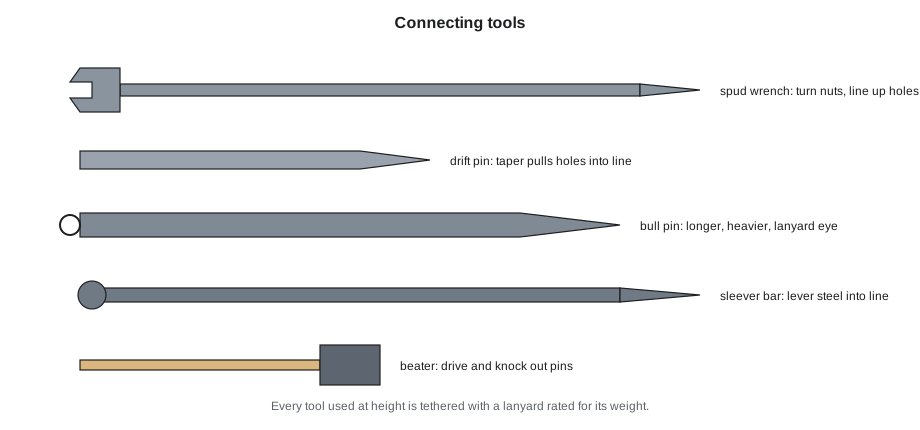
The spud wrench is the ironworker's signature tool: an open-end wrench at one end and a long tapered point, the spud, at the other. The wrench end turns nuts and bolt heads; the spud is used to line up holes by sliding it in and levering the pieces until the holes match, and to pry and position steel. Spud wrenches come in sizes matched to the nut or bolt head across its flats. Structural bolts use heavy hex heads and nuts, which are larger than ordinary hex nuts of the same diameter.
| Bolt diameter | Heavy hex size across flats (typical) | Usual spud wrench |
|---|---|---|
| 3/4 in | 1 1/4 in | 1 1/4 in |
| 7/8 in | 1 7/16 in | 1 7/16 in |
| 1 in | 1 5/8 in | 1 5/8 in |
| M20 | 34 mm | 34 mm |
| M22 | 36 mm | 36 mm |
| M24 | 41 mm | 41 mm |
Many North American jobs still use inch-sized structural bolts, commonly 3/4 in and 7/8 in; metric bolts, commonly M20 and M22, appear on some jobs and are increasingly common on Canadian work. The Ashcroft frame used 3/4 in bolts in its simple shear connections and 7/8 in bolts in its moment and bracing connections, so Andy carried a 1 1/4 in and a 1 7/16 in wrench. A wrench that is too big rounds the corners of the nut and slips; a slipping wrench at height can throw a worker off balance.
Spud wrenches are made in forged steel, with offset or straight heads. Some ironworkers prefer offset heads, which clear the flange of a beam and leave room for knuckles. The spud is not a pry bar for heavy work; levering a big beam with a spud can bend the wrench or make it slip. Use a sleever bar or a come-along for heavy alignment.
Drift pins and bull pins
A drift pin is a tapered steel pin, usually 300 to 400 mm long, pointed at one end and sized at the other to match a bolt hole. Driven into two holes that are nearly lined up, its taper pulls the holes into line. Once two or three holes in a connection are pinned and a bolt is in each of the other holes, the pins are knocked out and replaced with bolts. A bull pin is a longer, heavier drift pin, often with a lanyard eye, used to line up holes from farther away and to hold a heavy piece while the first bolts go in.
Pins are for alignment, never for support. A drift pin is not a bolt and is not designed to carry the load of a beam. Steel must never be released from the crane until the connection has the number of bolts the rules and the erection plan require, tightened by hand at least. The rules for that are covered in IRW-210; for now, remember that no beam is left hanging on pins.
Driving a pin with a hammer throws chips. Hammer faces and pin heads mushroom with use, and the mushroomed edge can break off and fly. Grind off mushroomed heads, and replace pins that are cracked, bent or worn undersize. Wear eye protection when driving pins.
Sleever bars and pry bars
A sleever bar is a long steel bar with a tapered point at one end and a knob or striking head at the other, used to line up holes and move steel by leverage. Connectors use it to pull a beam end into position or to bring holes into line before a pin goes in. Some crews leave a sleever bar at each connecting point rather than carrying it. A pinch bar or pry bar is used on the ground and on deck to move and lift pieces a short distance. Every bar used at height needs a lanyard, because a bar that slips is a heavy, pointed missile.
Leverage multiplies force. A bar with a long handle on one side of the pivot and a short nose on the other turns a small push into a big force at the nose. That is useful, and it is also how bars slip, bend and fling. Keep your body out of the line the bar would travel if it slipped, and never stand on a bar or use a cheater pipe on it.
Worked problem
Force from a sleever bar
Andy places the point of a sleever bar in a hole, with the bar resting on the edge of the beam flange as a pivot 50 mm from the point. He pushes 850 mm from the pivot with a force of 200 N. What force does the bar put on the steel at the point?
Show solution
- Leverage ratio: 850 ÷ 50 = 17.
- Force at the point: 200 × 17 = 3,400 N.
- In kilonewtons: 3.4 kN.
Answer: About 3.4 kN, enough to move a beam end a few millimetres into line. It is also enough to bend a light bar or break a hole edge if the steel is badly out; when the steel is far out, use a come-along or ask the crane to move it.
Hammers, levels and measuring tools
Ironworkers use short sledges and beaters to drive pins, tap pieces into line and knock out pins. Use hammers with faces softer than the tools they strike where possible, keep faces dressed and handles sound, and never strike two hardened faces together. Measuring tools include tapes, levels, plumb bobs, string lines and squares. Plumbing a frame is covered in IRW-210; at this stage, an apprentice should be able to read a tape to 1 mm, hold a level correctly and read a plumb bob or laser.
Tag lines are part of the kit too. A tag line is a rope tied to a load so a worker on the ground or on the steel can control its swing and rotation without touching the load. Tag lines must be long enough to keep the worker out from under the load, made of non-conductive material near power lines, and free of knots that could snag. Rigging and tag line practice is covered in IRW-120.
Come-alongs, chain falls and clamps
Lever hoists (come-alongs) and chain falls pull or lift steel into position. The general rigging course (TRD-105) covered how to use and inspect them. On steel, they are used to pull bays into plumb, draw a beam end into a connection or hold a piece while it is fitted. Rated capacity is marked on the tool; never extend the handle, never use a hoist as a sling, and never stand in line with a loaded chain or cable.
C-clamps, beam clamps and vise-grip clamps hold pieces together while they are fitted or welded. Beam clamps used as fall protection anchors are a different product, designed and tested for that use; lesson 7 covers them. A clamp used to hold steel is not an anchor, and an anchor clamp is not a lifting clamp.
Inspecting and caring for hand tools
At Crossbeam, every worker checks their own tools at the start of the shift and the foreperson spot-checks. The checks are simple:
- Wrenches: jaws not sprung or cracked, spud straight and not cracked, lanyard point sound.
- Pins and bars: not bent or cracked, heads not mushroomed, points sound.
- Hammers: head tight, handle sound, face dressed.
- Tool lanyards: webbing or coil not cut or worn, connectors closing and locking, rated for the tool's weight.
- Hoists: hooks and latches sound, chain or cable not damaged, tagged with a current inspection.
Damaged tools are tagged out of service and returned to the yard, not left in the gang box for the next person. Shay learned to put his name on everything with a paint pen; on a big crew, tools wander.
Why dropped tools matter
A tool dropped from height falls faster every second, and it reaches the ground with a lot of energy. The energy depends on the weight of the tool and the height it falls from. Even a light tool can cause a serious head injury, and a spud wrench or a pin can kill. Hard hats protect against small falling objects, but they are not designed to stop a heavy tool falling from several floors.
Worked problem
A dropped spud wrench
A 1.5 kg spud wrench is dropped from the second-floor beam line at Ashcroft, 12 m above the ground. Ignoring air resistance, how much energy does it have when it reaches the ground, and how fast is it moving?
Show solution
- Energy: m × g × h = 1.5 × 9.81 × 12 ≈ 177 J.
- Speed: v = √(2gh) = √(2 × 9.81 × 12) = √235.4 ≈ 15.3 m/s.
- In kilometres per hour: 15.3 × 3.6 ≈ 55 km/h.
Answer: About 177 J, arriving at about 55 km/h, a pointed steel bar travelling like a car in town. Tie off every tool.
Because of that, Crossbeam's rule is 100 in 100 tool tethering above the ground floor, and controlled access zones below overhead work so that nobody walks under the connectors. Lesson 9 and lesson 10 explain how those zones are set up.
Choosing and carrying your own tools
Union and open-shop ironworkers are usually expected to supply their own basic hand tools, with the employer supplying power tools, rigging, fall protection and specialized equipment; the collective agreement or employer policy sets the list. A first-year apprentice does not need everything at once. Shay started with two spud wrenches in the sizes used at Ashcroft, two drift pins, a tape, a small level, a short sledge, side cutters, a tool belt with holders and a set of tool lanyards, and added a bull pin and a sleever bar later when he began connecting. Andy's advice was to buy good-quality forged tools, because cheap wrenches spread and cheap pins mushroom quickly.
Weight matters. Every tool on the belt is carried up and down all day, and a heavy belt pulls on the back and changes balance on narrow steel. Carry only what the day's work needs, keep heavy items close to the body, and balance the load on both sides. A tool that is not needed for the next few hours can stay in the gang box.
Shay marked his tools with his initials and a band of coloured tape, a common practice on crews where many people carry the same tools. The tape also helps in another way: it makes a dropped tool easier to spot in mud, gravel or snow, so it can be picked up before someone trips on it or a truck runs over it.
Common mistakes
MistakeUsing a wrench that is too big for the nut.
InsteadUse the size that fits the heavy hex flats snugly; a loose wrench rounds nuts and slips.
MistakeLeaving a beam hanging on drift pins.
InsteadPins only align holes; the required bolts must be installed before the load is released.
MistakeUsing a spud wrench as a heavy pry bar.
InsteadUse a sleever bar or a come-along for heavy alignment.
MistakeHanging tools on the fall protection harness.
InsteadCarry tools on a separate belt; fall protection equipment is never a tool holder.
MistakeWorking at height with untethered tools.
InsteadTether every tool to the worker or the structure with a lanyard rated for its weight.
MistakeDriving mushroomed pins without eye protection.
InsteadGrind off mushroomed heads and wear eye protection when striking.
Summary and key terms
- The connector's kit is short: spud wrenches, drift pins, a bull pin, a sleever bar, a hammer, a tape and a level.
- Spud wrenches fit heavy hex structural bolts; sizes must match the flats.
- Drift and bull pins align holes; they never support a load.
- Sleever bars multiply force; keep out of their line of travel and never use a cheater.
- Inspect tools every shift and tag out damaged ones.
- Dropped tools carry enough energy to kill; tether every tool at height.
- Spud wrench
- An open-end wrench with a tapered point used to line up holes and pry steel.
- Drift pin
- A tapered pin driven into bolt holes to pull them into line.
- Bull pin
- A longer, heavier drift pin used to align and hold heavy pieces.
- Sleever bar
- A long tapered bar used to line up holes and move steel by leverage.
- Heavy hex
- The larger hex head and nut size used on structural bolts.
- Tag line
- A rope tied to a load to control its swing and rotation.
- Tool lanyard
- A tether that attaches a tool to the worker or structure so it cannot fall.
Practice problems
Work each problem on paper first, then reveal the answer to check.
What size spud wrench fits a 3/4 in heavy hex structural nut?
Show answer
1 1/4 in.
Why must a beam never be left hanging on drift pins?
Show answer
Pins only align holes and are not designed to carry the load; required bolts must be in first.
A sleever bar has a pivot 50 mm from the point and is pushed 850 mm from the pivot with 200 N. What force acts at the point?
Show answer
200 × 850 ÷ 50 = 3,400 N.
How much energy does a 1.5 kg tool have after falling 12 m?
Show answer
1.5 × 9.81 × 12 ≈ 177 J.
Why should tools never hang from the fall protection harness?
Show answer
They can interfere with the harness and it is not designed to carry tools.
Lesson quiz · 5 questions
Score 60% or more to complete this lesson.
Create a free account to save your progress, take quizzes and earn a certificate.