
INS-420 · Lesson 1 of 12 · 22 min
How insulation work is bid
▶ Video coming soon A video version of this lesson is on the way.
On Monday, October 5, 2026, three e-mails arrived in Raj Sandhu's inbox within an hour of each other. Harcourt Mechanical, Vantage Mechanical and Ingleby Mechanical were all bidding the mechanical work on Ridgemount Secondary School, a new two-storey school for the Escarpment District School Board on the west mountain, and each wanted a price for the thermal insulation. The tender documents had been posted on the Friday: about 300 drawings and a specification of more than 1,200 pages. Raj forwarded the invitations to Walt Lowery with one line: "Bid closes for us Thursday, November 12. I'm in."
Priya Lam, the third-year apprentice who had been spending some of her evenings in the office that fall, asked whether she could follow the bid from start to finish. Raj agreed, on one condition: she would do part of the takeoff herself and check his. This course follows that bid, along with the jobs Coldstream was running at the same time, to show how insulation work is estimated, planned, run and closed out. It is written for the insulator who is ready to lead a crew, help an estimator or start estimating, and it builds on the materials and methods of the earlier courses, especially INS-310 and INS-410.
This first lesson explains how construction work reaches an insulation contractor, the documents that describe it, the contracts that govern it and the parts of a price. Later lessons take each part in turn: the takeoff in lessons 2 to 4, labour in lesson 5, access in lesson 6, the schedule in lesson 7, the crew in lesson 8, quality in lesson 9, changes in lesson 10, close-out in lesson 11 and the full Ridgemount estimate in lesson 12.
Where insulation work comes from
An insulation contractor rarely works directly for the building owner on new construction. Insulation is usually part of the mechanical work, so the insulator is a subcontractor to the mechanical contractor, who is in turn a subcontractor to the general contractor or construction manager. On plant maintenance work the picture is different: an owner such as Kellerton Foods hires Coldstream directly, often under a standing service agreement with set rates, as INS-410's audit work showed. Coldstream's work mix of about 55 in 100 industrial and 35 in 100 commercial means Raj and Walt bid both kinds of work every month.
Ridgemount followed the common Ontario pattern for a public school. The school board, as owner, hired an architect, who hired a mechanical engineer, Taversham Engineering, whose project engineer was Saskia Fennick. The board tendered the whole building to general contractors, who in turn collected prices from subcontractors. Oriel Construction was one of the general contractors bidding. The three mechanical contractors each collected prices from insulation, controls, water treatment and other specialty subcontractors, added their own work and submitted a mechanical price to every general contractor. The lowest compliant general contractor would get the contract, and that contractor's chosen mechanical contractor would then choose an insulation contractor.
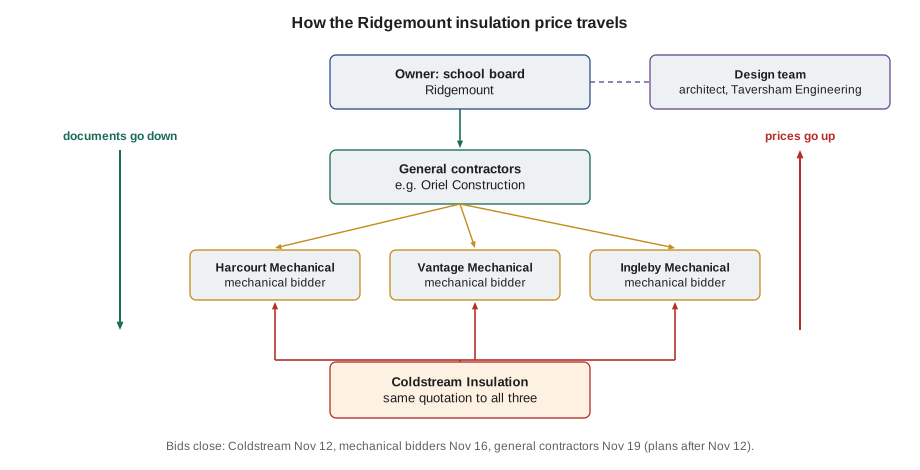
Because Coldstream's price went to all three mechanical bidders, it had to be the same price to each, built on the same documents. Raj would not know until after the general contractor's close which mechanical contractor, if any, would carry Coldstream. Bidding to every bidder is normal for a subcontractor, and so is the discipline that goes with it: no side deals, no lower price to a favourite customer, and a written quotation that every bidder can rely on.
The tender documents
The tender package is a contract waiting to be signed, and an estimator has to read it that way. For the insulation trade the important parts are:
- Instructions to bidders and the bid form: the closing time and place, how prices are submitted, which alternates and separate prices are asked for, and whether a bid bond or other security is required.
- The contract form and its conditions: the standard contract the owner will use, and the supplementary conditions that change it. These set payment terms, holdback or retainage, warranties, insurance and how changes are priced.
- The specification: organized by the MasterFormat numbering that INS-410 lesson 8 described. Insulation for plumbing is usually in Section 22 07 00 or its subsections, and for HVAC piping, ducts and equipment in Section 23 07 00 or the National Master Specification sections 23 07 13, 23 07 14 and 23 07 15. Division 01 sets general requirements that apply to every trade: submittals, schedules, cleaning, close-out and the like.
- The drawings: mechanical plans, sections, details, schedules and riser diagrams. Lesson 2 covers reading them for takeoff.
- Addenda: changes and answers issued during the tender. Each addendum forms part of the contract, and the bid form usually requires the bidder to list the addenda it has received.
Raj read the insulation sections first, then Division 01, then the drawings. He kept a running list of questions, and he sent three of them in writing to the engineer through the bidders' question process before questions closed. One asked whether the horizontal storm drains in the ceiling spaces were to be insulated, because the drawings showed it and the specification did not. Addendum 1, issued Friday, October 23, answered it: yes, the horizontal storm piping and the roof drain bodies were to be insulated, and that added about 380 m (1,250 ft) of pipe to the takeoff.
The habit matters. A bidder who notices a conflict and guesses has two bad outcomes: guess high and lose the job, or guess low and lose money on it. Asking in writing, so the answer goes to every bidder in an addendum, keeps the competition fair and gives the estimator a document to point to later.
The contracts behind the work
Most building work in Canada uses standard contract forms from the Canadian Construction Documents Committee (CCDC). The owner and general contractor would sign a CCDC 2, the stipulated price contract, with supplementary conditions written by the school board. Between the general contractor and the mechanical contractor, and between the mechanical contractor and Coldstream, the usual form is a stipulated price subcontract such as CCDC 17, or a contractor's own subcontract form that follows it. A subcontract normally passes the main contract's terms down the chain, so the insulation contractor is bound by the same specification, schedule, warranty and change procedures as everyone above it.
Two Ontario laws shape every construction subcontract. The Construction Act requires the owner to hold back 10 in 100 of the value of work as it is paid, to protect subcontractors and suppliers who have lien rights, and it sets prompt payment rules: the owner must pay a proper invoice within 28 days, and each contractor must pay its subcontractors within 7 days of being paid. Amendments in force from January 1, 2026 added an annual release of holdback on longer contracts and made an invoice proper unless the owner objects in writing within 7 days. The Occupational Health and Safety Act and its construction regulation, O. Reg. 213/91, set the safety duties that lessons 6 and 8 cover. Lesson 11 returns to holdback at close-out.
An estimator does not need to be a lawyer, but should read the payment, holdback or retainage, warranty, insurance, liquidated damages and change clauses before pricing, because each one costs money or carries risk. Raj marks them in yellow on the first read and lists anything unusual in Coldstream's qualifications.
Bonds, insurance and security
Owners and contractors want assurance that a bidder will sign the contract it bid and finish the work. The common tools are:
- Bid security: a bid bond, or sometimes a certified cheque, submitted with the bid. If the low bidder refuses to sign the contract, the security pays the owner the difference to the next bidder, up to its limit. A bid bond of 10 in 100 of the bid price is typical.
- Performance and payment bonds: after award, a performance bond guarantees that the work will be completed, and a labour and material payment bond guarantees that subcontractors and suppliers will be paid. Each is often set at 50 or 100 in 100 of the contract price, as the bid documents require.
- Insurance: commercial general liability, automobile, and on many sites contractor's equipment and pollution coverage, with certificates naming the owner and contractors as additional insureds.
- Workplace insurance: a clearance certificate from the Workplace Safety and Insurance Board (WSIB), showing the subcontractor's premiums are paid, before work starts and before each payment.
On Ridgemount the insulation subcontract would not need its own bid bond, because the subcontractors' prices go to the mechanical bidders rather than to the owner, but the mechanical subcontract would require Coldstream to provide a performance bond if asked. A bond costs a premium, usually a small fraction of the bonded amount, so Raj added a line to his price for a bond if required.
The parts of a price
However the documents arrive, an insulation price is built from the same parts. Each one is the subject of a later lesson:
| Part | What it covers | Lesson |
|---|---|---|
| Quantities | Lengths of pipe by size, thickness and system; fittings and valves; areas of duct and equipment | 2, 3 |
| Material | Insulation, jackets, fitting covers, adhesives, mastics, bands, pins, tapes and waste allowances | 4 |
| Direct labour | Crew hours from labour units, adjusted for conditions, times a burdened hourly rate | 5 |
| Access and equipment | Scaffold, lifts, ladders, staging, rentals and the time to move them | 6 |
| Supervision and job overhead | Foreperson time that is not on the tools, travel, parking, permits, safety, storage | 5, 8 |
| Small tools and consumables | Knives, saws, blades, cleaning, tape measures and other items used up on the job | 4 |
| Company overhead | Office, estimating, yard, shop, vehicles and insurance spread over all jobs | 12 |
| Profit | The return for the risk and the investment in the company | 12 |
Labour is usually the largest part. On commercial pipe and duct work it is often 55 to 70 in 100 of the selling price, which is why an estimator spends most of the effort on the labour units and the conditions that change them. Material is usually 15 to 30 in 100. Those are typical ranges, and they move with the work: a job of thick cellular glass on a cold system has a much higher material share than a job of glass fibre on small pipe.
Worked problem
Building up a price
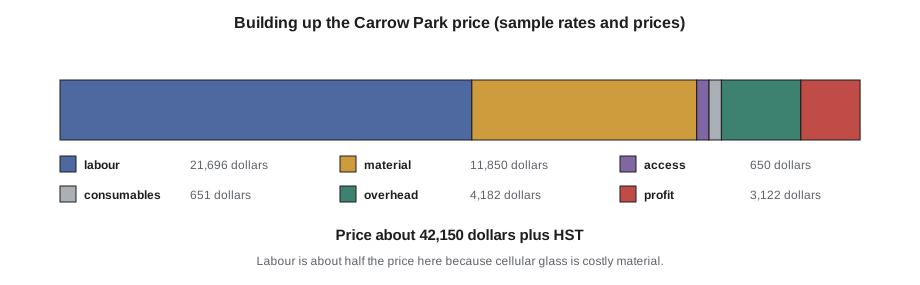
Before the Carrow Park arena job in INS-320, Raj estimated 226 crew-hours from Coldstream's labour units. Using a sample burdened rate of 96 dollars an hour, material of 11,850 dollars, access and equipment of 650 dollars, consumables at 3 in 100 of labour, company overhead at 12 in 100 and profit at 8 in 100 on top of that, what was the price?
Show solution
- Labour: 226 × 96 = 21,696 dollars.
- Consumables: 0.03 × 21,696 = 650.88 dollars.
- Direct cost: 21,696 + 11,850 + 650 + 650.88 = 34,846.88 dollars.
- Overhead: 0.12 × 34,846.88 = 4,181.63; running total 39,028.51 dollars.
- Profit: 0.08 × 39,028.51 = 3,122.28; price 42,150.79 dollars.
Answer: Raj quoted about 42,150 dollars plus HST. Labour was 51 in 100 of the price on this job because cellular glass is expensive material.
The burdened rate is more than the wage. It includes the employer's costs that follow every paid hour: vacation and holiday pay, statutory payroll costs, workplace insurance premiums, and for union crews the benefit, pension and training contributions set by the collective agreement. A wage of a certain amount can easily become a burdened cost half as much again. Walt sets Coldstream's burdened rates each year from the payroll records; estimators use them and do not change them.
Qualifications, exclusions and alternates
A quotation is only as clear as its scope. Raj's quotation form has three sections after the price:
- Inclusions: what the price covers, by specification section and system, and the addenda received. A bidder who reads "per plans and specifications" cannot be sure the insulator saw the same plans.
- Exclusions: what the price does not cover, such as heat tracing, firestopping (which Coldstream prices separately when asked), asbestos abatement, painting of jackets, removal of existing insulation, or work by other trades that the specification puts in the insulation section by mistake.
- Qualifications: conditions the price depends on, such as working hours, a number of mobilizations, the owner supplying hoisting, or a price being open for 60 days.
Alternates and separate prices are asked for on the bid form, and they must be priced exactly as described. Ridgemount's bid form asked mechanical bidders for an alternate to replace the glass fibre and PVC jacket on exposed piping in the gymnasium mechanical mezzanine with aluminum jacket, and Raj priced it as an add.
Clear exclusions are not a way to win by leaving things out. A mechanical contractor comparing three insulation quotations will add the missing items back to each one before choosing, and an insulator who excludes too much simply looks expensive. The goal is that every bidder knows exactly what it is buying.
Bid day and after
Bids close at a fixed time, and late bids are rejected. A subcontractor's price has to reach its bidders early enough for them to check it, so Coldstream's quotation went out on Thursday, November 12, at 11:00, a few days before the mechanical bidders' own close. Raj sent the same quotation to all three by e-mail, phoned each estimator to confirm it had arrived, and answered two questions about the alternate by phone. Any clarification he gave one bidder he wrote down and sent to all three.
The rest of the timeline was in the future: mechanical prices to the general contractors on Monday, November 16, general contractors' bids to the board on Thursday, November 19, and a board decision expected in December. If the contract went ahead, construction would start in the spring of 2027 and the insulation work would fall mostly in 2028.
Whether Coldstream wins or loses, the estimate is kept. Lesson 11 shows how comparing estimated and actual hours at the end of every job keeps the company's labour units honest, and lesson 12 walks through the Ridgemount estimate in full.
Common mistakes
MistakePricing from the drawings without reading the specification.
InsteadRead the insulation sections and Division 01 first; the specification sets thicknesses, materials, jackets and requirements the drawings never show.
MistakeGuessing at a conflict between the drawings and the specification.
InsteadAsk in writing before questions close, so the answer comes to every bidder in an addendum.
MistakeGiving one bidder a different price or scope.
InsteadSend the same written quotation to every bidder and copy any clarification to all of them.
MistakeUsing the wage instead of the burdened rate.
InsteadUse the company's burdened rate, which includes payroll costs, insurance and benefits.
MistakeWriting a scope of "per plans and specifications" only.
InsteadList the sections, systems and addenda included, and state exclusions and qualifications clearly.
Summary and key terms
- On new construction, insulation is usually a subcontract to the mechanical contractor; on plant work the owner often hires the insulator directly.
- The tender documents are the instructions to bidders, contract and conditions, specification, drawings and addenda; all of them become the contract.
- Standard forms (CCDC 2 and CCDC 17) and the Construction Act's holdback and prompt payment rules shape Ontario subcontracts.
- A price is built from quantities, material, labour at a burdened rate, access, supervision, consumables, overhead and profit; labour is usually the largest part.
- A clear quotation lists inclusions, exclusions, qualifications and alternates, and the same quotation goes to every bidder.
- Tender documents
- The drawings, specification, contract conditions, bid form and addenda issued to bidders.
- Addendum
- A written change or answer issued during the tender that becomes part of the contract documents.
- Subcontract
- A contract between a contractor and a specialty contractor for part of the work.
- Burdened rate
- The hourly labour cost including wages, payroll costs, insurance and benefits.
- Bid bond
- Security given with a bid that pays the owner if the bidder refuses to sign the contract.
- Exclusion
- Work that a quotation states it does not cover.
- Alternate
- A change to the base scope that the bid form asks bidders to price separately.
Practice problems
Work each problem on paper first, then reveal the answer to check.
Who usually hires the insulation contractor on a new school?
Show answer
The mechanical contractor, as a subcontractor under the general contractor or construction manager.
Why did Raj send his storm drain question in writing?
Show answer
So the answer would come to all bidders in an addendum and he could rely on it.
What does Addendum 1 add to Ridgemount's insulation scope?
Show answer
Horizontal storm piping and roof drain bodies, about 380 m (1,250 ft) of pipe.
What share of each payment does the Construction Act require the owner to hold back?
Show answer
10 in 100.
Why is labour the part of a price an estimator studies most?
Show answer
Because it is usually the largest part, often 55 to 70 in 100 of a commercial insulation price.
Lesson quiz · 5 questions
Score 60% or more to complete this lesson.
Create a free account to save your progress, take quizzes and earn a certificate.