
INS-420 · Lesson 4 of 12 · 23 min
Material waste and ordering
▶ Video coming soon A video version of this lesson is on the way.
Tomasz Nowicki keeps a pallet at the back of the Coldstream shop that he calls "the bill". It holds the leftovers that came back from jobs over the last year: half cartons of pipe covering in odd sizes, part rolls of jacket, three cases of an adhesive nobody uses any more, and a stack of PVC fitting covers for a size of pipe Coldstream rarely sees. "Every piece on that pallet was paid for twice," he tells new estimators: "once when we bought it, and again when we drove it back." The other kind of mistake is just as expensive: a crew standing idle because a carton of NPS 2 pipe covering ran out on a Thursday afternoon.
This lesson turns a takeoff into a material list and a purchase order. It covers how insulation products are packaged and sold, waste factors and where they come from, accessories that are easy to forget, the timing of orders and deliveries, and storage on site. It uses Priya's level 2 classroom wing takeoff from lesson 2 and the supply main from lesson 3.
How insulation products are sold
Every material has a selling unit, and the order has to be in that unit:
| Material | Typical selling unit | What to know |
|---|---|---|
| Glass fibre or mineral wool pipe covering | Sections 914 mm (3 ft) long, packed in cartons by pipe size and thickness | Carton quantities vary by size; small sizes have more sections per carton |
| Elastomeric and other flexible foam pipe insulation | Tubes, often 1.83 m (6 ft) long, in cartons; sheets and rolls | Adhesive is specific to the product |
| Rigid board | Sheets by thickness, in bundles or cartons | Board is cut to fit, so waste depends on the shapes |
| Duct wrap | Rolls by width, length and thickness | Order by wrap area, not duct area |
| PVC fitting covers | By pipe size and fitting type, in cartons | Inserts for the fitting are ordered with the covers |
| Metal jacket | Rolls by width and thickness, or pre-cut sheets | Laps and seams add to the area |
| Bands, wire, pins and washers | Boxes or rolls by size | Counted from spacing rules |
| Adhesives, mastics, sealants, tapes | Pails, cartridges, rolls | Coverage rates come from the data sheet |
Carton counts and roll sizes vary by manufacturer and size, so an estimator uses the supplier's packing list. Raj keeps a supplier sheet for each product Coldstream buys often, and he checks it again on large orders because packaging changes. For the examples in this lesson, sample carton quantities are used.
Waste factors
Insulation is cut to fit, and some material is always lost: offcuts too short to use, damaged sections, mistakes, and the extra needed at every joint and lap. A waste factor is the allowance added to the takeoff quantity to cover it. It is usually given as so many in 100 of the net quantity.
| Material | Typical waste allowance (company figures) |
|---|---|
| Pipe covering on straight runs | 3 to 5 in 100 |
| Pipe covering on short runs with many fittings | 8 to 10 in 100 |
| PVC fitting covers | 5 in 100, at least one spare of each size |
| Duct wrap | 10 in 100 |
| Rigid board on equipment | 10 to 15 in 100 |
| Metal jacket | 10 to 15 in 100, more on many small fittings |
| Bands, pins, tape, adhesive, mastic | 10 in 100 |
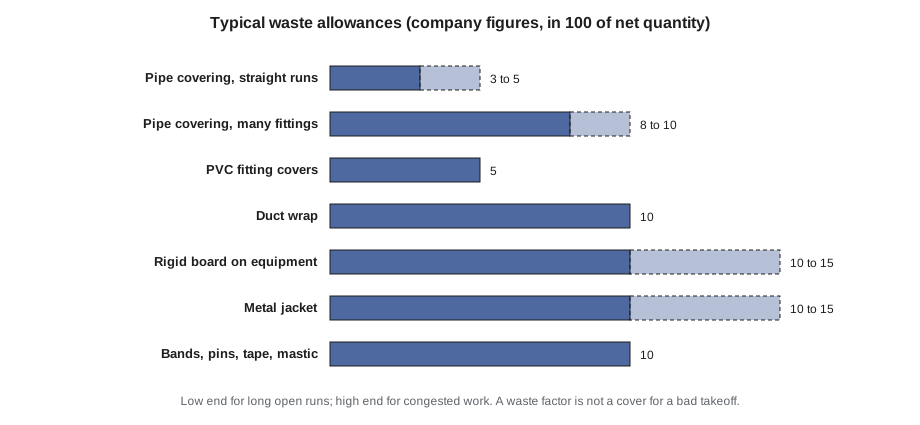
The right waste factor depends on the job. Long straight runs in an open ceiling waste little; a mechanical room full of short runs between fittings wastes a lot. Raj uses the low end of the range on long runs and the high end on congested work, and he checks his figures against what actually went into past jobs (lesson 11). A waste factor is not a contingency for a bad takeoff: if the quantities are wrong, adding more waste only hides the error until the order runs short somewhere else.
From takeoff to order
The steps are the same for every material: take the net quantity from the takeoff, add the waste allowance, convert to selling units, and round up to whole units.
Worked problem
Pipe covering for the level 2 wing
Priya's takeoff gave 136.4 m of NPS 2 heating water pipe at 51 mm and 98 m of NPS 3/4 at 38 mm. Sections are 914 mm long. With a waste allowance of 5 in 100, how many sections of each are needed? Sample carton quantities are 10 sections of NPS 2 × 51 mm and 16 of NPS 3/4 × 38 mm.
Show solution
- NPS 2: 136.4 × 1.05 = 143.2 m; 143.2 ÷ 0.914 = 156.7, so 157 sections; 157 ÷ 10 = 15.7, so 16 cartons (160 sections).
- NPS 3/4: 98 × 1.05 = 102.9 m; 102.9 ÷ 0.914 = 112.6, so 113 sections; 113 ÷ 16 = 7.1, so 8 cartons (128 sections).
Answer: 16 cartons of the larger size and 8 of the smaller. The last carton of the small size will be mostly unused unless the material can go to another area of the same job, which is why the order is placed for the whole job, not floor by floor.
Rounding up to whole cartons is unavoidable, but the leftover should be planned for. Raj orders by carton for the whole job and releases deliveries by area, so that the part carton left on one floor is used on the next. He orders broken cartons only when the supplier allows it without a large charge.
Worked problem
Duct wrap for the supply main
The supply main in lesson 3 needs 91.3 m² of wrap before waste. Rolls are 1.22 m wide and 15.24 m long. With a waste allowance of 10 in 100, how many rolls are needed?
Show solution
- With waste: 91.3 × 1.10 = 100.4 m².
- One roll: 1.22 × 15.24 = 18.59 m².
- Rolls: 100.4 ÷ 18.59 = 5.4, so 6 rolls.
Answer: 6 rolls. Ordering by the duct surface area instead of the wrap area would have bought one roll short on a bigger job.
Accessories and consumables
Insulation is only part of the order. Each system needs accessories, and missing ones stop a crew as surely as missing insulation:
- PVC fitting covers and their inserts, one per fitting by size and type, plus spares.
- Tape: ASJ lap tape, foil tape for duct wrap seams, vapour retarder tape on cold systems.
- Adhesive and mastic: for elastomeric joints, vapour stops on cold lines, and duct liner and board, with coverage from the data sheet.
- Mechanical fasteners: pins and washers for duct bottoms and equipment, with counts from the spacing rules in INS-310; bands, seals and clips for metal jacket; stainless wire for equipment.
- Hanger shields and inserts, if they are Coldstream's supply rather than the mechanical contractor's (lesson 2's specification check).
- Labels and identification, if they are in the insulation section.
- Consumables: knife blades, saw blades, rags, cleaning solvent, gloves and other items used up on the job, usually priced as a percentage of labour (lesson 1).
Raj's estimate sheets carry an accessory line under each system so that the order can be built from the same takeoff. For the level 2 wing, the 56 elbows need 56 PVC covers plus spares: 56 × 1.05 = 58.8, so 59 covers. Tees and valves need covers too, and the valves need the type of cover the specification asks for.
Timing, lead times and deliveries
Insulation materials are mostly stock items, but not all of them, and lead times change. Pipe covering in common sizes and thicknesses is usually available within days from a distributor, but large sizes, thick wall, special jackets, cellular glass, high-temperature materials and fabricated covers can take weeks. Removable blankets from a fabricator such as Pellam Thermal Covers take several weeks from measurement, as the Kellerton PRV covers did: measured November 9, due November 30.
An order schedule ties deliveries to the work schedule (lesson 7):
- Long-lead items are ordered as soon as submittals are approved: fabricated covers, special jackets, custom fitting covers, cellular glass.
- Bulk stock is ordered for the whole job at the price quoted in the estimate, with deliveries released by area or phase.
- Deliveries are timed for when the area is ready and there is somewhere dry to store the material. Insulation delivered weeks early is insulation that gets wet, crushed or stolen.
Price is part of timing too. A material price in an estimate is good for the supplier's quotation period, often 30 to 60 days. When the work comes a year or more after the bid, as Ridgemount's would, the estimator either gets a price that holds until the work is done or allows for the increase. Raj's Ridgemount quotation said his prices were based on supplier quotations dated November 2026, with escalation allowed for the 2028 work.
Receiving and storing material
Material is checked when it arrives, not when the crew opens the carton. The receiver checks the delivery slip against the order: product, size, thickness, jacket and quantity. INS-130 told the story of a carton of 19 mm (3/4 in) pipe covering that went on a Mountview chilled water branch where 38 mm (1 1/2 in) was specified, because the carton arrived with the domestic water shipment and nobody checked it. Lesson 9 returns to that mistake; it started at the loading dock.
Storage on a building site has three rules: dry, off the floor, and protected from damage. Glass fibre and mineral wool that get wet lose their insulating value and may never dry properly in the carton; foil and ASJ facings stain and peel; PVC and elastomeric products deform in heat and sunlight; adhesives and mastics have storage temperature limits and shelf lives, as INS-130's foil tape failure in a cold building showed. A lockable storage container or a dry room assigned by the general contractor is part of the job set-up, and its cost belongs in the estimate.
At the end of the job, leftover material is counted and returned to the shop or the supplier. Some suppliers accept returns of full cartons for credit, less a restocking charge. Part cartons and odd items end up on Tomasz's pallet, and the count goes into the job review so that the next estimate's waste factors are better.
Comparing supplier quotations
For a large job, Raj asks at least two distributors for quotations on the main materials. Comparing them takes care, because the cheapest total is not always the cheapest material. The things to check are: the products are the ones specified or approved equals; the thicknesses, jackets and facings match the takeoff; quantities are the estimator's, not the supplier's guess; freight and delivery are included or priced; the quotation is valid for long enough; and the supplier can deliver in the quantities and on the dates the job needs.
Ridgemount's quotations arrived on Monday, November 9. One distributor had quoted a duct wrap with a different facing from the one specified, which made its total look lower. Raj asked for a corrected price the same day, and the difference disappeared. Lesson 12 uses the corrected figures.
Material on plant maintenance work
On plant work the order looks different. A shutdown job such as the Kellerton boiler house work planned for the Christmas outage needs every item on site before the shutdown starts, because a missing carton cannot be fetched once the plant has been made safe and the crew is working. Raj orders plant shutdown material with a larger margin, often the high end of the waste ranges, and returns the surplus afterward. The cost of a few extra cartons is small beside the cost of a lost outage day.
Plant owners sometimes supply some materials themselves, or require particular products that their maintenance staff stock, such as an approved mastic or a stainless banding. Those items are listed in the quotation as owner-supplied or as specified by the owner, so that there is no question later about who buys them.
Material on the estimate sheet
On Coldstream's estimate sheet, each takeoff line carries its material as a cost per unit: dollars per metre or foot of pipe covering of that size and thickness, per fitting cover, per square metre or square foot of wrap. The unit cost already includes the accessories that go with it, such as lap tape on ASJ pipe covering. Waste is applied once, as a separate line on the total material, so that it can be seen and changed. Lesson 12 shows the result: material before waste, then waste at 6 in 100 on the whole.
Keeping waste separate has a second benefit. When the job review compares the material bought with the material installed, the real waste on that job can be calculated and compared directly with the figure in the estimate.
Common mistakes
MistakeOrdering duct wrap by duct surface area.
InsteadOrder by wrap area from the stretch-out, then add waste.
MistakeOrdering floor by floor in part cartons.
InsteadOrder the whole job in full cartons and release deliveries by area.
MistakeUsing a large waste factor to cover an uncertain takeoff.
InsteadFix the takeoff; use waste factors that reflect real cutting losses.
MistakeForgetting accessories such as fitting cover inserts, tape and adhesive.
InsteadCarry an accessory line under each system on the estimate.
MistakeNot checking deliveries against the order.
InsteadCheck product, size, thickness and quantity at the dock, before the material reaches the crew.
Summary and key terms
- Every material is sold in its own unit, such as 914 mm (3 ft) sections in cartons or rolls of wrap; orders use those units and round up.
- Waste factors are company figures, typically 3 to 5 in 100 on straight pipe and 10 to 15 in 100 on board and metal jacket.
- Net quantity plus waste, converted to selling units and rounded up, gives the order quantity.
- Accessories and consumables are ordered from the same takeoff; missing ones stop work.
- Order long-lead items early, release bulk deliveries by area, check every delivery and store material dry, off the floor and protected.
- Waste factor
- The allowance added to a net quantity for cutting losses, damage and laps.
- Selling unit
- The unit in which a material is packaged and sold, such as a carton, roll or pail.
- Lead time
- The time between placing an order and receiving the material.
- Release
- An instruction to a supplier to deliver part of a larger order.
- Restocking charge
- A fee charged by a supplier for accepting returned material.
- Accessory
- A product needed to install insulation, such as tape, adhesive, bands or fitting covers.
Practice problems
Work each problem on paper first, then reveal the answer to check.
A takeoff has 250 m of pipe. With 5 in 100 waste and 914 mm (3 ft) sections, how many sections are needed?
Show answer
250 × 1.05 = 262.5 m; 262.5 ÷ 0.914 = 287.2, so 288 sections.
Why is the last carton of a size often mostly unused?
Show answer
Because orders round up to whole cartons; the leftover should be used elsewhere on the job.
Which items need to be ordered first after submittals are approved?
Show answer
Long-lead items such as fabricated covers, special jackets and cellular glass.
What three rules apply to storing insulation on site?
Show answer
Keep it dry, off the floor and protected from damage.
How do leftover counts help the next estimate?
Show answer
They show the real waste, so waste factors can be corrected.
Lesson quiz · 5 questions
Score 60% or more to complete this lesson.
Create a free account to save your progress, take quizzes and earn a certificate.