
INS-420 · Lesson 5 of 12 · 23 min
Labour units and productivity
▶ Video coming soon A video version of this lesson is on the way.
Walt Lowery started estimating in the 1990s with a notebook of numbers he had collected as a foreperson: how long it took his crew to cover a hundred feet of small pipe in an open ceiling, how long a valve took, how long a square of duct. "The numbers in that book are why we're still in business," he told Priya when Raj brought her into his office. "Material prices you can phone for. Labour you have to know."
Labour is usually the largest part of an insulation price, as lesson 1 showed, and it is the part with the most uncertainty. This lesson explains labour units, how they are built and used, the conditions that change them, how crews and supervision are priced, and how productivity is tracked during a job so that problems show up while there is still time to fix them.
What a labour unit is
A labour unit is the time it takes to install one unit of work under stated conditions: hours per metre of pipe of a given size and thickness, hours per fitting, hours per valve, hours per square metre of duct or equipment. Multiplying the takeoff quantities by the units gives the direct labour hours for the job.
Labour units are expressed in crew-hours per unit: the total hours of all the workers involved, not the elapsed time. A unit of 0.25 h/m means one insulator covers about 4 m an hour, or two insulators cover 8 m an hour together. INS-130 gave the same figure in the other direction: about 4 m (13 ft) per hour per insulator for small pipe in an open ceiling.
Labour units come from three sources. The best is the company's own records: hours actually spent on finished jobs divided by the quantities installed. Industry labour unit manuals, published by trade associations and contractor groups in several countries, give a starting point when a company has no records for a kind of work. And for unusual items, the estimator builds a unit from the steps: measure, cut, fit, fasten, seal, finish, clean up. Coldstream's units are its own, from about 35 years of job records, and Raj reviews them each year against the job reviews described in lesson 11.
| Item | Base unit (company figures) |
|---|---|
| Glass fibre pipe covering with ASJ, NPS 1/2 to 1 1/4, open ceiling | 0.22 h/m |
| The same, NPS 1 1/2 to 3 | 0.28 h/m |
| The same, NPS 4 to 6 | 0.40 h/m |
| Chilled water with vapour retarder, NPS 2 to 6 | 0.45 h/m |
| Fitting with PVC cover: small, medium, large | 0.25, 0.40, 0.75 h each |
| Valve or strainer: small, medium, large | 0.50, 0.80, 1.50 h each |
| Duct wrap, supply and outdoor air | 0.18 h/m² |
| Rigid board on plenums and ducts | 0.60 h/m² |
| Equipment board with jacket (hot service) | 1.20 h/m² |
Base units assume normal conditions: a working height a person can reach from the floor or a short ladder, clear access, a heated and lit building, material on the floor, and a crew of experienced insulators. Every condition that differs from that changes the time, and the estimator adjusts for it.
Adjusting for conditions
Coldstream applies adjustment factors to the base hours for each area of a job. Typical factors from Raj's sheets are:
| Condition | Typical adjustment (company figures) |
|---|---|
| Working height 3 to 5 m (10 to 16 ft), rolling scaffold or ladder | Add 10 in 100 |
| Working from a lift above 5 m (16 ft) | Add 20 in 100, plus lift moves (lesson 6) |
| Congested mechanical room | Add 25 in 100 |
| Occupied building, restricted hours or infection control | Add 15 in 100 or more |
| Outdoor work in cold weather | Add 15 in 100 |
| Small quantities spread over many locations | Add 10 to 20 in 100 |
| Repeated identical work in long runs | Subtract up to 10 in 100 |
Adjustments should be applied to the work they affect, not to the whole job. On Ridgemount, the classroom wings had ceilings about 3.6 m (12 ft) high, so the pipe there took the 10 in 100 height factor; the mechanical room took the congestion factor; and the gymnasium duct took the lift factor (lesson 6). Raj kept a list of the factors he used and why, because the next estimator to look at the job needed to understand the number.
Worked problem
Hours for the level 2 wing
Using the base units in the table and Priya's quantities from lessons 2 and 4 (136.4 m of NPS 2, 98 m of NPS 3/4, 56 small elbows, 28 tees on the NPS 2 mains and 28 small valves), with a height factor of 10 in 100, how many hours does the level 2 wing heating water take?
Show solution
- NPS 2 pipe: 136.4 × 0.28 = 38.19 h.
- NPS 3/4 pipe: 98 × 0.22 = 21.56 h.
- Elbows: 56 × 0.25 = 14.0 h. Tees (medium): 28 × 0.40 = 11.2 h. Valves: 28 × 0.50 = 14.0 h.
- Base total: 38.19 + 21.56 + 14.0 + 11.2 + 14.0 = 98.95 h.
- With the height factor: 98.95 × 1.10 = 108.8 h.
Answer: About 109 hours, or a crew of two for about a week and a half. Lesson 7 uses this figure in the schedule.
The fittings and valves took 39 of the 99 base hours, about 40 in 100, though they would take up only a few metres of the run. This is typical of commercial heating water work with many branches, and it is the reason a takeoff that miscounts fittings is wrong by more than its length error.
Crews, supervision and the burdened rate
Labour hours become dollars at the burdened rate described in lesson 1. Two choices affect the result: the crew mix and the supervision.
Crew mix. A crew of journeypersons and apprentices costs less per hour than a crew of journeypersons alone, because apprentices are paid a percentage of the journeyperson rate that rises each year. In Ontario the trade's ratio of apprentices to journeypersons is no longer set by regulation, but collective agreements and owners' specifications often set one. An estimator usually prices a blended rate: the average burdened cost of the expected crew. Coldstream's sample rate of 96 dollars an hour is a blended rate for a typical commercial crew.
Supervision. A working foreperson on a small crew installs insulation most of the day and is included in the crew hours. On a large job, the foreperson spends much of the day planning, coordinating with other trades, ordering, inspecting and keeping records (lessons 7 to 10), and that time is not in the labour units. Coldstream adds non-working supervision on large jobs as a percentage of the crew hours, typically about 10 in 100, or as a number of weeks of a foreperson's time. A general foreperson or project manager on very large work is priced as job overhead.
Overtime. Working longer days or weekends to meet a schedule costs more than the premium on the wage. Studies of construction trades have found that productivity per hour drops as long weeks continue, so 50-hour weeks for several weeks in a row produce less than 50 hours of work each. If four insulators work 50-hour weeks and productivity drops by 10 in 100, 200 paid hours produce about 180 hours of output. Estimators allow for it when a schedule demands overtime, and project managers avoid long stretches of it when they can.
Tracking productivity during a job
An estimate is a prediction. The way to find out early whether the job is on track is to compare the hours the crew has earned with the hours it has spent. Earned hours are the installed quantities multiplied by the estimated units: if a crew has installed half the pipe in an area whose estimate is 200 hours, it has earned 100 hours, however long it took. The productivity factor is the earned hours divided by the actual hours.
Worked problem
A mid-job check
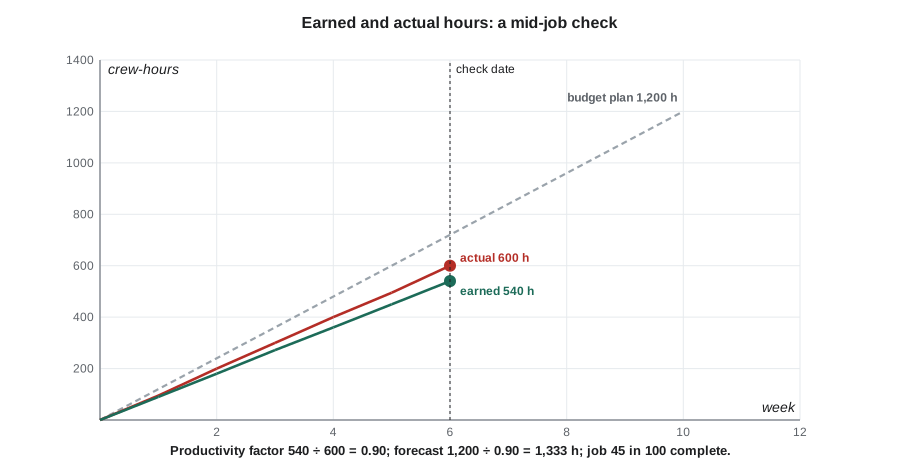
On a job with a budget of 1,200 crew-hours, the foreperson's quantities show the crew has installed work worth 540 earned hours, while the time sheets show 600 actual hours. How far along is the job, how productive is the crew against the estimate, and what will the job take if nothing changes?
Show solution
- Progress: 540 ÷ 1,200 = 0.45, so the job is 45 in 100 complete by earned hours.
- Productivity factor: 540 ÷ 600 = 0.90.
- Forecast at completion: 1,200 ÷ 0.90 = 1,333 hours, about 133 hours over budget.
Answer: The job is 45 in 100 complete but running at 90 in 100 of estimated productivity. Finding the cause now, while more than half the job is left, is worth far more than discovering the overrun at the end.
The common causes of low productivity are not lazy crews. They are areas that are not ready, so the crew works in small pieces; material that is late, wrong or stored far from the work; access that takes longer to move than planned; interruptions from other trades; rework from damage or deficiencies; and estimates that were wrong to begin with. Each cause has a different fix, and some, such as an area that the mechanical contractor has not released, are changes that may be claimed (lesson 10).
Coldstream's forepersons report quantities installed each week, by area and item, on a simple sheet. Raj turns them into earned hours and compares them with the payroll hours. When the Carrow Park trench work ran slow in July (INS-320), the weekly report showed it within days, and Raj priced the extra layer of cellular glass as a change while the work was still in progress.
Keeping the units honest
Labour units drift. Materials change, crews change, specifications get stricter, and the units in an old notebook can become too low or too high. The cure is the job review: at the end of each job, compare the estimated and actual hours by item, find out why they differ, and adjust the units if the difference is real rather than the result of something unusual. Lesson 11 shows Coldstream's review of five jobs from 2026. An estimator who never looks back at finished jobs is guessing with more decimal places.
Building a unit from the steps
When there is no record for a kind of work, the estimator builds a unit by thinking through the steps. Suppose Coldstream is asked to price a removable insulated box over a set of valves, an item it has not done before. Raj would list the steps and estimate each: measure the valves and plan the box, 0.5 h; cut and fold the panels in the shop, 2.0 h; line them with insulation and fit the fasteners, 1.5 h; carry and fit the box on site, 1.0 h; seal, label and photograph, 0.5 h. The total, 5.5 h, becomes the unit for that item, marked in the estimate as a built-up unit, not a record. After the job, the actual hours replace it.
Built-up units tend to be low, because the estimator thinks of the work going well. The usual corrections are to add time for getting tools and material to the location, for interruptions, and for the first one taking longer than the rest. Experienced estimators also compare a built-up unit with the closest item they do have a record for.
Learning curves and repetition
A crew gets faster on repeated work. The first floor of a classroom wing takes longer than the third, because the crew learns the layout, sets up its material and access, and solves the details once. Coldstream's units are averages over whole jobs, so they already include this effect. But on a job with a lot of identical work, such as several floors of the same plan or a row of identical air handling units, the later units can be a little lower, which is why lesson 5's adjustment table allows a small reduction for long repeated runs. The reverse is also true: a small job with many different kinds of work never gets the benefit of repetition.
Units for plant work
Plant maintenance work uses the same idea with different numbers. Removing old insulation, working around live equipment, permits, travel within a large site and the plant's own safety rules all add time. Coldstream keeps separate units for plant work rather than adjusting its commercial units, because the conditions are different enough that factors would be large and uncertain. The Kellerton yard rack estimate in INS-220, at 138 hours, and the Carrow Park estimate in INS-320 both used plant units, and both appear in the job review in lesson 11.
Common mistakes
MistakeTreating a labour unit as elapsed time.
InsteadLabour units are crew-hours; divide by crew size and hours per day to get duration.
MistakeApplying an adjustment factor to the whole job.
InsteadApply each factor to the work it affects, and record why.
MistakeLeaving non-working supervision out of a large job.
InsteadAdd foreperson time that is not in the labour units, typically as a percentage or a number of weeks.
MistakePricing overtime at the wage premium only.
InsteadAllow for lower productivity over long weeks as well.
MistakeWaiting until the end of the job to compare hours.
InsteadTrack earned and actual hours weekly and act on the productivity factor.
Summary and key terms
- A labour unit is crew-hours per unit of work under stated base conditions; quantities times units give direct hours.
- Units come from company records, industry manuals or a build-up of the steps; Coldstream uses its own.
- Adjustment factors for height, congestion, occupied buildings, weather and scattered work are applied area by area.
- Hours become cost at a blended burdened rate; large jobs add non-working supervision; overtime reduces productivity.
- Earned hours ÷ actual hours gives a productivity factor; budget ÷ factor forecasts the final hours.
- Labour unit
- The crew-hours to install one unit of work under stated conditions.
- Crew-hour
- One hour of work by one worker; a crew of three working an hour gives three crew-hours.
- Adjustment factor
- A percentage added to or subtracted from base hours for conditions that differ from normal.
- Blended rate
- The average burdened hourly cost of a crew of mixed classifications.
- Earned hours
- Installed quantities multiplied by the estimated labour units.
- Productivity factor
- Earned hours divided by actual hours.
Practice problems
Work each problem on paper first, then reveal the answer to check.
At 0.28 h/m, how many hours does 200 m of pipe take?
Show answer
56 h.
Two insulators work 8-hour days on 109 crew-hours of work. About how many days will it take?
Show answer
109 ÷ 16 = 6.8, about 7 days.
A job has earned 300 hours and spent 250. What is the productivity factor?
Show answer
1.20; the crew is ahead of the estimate.
Why add non-working supervision on large jobs?
Show answer
The foreperson's planning, coordination and records are not in the labour units.
What should happen to a labour unit that is consistently beaten or exceeded on finished jobs?
Show answer
Review the reasons and adjust it if the difference is real.
Lesson quiz · 5 questions
Score 60% or more to complete this lesson.
Create a free account to save your progress, take quizzes and earn a certificate.