
INS-420 · Lesson 8 of 12 · 21 min
Crew leadership and toolbox talks
▶ Video coming soon A video version of this lesson is on the way.
At 7:00 on Monday, October 5, 2026, Bernie Valois gathered her crew in the Mountview laydown area for the week's toolbox talk. It was not an ordinary Monday. Two weeks earlier, on September 22, Tessa Moreau had stopped work in the old corridor C when a fitter's cut exposed what turned out to be asbestos-containing pipe covering, as INS-230 described, and the area had just been cleared after abatement. Bernie's talk that morning lasted twelve minutes. She went over what had happened, what the hospital and the abatement contractor had done, what the clearance meant, and what each person should do if they found anything else that was not on the survey. Then she asked Tessa to tell the crew, in her own words, why she had stopped. Everyone signed the attendance sheet, and the crew went back into corridor C.
The best insulation estimate in the world cannot make a job succeed without a good foreperson. The foreperson turns the estimate's hours into a working plan, keeps the crew safe and productive, deals with the general contractor and other trades, and keeps the records that protect the company. This lesson covers the foreperson's role, the legal duties of a supervisor, toolbox talks and other safety communication, planning the crew's day, and working with people.
The foreperson's role
A foreperson's work falls into four parts:
- Safety: knowing the hazards of each task, making sure the crew has the training, equipment and procedures to control them, and stopping work that is unsafe.
- Production: planning the work so the crew always has released areas, material and access; meeting the schedule; and keeping the hours within the estimate (lesson 5).
- Quality: making sure the work meets the specification and passes inspection the first time (lesson 9).
- Communication and records: attending coordination meetings, reporting to the project manager, and keeping daily reports, time sheets, quantities and change records (lesson 10).
On a small crew the foreperson does all of this while working on the tools. On a large crew, such as the six insulators Raj planned for Ridgemount, the foreperson spends much of the day on the other three parts, and lesson 5 showed how that time is priced. Either way, the job of a foreperson is to make the crew successful, not to be the fastest insulator on it.
A supervisor's legal duties
Under Ontario's Occupational Health and Safety Act, a foreperson is a supervisor: a person who has charge of a workplace or authority over a worker. The Act gives supervisors specific duties. In our own words, a supervisor must make sure that workers follow the Act and the regulations and use the protective equipment and devices the employer requires; tell workers about any hazard to their health or safety that the supervisor knows about; give workers written instructions where they are required; and take every precaution reasonable in the circumstances to protect workers. A supervisor must also be competent: qualified by knowledge, training and experience to organize the work, familiar with the Act and regulations that apply, and aware of the hazards in the work. Ontario also requires supervisors to complete a basic health and safety awareness training program.
The Act also sets up the internal responsibility system on a construction project. Workers must work safely, use the equipment provided and report hazards; they have the right to know about hazards, the right to participate through a health and safety representative or joint health and safety committee, and the right to refuse unsafe work. On a project with 20 or more workers, a joint health and safety committee is required, and on smaller projects a health and safety representative where there are six or more. The general contractor, as constructor, has overall responsibility for the project, and each subcontractor is the employer of its own workers.
Bernie puts it simply to new forepersons: "If you're in charge, you're responsible. You can't delegate that away."
Toolbox talks
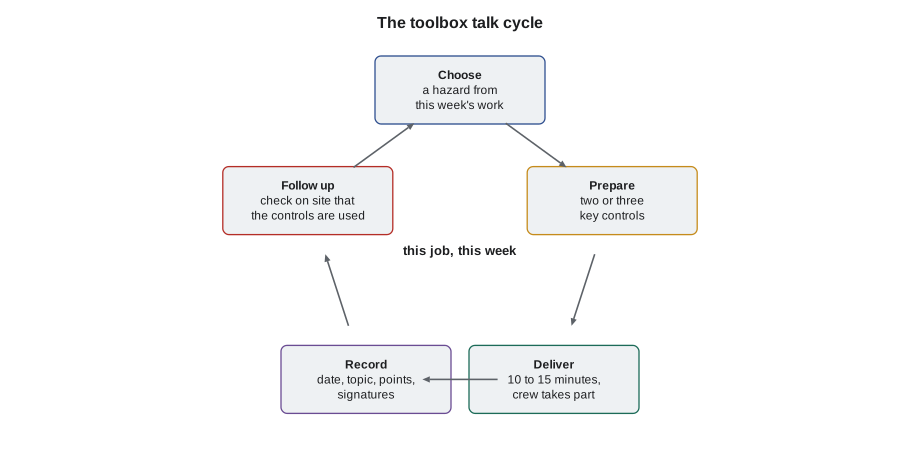
A toolbox talk is a short safety meeting, usually ten to fifteen minutes at the start of a shift or a week, about one topic. On many sites, the general contractor requires each trade to hold one weekly and keep attendance records; Coldstream holds them weekly on every job, and daily when the work or the hazards change. A good toolbox talk:
- Is about this job, this week: a hazard the crew will actually meet, such as a lift being used for the first time, a new chemical, hot work, a confined space, or something that happened on site.
- Is short and specific: one topic, with the controls the crew must use, not a lecture on everything.
- Involves the crew: questions, a demonstration, or a worker explaining a task or a near miss, as Tessa did on October 5.
- Is recorded: date, topic, key points and the signatures of those present. The record shows the training happened, and it reminds the foreperson what has been covered.
Topics for an insulation crew come from the work: ladder and scaffold set-up, lift pre-use checks, fall protection on a rooftop run, cuts from knives and sheet metal, eye protection when cutting board, dust from mineral wool, adhesive and solvent vapours, hot surfaces on live steam lines, cold surfaces and ammonia awareness on refrigeration work (INS-320), hearing protection in mechanical rooms, asbestos and stop-work procedures, heat stress in summer, and housekeeping. Mei Zhou keeps a binder of prepared talks, but she tells forepersons to use them as a start and add the details of their own job.
Toolbox talks are one part of safety communication. Others are the hazard assessment for each task, done before work starts and reviewed when conditions change; the site orientation that every worker gets on the first day at a new site; permits for hot work, confined spaces and lockout; and the daily conversation on site, when a foreperson sees something unsafe and stops to fix it.
Planning the crew's day
A foreperson who arrives in the morning without a plan wastes the crew's first hour. Coldstream's forepersons plan each day the afternoon before: what work is released, who will do what, what material and access each task needs, and what could go wrong.
Worked problem
A day plan
Bernie has four insulators for a day at Mountview. The toolbox talk takes 15 minutes for each person, and set-up and clean-up of the work areas take half an hour per person. How many productive crew-hours are left for installation? If the planned tasks for the day add up to 32 crew-hours from the labour units, what should she do?
Show solution
- Paid hours: 4 × 8 = 32 crew-hours.
- Toolbox talk: 4 × 0.25 = 1 crew-hour, leaving 31.
- Set-up and clean-up: 4 × 0.5 = 2 crew-hours, leaving 29.
- Planned work of 32 hours is 3 hours more than the crew can do. She should take one task off the day's list and plan it for tomorrow, rather than promise it to the superintendent.
Answer: 29 productive crew-hours. Labour units usually include normal set-up and clean-up, but a day plan that fills every paid hour with installation will always fall short.
A day plan pairs workers with tasks that suit them. Apprentices need tasks that teach them, with a journeyperson nearby, and Bernie pairs Devon with Tessa or Marcel on new kinds of work. Experienced insulators take the work that needs judgement: tight fittings, finished exposed work, cold systems. Nobody should work alone in a mechanical room, a confined space or at height without a way to get help.
Working with people
Most problems on a job site are people problems before they are technical ones. The skills a foreperson needs are not complicated, but they take practice:
- Set clear expectations: what the task is, how it should be done, when it should be finished and what good looks like. "Do the branches" is not a task; "cover the fan coil branches on the east side of level 2 by lunch, with the valves left for this afternoon" is.
- Teach, not just tell: show an apprentice how and why, then watch them do it. The program's courses describe the methods, but the trade is learned on the job.
- Give feedback early and privately: correct a mistake when it is small, out of earshot of the rest of the crew. Praise good work in front of them.
- Deal with conflict directly: between crew members, or with another trade, by talking to the person involved before it grows. Most disputes with other trades are about space, sequence and damage, and they are easier to settle in the ceiling than in a meeting.
- Respect everyone on site: the crew, other trades, the client's staff and, in an occupied building like Mountview, patients and visitors. Harassment and discrimination are not tolerated, and a foreperson who sees them must act. Coldstream's workplace policies, like those of most employers, set out how to report and deal with them.
Bernie's crew at Mountview included two first-year apprentices, a second-year apprentice and two journeypersons. Her rule for the apprentices was that by Friday each one should be able to tell her one thing they had learned that week and one thing they wanted to learn next. It took two minutes, and it told her more about the crew than any report.
Reporting up
The foreperson is the project manager's eyes on site. Raj expects a short report from each of his forepersons every Friday: hours worked, quantities installed by area, problems and constraints, changes and extras, safety items and next week's plan. On a job running well it takes ten minutes to write. On a job in trouble it is the most important document the company has, because it records what happened while it was happening. Lesson 10 covers daily reports and change records in detail.
Incidents and near misses
However good the planning, things go wrong. When an incident happens, the foreperson's first duties are to care for anyone hurt, make the area safe and stop the work that caused it. Then come the notifications: the company's safety coordinator, the general contractor, and any report the law requires within its deadline. Mei Zhou handles the formal reports at Coldstream, but she relies on the foreperson's account, written the same day, with names, times, what happened and what was done.
Ontario requires the constructor and employer to notify the Ministry of Labour, Immigration, Training and Skills Development immediately of a critical injury or a fatality, and to report other injuries, occurrences and illnesses in the ways and times the Act and regulations set. The workplace insurance board also requires an employer's report of injury. The scene of a critical injury must not be disturbed until an inspector allows it, except to help the injured or prevent further harm.
A near miss is an event that could have caused harm but did not: a dropped tool that missed someone below, a lift that tipped slightly on an unseen slope. Near misses are free lessons. Coldstream asks forepersons to report them like incidents, without blame, and to use the best ones in the next week's toolbox talk. A crew that reports near misses is a crew that trusts its foreperson.
Coaching the next foreperson
Part of a foreperson's job is to grow the next one. Bernie gives senior apprentices and new journeypersons pieces of the foreperson's work to try: running a toolbox talk, planning a day, walking an area with the checklist, filling in the quantities sheet. She reviews each one with them afterward. Priya's evenings in the office with Raj are the estimating side of the same idea. A company that does not develop its forepersons and estimators eventually runs out of them, and the courses in this program are only half of that development; the other half happens on site and in the office.
The foreperson and the customer
The foreperson is also the face of the company on site. The mechanical contractor's foreman, the general contractor's superintendent and the owner's representatives judge Coldstream mostly by what they see of its foreperson: whether the crew is where it said it would be, whether problems are raised early and honestly, whether the work areas are clean and whether promises are kept. Bernie's reputation with Harcourt's Gord Fennimore, built over several jobs, is one reason Harcourt invites Coldstream to bid. That kind of trust takes years to build and one bad week to lose.
Common mistakes
MistakeThinking a supervisor's safety duties can be passed to someone else.
InsteadIf you are in charge, the duties are yours; make sure the crew has what it needs to work safely.
MistakeReading a generic toolbox talk word for word.
InsteadChoose a topic from this week's work, keep it short and involve the crew.
MistakeNot recording toolbox talks.
InsteadRecord the date, topic, key points and signatures every time.
MistakePlanning a day that fills every paid hour with installation.
InsteadAllow for meetings, set-up, clean-up and moves, and plan only what the crew can do.
MistakeCorrecting an apprentice in front of the whole crew.
InsteadGive feedback early and privately; praise in public.
Summary and key terms
- A foreperson is responsible for safety, production, quality and communication, and makes the crew successful.
- Under the Occupational Health and Safety Act, a foreperson is a supervisor with duties to inform, instruct, enforce and take every reasonable precaution.
- Toolbox talks are short, specific to this week's work, involve the crew and are recorded.
- A day plan allows for meetings, set-up and clean-up, pairs workers with suitable tasks and never leaves anyone working alone in a hazardous place.
- Clear expectations, teaching, early private feedback, direct handling of conflict, respect and a weekly report make a good foreperson.
- Foreperson
- The person in charge of a crew on site, responsible for its safety, production, quality and records.
- Supervisor
- Under the Act, a person who has charge of a workplace or authority over a worker.
- Toolbox talk
- A short safety meeting on one topic, held at the start of a shift or week and recorded.
- Competent person
- A person qualified by knowledge, training and experience to identify hazards and with authority to correct them.
- Hazard assessment
- A review of a task's hazards and controls before work starts.
- Day plan
- The foreperson's plan of tasks, workers, materials and access for the next working day.
Practice problems
Work each problem on paper first, then reveal the answer to check.
What made Bernie's October 5 toolbox talk effective?
Show answer
It was about this job, was short, involved Tessa explaining her stop, and was recorded.
Name two duties of a supervisor under Ontario's Act.
Show answer
Tell workers about known hazards and make sure they follow the rules and use their protective equipment.
Five insulators work an 8-hour day, with a 15-minute talk and 30 minutes of set-up and clean-up each. How many productive crew-hours are there?
Show answer
40 − 1.25 − 2.5 = 36.25 crew-hours.
Who should take on tight fittings and finished exposed work?
Show answer
Experienced insulators, with apprentices learning beside them.
What goes in a foreperson's Friday report?
Show answer
Hours, quantities by area, problems, changes, safety items and next week's plan.
Lesson quiz · 5 questions
Score 60% or more to complete this lesson.
Create a free account to save your progress, take quizzes and earn a certificate.