
INS-410 · Lesson 8 of 12 · 21 min
Reading engineering specifications
▶ Video coming soon A video version of this lesson is on the way.
Every insulation job Coldstream bids starts with two documents: the drawings, which show where the pipe and duct go, and the specification, which says what the insulation must be. Raj Sandhu reads specifications for a living. When Priya asked how he does it so fast, he showed her his copy of the Kellerton kettle room specification from INS-120, marked up in three colours: green for the products, blue for the thicknesses and red for anything that conflicted with something else. "Nobody reads a spec from front to back," he said. "You learn where things live, and you learn what to look for."
This lesson explains how construction specifications are organized, where the insulation requirements are found, how prescriptive and performance requirements differ, how to check a thickness against a performance clause, how to deal with substitutions and conflicts, and what the submittal must show.
How specifications are organized
In Canada and the United States, building specifications are organized by MasterFormat, a numbering system that divides the work into divisions and sections. Federal and many public projects in Canada use the National Master Specification (NMS), which follows the same numbering with its own section titles. Insulation is covered in:
| Section | Typical title |
|---|---|
| 22 07 19 | Plumbing piping insulation (MasterFormat) |
| 23 07 13 | Duct insulation (MasterFormat); thermal insulation for ducting (NMS) |
| 23 07 16 / 23 07 14 | HVAC equipment insulation (MasterFormat 23 07 16); thermal insulation for equipment (NMS 23 07 14) |
| 23 07 19 / 23 07 15 | HVAC piping insulation (MasterFormat 23 07 19); thermal insulation for piping (NMS 23 07 15) |
| 07 84 00 | Firestopping, in the building envelope division |
Plant projects, such as the kettle room, often use the owner's own engineering standards instead, with their own numbering, but they usually follow the same three-part arrangement inside each section:
- Part 1, General: what the section covers, related sections, reference standards, definitions, submittals, quality assurance, delivery and storage, and site conditions.
- Part 2, Products: the materials, with their standards, types, grades, maximum conductivity, temperature limits and fire ratings; jackets, adhesives, mastics, tapes and accessories; and often named manufacturers.
- Part 3, Execution: examination of the work before starting, installation requirements, the insulation schedule of thicknesses, field quality control, repairs and cleaning.
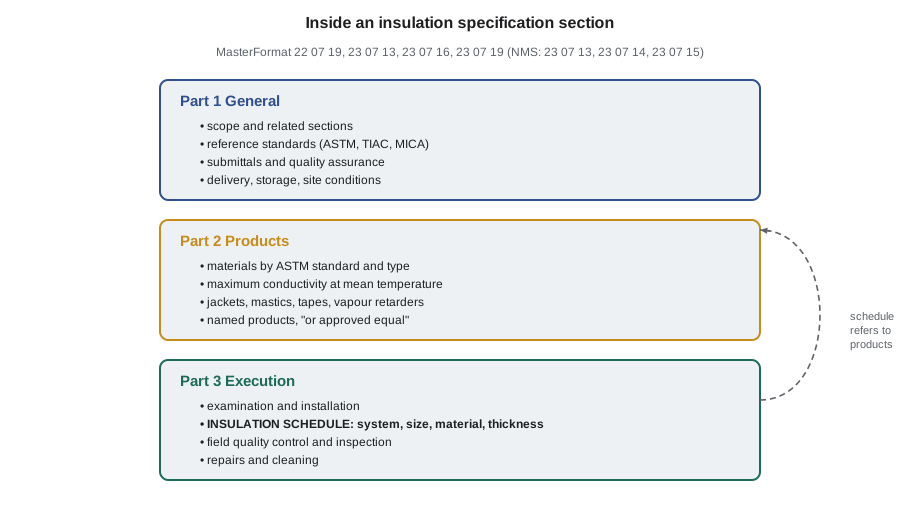
Raj reads every section in the same order. First the scope and related sections, to see what is in and out of the insulation contract: is the firestopping, the equipment or the heat tracing someone else's work? Then the schedule in Part 3, to see every system and its thickness. Then Part 2, to see what products are allowed for each system. Last, the rest of Part 3 and Part 1, for the installation rules, submittals, inspections and anything unusual.
The insulation schedule
The schedule is a table that lists each system, the pipe sizes, the material and the thickness. A typical excerpt, written for this course, looks like this:
| System | Pipe size | Material | Thickness | Jacket |
|---|---|---|---|---|
| Steam, 1,035 kPa, outdoors | All | Mineral wool pipe section, ASTM C547 Type II | 76 mm | Embossed aluminum with moisture barrier |
| Steam, 1,035 kPa, indoors (process area) | All | Expanded perlite, ASTM C610 | 76 mm | Stainless steel, sealed seams |
| Condensate return | NPS 3 and smaller | Mineral wool or glass fibre pipe section | 51 mm | Same as steam in same area |
| Domestic hot water | NPS 1 ¼ and smaller | Glass fibre with all-service jacket | 25 mm | PVC in exposed areas |
| Chilled water | All | Cellular glass or flexible elastomeric | 38 mm | PVC; aluminum outdoors |
Reading a schedule well means reading the notes. Schedules often carry footnotes such as "thicknesses based on insulation conductivity not exceeding a stated value at a stated mean temperature", "increase thickness where required for personnel protection" or "where the energy code requires a greater thickness, the code governs". Those notes are what turn the schedule into a requirement that can be checked.
Prescriptive and performance requirements
A prescriptive requirement names the material and thickness: 76 mm of mineral wool on the outdoor steam. A performance requirement states the result: a maximum heat loss per metre, a maximum surface temperature, a minimum surface temperature for condensation, or a code minimum. Many specifications use both, a thickness that the engineer has calculated and a performance clause behind it. Where a performance clause applies, the insulator can propose any system that meets it, and must show that it does.
Worked problem
Checking a performance clause
A specification that Raj bid in October for a hospital steam main has this clause: "Indoor steam piping at 186 °C shall be insulated to limit heat loss to 80 W/m or less in still air at 25 °C." The pipe is NPS 6 with mineral wool, k = 0.045 W/m·K at its mean temperature, and a stainless steel jacket, emittance about 0.3. Which standard thickness is the minimum that complies?
Show solution
- Using the method of lesson 2, iterated for each thickness:
- 51 mm: 85.6 W/m, surface 42.6 °C. Fails.
- 64 mm: 73.2 W/m, surface 39.5 °C. Complies.
- 76 mm: 65.3 W/m, surface 37.4 °C. Complies.
Answer: 64 mm is the minimum that meets the clause. The schedule in that specification showed 64 mm, which agrees; had it shown 51 mm, Raj would have raised a question before bidding.
The same check works backwards for substitutions. If a bidder proposes a material with a higher conductivity, the thickness that meets the clause goes up, and the bidder must price that thickness, not the scheduled one.
Products, standards and substitutions
Part 2 usually identifies each product by its ASTM standard and type, as INS-120 explained: mineral wool pipe insulation to ASTM C547 Type II, calcium silicate to C533, cellular glass to C552, flexible elastomeric to C534, and so on. It may add limits beyond the standard, such as a maximum conductivity at a stated mean temperature, a maximum chloride content for stainless steel service (ASTM C795), or flame spread and smoke ratings. Where manufacturers are named, the clause usually says whether others may be used:
- "No substitutions" or a single named product: only that product, unless the engineer agrees in writing.
- Named products "or approved equal": another product may be used if the engineer approves it before it is ordered.
- A performance or standards-based clause with no names: any product that meets the stated standards and limits.
A substitution request must show that the proposed product meets every requirement of the specified one: the same ASTM type or better, a conductivity no higher at the same mean temperature, the same temperature range, fire ratings and compatibility with jackets and coatings. Where its conductivity is higher, the request must show a thickness that performs the same. Lesson 9 shows the formula that energy standards use for exactly this adjustment.
Conflicts and questions
Specifications and drawings are written by people under deadlines, and they contain conflicts. Raj's red pen found three in the kettle room package:
- Thickness conflict. A drawing note said 64 mm on the indoor run, while the schedule said 76 mm.
- Product conflict. Part 2 listed glass fibre for "steam to 230 °C", while the schedule called for mineral wool outdoors and perlite indoors.
- Missing information. No sealant was specified for the stainless jacket seams in the food area.
Most specifications contain an order of precedence clause that says which document governs in a conflict, such as specifications over drawings, or the more stringent requirement over the less. Even so, the right answer to a conflict is a written question before pricing or ordering: a request for information (RFI) to the engineer or owner, quoting both documents and asking which applies. Raj sent the kettle room questions to Anika ahead of the meeting at the plant on November 12, and the answers came out of that meeting: 76 mm and the schedule's materials stood, and Anika asked for a Kellerton-approved food-area sealant, the request INS-120 recorded with the submittal approval on November 13.
What the submittal must show
Before materials are ordered, the specification usually requires a submittal: product data sheets and sometimes samples, sent to the engineer for review. A good insulation submittal makes the reviewer's job easy:
- A cover sheet listing each system in the schedule and the product proposed for it.
- Data sheets with the relevant ASTM type, conductivity at the specified mean temperatures, temperature limits and fire ratings marked.
- Data for jackets, bands, mastics, adhesives, sealants and vapour retarders, with their permeance where it matters.
- Any calculations that show compliance with a performance clause, with their inputs, as in the example above.
- Any substitution requests, kept separate and clearly labelled.
Raj adds one more item that is not always required: a list of any assumptions he made where the specification was silent. It costs nothing, and it has saved him several arguments.
Clauses that change the price
Beyond materials and thicknesses, specifications contain installation clauses that affect the cost, and an estimator who misses them loses money. Raj's checklist for any insulation section includes:
- Testing before insulating. Piping must be pressure tested and accepted before it is covered; insulating untested pipe means stripping it if a joint leaks.
- Hanger and support details. Inserts or shields at every support, insulation continuous through hangers, and who supplies the inserts.
- Penetrations. Whether insulation runs through walls and floors, and whether firestopping at those points is in the insulation contract or another section.
- Fittings and valves. Whether valves get removable covers, preformed fittings or built-up fittings, as INS-210 and INS-340 described.
- Jackets and finishes. Where metal jackets, PVC or painted finishes are required, and any colour coding or painting by others.
- Identification. Pipe labels, flow arrows, and labels for heat traced or hazardous lines, and who installs them.
- Inspection and acceptance. Hold points where the engineer or owner must inspect before covering, as at Mountview in INS-130 and INS-330.
- Cleaning and protection. Protecting finished insulation from other trades, and repairing damage.
Each one is a line in the estimate or a question to ask. When a clause is missing, the safe assumption is to ask, not to guess.
Owner standards in existing plants
Much of an industrial insulator's work is done without a project specification at all, under the owner's own engineering standard or maintenance practice. Kellerton's is short: a thickness table by temperature and pipe size, approved materials and jackets for each area, a list of items that get removable covers, and rules such as the one adopted after the 2026 outage, that no valve or flange job is closed until its insulation is back or a cover is ordered. Reading an owner standard is easier than reading a project specification, but the same skills apply: find the scope, the products, the thicknesses and the rules, and ask about anything that does not fit the job in front of you.
Where there is no written standard, the contractor's proposal becomes the specification. That is one more reason Raj writes his assumptions down: in a plant with no standard, the assumptions in the accepted proposal are what the work will be judged against.
Reading the scope correctly
The first part of any specification section, the scope and the list of related sections, decides what the insulation contractor must price. A common trap is work described in another section that touches insulation: pipe hanger inserts specified in the piping section, firestopping in the building envelope division, heat tracing in the electrical division, or jacket painting in the painting section. Raj reads every related section that the insulation section names, and the general conditions that say who supplies what, before he prices. On a large project, one missed scope line, such as supplying all the hanger inserts, can cost more than the profit on the job.
Addenda and bulletins issued during bidding change the specification too. They are numbered and must all be read; a bid that misses an addendum changing a thickness or a jacket is priced on a document that no longer exists.
Specifications also change during construction, through change orders, site instructions and approved substitutions. The current set of documents, with every change recorded, is the one the work is inspected against, so the foreperson on site needs the same version the estimator priced, plus every change since. On Mountview, as INS-130 and INS-330 showed, the engineer's field reviewer checked the work against the documents as amended, item by item.
Common mistakes
MistakePricing from the schedule without reading the notes.
InsteadRead every schedule note; conductivity limits and code clauses change the thickness.
MistakeTreating "or approved equal" as permission to substitute.
InsteadGet written approval before ordering any substitute.
MistakeResolving a conflict by choosing the cheaper option.
InsteadSend an RFI quoting both documents and wait for the answer.
MistakeSubstituting a higher-conductivity product at the scheduled thickness.
InsteadShow the thickness that gives the same performance and price that.
MistakeSending data sheets without marking the relevant values.
InsteadMark the ASTM type, conductivity, temperature limits and fire ratings the reviewer must check.
Summary and key terms
- Insulation is specified in MasterFormat sections 22 07 19, 23 07 13, 23 07 16 and 23 07 19 (NMS uses titles such as 23 07 15 for piping), or in an owner's standards.
- Each section has Part 1 General, Part 2 Products and Part 3 Execution; the schedule is in Part 3.
- Prescriptive requirements name the material and thickness; performance requirements state a result that the insulator must show is met.
- Substitutions need written approval and must perform at least as well, with a thicker layer if the conductivity is higher.
- Conflicts are resolved by an RFI, and submittals must make every requirement easy to check.
- Specification
- The written part of the contract documents, stating the requirements for materials and workmanship.
- MasterFormat
- The standard numbering system for organizing construction specifications in North America.
- Insulation schedule
- A table in the specification listing each system, pipe size, material, thickness and jacket.
- Prescriptive requirement
- A requirement that names the material and thickness to be used.
- Performance requirement
- A requirement that states a result, such as a maximum heat loss or a surface temperature.
- Substitution
- A product other than the one specified, used only with the engineer's approval.
- Request for information
- A written question to the engineer or owner to clarify the contract documents.
- Submittal
- Product data, samples or calculations sent for review before materials are ordered.
Practice problems
Work each problem on paper first, then reveal the answer to check.
In which part of a specification section is the insulation schedule usually found?
Show answer
Part 3, Execution.
What is the difference between a prescriptive and a performance requirement?
Show answer
A prescriptive one names the material and thickness; a performance one states the result to be achieved.
A drawing note and the schedule show different thicknesses. What should you do?
Show answer
Send an RFI quoting both and wait for the answer before pricing or ordering.
What must a substitution request show?
Show answer
That the product meets every requirement of the specified one, with a thickness that gives the same performance if its conductivity is higher.
For the hospital clause in the example, what is the minimum thickness?
Show answer
64 mm.
Lesson quiz · 5 questions
Score 60% or more to complete this lesson.
Create a free account to save your progress, take quizzes and earn a certificate.