
INS-410 · Lesson 12 of 12 · 20 min
Case study: an energy retrofit of a steam plant
▶ Video coming soon A video version of this lesson is on the way.
This lesson follows the Kellerton boiler house insulation retrofit from Thea Okerlund's audit to Raj Sandhu's draft savings table, the document Raj e-mailed to Anika Varga on the evening of Friday, November 13, 2026. It pulls together every method in the course: bare and insulated heat loss, economic thickness, personnel protection, condensation, freeze protection, savings and payback, specifications, standards, software and the audit itself. The priced proposal is due on Friday, December 4, and the work is planned for the plant's Christmas shutdown and the months after it, so everything after November 13 in this lesson is a plan.
The starting point
Kellerton Foods' boiler house supplies steam at about 1,035 kPa (150 psig) and 186 °C (366 °F) to the plant, with condensate returned to a receiver and a deaerator. Over the 2026 courses, Coldstream's crews had already worked through much of it: the outage of November 2 to 6 in INS-110, the PRV station rebuilt and insulated by Marcel and Devon in INS-210, the condensate receiver jacketed in INS-220, and the deaerator walk-through by Wendell and Priya in INS-310. Thea's audit, done on Tuesday, September 15 and reported on Wednesday, October 14, looked at the whole steam system at once and listed what was still wrong.
| Date | Event |
|---|---|
| September 15 | Thea's infrared survey with Anika; Raj joins in the afternoon |
| October 14 | Audit report issued |
| Late October | Raj and Priya begin checking the insulation items |
| November 2 to 6 | Outage week; bare fittings counted again by Lou, Marcel and Devon on November 6 (INS-210) |
| November 9 to 13 | PRV station insulated and its covers measured (INS-210 and INS-340); deaerator measured on November 13 (INS-310) |
| November 13 | Raj e-mails the draft savings table to Anika |
| December 4 (plan) | Priced proposal due |
| Christmas shutdown (plan) | Boiler house covers, wet header section and deaerator work |
| January to spring 2027 (plan) | Condensate tunnel, make-up water line; verification survey after the work |
Step 1: the scope
Thea's report listed eleven insulation measures. Raj grouped them into four packages that Coldstream could price and schedule as separate pieces of work:
- Package A, boiler house fittings. Removable covers for the 23 bare fittings: 3 NPS 6 gate valves, 4 NPS 4 valves, 6 NPS 6 and 8 NPS 4 flange pairs, and 2 NPS 4 strainers, the items Lou asked Coldstream to price on November 6.
- Package B, wet header section. Remove and replace 15 m (49 ft) of wet insulation on the NPS 8 main with 76 mm (3 in) of mineral wool and aluminum jacket, after the plant fixes the roof drain that wet it.
- Package C, condensate tunnel. Insulate 42 m (138 ft) of bare NPS 3 condensate return, with removable covers on five flange pairs, using 38 mm (1 ½ in) of glass fibre pipe insulation and PVC jacket, which suits the cool, damp tunnel.
- Package D, deaerator. The work described in INS-310: a framed nameplate opening with a hinged cover, a removable box over the manway, removable blankets on the relief valve inlets, 25 inspection plugs and jacket repairs around the nozzles.
Four other items in the report were not Coldstream's work: steam trap replacements, a leaking valve packing, a boiler tune-up and the roof drain. The make-up water line from lesson 6 Raj priced separately, as a maintenance repair rather than an energy measure. Raj listed them in a note so that nothing would fall between trades.
Step 2: thicknesses and systems
For each package Raj checked the system against the purposes of lesson 1, starting from Kellerton's own standards in INS-210:
- Energy. The plant standard of 64 mm (2 ½ in) on NPS 2 to 6 steam and 76 mm (3 in) on NPS 8 and up is close to the economic thickness of lesson 3 at Kellerton's prices, so Raj kept it.
- Personnel protection. Lesson 4 showed that the plant standard keeps an aluminum-jacketed steam line well below 60 °C (140 °F) even beside a boiler. The fitting covers have silicone-coated outer fabric, which runs cooler than aluminum, as INS-340 noted.
- Condensation. Not a concern on steam; in the tunnel, Raj chose a PVC jacket over glass fibre because the tunnel is damp and the PVC is easy to clean, not for condensation.
- Code. Kellerton's process steam is industrial piping, outside the building energy code's insulation tables, so the plant standard governs, as lesson 9 explained.
Worked problem
The condensate tunnel line, insulated
Find the heat loss of the NPS 3 condensate line at 95 °C in 20 °C air with 38 mm of glass fibre, typical k = 0.036 W/m·K at its mean temperature, and a PVC jacket of emittance 0.9, and compare it with the bare loss of 288 W/m.
Show solution
- Iterating as in lesson 2 gives a heat loss of 25.4 W/m and a jacket temperature close to room temperature.
- Ratio: 25.4 ÷ 288.2 = 0.088, about one eleventh of the bare loss.
- Insulation-only bound: 2π × 0.036 × 75 ÷ ln(82.45 ÷ 44.45) = 16.96 ÷ 0.618 = 27.4 W/m, just above 25.4, so the result passes the check of lesson 10.
Answer: About 25 W/m, a reduction of about 91 in 100.
Step 3: savings
Raj worked out the savings of each package with the inputs agreed with Anika and stated on the first page of the draft: 7,550 hours a year at full pressure, boilers 80 in 100 efficient, and the sample gas price used throughout this course, 13.16 dollars per GJ of steam. For the real proposal, Anika will substitute Kellerton's contract price.
- Package A: the bare loss of the 23 fittings, 15.1 kW, from INS-210, all but a small share saved by covers. INS-210 estimated about 410 GJ a year, about 5,395 dollars.
- Package B: from lesson 11, (310.4 − 77.6) × 15 = 3,492 W, or 94.9 GJ a year, about 1,249 dollars.
- Package C: with Raj's count of five flange pairs, the bare equivalent length is 42 + 5 × 0.3 = 43.5 m and the bare loss 288.2 × 43.5 = 12,537 W. Insulated, with the flange covers saving 90 in 100, the loss is 25.4 × 42 + 0.1 × 1.5 × 288.2 = 1,110 W. The saving is 11,427 W, or 310.6 GJ a year, about 4,087 dollars.
- Package D: the bare manway, about 0.36 m² at about 108 °C, loses about 1,000 W/m², or 361 W, and the two bare relief valve inlets, about 0.6 m equivalent each, about 404 W. Covering them saves about 90 in 100: 688 W, or 18.7 GJ a year, about 246 dollars.
Step 4: costs, payback and emissions
The installed costs below are SAMPLE budget figures for this course, including access, removal and disposal of old insulation, materials, the blanket fabricator's charges for covers and labour. They are not Coldstream's prices.
| Package | Energy saved (GJ per year) | Money saved (dollars per year) | Installed cost, SAMPLE (dollars) | Simple payback (years) |
|---|---|---|---|---|
| A, fittings | 410.0 | 5,395 | 14,600 | 2.7 |
| B, wet header | 94.9 | 1,249 | 4,500 | 3.6 |
| C, condensate tunnel | 310.6 | 4,087 | 3,800 | 0.9 |
| D, deaerator | 18.7 | 246 | 9,600 | 39 |
| Total | 834.2 | 10,977 | 32,500 | 3.0 |
| Total without D | 815.5 | 10,731 | 22,900 | 2.1 |
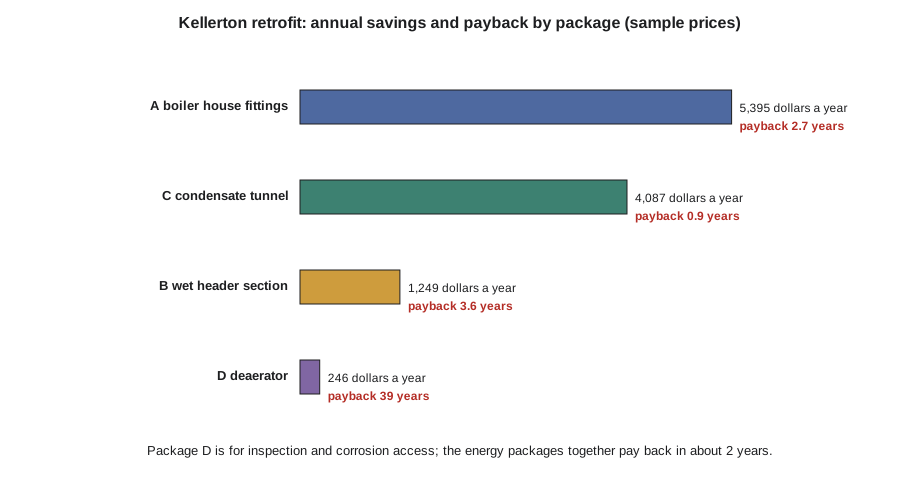
The whole retrofit saves about 834 GJ a year, about 27,440 m³ of gas, and pays back in about 3 years at the sample price. At about 1.9 kg of CO₂ per cubic metre, it avoids about 52 tonnes of CO₂ a year, the number Kellerton's corporate office asked for.
The deaerator package stands out: a payback of 39 years. Raj did not hide it or spread its cost over the others. He listed it separately, with a note that its purpose is the inspection items from the plant's boiler and pressure vessel inspection and the corrosion checks Anika asked for in INS-310, not energy. Without it, the energy packages pay back in about two years. An owner can only make good decisions when the reasons for each item are clear.
Step 5: checks
Before sending the draft, Raj and Priya ran the checks of this course on every line:
- Inputs: hours, efficiency and price stated and agreed; actual outside diameters; conductivities at mean temperatures; bare losses at the conditions where the items are, not outdoor values for indoor pipe.
- Calculations: the insulation-only bound and the bare-to-insulated ratio on each insulated line, and a hand check of one row of the spreadsheet.
- No double counting: the PRV station items insulated and covered in INS-210 and INS-340 were left out of Package A, because they were already done or ordered.
- Differences from the audit: the extra flange pair in the tunnel, noted in the draft and reported to Thea.
- Non-energy items: personnel protection near walkways, inspection access, corrosion risk under the wet section, and the roof drain to be fixed first.
Step 6: incentives and next steps
Some utilities pay incentives toward industrial energy-saving projects, including steam system insulation; Enbridge Gas, Ontario's gas utility, runs incentive programs for industrial customers. Programs, rules and amounts change, and many require approval before work starts, so Anika plans to check the current rules and apply before the work is ordered (a plan). Raj showed the installed cost and any incentive as separate lines, as lesson 7 advised.
The rest is planned. The priced proposal goes to Anika on Friday, December 4. If approved, the boiler house covers are measured in the first week of December, alongside the PRV covers that Marcel and Devon install the week of November 30, and installed with the wet header section and the deaerator work in the Christmas shutdown. The condensate tunnel follows in January, and the make-up water line in the spring when it can be drained. Thea plans a short verification survey with her infrared camera in February 2027, to confirm that the new work shows cool and even and that nothing has been missed.
Priya's last question was the one Raj liked best: "How do we know the savings were real?" He pointed to the verification survey and to the plant's gas meter. "A good estimate tells you what to expect," he said. "The meter tells you what you got. If our numbers are right, Anika will see it in the gas bills by spring, and the next audit will start with a phone call to us."
The course in one job
Priya listed, at the back of her notebook, where each lesson had shown up in the Kellerton proposal:
| Lesson | Where it appeared |
|---|---|
| 1, why calculate | Agreeing the purpose and inputs for each package with Anika |
| 2, heat loss | The bare and insulated losses of the tunnel line and header |
| 3, economic thickness | Confirming that the plant standard is still near the economic thickness |
| 4, personnel protection | Checking jacket and cover temperatures near walkways |
| 5, condensation | The 2027 suction main question, priced separately |
| 6, freeze protection | The make-up water line repair, priced separately |
| 7, savings and payback | The draft savings table and its CO₂ column |
| 8, specifications | The plant standard as the specification, and the stated assumptions |
| 9, standards | Why the building energy code does not set the process thicknesses |
| 10, software | The program runs, hand checks and saved input reports |
| 11, audits | Thea's inventory, the tape readings and the extra flange pair |
The e-mail
Raj's covering e-mail to Anika on November 13 was short. It said that the attached draft covered the four insulation packages from the audit, listed the inputs used and asked her to confirm Kellerton's gas price, hours and boiler efficiency, noted the one difference from the audit, the fifth flange pair in the tunnel, and pointed out that the deaerator package was justified by inspection rather than energy. It asked for a decision on the scheduling of the wet header section, which depended on the roof drain repair, and confirmed that the priced proposal would follow by December 4. Anika replied the next morning with the plant's contract gas price and a thank-you for the separate deaerator line, which she said would make the corporate review easier.
Risks in the plan
Raj's draft also listed the risks that could change the numbers or the schedule: the gas price and hours that Anika had still to confirm, the roof drain repair that must come before the header work, the chance that old fittings hide materials not on the plant's survey, which would stop work as Bernie insists, and the short shutdown window, which limits how much can be done at Christmas. Naming the risks early lets the owner plan for them, and makes a later change easy to explain.
Common mistakes
MistakePricing an audit list without checking it.
InsteadCheck every item against the plant, the drawings and your own survey before pricing.
MistakeSpreading a long-payback item's cost over quick-payback items.
InsteadList each package separately with its reason, so the owner can decide.
MistakeCounting work already done or ordered.
InsteadRemove items already insulated or covered from the savings.
MistakeReplacing wet insulation before the water source is fixed.
InsteadMake the leak repair a condition of the work.
MistakeTreating the estimate as the result.
InsteadPlan a verification survey and compare with metered energy.
Summary and key terms
- Raj grouped Thea's audit into four packages: boiler house fittings, the wet header section, the condensate tunnel and the deaerator.
- Each package was checked for energy, personnel protection, condensation and code, starting from the plant's own standards.
- At the sample price, the retrofit saves about 834 GJ a year, about 10,977 dollars, and pays back in about 3 years; without the deaerator, about 2 years.
- The deaerator package is justified by inspection and corrosion access, and is listed separately with its reason.
- Inputs, checks, differences from the audit, incentives and a verification survey make the numbers ones the owner can trust.
- Retrofit
- Work to improve an existing system, such as replacing or adding insulation.
- Package
- A group of related measures priced and scheduled as one piece of work.
- Verification survey
- A survey after the work to confirm that it performs as estimated.
- Incentive
- A payment from a utility or program toward the cost of an energy-saving project.
- Draft savings table
- A preliminary table of each measure's savings, costs and paybacks, sent for review before the priced proposal.
Practice problems
Work each problem on paper first, then reveal the answer to check.
Which package had the shortest payback, and why?
Show answer
The condensate tunnel, because it was a long bare run that is cheap to insulate.
Why was the deaerator package kept separate?
Show answer
Its purpose is inspection and corrosion access, not energy, and its energy payback is about 39 years.
Why were the PRV station items left out of Package A?
Show answer
They were already insulated and their covers ordered, so counting them would double count.
What must happen before the wet header section is replaced?
Show answer
The roof drain leak must be fixed.
How will Kellerton know whether the savings were real?
Show answer
From the verification survey and the gas meter readings.
Lesson quiz · 5 questions
Score 60% or more to complete this lesson.
Create a free account to save your progress, take quizzes and earn a certificate.