
INS-410 · Lesson 1 of 12 · 24 min
Why insulators calculate
▶ Video coming soon A video version of this lesson is on the way.
On a Friday evening in late October 2026, Raj Sandhu dropped a thick report on the table in Coldstream's office and opened it at a page of thermal images. Each image showed a pipe or a valve in false colour, with the bare and damaged spots glowing yellow and white against the blue of good insulation. The report was a steam system energy audit of the Kellerton Foods boiler house, written by Thea Okerlund of Harrowgate Energy Advisors for the plant's utilities engineer, Anika Varga. "Anika wants our numbers by the start of December," Raj told Priya Lam, the third-year apprentice who was spending some of her evenings in the office that fall learning the estimating side of the trade. "Not just a price. She wants to know how much energy each item saves, how long it takes to pay for itself and whether our thicknesses meet the spec. That means calculations."
Priya had used heat loss numbers before, in INS-120 and INS-210, but she had always taken them from a table or from Raj. This course is about where those numbers come from and how to produce them yourself. It covers the heat loss of bare and insulated pipe, economic thickness, surface temperature for personnel protection, thickness to stop condensation, freeze protection and heat tracing, energy savings and payback, specifications, codes and standards, calculation software and energy audits, and it ends with the Kellerton retrofit as a case study. This first lesson explains why insulators calculate at all, what inputs every calculation needs, and the units and conversions that the rest of the course uses.
Six reasons to calculate
Every insulation system is installed for a purpose, and each purpose sets a different test that the thickness must pass. Engineers usually write the purpose into the specification, but the insulator who understands it can spot a wrong thickness before it is installed, explain a choice to an owner and price an alternative that still works. The six common purposes are:
- Energy conservation. Reduce heat loss or heat gain to save fuel or electricity. The test is cost: the thickness that gives the lowest total cost over the life of the system, or a minimum thickness set by an energy code.
- Process control. Keep a fluid at the temperature the process needs, for example to deliver steam dry at the far end of a long line, keep a viscous product flowing or limit the temperature rise of chilled water. The test is a temperature or a heat flow at a point.
- Personnel protection. Keep surfaces that people can touch below a temperature that burns skin. The test is the surface temperature, usually about 60 °C (140 °F) for metal touched briefly.
- Condensation control. Keep the outer surface of a cold system above the dew point of the surrounding air, so that no water forms on it. The test is again a surface temperature, this time a minimum.
- Freeze protection. Delay freezing of water lines that may stop flowing in cold weather, or size heat tracing that keeps them above freezing. The test is a time or a heat input.
- Fire, noise and other purposes. Fire-resistant systems, acoustic lagging and similar systems, covered in INS-330 and INS-340, are tested in other ways, but they still interact with heat flow.
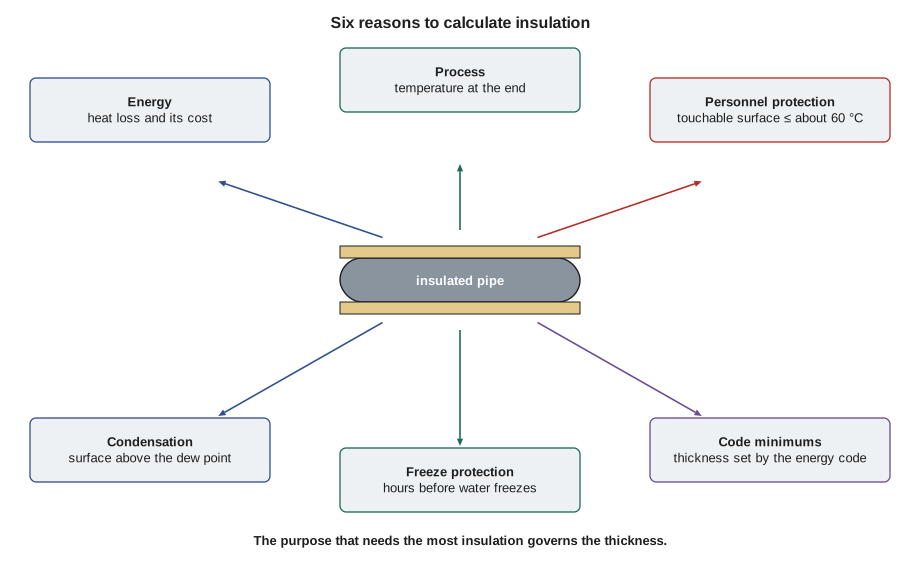
A single system often has more than one purpose. A steam line in a boiler house is insulated for energy, but the parts within reach must also meet the personnel protection limit. A chilled water line in a ceiling is insulated mostly to stop condensation, and the energy code adds a minimum thickness. The governing purpose is the one that needs the most insulation, and a good calculation checks all of them.
Who does the calculation
On most projects the mechanical engineer chooses the insulation thickness and writes it into the specification. The insulator still meets calculations every week. An estimator checks that the specified thickness can be bought and installed, proposes an alternative material and shows that it performs the same, or prices an owner's question such as "What would an extra inch save?" A foreperson checks that a substitute product with a different conductivity still meets the thickness intent. In plant maintenance work, where there is often no engineer, the insulation contractor may be the only one who calculates anything at all. Raj put it this way to Priya: "The engineer picks the number on a new job. On an old plant, the customer asks us. If we can't show our work, we're just another price."
In the Red Seal occupational standard for the trade, the senior insulator is expected to understand heat transfer well enough to read heat loss tables, calculate surface temperatures and thicknesses with the formulas and charts, and use the industry's calculation software. This course builds those skills step by step, with every number worked out.
What every calculation needs
Whatever the purpose, a heat transfer calculation for insulation needs the same group of inputs. Missing or wrong inputs are the most common source of wrong answers, so it pays to list them before starting:
| Input | What it means | Where it comes from |
|---|---|---|
| Operating temperature | Temperature of the pipe, duct or equipment surface, usually taken as the fluid temperature | Process data, the specification, a pressure gauge and a steam table |
| Ambient temperature | Temperature of the surrounding air | Design conditions in the specification; for outdoor work, local design weather data |
| Wind speed | Air movement over the surface | Indoors usually taken as still air; outdoors a design wind speed |
| Relative humidity | Moisture in the air (cold systems only) | Design conditions for the space |
| Pipe size or surface shape | Actual outside diameter, not the nominal size; flat surface orientation | Pipe dimension tables; equipment drawings |
| Insulation material | Its thermal conductivity at the mean temperature | Manufacturer data, tested to the ASTM standards named in INS-120 |
| Thickness | Nominal thickness, or the actual thickness of the sizes made | The product range; ASTM C585 for pipe insulation sizes |
| Outer surface | Jacket or finish and its emittance | Jacket type; typical emittance values |
| Operating hours and energy cost | Hours per year at temperature, and the cost of the energy | The owner |
Two inputs deserve special mention because they are easy to get wrong. The first is the pipe outside diameter. An NPS 6 pipe has an outside diameter of 168.3 mm (6.625 in), not 152 mm (6 in), and copper tube is sized differently again, as INS-130 explained. The second is the mean temperature of the insulation, the average of its hot and cold faces, because the conductivity of every insulation rises with temperature. A conductivity taken at room temperature can understate the heat loss of a steam line by 20 in 100 or more.
Raj keeps a one-page input sheet for every calculation he does, with the inputs written down and their source noted. When Anika questions a number later, he can show exactly what went into it.
Units and conversions
This course works in SI units, with US customary values shown alongside so that you can read American data sheets and the US versions of the software. The quantities used most are:
| Quantity | SI unit | US customary unit | Conversion |
|---|---|---|---|
| Heat flow | watt (W) | Btu per hour (Btu/h) | 1 W = 3.412 Btu/h |
| Heat loss per length of pipe | W/m | Btu/h per foot (Btu/h·ft) | 1 W/m = 1.040 Btu/h·ft |
| Heat loss per area | W/m² | Btu/h·ft² | 1 W/m² = 0.317 Btu/h·ft² |
| Thermal conductivity k | W/m·K | Btu·in/h·ft²·°F | 1 W/m·K = 6.933 Btu·in/h·ft²·°F |
| Surface coefficient h | W/m²·K | Btu/h·ft²·°F | 1 W/m²·K = 0.176 Btu/h·ft²·°F |
| Energy | joule (J); GJ = 10⁹ J | Btu; MMBtu = 10⁶ Btu; therm = 100,000 Btu | 1 GJ = 0.948 MMBtu |
| Energy (electrical) | kWh = 3.6 MJ | kWh = 3,412 Btu |
Temperatures need care. A temperature difference of 1 K is the same as 1 °C, and both equal 1.8 °F, but a temperature itself converts with °F = 1.8 × °C + 32. Radiation calculations need absolute temperature: kelvins (°C + 273.15) or degrees Rankine (°F + 459.67).
Worked problem
Converting a conductivity
A mineral wool data sheet lists a conductivity of 0.045 W/m·K at a mean temperature of 100 °C. Express it in US customary units.
Show solution
- 0.045 × 6.933 = 0.312 Btu·in/h·ft²·°F.
- Mean temperature: 1.8 × 100 + 32 = 212 °F.
- The INS-120 calculations used 0.31 Btu·in/h·ft²·°F, the same value rounded.
Answer: 0.045 W/m·K is about 0.31 Btu·in/h·ft²·°F. Always quote the mean temperature with a conductivity.
The size of the numbers
Insulators sometimes hear that insulation "pays for itself" without knowing by how much. A quick example puts it in proportion. In INS-120, Devon Marsh and his classmates looked at the new kettle room steam line at Kellerton: an NPS 6 line carrying steam at 186 °C (366 °F), with 64 m (210 ft) of it running outdoors. That course gave its heat loss, from the plant's program, as about 1,490 W/m bare and 74.1 W/m with 76 mm (3 in) of mineral wool.
Before using hours, one plant fact needs settling. INS-120 used 8,400 hours a year for Kellerton, the hours the boilers are fired. Thea Okerlund's audit found that the steam system runs at full pressure for about 7,550 hours a year, and lower on weekends, so the audit and this course use 7,550 hours for savings. The difference is a reminder that the hours are an input that the owner should confirm.
Worked problem
What a bare steam line would cost
Using the INS-120 figures and 7,550 hours a year, how much energy would the 64 m outdoor section lose each year bare rather than insulated with 76 mm? Kellerton's boilers turn about 0.0304 GJ of each cubic metre of natural gas into steam, and gas costs a sample 0.40 dollars per cubic metre.
Show solution
- Difference per metre: 1,490 − 74.1 = 1,415.9 W/m.
- For 64 m: 1,415.9 × 64 = 90,618 W, about 90.6 kW.
- Per year: 90,618 W × 7,550 h × 3,600 s/h = 2.463 × 10¹² J = 2,463 GJ.
- Cost of steam: 0.40 ÷ 0.0304 = 13.16 dollars per GJ.
- Annual cost: 2,463 × 13.16 ≈ 32,400 dollars, or about 81,000 m³ of gas.
Answer: Leaving that one outdoor section bare would waste about 32,400 dollars a year at the sample price, more than the whole insulation job costs. That is why bare steam lines are always the first item in an energy audit.
The same method, with the plant's real price, is what Raj uses for every line of Anika's list. Lesson 7 develops it fully, and lesson 2 shows where numbers such as 1,490 W/m come from.
Accuracy and judgement
Insulation calculations are estimates. The conductivity of real insulation varies a few in 100 from the data sheet, installed joints and supports leak heat, wind changes from hour to hour, and emittance changes as a jacket weathers. ASTM C680, the standard practice for these calculations that lesson 9 describes, gives the method but warns that results depend on the inputs. For most insulation decisions an answer within about 10 in 100 is good enough, and the habits that matter are:
- Use the right inputs: actual outside diameter, conductivity at the mean temperature, real operating hours.
- Check the answer against experience: a heat loss that comes out less than the loss through the insulation alone, or a surface temperature above the pipe temperature, means a mistake.
- Be conservative where safety is involved: for personnel protection and condensation, use the worst conditions, not the average ones.
- Write down what you assumed, so that someone else can check it or redo it when conditions change.
Bernie Valois, the crew foreperson, puts it in her own words: "Measure the pipe, not the drawing." The same goes for the calculation: use the real pipe, the real temperature and the real hours.
Anika's list and this course
Thea's report gave Raj the questions; this course gives the methods to answer them. Each lesson that follows takes one kind of question that came up on Anika's list:
| Question on the list | Lesson |
|---|---|
| How much heat does this bare line or fitting lose? | 2 and 11 |
| What thickness is worth installing? | 3 |
| Is the jacket safe to touch beside the boiler? | 4 |
| What will the new suction main need so it does not sweat? | 5 |
| Will the make-up water line freeze if the tracing trips? | 6 |
| How much money and CO₂ does each item save, and how fast does it pay back? | 7 |
| Does our system meet the specification and the code? | 8 and 9 |
| Can we trust the program's numbers? | 10 |
| What did the audit find, and how good is it? | 11 |
| What is the whole proposal worth? | 12 |
Significant figures
Because the inputs are uncertain, answers should not be given to more figures than they deserve. A heat loss of 74.1 W/m is fine in a table, but a savings estimate of 32,408 dollars a year suggests a precision that does not exist; about 32,400 dollars, or a range, is more honest. Keep full figures through the working, so rounding errors do not build up, and round only the final answer. Raj's habit is to quote savings to two or three significant figures and to state the inputs beside them.
Common mistakes
MistakeUsing the nominal pipe size as the outside diameter.
InsteadLook up the actual outside diameter: NPS 6 is 168.3 mm across.
MistakeTaking the conductivity at room temperature for a hot line.
InsteadUse the conductivity at the mean temperature of the insulation.
MistakeChecking only the energy purpose.
InsteadCheck personnel protection, condensation and code minimums as well, and use the thickness that satisfies all of them.
MistakeForgetting to confirm operating hours and energy cost with the owner.
InsteadAsk for them, and write down the values used.
MistakeMixing temperature and temperature difference in conversions.
InsteadUse °F = 1.8 × °C + 32 for temperatures, and 1 K = 1 °C = 1.8 °F for differences.
Summary and key terms
- Insulation is calculated to save energy, control a process, protect people, stop condensation, delay freezing and meet code minimums; the purpose needing the most insulation governs.
- Engineers usually set thicknesses, but insulators check them, prove alternatives and answer owners' questions, especially in plant work.
- Every calculation needs operating and ambient temperatures, wind, humidity for cold work, actual pipe size, conductivity at the mean temperature, thickness, jacket emittance, hours and energy cost.
- Heat loss per length is in W/m; 1 W/m = 1.040 Btu/h·ft.
- A bare steam line can waste tens of thousands of dollars a year; the audit at Kellerton uses 7,550 hours a year at full pressure.
- Governing purpose
- The purpose of an insulation system that requires the greatest thickness.
- Mean temperature
- The average of the temperatures of the hot and cold faces of the insulation, at which its conductivity is taken.
- Actual outside diameter
- The real outside diameter of a pipe, which differs from its nominal size.
- Operating hours
- The hours per year a system runs at its operating temperature.
- Energy audit
- A survey and report that identifies where a facility loses energy and what it would save to fix it.
- Input sheet
- A record of every input used in a calculation and its source.
Practice problems
Work each problem on paper first, then reveal the answer to check.
Which purpose usually governs the thickness of insulation on a chilled water line in a humid ceiling space?
Show answer
Condensation control.
Convert 90.6 kW to Btu/h.
Show answer
90.6 × 3,412 ≈ 309,000 Btu/h.
Why must the conductivity be taken at the mean temperature?
Show answer
Because conductivity rises with temperature; a room-temperature value understates heat loss on hot work.
What is the actual outside diameter of an NPS 4 steel pipe?
Show answer
114.3 mm.
Why does the Kellerton audit use 7,550 hours rather than 8,400?
Show answer
Because the steam system runs at full pressure for about 7,550 hours a year, although the boilers are fired for about 8,400.
Lesson quiz · 5 questions
Score 60% or more to complete this lesson.
Create a free account to save your progress, take quizzes and earn a certificate.