
INS-410 · Lesson 4 of 12 · 22 min
Surface temperature and personnel protection
▶ Video coming soon A video version of this lesson is on the way.
In June, before Compressor No. 5 was lagged, a Kellerton operator burned his palm through his glove on a bare discharge line, as INS-340 described. Burns from hot pipes are among the most common injuries in boiler houses and plants, and they are the reason many lines are insulated at all. When Thea Okerlund's audit listed the bare fittings near the boiler house walkways, she marked several as "personnel protection" as well as "energy". Raj showed Priya the difference. "For energy, we care about the heat that gets through. For people, we care about the temperature of the outside. Same calculation, different answer."
This lesson covers the surface temperature that burns skin and how ASTM guidance sets limits, how jacket choice changes the surface temperature, how to calculate the thickness that keeps a surface below a limit, the interface temperature between layers on very hot equipment, and the alternatives to insulation for personnel protection.
How hot is too hot
Skin burns when its temperature rises far enough for long enough. A short touch on a very hot surface burns as surely as a long touch on a warm one. The industry guidance is ASTM C1055, the standard guide for heated system surface conditions that produce contact burn injuries. It relates surface temperature, contact time and the kind of surface to the threshold of a burn, and it is used with ASTM C1057, the practice for working out the skin contact temperature from a heated surface by calculation or with a test instrument.
In practice, specifications and plants usually set a single limit for touchable surfaces, most often about 60 °C (140 °F) for a metal surface, based on a contact of about 5 seconds, the time it takes to react and pull away. Some owners use a lower limit, such as 55 °C (130 °F), for margin or where people may not be able to pull away quickly. Two points from the guidance matter on the job:
- The surface material matters. A metal jacket conducts heat into the skin quickly, so it burns at a lower temperature than a plastic, fabric or painted surface at the same temperature. The 60-degree figure is for metal; ASTM C1055 allows a higher surface temperature for low-conductivity surfaces, but only when the calculation or the specification says so.
- The limit applies where people can touch. Plants usually define a reach zone: surfaces within about 2.1 m (7 ft) of a floor or platform and within about 600 to 900 mm (2 to 3 ft) of a walkway edge, as INS-340 noted. Surfaces out of reach are insulated for energy only.
The jacket changes the answer
Lesson 2 showed that a bright aluminum jacket gives off heat less readily than a dull surface. For the same heat flow, a low-emittance surface must run hotter to shed it. On a steam line, that difference can decide whether a jacket passes or fails a personnel protection limit.
Worked problem
A condensate line with an aluminum jacket
An NPS 2 condensate line (outside diameter 60.3 mm) runs at 150 °C along a walkway where the air can reach 32 °C in summer. It has 25 mm of glass fibre pipe insulation, k = 0.040 W/m·K at its mean temperature, and a new aluminum jacket, emittance 0.10. Find the jacket temperature by iteration.
Show solution
- Radii: r₁ = 30.15 mm, r₂ = 55.15 mm; D₂ = 0.1103 m.
- Rᵢₙₛ = ln(55.15 ÷ 30.15) ÷ (2π × 0.040) = 0.6039 ÷ 0.2513 = 2.403 m·K/W.
- Iteration 1: guess Tₛ = 40 °C. hc = 3.85, hr = 0.67, h = 4.52 W/m²·K; Rₛ = 1 ÷ (4.52 × π × 0.1103) = 0.638; q = 118 ÷ (2.403 + 0.638) = 38.8 W/m; Tₛ = 32 + 38.8 × 0.638 = 56.8 °C.
- Iteration 2: Tₛ = 56.8 °C. hc = 5.11, hr = 0.73, h = 5.84; q = 40.7 W/m; Tₛ = 52.1 °C.
- Iteration 3: Tₛ = 52.1 °C. hc = 4.85, hr = 0.71, h = 5.56; q = 40.4 W/m; Tₛ = 53.0 °C.
- Iteration 4: Tₛ = 53.0 °C. h = 5.61; q = 40.5 W/m; Tₛ = 52.8 °C. Settled.
Answer: The aluminum jacket runs at about 53 °C, below the 60 °C (140 °F) limit. With a PVC or painted jacket (emittance 0.9) the same insulation gives about 44 °C. The bare line would be at 150 °C (302 °F): a burn in a fraction of a second.
In iteration 1 the guess was too low and the answer overshot. Convection on a small, warm surface is weak and rises quickly with temperature, so the first estimate of h is poor. A better first guess, about a quarter of the way from ambient to the pipe temperature for a thin layer, settles the calculation faster.
Choosing a thickness for personnel protection
To choose a thickness, work the calculation for each standard thickness at the worst conditions, the highest pipe temperature and the highest ambient, and choose the first thickness that stays below the limit with some margin. The worst conditions are used because the injury happens on the hottest day, not the average one.
| Thickness | Aluminum jacket (ε = 0.10) | PVC or painted (ε = 0.90) |
|---|---|---|
| 25 mm | 66.7 °C | 53.5 °C |
| 38 mm | 58.1 °C | 47.7 °C |
| 51 mm | 53.3 °C | 44.6 °C |
| 64 mm | 50.2 °C | 42.6 °C |
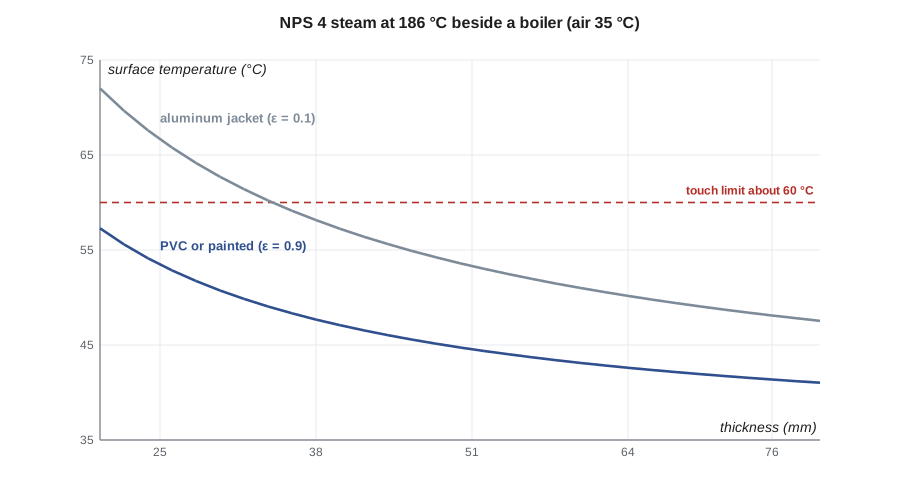
For the NPS 4 line in the table, 38 mm with an aluminum jacket just meets the limit, with less than 2 K to spare; 51 mm gives a comfortable margin. Kellerton's plant standard for steam lines of NPS 2 to 6, from INS-210, is 64 mm (2 ½ in) with aluminum jacket, chosen for energy, and it gives about 50 °C, so the plant standard also protects people. That is typical: on steam lines the economic thickness is usually more than enough for personnel protection, and personnel protection governs only on small hot lines where energy is not the reason for insulating, or where an owner wants to use the minimum.
Personnel protection insulation is sometimes specified on lines that do not need insulating for energy at all, such as a hot drain, a blowdown line or the exhaust of a small engine, where the heat loss does not matter but the burn does. In those cases the calculation above is the only one that counts, and the thinnest system that meets the limit is the right one.
Very hot surfaces and layer temperatures
On very hot equipment, insulation is often installed in two or more layers of different materials: a high-temperature material against the hot surface and a cheaper or lighter material outside. Two temperatures must then be checked: the outer surface temperature, and the interface temperature between the layers, which must be below the maximum use temperature of the outer material. On a flat surface the heat flow per area is:
and the temperature at each interface is found by subtracting the drop across each layer, q × L ÷ k, from the hot temperature in turn.
Worked problem
The cogeneration exhaust duct
In INS-120, Walt Lowery and Devon measured Kellerton's cogeneration exhaust duct, which runs at 540 °C. The quote was 50 mm of high-temperature mineral wool against the duct, with typical k = 0.085 W/m·K at its mean temperature, and 50 mm of an outer board, with typical k = 0.055 W/m·K at its mean. Find the heat flow, the interface temperature and the surface temperature in still air at 30 °C, for an aluminum jacket and for a painted jacket. Use a vertical wall about 1.5 m high.
Show solution
- Layer resistances per m²: 0.050 ÷ 0.085 = 0.588 and 0.050 ÷ 0.055 = 0.909 m²·K/W.
- Aluminum jacket (iterated): h = 4.52 W/m²·K, 1/h = 0.221; total R = 0.588 + 0.909 + 0.221 = 1.718; q = 510 ÷ 1.718 = 297 W/m².
- Interface: 540 − 297 × 0.588 = 365 °C. Surface: 30 + 297 × 0.221 = 96 °C.
- Painted jacket (iterated): h = 9.74, 1/h = 0.103; q = 510 ÷ (0.588 + 0.909 + 0.103) = 319 W/m²; interface 540 − 319 × 0.588 = 353 °C; surface 30 + 319 × 0.103 = 63 °C.
Answer: The outer board sees about 365 °C at its hot face, so it must be rated for at least that with margin; Walt's quote specified an outer board rated to 454 °C (850 °F), and the data sheet must confirm it. With aluminum, the jacket would run at about 96 °C, far above the touch limit; painted, about 63 °C, still slightly above it.
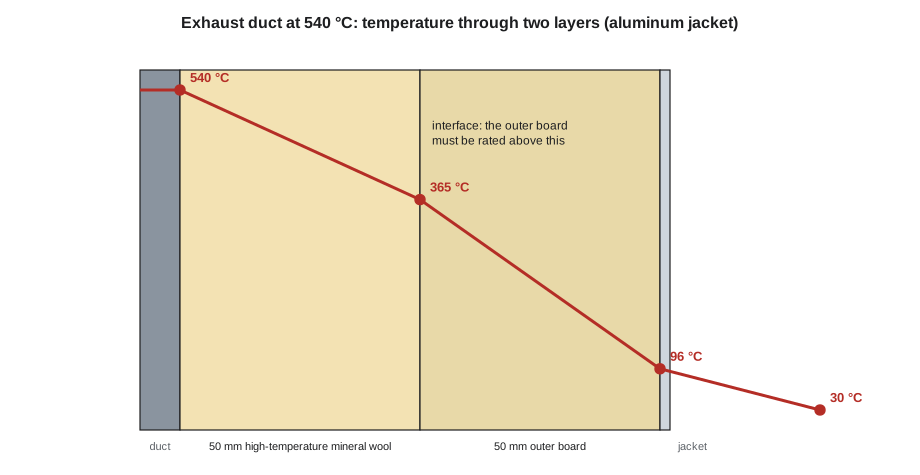
The duct runs about 20 m (65 ft) up the side of the boiler house, most of it well above the reach zone, so energy governs there. Where it passes the access platform, the drawing calls for an expanded metal guard standing off the jacket, which is the usual answer for very hot surfaces in reach.
Alternatives to insulation
Insulation is not the only way to protect people, and on some surfaces it is the wrong way:
- Guards and cages. Expanded metal or perforated sheet standing 50 to 100 mm (2 to 4 in) off the hot surface, so that air circulates and a hand cannot reach it. Used on exhausts, mufflers, steam traps that must stay bare and surfaces that must be inspected.
- Barriers and signs. Railings and "hot surface" warning signs where a surface is out of normal reach but could be touched.
- Removable covers, as INS-340 described, for valves and flanges that need access.
Insulation may be wrong on surfaces that must lose heat to work, such as some steam traps, condensate cooling legs and heat exchangers meant to reject heat, as INS-210 explained. A guard protects people without stopping the heat loss the equipment needs.
Fittings, covers and odd shapes
Pipe calculations cover straight runs, but burns often happen at valves, flanges and equipment, where insulation is thinner, removed for maintenance or never installed. A removable cover from INS-340, with 25 to 50 mm (1 to 2 in) of mat and a fabric outer jacket, usually gives a surface temperature similar to the adjacent pipe insulation, because fabric has a high emittance and a low conductivity. Two places need extra attention: the gap where a cover meets the pipe insulation, which can open if the cover is not refitted properly, and the exposed stem and bonnet of a valve, which stay at nearly the line temperature. Plants handle those with guards, signs and training rather than insulation.
Equipment surfaces such as vessel heads and exchanger channels are handled with the flat-wall method of this lesson, using the height of the surface in the convection formula. Their large, flat areas of aluminum or stainless jacket often run hotter than pipe insulation of the same thickness, so they deserve a check where people work beside them.
Checking a complaint in the field
Sometimes the question comes the other way round: an operator reports that a jacket is "too hot to touch". The first step is to measure it, with a contact thermometer or a tape patch and an infrared camera as lesson 11 describes, rather than to argue about it. Then compare the reading with a calculation for the installed thickness at the conditions on the day. A reading close to the calculation means the system is working as designed and the design needs more thickness or a guard; a reading well above it means something is wrong: thinner insulation than specified, a gap, wet insulation or a missing layer. On the Kellerton header in lesson 11, a jacket nearly 40 K hotter than its dry calculation was the clue that led Thea to a roof drain leak.
Whatever the cause, a surface found above the plant's limit in a reach zone should be reported and guarded at once, before the fix is planned.
Personnel protection also matters during work. A crew removing old insulation from a live line, as on the PRV station in INS-210, is exposed to the full line temperature, so the plant's rules for working near hot surfaces, heat-resistant gloves, long sleeves and planned reach, apply until the new insulation is on.
Common mistakes
MistakeCalculating personnel protection at average conditions.
InsteadUse the highest operating temperature and the highest ambient, because the injury happens on the worst day.
MistakeAssuming the jacket makes no difference to surface temperature.
InsteadCalculate with the jacket's emittance; aluminum runs much hotter than PVC or paint.
MistakeChecking only the outer surface on multi-layer systems.
InsteadCheck the interface temperature against the outer material's maximum use temperature.
MistakeInsulating a steam trap or cooling leg for personnel protection.
InsteadUse a guard where the equipment must lose heat.
MistakeApplying the metal touch limit to every surface without checking the specification.
InsteadFollow the specification's limit and surface type; ASTM C1055 relates the limit to the surface material and contact time.
Summary and key terms
- ASTM C1055 relates surface temperature, contact time and surface material to burns; specifications usually set about 60 °C (140 °F) for touchable metal.
- A low-emittance aluminum jacket runs much hotter than a painted or PVC jacket on the same insulation.
- Choose the first standard thickness that stays below the limit with margin at the worst conditions.
- On multi-layer systems, the interface temperature must not exceed the outer layer's maximum use temperature.
- Guards, barriers and removable covers protect people where insulation is not practical or not wanted.
- Personnel protection
- Insulation or guarding that keeps touchable surfaces below a temperature that burns skin.
- Contact burn
- A burn caused by touching a hot surface.
- Reach zone
- The area around floors, platforms and walkways where a surface can be touched in normal work.
- Interface temperature
- The temperature at the boundary between two layers of insulation.
- Maximum use temperature
- The highest temperature at which an insulation material may be used, from its standard and data sheet.
- Guard
- An expanded metal or perforated cover standing off a hot surface so it cannot be touched.
Practice problems
Work each problem on paper first, then reveal the answer to check.
What contact time is the usual 60 °C (140 °F) metal limit based on?
Show answer
About 5 seconds.
Why does an aluminum jacket run hotter than a PVC jacket?
Show answer
Its low emittance gives off radiant heat less readily, so it must run hotter to shed the same heat.
At what conditions should a personnel protection calculation be done?
Show answer
The highest pipe temperature and the highest ambient temperature.
On the duct example, what was the interface temperature with an aluminum jacket?
Show answer
About 365 °C.
Name a surface that should be guarded rather than insulated.
Show answer
A steam trap that must stay bare, a condensate cooling leg or an engine exhaust.
Lesson quiz · 5 questions
Score 60% or more to complete this lesson.
Create a free account to save your progress, take quizzes and earn a certificate.