
INS-330 · Lesson 8 of 12 · 25 min
Grease duct and fire-rated duct wraps
▶ Video coming soon A video version of this lesson is on the way.
Kellerton Foods renovated the staff cafeteria in its office block in the fall of 2026, with a new cooking line, a new exhaust hood and a new grease duct that runs from the hood up through a storage room on the second floor and out through the roof. The kitchen ventilation contractor welded and tested the duct in the first week of November. Rhoda and Nico wrapped it from Monday, November 9, to Wednesday, November 11, working from a rolling scaffold in the kitchen and the storage room while the plant's maintenance manager, Lou Brisebois, kept the cafeteria staff out of their way.
Grease ducts are one of the most dangerous parts of any building, and fire-rated duct wraps are a firestopping specialty that insulators are well suited to, because the work is much like insulating a duct, done to a far stricter listing. This lesson covers why grease ducts need protection, what the codes require, how field-applied grease duct enclosures are installed, and the related wraps used on other ducts.
Why grease ducts are dangerous
Commercial cooking produces grease-laden vapour, which the hood draws into the exhaust duct. Some of the grease condenses on the inside walls of the duct, and over time a layer builds up, however well the duct is cleaned. If a fire on the cooking line is drawn into the hood, or a hot spot ignites the deposit, the grease inside the duct can catch fire. A grease duct fire burns fiercely along the length of the duct, with temperatures inside that can pass 1,000 °C (1,800 °F), and it can heat the duct walls enough to ignite anything combustible near them, in rooms and concealed spaces far from the kitchen.
For that reason, the codes treat a grease duct as a fire hazard that must be kept away from combustibles and, wherever it passes through a building, enclosed so that a fire inside it cannot spread out.
- The duct itself must be built of heavy steel, with continuous liquid-tight welded joints, sloped to drain grease back toward the hood, and fitted with cleanout openings. Before it is enclosed, it is tested for leaks, usually by passing a bright light through it and looking for light escaping at the seams. This is the ventilation contractor's work.
- Clearance. An unprotected grease duct must be kept a set distance from combustible construction, typically 457 mm (18 in), with smaller distances to limited-combustible and none to noncombustible construction.
- Enclosure. Where a grease duct passes through a floor, a ceiling, a wall or a concealed space, it must be enclosed, either in a rated shaft built around it, or by a listed field-applied enclosure (a duct wrap) or a listed factory-built duct assembly that gives the same protection.
What the codes require
In Canada, the building codes require commercial cooking ventilation to be installed to NFPA 96, the standard for ventilation control and fire protection of commercial cooking operations. NFPA 96 allows a field-applied or factory-built grease duct enclosure in place of a rated shaft, provided firestopping is installed where the system passes through rated assemblies. The Canadian codes recognize such enclosures when their fire-resistance has been tested to CAN/ULC-S144, and products used to reduce the clearance to combustibles are evaluated to the US standard ASTM E2336. Many wraps sold in Canada are tested to both.
The rating needed depends on the building. NFPA 96 calls for an enclosure rated 1 hour in buildings of fewer than four storeys and 2 hours in buildings of four storeys or more. The Kellerton office block has two storeys, so the cafeteria duct needed a 1-hour enclosure; the same duct in the four-storey Mountview addition would have needed 2 hours.
Several points about these listings catch installers out:
- One layer is not one hour. The number of layers, the thickness and the density of the wrap are set by the listing for each rating. Many systems need two layers for any rating.
- Partial wrapping does not reduce clearance. A wrap reduces the clearance to combustibles only where the listing says, usually only for the full enclosure. Wrapping a short section near a joist does not make the duct safe beside it.
- Each duct has its own enclosure. One wrap cannot enclose two grease ducts together, and a grease duct enclosure serves only one exhaust system.
- The wrap is part of a system. The duct gauge and size range, hanger type and spacing, access doors and firestops at penetrations are all in the listing.
Materials
Grease duct wraps are flexible blankets of high-temperature inorganic fibre, typically rated for continuous exposure to about 1,260 °C (2,300 °F), fully encapsulated in a foil or foil-scrim facing so that fibres do not shed and grease cannot soak in. Many modern wraps use alkaline earth silicate (AES) fibre, which the body clears more easily than the older refractory ceramic fibre; INS-230 described why Coldstream prefers AES products where there is a choice. The wrap is noncombustible and has low flame spread and smoke development. It is supplied in rolls of set widths, such as 610 mm (24 in), and set thicknesses, such as 38 mm (1½ in).
The other materials are as important as the blanket: steel bands and seals, or welding pins and speed clips, to hold it; foil tape for cut edges; the listed firestop sealant or system for penetrations; and the access door kit the listing names.
Installing a field-applied grease duct enclosure
Rhoda's crew follows the listing step by step. A typical two-layer system goes like this:
- Confirm the duct is ready. The leak test has been done and accepted, the duct is supported, cleanouts are in place, and nothing combustible is closer than the listing allows during installation.
- Plan the layers. Seams in the second layer must be offset from those in the first; each layer's longitudinal and circumferential joints are either overlapped by a set amount, such as 76 mm (3 in), or tightly butted with a collar strip over the joint, as the listing says.
- Wrap the first layer. Cut the blanket to the duct's perimeter plus the overlap, wrap it tightly, and hold it with filament tape while banding.
- Fasten it. Steel bands at the listed spacing, and within a set distance of each joint, tightened so they hold without crushing the blanket. On large ducts, the bottom and sides also get welded pins and speed clips at a set spacing, because bands alone let the blanket sag.
- Wrap the second layer the same way with joints offset, and band it.
- Cover cut edges and exposed fibre with foil tape.
- Treat access doors and supports exactly as the listing shows: access doors usually get a removable section of wrap held with its own bands or a listed cover, so that the cleanout can be opened without destroying the enclosure; hangers are wrapped or left outside the wrap as detailed.
- Firestop the penetrations. Where the wrapped duct passes through a rated floor or wall, use the listed through-penetration system for a wrapped grease duct, usually a 7000-series system.
- Label and record as for any firestop.
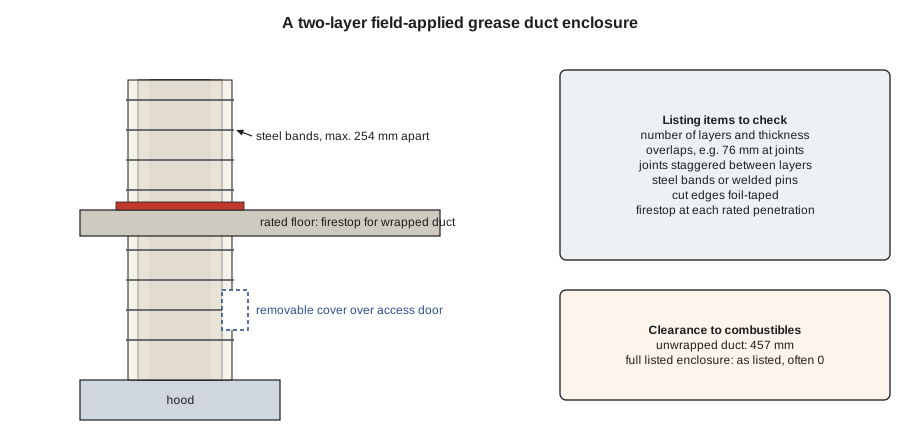
Bands must be steel. Aluminum bands, which look the same and are common on ordinary insulation work, soften and fail at temperatures a grease duct fire easily reaches, and the listing will not allow them. Self-adhesive pins, which stick to the duct with an adhesive pad, also fail in heat and are not used on grease ducts.
Worked problem
How much wrap for the Kellerton grease duct?
The Kellerton cafeteria grease duct is 450 × 300 mm and 14 m long from the hood to the roof curb. The listing calls for two layers of 38 mm wrap, each overlapped 75 mm at the longitudinal seam. Allow the perimeter of each layer at its mid-thickness: the duct perimeter plus 4 × the thickness for the first layer, and plus 12 × the thickness for the second. The wrap comes in rolls 610 mm wide and 7.62 m long. Allowing 10 in 100 for circumferential overlaps and waste, how many rolls are needed?
Show solution
- Duct perimeter = 2 × (0.45 + 0.30) = 1.50 m.
- First layer cut width = 1.50 + 4 × 0.038 + 0.075 = 1.727 m.
- Second layer cut width = 1.50 + 12 × 0.038 + 0.075 = 2.031 m.
- Area = (1.727 + 2.031) × 14 = 3.758 × 14 = 52.6 m².
- With 10 in 100: 52.6 × 1.10 = 57.9 m².
- One roll = 0.61 × 7.62 = 4.65 m², so 57.9 ÷ 4.65 = 12.45, so 13 rolls.
Answer: 13 rolls. Rhoda ordered 14, because one roll would be cut into short pieces for the access door covers and the firestop at the floor.
Worked problem
How many bands?
The listing calls for steel bands at no more than 254 mm centres along the duct on each layer. The bands go around each layer at its outside perimeter (the duct perimeter plus 8 × the thickness for the first layer and plus 16 × for the second), with 150 mm added to each band for the seal. How many bands and how many metres of banding are needed for the 14 m duct, and how many 30.5 m rolls?
Show solution
- Spaces along the duct = 14,000 ÷ 254 = 55.1, so 56 spaces and 57 bands per layer.
- First layer band = 1.50 + 8 × 0.038 + 0.15 = 1.954 m; second layer band = 1.50 + 16 × 0.038 + 0.15 = 2.258 m.
- Banding = 57 × (1.954 + 2.258) = 57 × 4.212 = 240.1 m.
- Rolls = 240.1 ÷ 30.5 = 7.87, so 8 rolls.
Answer: 114 bands from 8 rolls of steel banding, plus extra bands for the access door covers.
Access doors and inspection
Grease ducts must be cleaned regularly, and the cleaning crews need the access doors. A wrap that buries a cleanout, or a cover that must be torn off to reach it, will be torn off and never put back. The listing's access door detail is therefore as important as the wrap. At Kellerton, the duct had three access doors, one at each change of direction, and Rhoda's crew made a removable two-layer cover for each, held with its own bands and labelled "Grease duct access: replace cover after cleaning".
Before the ceiling and the storage room wall were closed, the building official inspected the wrapped duct against the listing. The inspector checked the layers and overlaps, the band spacing, the clearance where the duct passed near the storage room's wood shelving, and the firestop at the second floor, and asked for one extra band near the roof curb, where the spacing had stretched to 280 mm (11 in).
Clearance to combustibles
Where an unwrapped grease duct would be too close to combustible material, a listed wrap can reduce the clearance, often to zero, but only where the listing for the full enclosure says so. Rhoda checks clearances before wrapping as well as after, because some listings require a small clearance even when wrapped, and because the wrap does nothing for parts of the duct it does not cover.
Worked problem
Does the duct need more clearance?
Where it passes through the storage room, the unwrapped Kellerton duct would be 300 mm from wood shelving. The clearance to combustibles for an unprotected grease duct is 457 mm. The listing for the full enclosure allows zero clearance to combustibles. Is the shelving acceptable before and after wrapping?
Show solution
- Before wrapping: 300 mm is less than 457 mm, so the shelving is too close by 457 − 300 = 157 mm.
- After the full listed enclosure is installed: the listing allows zero clearance, so the shelving is acceptable, as long as the wrap is complete along that whole section.
Answer: Not acceptable before, acceptable after, which is why the cafeteria could not use the storage room until the wrap was finished and inspected.
Fire-rated wraps on other ducts
Similar wraps are used on some ventilation and exhaust ducts, for example to protect a duct that passes through a fire compartment without a shaft, or a stair pressurization duct that must keep working in a fire. In the US these HVAC duct enclosures are tested to ASTM E2816 and are accepted in place of shafts under specific conditions. In Canada, the codes generally call for ducts to be enclosed in rated shafts or protected by dampers, so a wrap used in place of a shaft is usually accepted only where the code specifically allows it or as an alternative solution approved by the building official.
These wraps are not interchangeable with grease duct wraps, even from the same maker, and a wrap listed only for ventilation ducts must never be used on a grease duct.
Safety on wrap jobs
Wrap blankets are encapsulated, but cutting them exposes fibre. Rhoda's crew cuts wrap on a table at one end of the work area, with a HEPA vacuum at the cut, and wears long sleeves, gloves and eye protection; respirators are used as the product's safety data sheet and Coldstream's exposure assessment call for. Work in a kitchen also means grease-coated floors and surfaces, hot equipment if the kitchen is still running, and, at Kellerton, food hygiene rules: tools and materials stayed out of food areas, and the kitchen was cleaned before cooking resumed.
Common mistakes
MistakeAssuming one layer of wrap gives a one-hour rating.
InsteadInstall the number of layers, thickness and density the listing gives for the rating.
MistakeUsing aluminum bands or self-adhesive pins.
InsteadUse steel bands and welded pins as the listing requires.
MistakeBurying an access door under the wrap.
InsteadBuild the listed removable cover so that the cleanout can be used and the cover replaced.
MistakeWrapping a short section to clear a combustible.
InsteadClearance reduction applies only with the full listed enclosure.
MistakeUsing an HVAC duct wrap on a grease duct.
InsteadUse only a wrap listed for grease ducts, tested to the grease duct standard.
Summary and key terms
- Grease deposits in kitchen exhaust ducts can burn fiercely, so grease ducts must be welded, tested, kept clear of combustibles and enclosed where they pass through a building.
- Canadian codes require NFPA 96; field-applied enclosures in place of shafts are recognized when tested to CAN/ULC-S144, with ASTM E2336 for clearance reduction.
- Enclosures are rated 1 hour in buildings under four storeys and 2 hours in taller ones; firestops at penetrations must be rated for the wrapped duct.
- Wraps are encapsulated high-temperature fibre blankets, often AES, installed in listed layers with staggered, overlapped joints and steel bands or welded pins.
- Access doors need listed removable covers; clearance to combustibles is reduced only by the complete listed enclosure.
- HVAC duct wraps are a different product and test, and must never be used on grease ducts.
- Grease duct
- An exhaust duct that carries grease-laden vapour from a commercial cooking hood.
- Field-applied grease duct enclosure
- A listed wrap system installed on site around a grease duct in place of a rated shaft.
- Clearance to combustibles
- The minimum distance between a hot duct or appliance and combustible construction.
- Light test
- A leak test of a welded grease duct, made by passing a bright light through it and looking for leaks at seams.
- Access door
- A cleanout opening in a grease duct, which must stay usable after the duct is wrapped.
- AES fibre
- Alkaline earth silicate fibre, a high-temperature fibre used in many wraps and blankets.
- Speed clip
- A spring washer pushed over a welded pin to hold insulation or wrap in place.
Practice problems
Work each problem on paper first, then reveal the answer to check.
A grease duct runs through a five-storey building. What enclosure rating is needed under NFPA 96?
Show answer
2 hours.
Why must bands on a grease duct wrap be steel?
Show answer
Aluminum softens and fails at grease fire temperatures.
A duct perimeter is 1.2 m and the wrap is 38 mm. What is the cut width of the first layer with a 75 mm overlap?
Show answer
1.2 + 4 × 0.038 + 0.075 = 1.427 m.
Bands are required at 254 mm centres on a 6 m duct. How many bands per layer?
Show answer
6,000 ÷ 254 = 23.6, so 24 spaces and 25 bands.
What must be done before a grease duct is wrapped?
Show answer
The duct must be leak-tested and accepted, supported, and fitted with its cleanouts.
Lesson quiz · 5 questions
Score 60% or more to complete this lesson.
Create a free account to save your progress, take quizzes and earn a certificate.