
INS-120 · Lesson 8 of 12 · 24 min
High-temperature and refractory products
▶ Video coming soon A video version of this lesson is on the way.
Kellerton's small cogeneration unit, a gas turbine that makes electricity and sends its hot exhaust through a heat-recovery boiler, sits in a steel enclosure behind the boiler house. In late October, Walt took Devon and Tessa along when he went to measure the exhaust duct for a quote. Through a viewing port, the turbine's exhaust casing glowed a dull red in the dark enclosure. "About 540 °C (1,000 °F) in the duct," Walt said. "Most of what you've learned so far melts, burns or falls apart at that temperature. This is where the products get special."
High-temperature insulation covers surfaces from a few hundred degrees up to more than a thousand: turbine exhausts, boiler breeching and stacks, furnaces, kilns, incinerators, hot oil and process heaters, and the equipment of steel mills and refineries. This lesson describes the products used at these temperatures, the hazards some of them bring and the way high-temperature systems are built in layers. It also explains where insulation work ends and refractory work begins.
What counts as high temperature
There is no single definition, but for insulators it is useful to think in three bands. Below about 450 °C (850 °F), glass fibre, mineral wool, calcium silicate, perlite and cellular glass all have products that work. From about 450 °C to 650 °C (850 °F to 1,200 °F), glass fibre is out and the choice narrows to mineral wool, calcium silicate, perlite and some specialty products. Above about 650 °C (1,200 °F), the choices are high-temperature mineral wool, calcium silicate Type II, refractory and other high-temperature fibres, microporous insulation and refractories.
| Product | Standard | Typical maximum use temperature |
|---|---|---|
| Mineral wool pipe insulation, C547 Type V | ASTM C547 | 760 °C (1,400 °F) |
| Mineral wool board, highest C612 type | ASTM C612 | about 982 °C (1,800 °F) |
| Calcium silicate block, Type II | ASTM C533 | 927 °C (1,700 °F) |
| Microporous insulation | ASTM C1676 | about 1,000 °C (1,832 °F) for common grades |
| Flexible aerogel blanket, high-temperature grades | ASTM C1728 | 650 °C (1,200 °F) |
| Alkaline earth silicate (low biopersistence) fibre blanket | ASTM C892 for blankets | about 1,100 °C to 1,300 °C (2,000 °F to 2,400 °F) depending on grade |
| Refractory ceramic fibre blanket, common grade | ASTM C892 for blankets | about 1,260 °C (2,300 °F), with higher grades available |
High-temperature mineral wool and calcium silicate
For most high-temperature work up to about 650 °C to 760 °C (1,200 °F to 1,400 °F), insulators still use the familiar materials in their high-temperature forms: mineral wool pipe insulation, board and metal-mesh-covered blanket, and calcium silicate block. They are noncombustible, well understood and relatively economical. Calcium silicate Type II block reaches 927 °C (1,700 °F) and is used where a rigid, strong surface is needed at those temperatures.
Two things change near the top of their range. First, the organic binder in mineral wool burns out completely on the hot side, so the inner layer becomes soft and loses strength; it still insulates, but it can be damaged by vibration or by being disturbed. Second, these products shrink slightly at their maximum temperature. A small shrinkage in each piece adds up to open joints over a long run. Both effects are reasons to build high-temperature insulation in more than one layer, with staggered joints.
Refractory ceramic fibre and its alternatives
Refractory ceramic fibre, often called RCF or ceramic fibre, is made by melting alumina and silica and blowing or spinning the melt into fibres. It is sold as blanket, board, paper, rope, textiles and modules for furnace linings, and it handles temperatures well above any mineral wool. Insulators use it for furnace and heater work, high-temperature expansion joints, removable covers, and packing around hot penetrations.
RCF brings a health concern that mineral wool and glass fibre do not. It is more biopersistent, meaning it stays in the lungs longer, and the International Agency for Research on Cancer classifies it as possibly carcinogenic to humans (Group 2B). In addition, when RCF has been in service above roughly 900 °C to 1,000 °C (1,650 °F to 1,830 °F), part of it can change into cristobalite, a form of crystalline silica. Removing old furnace linings or blankets that have been at those temperatures therefore means dealing with crystalline silica as well as fibres.
Manufacturers and their industry groups run product stewardship programs for RCF, with recommended exposure limits, work practices and training. The controls follow the hierarchy from INS-110: use a lower-hazard product where possible; cut with knives and hand tools rather than power saws; keep material in its packaging until needed; use local exhaust and HEPA vacuums; avoid compressed air and dry sweeping; and wear a respirator suited to the exposure, coveralls and gloves. Employers must follow their own jurisdiction's exposure limits and assessment rules, and the job's hazard assessment sets the respirator.
Because of these concerns, many owners now specify alkaline earth silicate (AES) fibres, also called low biopersistence or body-soluble fibres, for temperatures they can handle. AES fibres are made with calcium and magnesium silicates that dissolve much faster in the lungs. They are used in the same forms as RCF, up to about 1,100 °C to 1,300 °C (2,000 °F to 2,400 °F) depending on the grade, although they are less resistant to some chemical attack and moisture. Insulators should still control dust from AES products, as from any fibre.
Microporous and aerogel insulations
Microporous insulation is made from very fine particles of silica with opacifiers that block infrared radiation and reinforcing fibres, pressed into boards and panels. Its pores are so small that air molecules hardly move within them, and the opacifier stops most radiation, so its k at high temperature is far lower than that of other products, often less than half that of mineral wool at the same mean temperature. It is used where space is tight, such as in thin linings, turbine enclosures and specialty equipment. It is expensive, fragile and must be kept dry, and its panels usually come in sealed envelopes that must not be cut on site unless the manufacturer allows it.
Flexible aerogel blankets, covered by ASTM C1728, contain silica aerogel, a material with extremely small pores, held in a fibre mat. They have very low k and are thin and flexible. Different grades cover cryogenic, dual-temperature and high-temperature service up to about 650 °C (1,200 °F). They are used where thickness is limited, such as on congested pipe racks and in retrofits. Cutting them releases fine dust, so manufacturers specify dust controls and respiratory protection.
Building high-temperature insulation in layers
Above about 315 °C (600 °F), and often at lower temperatures for large thicknesses, specifications usually require two or more layers with all joints staggered. Staggering means the longitudinal and circumferential joints of each layer are offset from those of the layer below, so no joint runs straight from the hot surface to the outside.
- Staggered joints block the straight paths that radiation and convection would follow through an open joint.
- Shrinkage of the inner layer opens gaps that the outer layer covers.
- Each layer can be a different material: a higher-rated product next to the hot surface and a less expensive or stronger one outside, as long as the temperature at the interface between them stays below the outer layer's limit.
- Thinner layers are easier to fit tightly to curves and around irregular shapes.
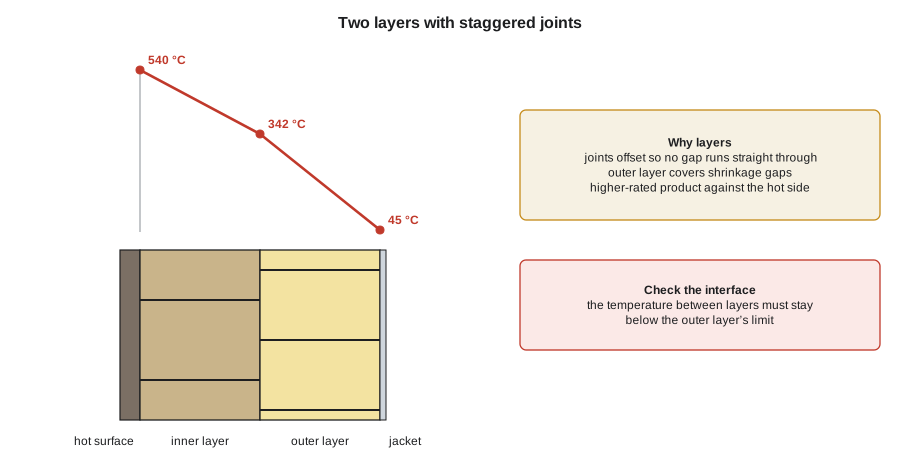
Because the heat flow is the same through each layer, the temperature drop across each layer is in proportion to its resistance. The designer uses this to check the interface temperature, which must be below the outer layer's maximum use temperature.
Worked problem
Interface temperature in a two-layer system
Walt's quote for the Kellerton exhaust duct uses an inner layer of 50 mm high-temperature mineral wool board and an outer layer of 50 mm glass fibre board rated to 454 °C. The duct runs at 540 °C and the outer face is about 45 °C. At their mean temperatures, the inner layer's k is about 0.075 W/(m·K) and the outer layer's about 0.050 W/(m·K). What is the temperature between the layers, and is the glass fibre within its limit?
Show solution
- Resistance of the inner layer: 0.050 ÷ 0.075 ≈ 0.667 m²·K/W.
- Resistance of the outer layer: 0.050 ÷ 0.050 = 1.000 m²·K/W.
- Heat flow: q = (540 − 45) ÷ (0.667 + 1.000) = 495 ÷ 1.667 ≈ 297 W/m².
- Drop across the inner layer: 297 × 0.667 ≈ 198 °C.
- Interface temperature: 540 − 198 = 342 °C.
- Check: 342 °C is below the glass fibre limit of 454 °C, with a margin of about 112 °C.
Answer: About 342 °C, safely below 454 °C. If the order were reversed, the glass fibre would sit against the 540 °C duct and fail.
This is why the order of layers on a high-temperature drawing matters, and why an insulator must never swap them to make the work easier. Bernie keeps a story about a crew that installed a two-layer system on a hot oil heater inside out, with the cheaper outer product against the hot casing. Within a month the inner layer had slumped to the bottom of the casing and the jacket was too hot to touch.
Expansion and support at high temperature
Hot equipment grows. Steel expands by about 12 millionths of its length for every degree Celsius (6.5 millionths of its length for every degree Fahrenheit) of temperature rise, so long hot ducts and pipes move a surprising amount between cold and operating temperature. The insulation and jacket must allow for that movement, with expansion joints in the insulation and slip joints in the jacket, and supports that let the surface slide under the insulation.
Worked problem
Growth of a hot duct
The Kellerton exhaust duct is 20 m long and heats from 20 °C to 540 °C. How much does it grow?
Show solution
- Temperature rise: 540 − 20 = 520 °C.
- Growth = 20 m × 0.000012 × 520 ≈ 0.125 m.
Answer: About 125 mm. Insulation fixed rigidly along the whole length would tear apart; the system needs expansion joints packed with compressible high-temperature blanket.
On hot equipment, insulation is usually held by welded pins or studs with speed washers, and by support rings or angles at intervals that carry the weight of the insulation and jacket. INS-310 covers equipment insulation. On high-temperature work, all fasteners, bands and wire must be rated for the temperature: galvanized steel and aluminum are fine on the cool outer surface but stainless steel is used where fasteners pass close to the hot surface.
Refractories and the insulator's role
Refractories are materials made to withstand very high temperatures, often above 1,000 °C (1,830 °F), and the direct attack of flames, hot gases and molten materials. They line furnaces, kilns, boilers, incinerators and ladles. Refractory materials include dense firebrick, insulating firebrick, castables (concrete-like mixes poured or gunned into place), plastic refractories rammed into place, and ceramic fibre modules.
In most plants, dense refractory linings are installed by specialist refractory contractors and by bricklayers or masons with refractory experience. Insulators often work on the same equipment: they install the backup insulation between the refractory and the steel shell, high-temperature blankets and boards, fibre modules on some furnaces, insulation on the outside of the casing and the jacketing. Where the trade boundary sits depends on the jurisdiction, the collective agreement and the job. The important skills for an insulator are to recognize refractory products, to understand that a refractory lining is part of the pressure and temperature boundary of the equipment, and never to cut into or remove a lining without the owner's instruction and the right controls.
| Product | What it is | Who usually installs it |
|---|---|---|
| Dense firebrick | Fired clay or alumina brick for the hot face of furnaces | Refractory contractors, bricklayers |
| Insulating firebrick | Lightweight porous brick used as backup or a lighter hot face | Refractory contractors, bricklayers |
| Castable refractory | Refractory concrete poured, pumped or sprayed into forms | Refractory contractors |
| Ceramic or AES fibre modules | Folded blanket blocks anchored to the furnace shell | Refractory contractors; sometimes insulators |
| Backup board and blanket | Insulation behind the hot-face lining | Insulators or refractory contractors |
| External casing insulation and jacket | Insulation outside the steel shell | Insulators |
Safety on high-temperature work
- Hot work permits and lockout apply as on any plant job, and equipment must be cooled to a safe working temperature before insulators work on it, unless a hot-work procedure says otherwise.
- Heat stress is a serious hazard in enclosures around hot equipment. Plan breaks, water and cool-down areas, as INS-110 described.
- Fibres from high-temperature products, especially RCF and after-service material, need the controls described above.
- Insulation that has been in high-temperature service may also hold residues from the process, such as oil, soot or chemicals, which add hazards when it is removed.
- Old high-temperature insulations, cements and gaskets in older plants may contain asbestos. Treat them as suspect.
Common mistakes
MistakeSwapping the order of layers in a two-layer system.
InsteadInstall the higher-rated product against the hot surface, exactly as the specification shows.
MistakeLining up the joints of both layers.
InsteadStagger longitudinal and circumferential joints so no joint runs straight through.
MistakeTreating RCF like glass fibre.
InsteadUse the stronger controls RCF needs: low-dust methods, HEPA cleanup and the respirator the assessment requires.
MistakeRemoving old furnace fibre without considering cristobalite.
InsteadAssume after-service RCF contains crystalline silica and plan controls for it.
MistakeFixing insulation rigidly on a long hot duct.
InsteadProvide expansion joints and slip joints for thermal growth.
MistakeUsing galvanized fasteners close to a very hot surface.
InsteadUse fasteners rated for the temperature, usually stainless steel near the hot side.
Summary and key terms
- Above about 450 °C (850 °F), glass fibre is no longer used; above about 650 °C (1,200 °F), the choice narrows to high-temperature mineral wool, calcium silicate Type II, high-temperature fibres, microporous products and refractories.
- Refractory ceramic fibre handles very high temperatures but is classed as possibly carcinogenic and can form cristobalite after service above about 900 °C (1,650 °F).
- Alkaline earth silicate fibres are lower-hazard alternatives for many uses.
- Microporous and aerogel products have very low k and are used where space is tight.
- High-temperature systems are built in staggered layers, and the interface temperature must stay below the outer layer's limit.
- Hot equipment expands, so insulation and jackets need expansion and slip joints.
- Refractory linings are usually installed by refractory specialists; insulators install backup and external insulation and must not disturb linings without instruction.
- Refractory
- A material made to withstand very high temperatures and direct flame or hot gas, used to line furnaces and kilns.
- Refractory ceramic fibre
- A high-temperature alumina-silica fibre used in blankets, boards and modules; RCF.
- Biopersistence
- How long a fibre stays in the lungs before it dissolves or is cleared.
- Alkaline earth silicate fibre
- A high-temperature fibre made with calcium and magnesium silicates that dissolves faster in the lungs; AES.
- Cristobalite
- A form of crystalline silica that can form in ceramic fibre after long use at very high temperature.
- Microporous insulation
- Insulation of very fine silica particles and opacifiers with extremely low k at high temperature.
- Staggered joints
- Joints in one layer offset from the joints in the layer below.
- Interface temperature
- The temperature at the boundary between two insulation layers.
Practice problems
Work each problem on paper first, then reveal the answer to check.
What is a common maximum use temperature for standard RCF blanket?
Show answer
About 1,260 °C.
Why are high-temperature systems often installed in two layers?
Show answer
Staggered joints block heat paths, cover shrinkage gaps and allow a higher-rated inner layer.
Inner layer R = 0.5 m²·K/W, outer layer R = 1.0 m²·K/W, hot face 600 °C, outer face 50 °C. What is the interface temperature?
Show answer
q = 550 ÷ 1.5 ≈ 367 W/m²; interface = 600 − 367 × 0.5 ≈ 417 °C.
How much does a 10 m steel duct grow from 20 °C to 420 °C?
Show answer
10 × 0.000012 × 400 = 0.048 m, or 48 mm.
What can form in RCF after long service at very high temperature?
Show answer
Cristobalite, a form of crystalline silica.
Lesson quiz · 5 questions
Score 60% or more to complete this lesson.
Create a free account to save your progress, take quizzes and earn a certificate.