
INS-120 · Lesson 1 of 12 · 25 min
Why we insulate: energy, process control and safety
▶ Video coming soon A video version of this lesson is on the way.
On the Monday after the Kellerton outage, Bernie Valois handed Devon Marsh a sheet of paper with a single question written across the top: "Why did we put 76 mm of mineral wool on that header?" Devon had spent a week stripping, measuring and reinsulating the steam header, and he thought the answer was obvious. "Because the spec said so." Bernie nodded. "That's the right answer for an apprentice on his first plant job. By the end of this course I want the real answer."
Coldstream runs a Friday afternoon material school in the Stoney Creek shop for its first-year apprentices, taught by Tomasz Nowicki and whichever journeyperson is in the shop that day. Devon had been attending since September, but the outage had made the lessons real. This course follows those Friday sessions and the jobs around them. It starts with the reason the trade exists: insulation is installed to control the flow of heat, and controlling heat flow does several different jobs at once.
Insulators often hear their work described as energy conservation, and that is one important reason. It is not the only one, and on many jobs it is not even the main one. A specification writer chooses the material, thickness and jacket by deciding which job the insulation must do on each system. When you understand those reasons, you can read a specification and see why it asks for what it asks for, and you can spot a problem when something on the job does not fit.
Seven reasons to insulate
Industry guides such as the TIAC Mechanical Insulation Best Practices Guide and the National Insulation Association's training material list the reasons for mechanical insulation in slightly different words, but they cover the same ground. Most systems are insulated for more than one of these reasons at the same time.
| Reason | What the insulation does | Typical systems |
|---|---|---|
| Energy conservation | Reduces heat lost from hot systems or gained by cold systems, so less fuel or electricity is used | Steam, condensate, heating water, chilled water, refrigeration |
| Process control | Keeps a fluid at the temperature the process needs from one end of the line to the other | Process piping, hot oil, asphalt, food and chemical lines |
| Personnel protection | Keeps surfaces people can touch below the temperature that causes burns | Steam lines, exhaust, boilers, hot equipment within reach |
| Condensation control | Keeps the outer surface of a cold system above the dew point so moisture does not form | Chilled water, domestic cold water, refrigerant suction lines, cold ducts |
| Freeze protection | Slows heat loss so water lines stay above freezing longer, often with heat tracing | Outdoor water and fire lines, unheated spaces |
| Fire protection | Helps keep heat from a fire away from structure, ducts or pipes for a rated time | Grease ducts, structural steel, fire-rated assemblies |
| Noise control | Absorbs or blocks sound from pipes, ducts and equipment | Valves, compressors, duct systems, fan rooms |
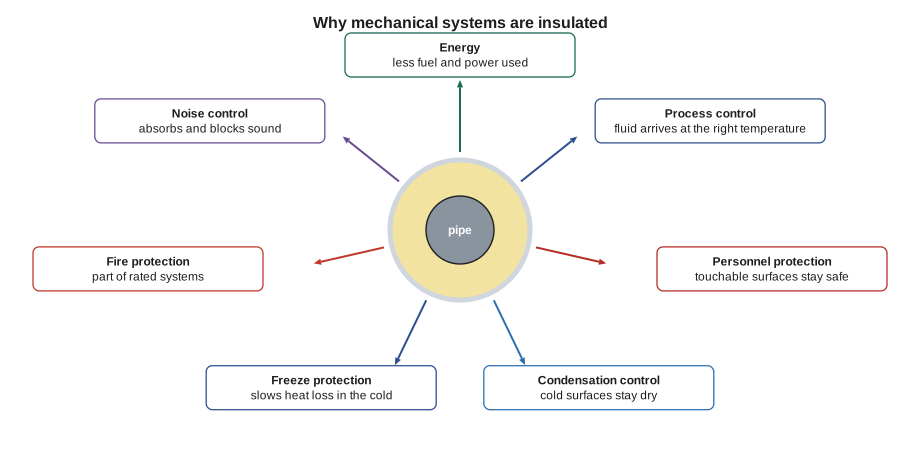
Energy conservation
A bare steam pipe is a heater. It warms the room it passes through, whether anyone wants the heat or not, and every unit of heat it gives off had to be made by burning fuel in the boiler. Insulation slows that flow of heat so the energy stays in the steam and reaches the equipment that needs it.
The savings from insulating hot pipe are large, because a bare hot surface loses heat quickly and even modest insulation cuts the loss by nine-tenths or more. Lesson 4 shows how to calculate heat loss, and INS-410 goes further into economic thickness. For now, it is enough to know the size of the numbers: a short length of bare steam pipe can waste as much energy in a year as several houses use.
Worked problem
A bare section of steam header
During the Kellerton outage, the crew found a 20 m length of NPS 4 steam line in the boiler house that had been left bare after a valve replacement in 2025. At 186 °C in a 10 °C room, the bare pipe loses about 0.98 kW per metre. With 76 mm of mineral wool it would lose about 0.059 kW per metre. The plant runs 8,400 hours a year, and the boiler turns 80 in 100 of its fuel energy into steam. How much energy is wasted each year, and how much natural gas does that represent at about 37.3 MJ per cubic metre?
Show solution
- Bare loss: 0.98 kW/m × 20 m = 19.6 kW.
- Insulated loss: 0.059 kW/m × 20 m = 1.18 kW.
- Heat saved by insulating: 19.6 − 1.18 = 18.42 kW.
- Per year: 18.42 kW × 8,400 h = 154,728 kWh of heat.
- Fuel needed to make that heat: 154,728 ÷ 0.80 = 193,410 kWh of fuel energy.
- In gigajoules: 193,410 kWh × 3.6 MJ/kWh = 696,276 MJ, or about 696 GJ.
- Natural gas: 696,276 MJ ÷ 37.3 MJ/m³ ≈ 18,670 m³.
Answer: About 155,000 kWh of heat, or about 18,700 m³ of natural gas a year, from a 20 m bare section. At roughly 1.9 kg of carbon dioxide per cubic metre of gas, that is also about 35 tonnes of carbon dioxide a year.
Walt Lowery likes to use numbers like these when he talks to plant managers. A bare section left after a repair looks like a small thing, but the boiler pays for it every hour of every day. That is why Kellerton's maintenance manager added a rule after the outage: no valve or flange job is closed until the insulation is back on or a removable cover is ordered.
Energy conservation also matters for cold systems. A chilled water pipe gains heat from the room, and the chiller has to remove that heat again with electricity. Refrigeration lines running at well below freezing gain heat even faster because the temperature difference is larger. Every unit of heat that leaks in through poor insulation is a unit the compressor must pump back out.
Process control
In a plant, many fluids must arrive at a set temperature. Kellerton's cooking kettles need steam at a steady pressure; hot syrup lines must stay above the temperature at which the syrup thickens; and some chemical lines must stay hot enough that the product does not crystallize or cold enough that it does not react. Insulation keeps the temperature drop along the line small, so the fluid that comes out the far end is close to what went in.
Process control is the reason some industrial specifications call for more insulation than energy savings alone would justify. It is also why the plant cares so much about wet or missing insulation on a process line: a cold spot can change the product. On steam lines, heat lost along the way turns some of the steam back into water, called condensate. Condensate has to be drained by steam traps, and too much of it can cause water hammer, a violent slug of water driven along the pipe by the steam behind it.
Worked problem
Condensate from heat loss
The 18.42 kW of heat saved in the last example would otherwise condense steam in the bare section. At 1,035 kPa gauge, each kilogram of steam gives up about 1,995 kJ when it condenses. How much condensate does the bare section form each hour?
Show solution
- 18.42 kW is 18.42 kJ every second.
- Condensate rate: 18.42 kJ/s ÷ 1,995 kJ/kg ≈ 0.00923 kg/s.
- Per hour: 0.00923 × 3,600 ≈ 33.2 kg/h.
Answer: About 33 kg of condensate an hour, roughly 33 litres of water, that the steam traps must remove. That water is steam the kettles never received.
Personnel protection
Hot surfaces burn people. A worker who brushes against a bare steam line at 186 °C is burned almost instantly. Insulation installed for personnel protection, often written as "PP" on drawings and schedules, keeps the surface that people can touch below a temperature that would cause a burn in a short contact.
INS-110 introduced the safe-to-touch idea. Most specifications aim for an outer surface temperature of about 60 °C (140 °F) or lower, based on ASTM C1055, the standard guide for heated system surface conditions that produce contact burn injuries. The guide relates surface temperature, contact time and the material of the surface to the risk of a burn. Metal jackets conduct heat into the skin faster than a cloth or plastic finish at the same temperature, so a metal jacket may need a cooler surface to be equally safe.
Personnel protection insulation is often required only where people can reach the surface, usually within about 2.1 m (7 ft) of a floor or platform and within about 0.6 m (2 ft) of a walkway edge, although each owner and specification sets its own limits. Sometimes the specification allows a guard, such as an expanded metal cage held off the pipe, instead of insulation. A guard protects people but does nothing for energy or process control, so it is used where the heat is wanted, for example near an exhaust that must stay hot to avoid acid condensation.
Common mistakes
MistakeAssuming a pipe is safe to touch because its insulation is thick.
InsteadCheck the surface temperature with an infrared thermometer or contact probe. Wet, damaged or thin insulation can leave hot spots.
Condensation control
When warm, humid air touches a surface colder than its dew point, water vapour in the air condenses into liquid on the surface. A bare chilled water pipe on a humid summer day drips like a cold drink glass. On a ceiling, that water stains tiles, grows mould, rots building materials and drips on equipment and people.
Insulation on cold systems has two jobs. First, it must be thick enough that its outer surface stays above the dew point of the surrounding air. Second, it must be sealed with a continuous vapour retarder, because water vapour moves from warm, humid air toward the cold pipe and will condense inside the insulation if it can get in. Wet insulation insulates poorly, so the surface gets colder, more vapour condenses and the problem grows until the insulation is soaked or frozen. INS-110 described the iced ammonia line at Kellerton; INS-320 covers cold systems in depth.
This is why insulators say that on cold work the vapour retarder matters more than the insulation. A small gap at a hanger or a fitting can ruin metres of otherwise perfect work. Materials such as cellular glass and flexible elastomeric foam are popular on cold service partly because they resist water vapour on their own, so a small breach does less damage.
Freeze protection, fire protection and noise
Insulation cannot stop water from freezing in a pipe that is exposed to freezing air for long enough. It only slows the loss of heat. In a building with intermittent heating, that delay may be enough. For outdoor lines and long exposures, the specification usually combines insulation with electric heat tracing, a heating cable run along the pipe under the insulation, or with a flow of water that keeps the line warm. The insulation reduces the heat the tracing must supply.
Some insulation products are installed as part of fire-resistance-rated systems, such as wraps on grease ducts, wraps that let ducts pass through fire separations and spray-applied fireproofing on structural steel. These systems must match a tested and listed design exactly. INS-330 covers firestopping and fire-resistant systems. In every building, codes also limit how readily the insulation and its facings spread flame and produce smoke, which lesson 9 explains.
Finally, insulation absorbs and blocks sound. Pipes carrying high-velocity steam or gas, control valves and ducts near fans are noisy, and an acoustic insulation system with a heavy barrier layer can reduce the noise in an occupied room or meet a plant's noise limit. INS-340 covers acoustic insulation.
What insulation cannot do
Insulation slows heat flow; it never stops it completely. Even the best insulation lets some heat through, and insulation that is wet, crushed, missing or poorly fitted lets far more through than its data sheet promises. A pipe insulated with gaps at every joint can lose several times the heat of the same pipe with tight joints. This is why the quality of the installation matters as much as the material chosen.
Insulation also cannot protect a pipe from corrosion. In fact, wet insulation over carbon steel can cause severe corrosion under insulation, often called CUI, because the insulation holds water against the metal at a temperature where corrosion is fast. The Kellerton header that Devon reinsulated had early CUI where a roof drain had leaked into the old insulation. Keeping water out is part of every insulator's job, on hot work as well as cold.
Bernie summed up the first Friday session in the shop with a question for each apprentice. "Pick one system on the Mountview job and tell me every reason it's insulated." Devon chose the medium-pressure steam line to the sterilizer room: energy, personnel protection in the mechanical room, and process control, because the sterilizers need dry steam. Tessa Moreau chose the chilled water main above the corridor ceilings: condensation control first, energy second. "Good," said Bernie. "Now you know why the spec has a vapour retarder on Tessa's pipe and not on yours."
| System at Mountview Hospital | Main reasons | What it means for the insulation |
|---|---|---|
| Medium-pressure steam to sterilizers | Energy, personnel protection, process control | High-temperature material, tight joints, metal or canvas jacket in mechanical room |
| Heating hot water | Energy, personnel protection | Glass fibre or mineral wool with an all-service jacket |
| Domestic hot water | Energy, code requirements | Glass fibre with all-service jacket, thickness from the energy code table |
| Domestic cold water | Condensation control | Insulation with a sealed vapour retarder jacket |
| Chilled water | Condensation control, energy | Thicker insulation with a continuous, sealed vapour retarder |
| Supply air duct | Energy, condensation control | Duct wrap or board with a foil facing sealed at seams |
Common mistakes
MistakeThinking insulation is only about saving energy.
InsteadAsk what each system needs: process control, personnel protection, condensation control, freeze or fire protection or noise control may matter more.
MistakeLeaving a short bare section after a repair.
InsteadEven a few metres of bare steam pipe wastes large amounts of energy and is a burn hazard. Reinsulate or order a removable cover before closing the job.
MistakeTreating a small gap in a cold line's vapour retarder as harmless.
InsteadMoisture enters through the gap, condenses and spreads. Seal every joint, seam and penetration.
MistakeBelieving insulation will stop a pipe from freezing.
InsteadInsulation only delays freezing. Long exposures need heat tracing or flow as well.
MistakeIgnoring wet insulation on a hot pipe because the pipe is hot.
InsteadWet insulation loses much of its value and can cause corrosion under insulation. Report it and find the source of the water.
Summary and key terms
- Insulation controls heat flow, and that serves several purposes: energy conservation, process control, personnel protection, condensation control, freeze protection, fire protection and noise control.
- Most systems are insulated for more than one reason, and the main reason decides the material, thickness and jacket.
- Bare hot pipe wastes large amounts of energy; insulating it usually cuts the loss by nine-tenths or more.
- Heat lost from steam lines forms condensate that must be drained and can cause water hammer.
- Personnel protection keeps touchable surfaces below about 60 °C (140 °F), following ASTM C1055.
- On cold systems, the outer surface must stay above the dew point and the vapour retarder must be continuous.
- Insulation slows heat flow but never stops it, and wet or damaged insulation can cause corrosion under insulation.
- Mechanical insulation
- Insulation on piping, ducts, equipment and vessels, as opposed to insulation in building walls and roofs.
- Process control
- Keeping a fluid at the temperature a process needs as it moves through a system.
- Personnel protection
- Insulation or guards that keep surfaces people can touch below a burn-causing temperature.
- Condensate
- Water formed when steam gives up heat and condenses.
- Dew point
- The temperature at which water vapour in air begins to condense into liquid.
- Water hammer
- A violent shock in a pipe caused by a slug of water driven by steam or a sudden change in flow.
- Corrosion under insulation
- Corrosion of metal under wet insulation, often abbreviated CUI.
- Heat tracing
- Electric cable or small tubing run along a pipe under the insulation to add heat.
Practice problems
Work each problem on paper first, then reveal the answer to check.
List four reasons a system might be insulated.
Show answer
Any four of: energy conservation, process control, personnel protection, condensation control, freeze protection, fire protection, noise control.
A bare pipe loses 0.5 kW per metre and the insulated pipe 0.04 kW per metre. What is saved on a 10 m run in 1,000 hours?
Show answer
(0.5 − 0.04) × 10 × 1,000 = 4,600 kWh.
Why does a cold line need a vapour retarder?
Show answer
Water vapour moves toward the cold surface and would condense inside the insulation.
Why might a guard be used instead of insulation for personnel protection?
Show answer
Where the heat must stay in the surface, such as an exhaust that must stay hot, a guard protects people without insulating.
Steam gives up 2,000 kJ per kilogram when it condenses. How much condensate does a 10 kW heat loss form in an hour?
Show answer
10 ÷ 2,000 × 3,600 = 18 kg/h.
Lesson quiz · 5 questions
Score 60% or more to complete this lesson.
Create a free account to save your progress, take quizzes and earn a certificate.