
INS-120 · Lesson 7 of 12 · 25 min
Granular insulations: calcium silicate and perlite
▶ Video coming soon A video version of this lesson is on the way.
On the Kellerton pipe rack outside the boiler house, Devon noticed that the insulation at every pipe support was white and chalky, not the brownish mineral wool on the rest of the line. He pressed his thumb hard against a piece where the jacket had been removed. It did not give at all. "Calcium silicate," said Bernie. "Mineral wool can't hold a pipe up. That stuff can. You could stand on it." She paused. "Don't. But you could."
Granular insulations are rigid materials made from small particles or grains bonded together, with tiny air spaces between and within the grains. The two main types in mechanical insulation are calcium silicate and expanded perlite. Both are hard, strong, noncombustible and suited to hot service, and both are heavier and conduct more heat than the fibrous products. Insulators use them where strength matters more than the lowest k: at supports, on surfaces that people walk on or bump into, and on high-temperature equipment that must keep its shape.
Calcium silicate
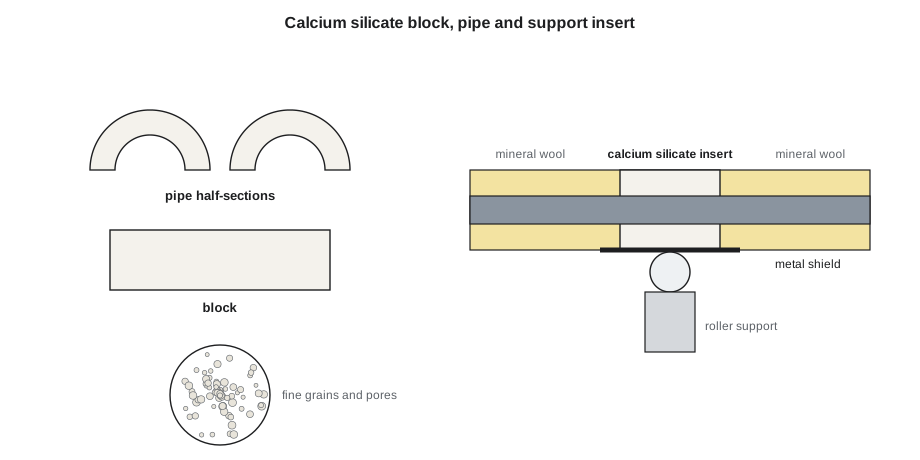
Calcium silicate, usually called cal-sil or calsil, is made by reacting lime and silica with water under heat and pressure, mixing in reinforcing fibres and forming the slurry into blocks and pipe half-sections that are then dried. The result is a white or off-white, chalky, rigid material with very fine pores. Modern calcium silicate is asbestos-free and reinforced with other fibres, such as cellulose or glass. The material standard is ASTM C533.
| ASTM C533 type | Forms | Maximum use temperature | Maximum dry density |
|---|---|---|---|
| Type I | Block and pipe | 649 °C (1,200 °F) | 240 kg/m³ (15 lb/ft³) |
| Type IA | Block only | 649 °C (1,200 °F) | 352 kg/m³ (22 lb/ft³) |
| Type II | Block only | 927 °C (1,700 °F) | 352 kg/m³ (22 lb/ft³) |
A current Type I product's data sheet shows the typical properties that make calcium silicate useful:
| Property | Typical value for a common Type I product |
|---|---|
| Compressive strength at 5 in 100 deformation | over 690 kPa (100 psi) |
| Flexural strength | over 345 kPa (50 psi) |
| k of pipe insulation at 38 °C (100 °F) mean | 0.050 W/(m·K) (0.344 Btu·in/(h·ft²·°F)) |
| k of pipe insulation at 93 °C (200 °F) mean | 0.056 W/(m·K) (0.389 Btu·in/(h·ft²·°F)) |
| k of pipe insulation at 204 °C (400 °F) mean | 0.070 W/(m·K) (0.486 Btu·in/(h·ft²·°F)) |
| k of pipe insulation at 316 °C (600 °F) mean | 0.085 W/(m·K) (0.591 Btu·in/(h·ft²·°F)) |
| Linear shrinkage after soaking at the maximum temperature | less than 2 in 100 |
| Use over austenitic stainless steel | meets ASTM C795 |
Compare those k-values with mineral wool's in lesson 5. Calcium silicate conducts noticeably more heat at the same mean temperature, so it needs more thickness for the same heat loss, and it weighs about twice as much. Designers accept that where its strength is needed.
Where calcium silicate is used
- Pipe supports and hangers on hot lines: high-density inserts carry the pipe load without crushing, with a metal shield outside to spread the load. INS-130 and INS-210 cover the details.
- High-abuse areas: lines near floors and platforms, where people step on, lean ladders against or bump into the insulation.
- Hot equipment and vessels where the insulation must keep its shape, such as boiler casings, turbine casings, ducts and hot tanks.
- Industrial plants where owners prefer one rigid, noncombustible material for steam and process lines, especially in refineries and chemical plants.
- High-temperature service up to 649 °C (1,200 °F) for Type I and 927 °C (1,700 °F) for Type II block.
Calcium silicate is not used on cold service. Its pores readily take up water, and it is designed for surfaces at or above about 27 °C (80 °F). If it is wetted on a hot line, its k rises and it can lose strength while wet. Many products are treated to resist water, and a wet piece will often regain its strength once dried, but the right practice is to keep it dry: store it under cover, never install wet material and jacket it promptly.
Expanded perlite
Perlite is a natural volcanic glass that contains a little water. When perlite ore is crushed and heated quickly, the water turns to steam and the softened glass pops like popcorn into tiny, light, white beads full of sealed cells. Expanded perlite is used loose as a fill and, for mechanical insulation, bonded with binders and reinforcing fibres into block and pipe sections. The material standard for molded perlite block and pipe is ASTM C610, which covers temperatures up to 649 °C (1,200 °F).
Molded perlite products for hot piping and equipment are usually treated with a water-repellent additive throughout. They resist water better than untreated calcium silicate and are lighter, but they are somewhat weaker and more brittle; a common product specifies a minimum compressive strength of about 550 kPa (80 psi) for block. Their k is in the same general range as calcium silicate, often a little higher at the same mean temperature. Like calcium silicate, perlite is noncombustible, and products intended for stainless steel are certified to ASTM C795.
In practice, specifications often give the insulator a choice: "calcium silicate or expanded perlite, ASTM C533 Type I or C610." Owners in wet locations, such as outdoor pipe racks in coastal plants, sometimes prefer perlite for its water resistance. Owners with heavy abuse or high loads prefer calcium silicate for its strength.
Comparing the two
| Property | Calcium silicate (C533 Type I) | Expanded perlite (C610) |
|---|---|---|
| Maximum use temperature | 649 °C (1,200 °F) | 649 °C (1,200 °F) |
| Typical density | up to 240 kg/m³ (15 lb/ft³) | lower than calcium silicate for most products |
| Compressive strength | about 690 kPa (100 psi) or more | about 550 kPa (80 psi) minimum for common block |
| Water resistance | absorbs water unless treated; dry before use if it gets wet | usually water-repellent throughout |
| k at the same mean temperature | higher than mineral wool | similar to calcium silicate, often a little higher |
| Cold service | not used | not used |
| Combustibility | noncombustible | noncombustible |
Weight and strength on the job
Granular insulation is heavy. A pipe rack, a hanger rod or a vessel support has to carry the insulation and jacket as well as the pipe and its contents, and the designer allows for it. Insulators feel the difference too: a box of calcium silicate half-sections weighs far more than the same volume of glass fibre, and lifting and carrying it is part of the job plan.
Worked problem
Weight of insulation on a run
A 64 m run of NPS 6 pipe (168.3 mm OD) gets 76 mm of insulation. Compare the weight of calcium silicate at 240 kg/m³ with mineral wool at 128 kg/m³.
Show solution
- Inner radius: 84.15 mm = 0.08415 m. Outer radius: 0.08415 + 0.076 = 0.16015 m.
- Cross-section area of the insulation: π × (0.16015² − 0.08415²) = π × (0.025648 − 0.007081) ≈ 0.0583 m².
- Volume: 0.0583 m² × 64 m ≈ 3.73 m³.
- Calcium silicate: 3.73 × 240 ≈ 896 kg.
- Mineral wool: 3.73 × 128 ≈ 478 kg.
Answer: About 900 kg of calcium silicate against about 480 kg of mineral wool, nearly twice as heavy.
Worked problem
Bearing pressure on a support insert
The NPS 6 steam line weighs about 28.3 kg/m for the pipe, 14 kg/m for calcium silicate and 2 kg/m for jacket. Supports are 5 m apart. At each support, the load bears on an insert through a shield whose contact area is about 305 mm × 150 mm. What is the bearing pressure, and how does it compare with the insert's compressive strength of 690 kPa?
Show solution
- Weight per metre: 28.3 + 14 + 2 = 44.3 kg/m.
- Load per support: 44.3 kg/m × 5 m ≈ 221 kg, or 221 × 9.81 ≈ 2,170 N.
- Contact area: 0.305 m × 0.150 m ≈ 0.0458 m².
- Pressure: 2,170 N ÷ 0.0458 m² ≈ 47,400 Pa, or about 47 kPa.
- Compared with strength: 690 ÷ 47 ≈ 14.6.
Answer: About 47 kPa, roughly one-fifteenth of the insert’s strength, a comfortable margin that also covers thermal movement and the odd careless boot. Soft mineral wool in the same spot would crush.
Cutting, fitting and finishing
Calcium silicate and perlite are cut with saws: hand saws with coarse or medium teeth in the field and band saws in the shop. Fittings are made from mitred segments cut from pipe sections and fitted tightly, with joints buttered with a high-temperature insulating cement where the specification calls for it. INS-210 covers fitting fabrication.
Granular products are usually secured with stainless steel or galvanized wire or bands and finished with a metal jacket, or on some equipment with an insulating and finishing cement and a reinforcing mesh, then a coating. Because they are rigid, they do not follow small irregularities; gaps are filled with loose mineral wool or cement, never left open.
Sawing produces fine dust. Some products contain small amounts of crystalline silica, and the safety data sheet will say so. Use a saw with dust extraction where possible, wet methods where the manufacturer allows them, and the respiratory protection the job's hazard assessment requires. INS-110 covered silica controls, and INS-230 covers them in more detail.
A word on old granular insulation
Calcium silicate pipe covering and block made before the 1970s very often contained asbestos as its reinforcing fibre, and older hard, white pipe covering, block insulation and insulating cements in plants and older buildings must be treated as suspect until tested. They look much like modern asbestos-free calcium silicate. On the Kellerton outage, the asbestos-containing tee that Devon found was a cement-finished fitting of exactly this kind. The rule from INS-110 stands: if you did not install it and the survey does not clear it, stop and report it before you cut, break or remove it.
Receiving, storing and checking rigid hot-service insulation
Granular products are tough once installed but easy to spoil before then. Cartons crushed by a forklift, sections chipped at the edges or a pallet left uncovered in the rain all mean waste or, worse, poor work if the damaged pieces are installed anyway. Coldstream's receiving routine for calcium silicate and perlite is short:
- Check the label against the specification and the order: material, ASTM standard and type, pipe size or block size, thickness and quantity. Granular pipe sections, like fibrous ones, are made to fit iron pipe size or copper tube size, and the two do not interchange.
- Check for the C795 marking on any carton that will be used on or near austenitic stainless steel.
- Open one carton from each pallet and look for broken, cracked or damp pieces. Report damage on the delivery slip before the driver leaves.
- Store pallets off the ground, under cover and away from wash water, steam leaks and traffic. A tarp tied over a pallet in the yard keeps rain out only if it covers the sides as well as the top.
- Keep cut-offs for filling small gaps and making inserts, but throw away anything that is wet, contaminated with oil or crumbled.
Rigid sections also have to be cut from stock for inserts, segments and odd lengths, and planning those cuts saves material.
Worked problem
Cutting support inserts from stock
Coldstream's support detail for the outdoor steam line calls for a calcium silicate insert 457 mm long at each of the 14 supports. Calcium silicate pipe sections for NPS 6 come 914 mm long. How many sections are needed for the inserts, and how much is left over?
Show solution
- Inserts per section: 914 ÷ 457 = 2.
- Sections: 14 ÷ 2 = 7 sections.
- Left over: 7 × 914 − 14 × 457 = 6,398 − 6,398 = 0 mm, apart from the saw kerf.
Answer: 7 sections, cut exactly in half. Raj orders one extra section in case a piece cracks during cutting.
The saw kerf, the width of material the blade removes, is small on a band saw but real. When two inserts are cut from one section, each will be a millimetre or two short of half, which the support detail allows. When a detail calls for an exact length, measure each cut rather than assuming the section is exactly the nominal length.
Common mistakes
MistakeUsing calcium silicate or perlite on cold lines.
InsteadThese products are for hot service, from about 27 °C (80 °F) up. Use closed-cell materials on cold work.
MistakeInstalling calcium silicate that got rained on in the yard.
InsteadStore it covered and off the ground; do not install wet material.
MistakeLeaving gaps between rigid sections because they do not quite fit.
InsteadCut and fit tightly, and fill unavoidable gaps with loose mineral wool or cement as the specification allows.
MistakeDry-sawing in a crowded area without dust control.
InsteadUse dust extraction or wet methods, and wear the required respiratory protection.
MistakeAssuming hard white pipe covering in an old plant is modern calcium silicate.
InsteadTreat it as suspect asbestos until the survey or a sample clears it.
MistakeForgetting the extra weight when planning lifts.
InsteadPlan for heavier cartons and use mechanical lifting or two-person lifts.
Summary and key terms
- Granular insulations are rigid, noncombustible materials for hot service; the main types are calcium silicate and expanded perlite.
- Calcium silicate (ASTM C533) is rated to 649 °C (1,200 °F) for Type I and 927 °C (1,700 °F) for Type II block, with compressive strength around 690 kPa (100 psi) or more.
- Expanded perlite (ASTM C610) is rated to 649 °C (1,200 °F), is usually water-repellent and is lighter but weaker than calcium silicate.
- Both conduct more heat than mineral wool and weigh about twice as much; they are chosen for strength, abuse resistance and shape stability.
- Their most common use on fibrous-insulated lines is as inserts at pipe supports.
- Neither is used on cold service, and both must be kept dry.
- Older hard pipe covering and block may contain asbestos and must be treated as suspect until cleared.
- Granular insulation
- Rigid insulation made of small particles or grains bonded together, such as calcium silicate and perlite.
- Calcium silicate
- A rigid, white, noncombustible insulation made by reacting lime and silica; used for hot service and supports.
- Expanded perlite
- Volcanic glass heated until it pops into light beads, bonded into rigid insulation for hot service.
- Compressive strength
- The load per unit area a material can carry before it deforms by a set amount.
- Insert
- A high-strength insulation section at a pipe support that carries the load without crushing.
- Shield
- A curved sheet metal piece outside an insert that spreads the support load over the insulation.
- Insulating cement
- A mixture of insulating fibres and binders applied wet to fill gaps or finish irregular shapes.
- Linear shrinkage
- The change in length of an insulation after it is held at a high temperature, given as a fraction of the original length.
Practice problems
Work each problem on paper first, then reveal the answer to check.
What is the maximum use temperature of calcium silicate Type I?
Show answer
649 °C.
Why is calcium silicate used at supports on mineral-wool-insulated lines?
Show answer
It has high compressive strength and carries the pipe load without crushing.
A support carries 3,000 N on a 0.05 m² bearing area. What is the pressure?
Show answer
3,000 ÷ 0.05 = 60,000 Pa, or 60 kPa.
Name one advantage of perlite over calcium silicate.
Show answer
It is usually water-repellent throughout and lighter.
Why should hard, white pipe covering in an old plant be treated with caution?
Show answer
Older calcium silicate and similar products often contained asbestos.
Lesson quiz · 5 questions
Score 60% or more to complete this lesson.
Create a free account to save your progress, take quizzes and earn a certificate.