
INS-120 · Lesson 4 of 12 · 30 min
Thermal conductivity and R-values
▶ Video coming soon A video version of this lesson is on the way.
Raj Sandhu came to the shop on the fourth Friday with a stack of submittal data sheets from the Mountview job. "Every one of these products says it's the best," he said, fanning them out on the bench. "Your job is to read past the marketing and find two numbers: the k-value at the right mean temperature and the temperature limit. If you can do that, you can compare any two products in the world."
Lesson 3 introduced thermal conductivity as the property that tells how readily a material conducts heat. This lesson explains how k is measured and reported, why it changes with temperature, moisture and age, and how it relates to the R-values and RSI values that appear on building insulation. It ends with the most important difference between flat insulation and pipe insulation: heat flow through a cylinder.
What thermal conductivity means
Thermal conductivity, written k or λ, is the rate of heat flow through a unit area of a material of unit thickness when there is a unit temperature difference across it. In plainer words, it is how much heat passes through a slab of the material one unit thick, per unit of area, for each degree of difference between its faces. The lower the k, the better the insulator.
| System | Unit of k | Meaning |
|---|---|---|
| SI | W/(m·K) | Watts through 1 m² of material 1 m thick with 1 K (1 °C) difference across it |
| US customary | Btu·in/(h·ft²·°F) | Btu per hour through 1 ft² of material 1 in thick with 1 °F difference across it |
To convert, multiply a US customary k by 0.1442 to get W/(m·K), or divide a k in W/(m·K) by 0.1442 to get Btu·in/(h·ft²·°F). Some older documents also give k in Btu/(h·ft·°F), which is the US value divided by 12.
Worked problem
Converting a k-value
A glass fibre pipe insulation data sheet from a US manufacturer lists k = 0.24 Btu·in/(h·ft²·°F) at a mean temperature of 100 °F. What is this in W/(m·K)?
Show solution
- k = 0.24 × 0.1442 ≈ 0.0346 W/(m·K).
- The mean temperature of 100 °F is (100 − 32) ÷ 1.8 ≈ 38 °C.
Answer: About 0.035 W/(m·K) at a mean of about 38 °C.
Typical values give a sense of scale. Copper conducts about 400 W/(m·K), steel about 50, concrete about 1 to 2, water about 0.6 and still air about 0.025. Most insulation materials fall between about 0.020 and 0.070 W/(m·K) (0.14 and 0.50 Btu·in/(h·ft²·°F)) at room temperature. Still air is the benchmark: most insulations are simply ways of keeping air still, and their k-values are close to air's or a little above.
How k is measured
Manufacturers measure k in a laboratory using standard test methods, so that products can be compared fairly. The specification standard for a material, such as ASTM C547 for mineral fibre pipe insulation, names the test methods and the maximum k the product must meet at stated mean temperatures.
- Guarded hot plate (ASTM C177): a flat sample is placed between a heated plate and cooled plates, and the heat input needed to hold a steady temperature difference is measured. It is the reference method for flat materials.
- Heat flow meter (ASTM C518): a faster method for flat samples that uses calibrated sensors to measure heat flow. It is widely used for quality control.
- Pipe test apparatus (ASTM C335): a heated test pipe is insulated with the actual pipe covering and the heat needed to keep it at temperature is measured. This gives the k of real pipe insulation, including the effect of its shape and joints.
In Canada, many building insulation products are tested to the same ASTM methods or to the equivalent CAN/ULC standards, and the product standards for building insulation, such as CAN/ULC-S702 for mineral fibre and CAN/ULC-S701.1 for polystyrene, set their own requirements. Mechanical insulation specifications in Canada usually still refer to the ASTM C-series material standards, because they cover pipe and equipment products that the building standards do not.
Laboratory k-values are measured on dry, clean, new material with no joints. Installed insulation is rarely as good. Joints, gaps, compression, moisture, aging and supports all add heat flow. Designers allow for this with safety factors, and insulators reduce the gap between the lab and the job by installing carefully.
k changes with mean temperature
The k-value of every insulation material rises as its mean temperature rises. At higher temperatures, the gas in the material conducts heat better and radiation through the material grows rapidly. This is why data sheets list k at several mean temperatures, often in a table or graph, and why lesson 2 taught you to calculate the mean temperature.
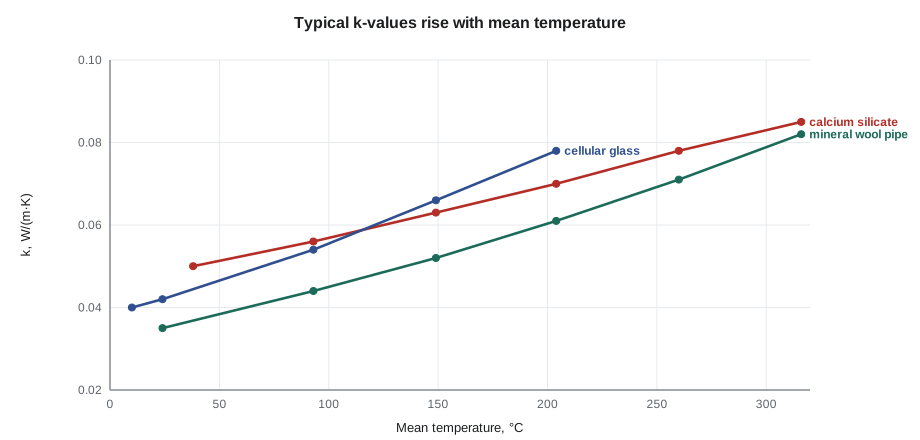
| Mean temperature | Typical cellular glass k |
|---|---|
| −46 °C (−50 °F) | 0.032 W/(m·K) (0.22 Btu·in/(h·ft²·°F)) |
| −18 °C (0 °F) | 0.036 W/(m·K) (0.25 Btu·in/(h·ft²·°F)) |
| 24 °C (75 °F) | 0.042 W/(m·K) (0.29 Btu·in/(h·ft²·°F)) |
| 93 °C (200 °F) | 0.054 W/(m·K) (0.38 Btu·in/(h·ft²·°F)) |
| 149 °C (300 °F) | 0.066 W/(m·K) (0.46 Btu·in/(h·ft²·°F)) |
| 204 °C (400 °F) | 0.078 W/(m·K) (0.54 Btu·in/(h·ft²·°F)) |
Worked problem
Choosing k at the right mean temperature
Cellular glass on a hot line has its inner face at 186 °C and its outer face at about 20 °C. Using the table above, which k should be used?
Show solution
- Mean temperature: (186 + 20) ÷ 2 = 103 °C.
- The table gives 0.054 W/(m·K) at 93 °C and 0.066 at 149 °C.
- Interpolating: 103 is 10 ÷ 56 of the way from 93 to 149, so k ≈ 0.054 + 0.012 × 10 ÷ 56 ≈ 0.054 + 0.002 = 0.056 W/(m·K).
Answer: About 0.056 W/(m·K), a third higher than the 0.042 at room temperature.
The same rule works in reverse for cold service. At the low mean temperatures of a refrigeration line, k is lower than the room-temperature value printed on the front of the brochure. Comparing two products fairly means comparing them at the same mean temperature, which is the first thing Raj checks on a submittal.
Other things that change k
- Density: each material has a density at which its k is lowest. Products made too light let air move and radiation pass; products made too dense conduct through the solid.
- Moisture: water raises k sharply. A few parts in 100 of moisture by volume can increase the k of a fibrous insulation by a large fraction, and soaked insulation may conduct many times as much heat as dry insulation.
- Aging: some foam plastics, such as polyisocyanurate and extruded polystyrene, are made with blowing agents that conduct less heat than air. Over months and years, some of the gas diffuses out and air diffuses in, so k slowly rises. Standards for these products require an aged k, measured after a conditioning period, and good data sheets report it.
- Compression: squeezing a fibrous insulation reduces its thickness more than it lowers its k, so the heat flow rises. Compressed duct wrap at a hanger or a tight band is a weak spot.
- Fibre size and orientation: finer fibres and fibres laid across the direction of heat flow give lower k values.
Conductance, R-value and RSI
Thermal conductivity is a property of a material. A layer of a given thickness has a thermal conductance and a thermal resistance, which depend on both the material and the thickness.
The thermal resistance, R, tells how strongly a flat layer resists heat flow: the larger the R, the better. Resistances of flat layers in series add up, as lesson 3 showed. Building insulation in the United States is labelled with its R-value in h·ft²·°F/Btu, for example R-13 batts or R-20 board. In Canada, building insulation is labelled with its RSI value in m²·K/W, usually alongside the imperial R-value, for example RSI 3.52 (R-20).
Worked problem
R-value and RSI of a board
A 76 mm mineral wool board has k = 0.036 W/(m·K) at a 24 °C mean. What is its RSI, and what R-value is that?
Show solution
- RSI = L ÷ k = 0.076 m ÷ 0.036 W/(m·K) ≈ 2.11 m²·K/W.
- R = 2.11 × 5.678 ≈ 12.0.
Answer: RSI 2.11, about R-12.
The R-value per inch is a quick way to compare flat products: it is simply 1 ÷ k in US units. A product with k = 0.25 has R-4 per inch. In SI, the RSI per 25 mm serves the same purpose. These numbers are useful for walls, roofs, ducts and flat equipment. For pipe insulation they can be misleading, because of the cylinder.
Heat flow through a cylinder
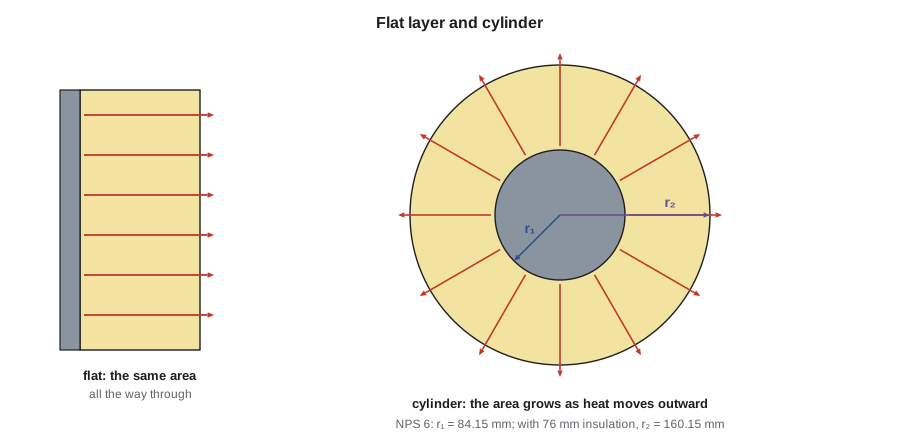
On a flat wall, each layer of insulation has the same area as the next. On a pipe, the insulation gets larger as you move outward. Heat leaving the pipe passes first through the small inner surface of the insulation and spreads out through ever larger circles until it reaches the much larger outer surface. Because the area keeps growing, each added layer of thickness does less than the one before. The heat flow per unit length of pipe is given by the cylinder form of Fourier's law:
Here Q/L is the heat flow per metre of pipe in W/m, k is in W/(m·K), T₁ and T₂ are the inner and outer face temperatures, r₁ is the outer radius of the pipe and r₂ is the outer radius of the insulation, and ln is the natural logarithm, a key found on every scientific calculator and phone calculator. The two radii must be in the same unit; their ratio has no units.
Worked problem
Heat loss from an insulated steam pipe
An NPS 6 steel steam pipe has an outside diameter of 168.3 mm and carries steam at 186 °C. It has 76 mm of mineral wool with k = 0.045 W/(m·K) at the mean temperature. Assume the outer face of the insulation is at 10 °C. What is the heat loss per metre?
Show solution
- Pipe radius: r₁ = 168.3 ÷ 2 = 84.15 mm.
- Insulation outer radius: r₂ = 84.15 + 76 = 160.15 mm.
- Ratio: r₂ ÷ r₁ = 160.15 ÷ 84.15 ≈ 1.903; ln(1.903) ≈ 0.644.
- Temperature difference: 186 − 10 = 176 °C.
- Q/L = 2 × π × 0.045 × 176 ÷ 0.644 ≈ 49.8 ÷ 0.644 ≈ 77.3 W/m.
Answer: About 77 W per metre. In the real installation the surface film adds a little resistance, so the true loss is slightly lower.
Compare that with what you would get by treating the pipe insulation as a flat board. The flat formula gives 0.045 × 176 ÷ 0.076 ≈ 104 W/m² (0.31 × 316 ÷ 3 ≈ 32.7 Btu/h·ft²). Multiplied by the pipe's own surface area of 0.529 m² per metre (1.73 ft² per foot), it gives about 55 W/m (57 Btu/h·ft), too low. Multiplied by the outer surface area of the insulation, 1.006 m² per metre (3.31 ft² per foot), it gives about 105 W/m (108 Btu/h·ft), too high. The true answer from the cylinder formula lies between. This is why pipe insulation is never chosen by R-value alone, and why specifications give pipe insulation as a thickness for each pipe size, or as a maximum heat loss per length.
Equivalent thickness
Some manufacturers and design guides use the idea of equivalent thickness: the thickness of flat insulation that would have the same heat flow per unit of outer surface area as the pipe insulation. It is calculated from the radii:
Worked problem
Equivalent thickness of pipe insulation
For the NPS 6 pipe with 76 mm of insulation above, what is the equivalent thickness?
Show solution
- r₂ = 160.15 mm and ln(r₂ ÷ r₁) ≈ 0.644.
- t_eq = 160.15 × 0.644 ≈ 103 mm.
Answer: About 103 mm. Per square metre of jacket surface, the 76 mm of pipe insulation behaves like about 103 mm of flat board.
Equivalent thickness is always larger than the actual thickness, because the outer surface of pipe insulation is so much larger than the pipe. It is used mainly in surface temperature and condensation calculations, which INS-320 and INS-410 cover.
Energy codes and k-values
Energy codes set minimum insulation thicknesses for piping and ducts in new buildings. In Ontario, the energy efficiency requirements for larger buildings are in Supplementary Standard SB-10 of the Building Code, which lets designers comply with ASHRAE 90.1 or the National Energy Code of Canada for Buildings in the editions it names. These documents give pipe insulation thickness tables by fluid temperature and pipe size, and each table is based on insulation with k in a stated range at a stated mean temperature. When the product's k is higher than the range, the code requires extra thickness, worked out from a formula in the code; when it is lower, the thickness may be reduced. This is another reason Raj checks k at the code's mean temperature on every submittal.
The code tables are minimums for energy. A specification may call for more insulation for process control, personnel protection or condensation control. The insulator installs what the specification calls for and raises a question in writing if it appears to be less than the code minimum.
Common mistakes
MistakeComparing two products' k-values at different mean temperatures.
InsteadCompare at the same mean temperature, ideally the one the system will run at.
MistakeUsing the room-temperature k for a hot line.
InsteadCalculate the mean temperature and use the data sheet value for it; k on hot lines is higher.
MistakeChoosing pipe insulation by R-value.
InsteadPipe insulation is specified by thickness for each pipe size, or by heat loss per length, because of the cylinder effect.
MistakeForgetting to divide a per-inch k by 12 in the US cylinder formula.
InsteadThe cylinder formula needs k in Btu/(h·ft·°F) when the heat loss is per foot.
MistakeAssuming installed insulation performs like the lab sample.
InsteadJoints, gaps, moisture and supports add heat flow. Install tightly and keep it dry.
Summary and key terms
- Thermal conductivity, k, is the rate of heat flow through a unit thickness and area of a material per degree of difference. Lower k means better insulation.
- 1 Btu·in/(h·ft²·°F) ≈ 0.1442 W/(m·K).
- k is measured by standard methods such as ASTM C177, C518 and, for pipe insulation, C335.
- k rises with mean temperature and with moisture, and some foams' k rises slowly with age.
- For flat layers, R = L ÷ k (or RSI in SI), and resistances in series add up; RSI = R × 0.1761.
- Heat flow through pipe insulation follows the cylinder formula, so each extra unit of thickness does less than the one before.
- Energy codes set minimum pipe insulation thicknesses based on a k range at a stated mean temperature.
- Thermal conductivity
- The rate at which heat passes through a unit thickness and area of a material per degree of temperature difference; k or λ.
- Apparent thermal conductivity
- The measured k of an insulation, which includes conduction, convection and radiation inside it.
- Thermal conductance
- The heat flow through a layer of given thickness per unit area per degree; C = k ÷ L.
- R-value
- Thermal resistance of a flat layer in h·ft²·°F/Btu; R = L ÷ k.
- RSI
- Thermal resistance of a flat layer in m²·K/W; RSI = R × 0.1761.
- Natural logarithm
- The mathematical function ln, used in the formula for heat flow through cylinders.
- Equivalent thickness
- The thickness of flat insulation that would give the same heat flow per unit of outer surface as a given pipe insulation.
- Aged k
- The thermal conductivity of a foam after the blowing agent has partly diffused out, measured after a set conditioning period.
Practice problems
Work each problem on paper first, then reveal the answer to check.
Convert k = 0.30 Btu·in/(h·ft²·°F) to W/(m·K).
Show answer
0.30 × 0.1442 ≈ 0.043 W/(m·K).
What is the RSI of 50 mm of board with k = 0.033 W/(m·K)?
Show answer
0.050 ÷ 0.033 ≈ 1.52 m²·K/W.
Convert RSI 2.5 to an R-value.
Show answer
2.5 × 5.678 ≈ R-14.2.
Why does k rise at higher mean temperatures?
Show answer
Gas conduction and radiation through the material increase with temperature.
An NPS 2 pipe (60.3 mm OD) has 38 mm of insulation. What is r₂ ÷ r₁?
Show answer
r₁ = 30.15 mm, r₂ = 68.15 mm, ratio ≈ 2.26.
Lesson quiz · 5 questions
Score 60% or more to complete this lesson.
Create a free account to save your progress, take quizzes and earn a certificate.