
INS-120 · Lesson 12 of 12 · 29 min
Case study: selecting insulation for a steam line
▶ Video coming soon A video version of this lesson is on the way.
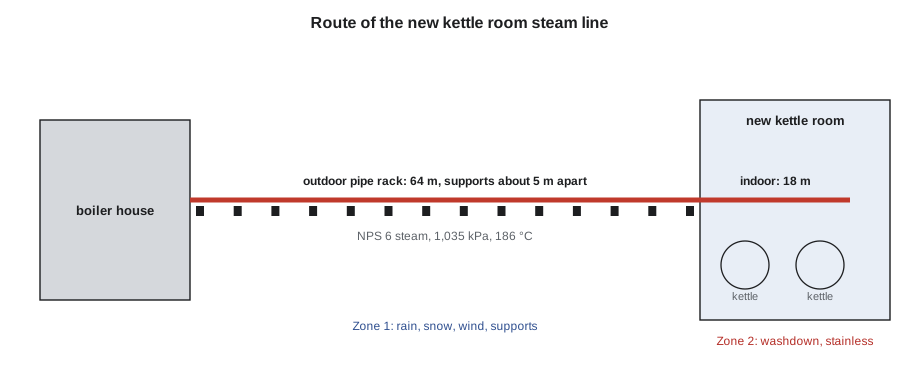
On Thursday, November 12, 2026, a week after the outage, Walt Lowery and Raj Sandhu drove to Kellerton for a meeting about the plant's next project, and Bernie brought Devon along. Kellerton is adding a new kettle room for a line of soups and sauces, with steam-jacketed cooking kettles, to be built through the winter and started up in the spring of 2027. A new steam line will run from the boiler house header across the outdoor pipe rack and into the kettle room. The mechanical contractor will install the pipe in late November and early December, and Coldstream has been asked to propose the insulation system and price it. Installation is planned for the week of December 7, after the pipe passes its pressure test.
In the meeting room were Kellerton's utilities engineer, Anika Varga, and its maintenance manager, Lou Brisebois. Anika had the piping drawings and the plant's insulation standard. Lou had a list of everything that had gone wrong with insulation in the plant over the last ten years. This case study follows the selection from the system data to the material list, using the method from lesson 11 and the calculations from the rest of the course. All the numbers are worked out the way Raj worked them out that afternoon.
The system
| Item | Data |
|---|---|
| Service | Saturated steam from the boiler house header to the new kettle room |
| Pipe | NPS 6 carbon steel, 168.3 mm (6.625 in) outside diameter |
| Operating pressure and temperature | 1,035 kPa (150 psig), about 186 °C (366 °F) |
| Design temperature (piping specification) | 200 °C (392 °F) |
| Outdoor section | 64 m (210 ft) on the existing pipe rack, about 6 m (20 ft) above grade, supports at about 5 m (16 ft) centres on roller supports |
| Indoor section | 18 m (60 ft) inside the kettle room, about 3 m (10 ft) above the floor, near stainless steel kettles, daily washdown with hot water and mild detergent |
| Ambient | Outdoor: −25 °C to 32 °C (−13 °F to 90 °F), design winter 10 °C (50 °F) average for energy; indoor: about 30 °C (86 °F) near operating kettles |
| Operating hours | About 8,400 hours a year |
| Related work | An NPS 2 condensate return alongside, insulated to the same standard (priced separately) |
Step 1: the temperature range
Raj started with the temperatures. The normal operating temperature is 186 °C (366 °F), and the design temperature is 200 °C (392 °F). Lou added a detail: twice a year, the plant raises the header pressure briefly to test the safety valves, so the line can reach the design temperature. When the plant is shut down at Christmas, the outdoor section cools to the outdoor temperature, which can be −25 °C (−13 °F). The line cycles from cold to hot at every start-up.
That ruled out every foam plastic and elastomer at once. Even C534 Grade 2 elastomeric, rated to 175 °C (350 °F), is below the operating temperature. It left glass fibre, mineral wool, calcium silicate, perlite and cellular glass, all rated well above 200 °C (392 °F). The cold winter shutdown did not rule anything out: all of these products tolerate low temperatures when dry, and the line is not below ambient in operation, so condensation control is not the purpose.
Step 2: the purpose
Anika listed the reasons for insulating, in the plant's order of priority: energy conservation, process control (the kettles need dry steam at a steady pressure, and condensate in the line must be kept to a minimum), and personnel protection inside the kettle room, where operators work within reach of the line on a platform. On the outdoor rack, nobody can touch the line in normal operation, but maintenance workers on the rack can.
Step 3: the environment, zone by zone
The two sections of the line live in very different places, so Raj treated them as two zones.
- Outdoor zone: rain, snow and wind; occasional foot traffic by maintenance workers on the rack walkway; roller supports at about 5 m (16 ft) centres that carry the pipe weight through the insulation; no stainless steel.
- Indoor zone: daily washdown with hot water that can splash and run onto the line; a humid, warm room; stainless steel kettles and equipment below and beside the line, although the steam line itself is carbon steel; operators within reach; a food plant, so the finish must be smooth, cleanable and must not shed fibres.
Lou's list of past failures was mostly about water: insulation soaked by washdown in the old kitchen, a roof drain leaking into the boiler house header (the one Devon had seen in INS-110), and jackets on the rack with seams on top that let rain in. "Whatever you pick," he said, "design it like water's trying to get in. Because it is."
Step 4: the outdoor zone
For the outdoor run, the candidates were mineral wool, glass fibre, perlite, calcium silicate and cellular glass. Raj compared them against the plant standard, which calls for mineral wool with an aluminum jacket on steam lines, and against the environment.
| Candidate | For | Against | Decision |
|---|---|---|---|
| Mineral wool, C547 Type II | Plant standard; low k; handles upsets; water-repellent grades; easy to install | Low compressive strength at supports; must be kept dry | Chosen for the run |
| Glass fibre, C547 Type I | Low k; light; rated high enough | Less tolerant of wetting outdoors; not the plant standard | Ruled out |
| Expanded perlite, C610 | Water-repellent; rigid; strong | Higher k, so more thickness or more heat loss; heavier | Kept for the indoor zone |
| Calcium silicate, C533 Type I | Very strong; rigid | Higher k; absorbs water if the jacket fails; heavier | Chosen for support inserts |
| Cellular glass, C552 | Vapour-tight; does not absorb water; strong | Higher cost; brittle; more abrasive on a cycling hot line | Ruled out for this service |
The finish would be the plant's standard aluminum jacket, 0.41 mm (0.016 in) thick with a factory moisture barrier, stucco-embossed for stiffness, with longitudinal seams below the centre line facing down and circumferential laps facing downhill, secured with stainless steel bands. At each roller support, a calcium silicate insert would carry the load, with a galvanized steel shield outside the jacket.
Step 5: the indoor zone
Inside the kettle room, Raj and Bernie disagreed at first. Raj proposed the same mineral wool as outside, with a stainless steel jacket to resist washdown. Bernie pointed out that the jacket would have to be perfect forever: one dented lap or one open seam after a washdown, and hot water would run into the mineral wool. She proposed expanded perlite, which is water-repellent throughout and rigid, under a stainless steel jacket with sealed laps. Anika agreed with Bernie, and added that the perlite product they would use is certified to ASTM C795, which mattered because insulation debris and wash water would reach stainless steel kettles below. Perlite costs some heat loss compared with mineral wool, as lesson 11 showed, but on an 18 m (60 ft) run the extra loss is small and the protection is worth it.
The stainless steel jacket was chosen over aluminum because of the washdown detergent and because a smooth stainless surface is easy to clean. The laps would be sealed with a food-grade sealant compatible with stainless steel, and there would be no exposed fibrous material anywhere in the room.
Step 6: the thickness
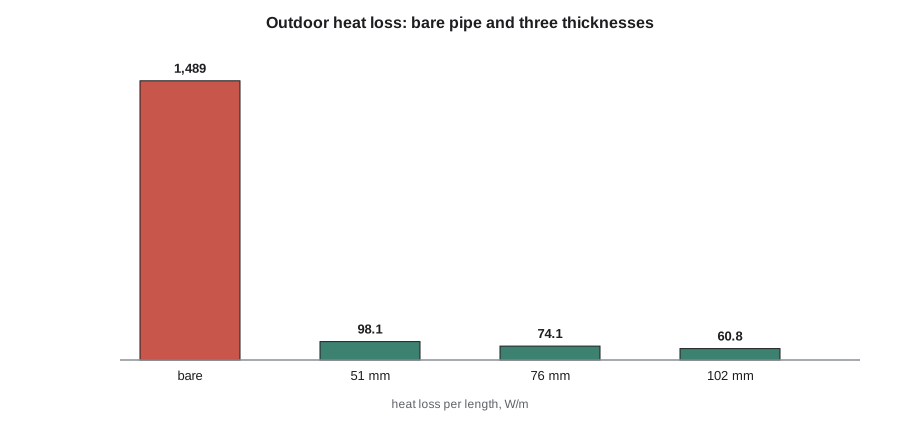
Kellerton's standard calls for 76 mm (3 in) on NPS 6 steam at this pressure. Raj checked it with NAIMA's 3E Plus program on his laptop, using the outdoor zone conditions, and printed a comparison for the meeting. He also showed the bare pipe loss, as a reminder of what the insulation is doing.
| Mineral wool thickness | Heat loss per length | Outer surface temperature |
|---|---|---|
| Bare pipe | about 1,490 W/m (about 1,530 Btu/h·ft) | about 186 °C (366 °F) |
| 51 mm (2 in) | 98.1 W/m (101.5 Btu/h·ft) | 21.6 °C (70.7 °F) |
| 76 mm (3 in) | 74.1 W/m (76.2 Btu/h·ft) | 17.4 °C (63.1 °F) |
| 102 mm (4 in) | 60.8 W/m (62.9 Btu/h·ft) | 15.2 °C (59.3 °F) |
Worked problem
What the insulation saves outdoors
Using the table, how much heat does 76 mm of mineral wool save on the 64 m outdoor run compared with bare pipe in a year of 8,400 hours, and how much natural gas is that at 80 in 100 boiler efficiency and 37.3 MJ per cubic metre?
Show solution
- Saving per metre: 1,489 − 74.1 ≈ 1,415 W/m.
- For 64 m: 1,415 × 64 ≈ 90,550 W, or 90.55 kW.
- Per year: 90.55 × 8,400 ≈ 760,600 kWh of heat.
- Fuel: 760,600 ÷ 0.80 ≈ 950,800 kWh, or 950,800 × 3.6 ≈ 3,423,000 MJ.
- Gas: 3,423,000 ÷ 37.3 ≈ 91,800 m³.
Answer: About 760,000 kWh of heat, or nearly 92,000 m³ of gas, every year from this one run.
Worked problem
Is the standard thickness reasonable?
How much extra gas does going from 51 mm to 76 mm save on the outdoor run each year, and how much more would going from 76 mm to 102 mm save?
Show solution
- 51 to 76 mm: (98.1 − 74.1) × 64 = 1,536 W, or 1.536 kW; × 8,400 h ≈ 12,900 kWh of heat; ÷ 0.80 × 3.6 ÷ 37.3 ≈ 1,560 m³ of gas.
- 76 to 102 mm: (74.1 − 60.8) × 64 ≈ 851 W, or 0.851 kW; × 8,400 h ≈ 7,150 kWh of heat; ÷ 0.80 × 3.6 ÷ 37.3 ≈ 860 m³ of gas.
Answer: The second step saves only a little over half as much as the first. Whether the extra 26 mm is worth buying depends on the cost of the material, the labour and the gas, which is the economic thickness calculation in INS-410. The plant standard of 76 mm sits where most such calculations land for this pipe and temperature.
For the indoor zone, the question was personnel protection. Raj ran the indoor case with 76 mm (3 in) of perlite, k = 0.060 W/(m·K) (k = 0.42 Btu·in/(h·ft²·°F)) at the mean, a stainless steel jacket with a low emittance, and a warm room at 30 °C (86 °F).
Worked problem
Personnel protection in the kettle room
Raj's indoor run gives a heat loss of about 80.9 W/m and an outer surface temperature of about 47.9 °C. Does this meet the 60 °C personnel protection target, and what is the heat loss of the 18 m indoor section?
Show solution
- Surface temperature 47.9 °C is below 60 °C, with a margin of about 12 °C.
- Indoor section loss: 80.9 W/m × 18 m ≈ 1,456 W, or about 1.5 kW.
Answer: Yes. The low emittance of the stainless jacket makes the surface warmer than a painted surface would be, but it is still well below the target. The thickness stays at 76 mm.
Step 7: accessories and details
With the materials chosen, Bernie went through the details that decide whether the system lasts. Each came from a lesson in this course and from Lou's list of past failures.
- Supports: calcium silicate inserts at each roller support on the outdoor run, long enough to extend past the shield on both sides, with the shield sized for the bearing pressure from lesson 7.
- Jacket seams: longitudinal seams at about the four o'clock or eight o'clock position, facing down; circumferential laps facing downhill on the slight slope of the line toward the drip legs; stainless steel bands at each lap.
- Terminations: where the insulation stops at flanges and valves, the jacket is closed with a weatherproof end cap and sealant; valves get removable covers to the plant's standard for steam valves larger than NPS 2.
- Penetrations: where the line enters the kettle room through the wall, a sealed sleeve and flashing on the jacket keep rain and washdown out.
- Drip legs and traps: insulated to the same standard, with removable covers on the traps so maintenance can test them.
- Heat-up: the mineral wool is Grade A, so no heat-up schedule is needed, but the plant will be told to expect smoke and odour from binder burnout on first start-up.
- Stainless steel: only C795-certified insulation and low-chloride sealants and tapes inside the kettle room.
Step 8: quantities for the quote
Raj turned the selection into a material list, using the methods from lessons 5, 7 and 10.
| Item | Outdoor zone | Indoor zone |
|---|---|---|
| Insulation | 75 sections mineral wool C547 Type II, 76 mm, NPS 6 (64 m + 5 in 100 waste) | 21 sections perlite C610, 76 mm, NPS 6 (18 m + 5 in 100 waste) |
| Support inserts | 14 calcium silicate inserts | Hanger supports to suit the kettle room steel |
| Jacket | About 74 m² aluminum, 0.41 mm, embossed, with moisture barrier | Stainless steel, smooth, with sealed laps |
| Bands | 11 coils stainless steel banding, 30.5 m each, plus seals | Stainless steel banding and seals |
| Accessories | End caps, sealant, removable valve covers | Food-grade low-chloride sealant, end caps, removable trap covers |
Worked problem
Jacket area for the outdoor zone
The insulated outside diameter is 320.3 mm, and each jacket piece needs a 50 mm longitudinal lap. What area of aluminum is needed for 64 m, with 10 in 100 for waste and circumferential laps?
Show solution
- Width of jacket per length: π × 0.3203 + 0.050 ≈ 1.006 + 0.050 = 1.056 m.
- Area: 1.056 m × 64 m ≈ 67.6 m².
- With waste: 67.6 × 1.10 ≈ 74.4 m².
Answer: About 74 m² of aluminum jacketing for the outdoor run.
Step 9: the submittal
Back at the shop, Raj prepared the submittal package for Anika: the product data sheet for each material, showing the ASTM standard and type, the maximum use temperature and k at the relevant mean temperatures; the C795 certificate for the perlite; the jacket and band data; the 3E Plus printouts for both zones; and a one-page drawing of the support detail. He listed the plant standard clause each choice met and noted the one place the proposal went beyond the standard: perlite instead of mineral wool in the washdown zone, with the reason. Anika approved the submittal on Friday, November 13, with one change: she asked for the indoor jacket laps to be sealed with a product already on Kellerton's approved list for food areas.
Devon kept a copy. On the cover, he wrote the answer to the question Bernie had given him on the first day of the course: "We put 76 mm of mineral wool on that header because it's above 186 °C so foams are out, it's mineral wool because the plant wants something that handles water and abuse better than glass, 76 mm because that's where the savings stop paying for more, and it's safe to touch, and it's jacketed and supported so it stays dry and uncrushed. And the spec said so." Bernie read it and handed it back. "Now you're an insulator," she said. "Second year, anyway."
What the case study shows
| Course lesson | Where it appeared in the selection |
|---|---|
| 1 Why we insulate | The owner ranked energy, process control and personnel protection |
| 2 Heat, temperature and units | Temperatures, energy units, therms and cubic metres of gas |
| 3 Conduction, convection and radiation | Surface film, wind and the stainless jacket's low emittance |
| 4 Thermal conductivity and R-values | k at the mean temperature; the cylinder equation |
| 5 to 8 Materials | Each candidate's temperature limit, strength and water behaviour |
| 9 Jacketing | Aluminum outdoors, stainless steel in the washdown zone, seams that shed water |
| 10 Fasteners | Stainless bands, low-chloride sealant, end caps |
| 11 Choosing materials | The method: temperature, purpose, environment, owner standard, comparison |
Common mistakes
MistakeTreating a line that runs through two environments as one system.
InsteadDivide it into zones and choose the material and jacket for each.
MistakeSelecting by temperature alone.
InsteadTemperature is the first filter; water, abuse, stainless steel, fire and the owner standard decide the rest.
MistakeAssuming more thickness is always better.
InsteadEach added layer saves less; the economic thickness balances cost and savings.
MistakeForgetting the supports.
InsteadPlan inserts and shields at every support before ordering material.
MistakeProposing a change from the owner standard without explaining it.
InsteadList the standard clause and give the reason for any departure in the submittal.
Summary and key terms
- The new steam line runs at 186 °C (366 °F) with a design temperature of 200 °C (392 °F), which ruled out all foams and elastomers.
- The line was split into an outdoor zone and an indoor washdown zone with different needs.
- Outdoors: mineral wool C547 Type II, 76 mm (3 in), aluminum jacket with moisture barrier, stainless bands and calcium silicate inserts at supports.
- Indoors: water-repellent perlite C610 certified to C795, 76 mm (3 in), sealed stainless steel jacket.
- The thickness was checked for energy and personnel protection; each extra layer saved less than the one before.
- The submittal documented the products, standards, calculations and the reason for the one departure from the owner standard.
- Submittal
- A package of product data, certificates and calculations sent to the owner or designer for approval before work begins.
- Zone
- A part of a system with its own conditions, treated separately when choosing materials.
- Design temperature
- The temperature a piping system is designed for, usually above its operating temperature.
- Drip leg
- A short vertical pipe at a low point of a steam line where condensate collects and drains to a trap.
- Steam trap
- A valve that drains condensate from a steam line while holding back the steam.
- Economic thickness
- The insulation thickness at which the total cost of insulation and lost energy over time is lowest.
Practice problems
Work each problem on paper first, then reveal the answer to check.
Why were all foams ruled out for the new steam line?
Show answer
The operating and design temperatures are above their upper limits.
Why was perlite chosen for the indoor zone instead of mineral wool?
Show answer
It is water-repellent throughout, rigid and C795-certified, so washdown water and nearby stainless steel are less of a risk.
A 30 m section loses 74 W/m insulated and 1,490 W/m bare. What is saved per year at 8,400 hours?
Show answer
(1,490 − 74) × 30 × 8,400 ≈ 356,800 kWh.
What is the jacket width for an insulated OD of 220 mm with a 50 mm lap?
Show answer
π × 0.220 + 0.050 ≈ 0.741 m.
Name two details that keep an outdoor jacket dry.
Show answer
Any two of: seams below the centre line facing down, laps facing downhill, end caps and sealant at terminations, flashing at penetrations.
Lesson quiz · 5 questions
Score 60% or more to complete this lesson.
Create a free account to save your progress, take quizzes and earn a certificate.