
HSE-405 · Lesson 8 of 12 · 20 min
Work refusals and the committee's role
At 3:15 on a Sunday morning, Jasmine Clarke stopped her order picker in the middle of the freezer and refused to keep using it. The truck's mast had jerked twice while she was lifting at the top level, and the second time a case slid off the forks and fell past her into the aisle. She called the night supervisor, Owen Fraser, and told him she would not go up again until the truck had been checked. Owen looked at the truck, could not find anything wrong and asked if she was sure. She was.
What happened next was a work refusal, one of the most important rights workers have and one of the situations where a committee's role is most direct. This lesson covers the right to refuse, the steps of a refusal in Nova Scotia and the committee's part in them, and how to handle refusals well.
The right to refuse
Every Canadian jurisdiction gives workers the right to refuse work they have reasonable grounds to believe is dangerous to themselves or others. In Nova Scotia the right is in the Occupational Health and Safety Act. A worker may refuse to do any act where they have reasonable grounds for believing it is likely to endanger their health or safety or that of any other person. The test is reasonable grounds, not certainty. A worker does not have to prove the danger exists, only that a reasonable person in their position could believe it does.
The right exists because the internal responsibility system can fail. Most hazards are dealt with by raising them with a supervisor. A refusal is for the moment when a worker believes a task is dangerous now, and the normal process is not working fast enough or at all.
The steps of a refusal in Nova Scotia
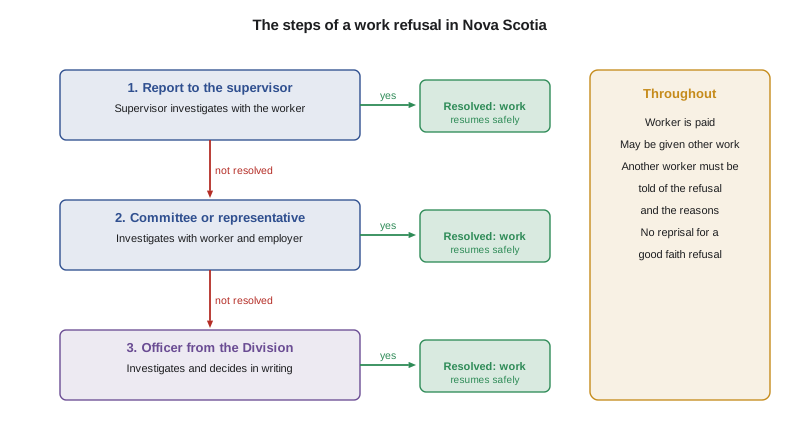
The Act sets out a process with escalating steps. At each step, someone tries to resolve the concern. If they cannot, it goes to the next.
- Step 1: report to the supervisor. The worker tells the supervisor or employer right away that they are refusing and why. The supervisor investigates with the worker and either fixes the problem or explains why they believe the work is safe.
- Step 2: the committee or representative. If the worker still believes the work is dangerous, the matter goes to the committee, or to the representative at a workplace without a committee. The committee investigates with the worker and the employer.
- Step 3: an officer. If the matter is still not resolved, the worker or employer can call the Occupational Health and Safety Division, and an officer investigates and decides whether the work is dangerous, giving the decision in writing.
While the refusal is being dealt with, the worker continues to be paid and can be given other work they are reasonably able to do. The employer may not assign another worker to do the refused work without telling them about the refusal and the reasons for it. And the employer may not discipline, dismiss or otherwise penalize the worker for exercising the right in good faith. A worker who believes they have been penalized can file a complaint with the Division.
The committee's part
Back in the freezer, Owen could not find a fault, and Jasmine still believed the truck was dangerous. That moved the matter to step 2. Owen called Leila, the worker member on shift, and as a management member of the committee he joined her. Together with Jasmine, they did several things:
- Listened first. Leila asked Jasmine to describe exactly what happened, in order, before anyone gave an opinion.
- Looked at the evidence. The fallen case was still in the aisle. The truck's fault log showed two hydraulic pressure alerts in the past hour.
- Tested safely. With the truck at floor level and the aisle clear, Ravi Patel, called in from maintenance, raised the mast slowly while everyone watched from a safe distance. On the third lift it jerked at about the same height.
- Agreed what to do. The truck was tagged out, Jasmine was moved to a ground-level picking task for the rest of the shift, and the truck went to the dealer for repair. A failing hydraulic valve was found.
The refusal was resolved at step 2. It took 50 minutes. Without the committee, it might have gone one of two bad ways: Owen might have insisted the truck was fine and asked another picker to use it, or Jasmine might have felt pressured into going back up.
Doing it well
Refusals are stressful for everyone. The worker is afraid of the hazard and often of what refusing will cost them. The supervisor is under pressure to keep work moving. Committee members feel the weight of a decision that could put someone in danger. Some practices help:
- Assume good faith. A refusal is not a challenge to the supervisor's authority. Treat it as a safety concern from the person closest to the hazard.
- Keep the worker involved. The worker takes part in every step of the investigation, not just the start.
- Make the area safe first. While the refusal is dealt with, nobody else should be exposed to the hazard.
- Record what happened. Write down the time, the concern, what was checked, what was found and what was decided, and sign it.
- Debrief afterwards. At the next meeting, the committee reviews the refusal: what went well, what could be better, and whether the hazard exists elsewhere.
Even when a refusal turns out to be unfounded, it is useful. It tells the committee that a worker was worried enough to stop, which usually means something needs explaining, training or fixing, even if the task itself was safe.
Concerns that are not refusals
Most safety concerns never reach a refusal. A worker notices a hazard and tells a supervisor or a committee member. The committee's role in these everyday concerns is to make sure they are recorded, answered and fixed, and that the person who raised them hears back. The distribution centre committee keeps a concern log, and lesson 9 covers how concerns become recommendations. A concern can also be taken to the Occupational Health and Safety Division directly, but Harrowgate Foods Ltd. encourages workers to try the internal routes first, because they are usually faster.
# Review of stop-work and refusal events across a year at the distribution site.
events = [
    ("order picker mast jerk", 2, True), ("freezer door won't open", 1, True),
    ("dock plate damaged", 1, True), ("wrapper guard missing", 1, True),
    ("ammonia smell in cooler", 2, True), ("pallet stack leaning", 1, True),
    ("cold gloves too thin", 2, False), ("battery room eyewash dry", 1, True),
]
for what, step, hazard in events:
    print(f"step {step}  {'hazard found' if hazard else 'no hazard'}  {what}")
resolved_1 = sum(1 for e in events if e[1] == 1)
found = sum(1 for e in events if e[2])
print(f"{len(events)} events, {resolved_1} resolved by the supervisor,"
f" {found} confirmed a real hazard")step 2 hazard found order picker mast jerk step 1 hazard found freezer door won't open step 1 hazard found dock plate damaged step 1 hazard found wrapper guard missing step 2 hazard found ammonia smell in cooler step 1 hazard found pallet stack leaning step 2 no hazard cold gloves too thin step 1 hazard found battery room eyewash dry 8 events, 5 resolved by the supervisor, 7 confirmed a real hazard
Eight stop-work events in a year, five resolved at the first step and three at the second. Seven found a real hazard. The eighth, the gloves, found that the gloves met the specification but pickers were spending longer in the freezer than the specification assumed, which led to a change in break timing rather than gloves.
Worked problem
A supervisor wants to assign the refused task to another worker
Show solution
- A worker refuses to clean a mixer at the sauces plant because the lockout device does not fit the new isolator.
- The supervisor believes the isolator can be locked with a padlock alone, and asks another worker to do the cleaning.
- The Act does not allow another worker to be assigned to the refused work without being told about the refusal and the reasons.
- The second worker hears the reasons and also refuses.
Answer: The matter goes to committee members, who find the padlock alone does not prevent the isolator being switched. A correct lockout device is fitted before cleaning resumes.
Preparing for refusals before they happen
The order picker refusal went well partly because the committee had prepared. Every member had a one-page refusal card in their locker and on the safety board, listing the steps, the questions to ask and the phone numbers they might need. The card also reminded members what not to do: do not promise an outcome before checking, do not discuss discipline, and do not leave the worker alone with the decision.
The committee also made sure every shift had trained members who could respond. After the training gaps found in lesson 4, the co-chairs set a rule that every shift, including weekends, would have at least one worker member and one management member who had completed the concerns and refusals module. Where a shift fell short, a trained member from another shift was on call by phone.
What the supervisor learned
Owen said afterwards that the order picker refusal had changed how he thought about refusals. His first reaction, when he could not see a fault, had been mild irritation: the dispatch deadline was two hours away and he was a picker short. Looking back, he realized that the truck's fault log had been available the whole time and he had not thought to check it. He now begins every safety concern by asking what records exist, such as fault logs, maintenance history and earlier concerns, before he decides whether the worker is right. He also told the committee that the most useful thing Leila did was ask Jasmine to tell the whole story before anyone interrupted, because the detail that the mast jerked at the same height both times was what led Ravi to the valve.
When an officer is called
Refusals at Harrowgate Foods Ltd. rarely reach step 3, but the committee prepares for it. If the worker or employer calls the Division, an officer will usually speak to the worker, the supervisor and the committee members involved, look at the work and the evidence, and decide whether the work is likely to endanger anyone. The officer may give orders to correct the hazard. The decision is in writing, and either side can appeal it within the time limits in the Act.
The committee's job during an officer's visit is to help the officer understand what happened. Members bring the record of the refusal, the evidence they collected and their view of the hazard. Worker members can speak with the officer privately. The committee then receives a copy of any orders and follows up the employer's compliance through its tracking log, just as it would for its own recommendations.
Elena told the committees that she did not see a call to the Division as a failure. 'If two reasonable people can't agree whether something is safe,' she said, 'that's exactly when we want someone independent to look at it.' In the company's first year under the new standard, one refusal at the sauces plant went to an officer. It concerned a new chemical dosing pump, the officer found the pump guarding inadequate and ordered it fixed, and the fix was made before the next shift.
Refusals by workers with less power
Not every worker feels able to refuse. Agency workers, new workers, workers on probation and workers whose first language is not English are often less likely to use the right, even when the danger is real. The committee tries to close that gap. Orientation for every new and agency worker explains the right to refuse in plain language and in the main languages spoken at each site, and introduces the committee members on their shift. Members on the floor watch for workers who seem uneasy about a task, and ask.
Common mistakes
MistakeTreating a refusal as insubordination.
InsteadTreat it as a safety concern from the person closest to the hazard.
MistakeAsking another worker to do the task without telling them.
InsteadTell any other worker about the refusal and the reasons before they are asked.
MistakeDeciding without the worker present.
InsteadKeep the refusing worker involved in every step.
MistakeLeaving others exposed while the refusal is investigated.
InsteadMake the area safe first.
MistakeForgetting the refusal once it is resolved.
InsteadDebrief at the next meeting and check for the hazard elsewhere.
Summary and key terms
- Nova Scotia workers may refuse work they have reasonable grounds to believe is dangerous.
- A refusal goes from supervisor to committee or representative to an officer.
- Workers are paid throughout and protected from reprisal.
- Committee members listen, examine evidence, test safely and agree what to do.
- Assume good faith, keep the worker involved, make the area safe and record what happened.
- Everyday concerns go to the concern log and become recommendations.
- Right to refuse
- The right of a worker to refuse work they have reasonable grounds to believe is dangerous.
- Reasonable grounds
- A belief that a reasonable person in the worker's position could hold.
- Good faith
- An honest belief, without an ulterior motive.
- Discriminatory action
- Punishing a worker for exercising a safety right.
- Stop-work steps
- A set process for checking a concern when a worker stops a task.
Practice problems
Work each problem on paper first, then reveal the answer to check.
What test applies to a refusal in Nova Scotia?
Show answer
Reasonable grounds to believe the work is likely to endanger health or safety.
What did the committee members find in the order picker refusal?
Show answer
A failing hydraulic valve, after the fault log and a safe test confirmed the problem.
Can another worker be given the refused task?
Show answer
Only after being told about the refusal and the reasons.
What happens to the refusing worker's pay?
Show answer
They continue to be paid and may be given other work.
Who decides if the committee cannot resolve a refusal?
Show answer
An officer from the Occupational Health and Safety Division.
Lesson quiz · 5 questions
Score 60% or more to complete this lesson.
Create a free account to save your progress, take quizzes and earn a certificate.