
HSE-405 · Lesson 6 of 12 · 21 min
Conducting inspections and ranking hazards
Leila Haddad and Hana Kim started the freezer inspection at 1:30 a.m. with a clear plan, a zone checklist and a quarterly focus on slips and trips. Ninety minutes later they had 31 findings written in a notebook, ranging from a missing label on a first aid kit to a pallet stack leaning badly over the main pick aisle. Back in the break room, Hana asked the question every new inspector asks: 'What do we do with all of this?' The answer is the subject of this lesson: how to conduct the inspection so it finds what matters, and how to rank what it finds so the most serious hazards are dealt with first.
Opening the inspection
A good inspection starts with the supervisor. Leila and Hana found the night freezer lead, explained which parts of the zone they would cover and asked whether anything had changed or gone wrong recently. He mentioned that a rack had been hit by a reach truck two nights earlier and was waiting for an assessment. That one conversation pointed them straight to the leaning stack, which turned out to be on the damaged rack.
Opening with the supervisor also makes clear that the inspection is not an audit of the supervisor's performance. Inspectors who arrive unannounced and start writing without a word tend to meet defensiveness. Inspectors who ask for help tend to get it.
Looking, listening and asking
Inspectors use three methods together. They look: at the condition of the floor, racking, equipment, guards, signs and PPE, and at how people are actually working. They listen: to equipment that sounds wrong, to alarms, and to what workers say among themselves. And they ask: the open questions from the zone checklist, plus follow-up questions about anything they notice.
The asking is often the hardest part for new inspectors. Leila's approach was to start with the work rather than the hazard. Instead of 'Are there any safety problems here?', which usually gets 'No', she asked a picker to show her how he picked from the top level of the freezer racks. He showed her, and explained that the step stools had been removed months ago because one broke, so pickers stood on the bottom rail of the pallet. That was not on any checklist, and no supervisor had mentioned it.
Inspectors watch for the gap between how work is supposed to be done and how it is actually done. That gap is rarely carelessness. It usually means the official method does not work in practice, because equipment is missing, the time allowed is too short or the procedure was written by someone who never did the job. The committee's job is to find the gap and understand why it exists, not to catch people in it.
Recording findings
Each finding is recorded in a way that someone who was not there can understand and act on. The committee's standard format has five parts:
- Where: the zone and exact location, such as 'freezer aisle 14, bay 6, level 3'.
- What: the condition or practice, described factually, such as 'pallet leaning about 15 cm into the aisle on a rack beam with a visible dent'.
- Why it matters: the harm that could result, such as 'pallet could fall into the main pick aisle where pickers walk'.
- Evidence: a photo, a measurement or what a worker said.
- Immediate action: anything done on the spot, such as 'area taped off and supervisor informed at 2:05 a.m.'.
Photos are particularly valuable. A photo of a leaning pallet persuades a manager far faster than a description. Inspectors avoid photographing faces where possible and never photograph a worker doing something unsafe to use against them. The photo is of the hazard.
When to stop and act at once
Some findings cannot wait for a report. If inspectors find a hazard that could cause serious injury at any moment, they deal with it immediately. They tell the supervisor, make sure the area or equipment is made safe, by taping off, stopping a machine or removing equipment from service, and record what was done. They do not leave the zone until the immediate danger is controlled. The leaning pallet was one of these: Leila and Hana stopped picking in that aisle, the supervisor had the stack taken down, and the rack bay was tagged out until maintenance could assess it the next morning.
The committee itself does not usually have the power to order work to stop. The employer does, and supervisors act on the committee's behalf. Harrowgate Foods Ltd.'s standard makes this explicit: a supervisor told of an immediate danger by inspectors must act at once and record the action, and the site manager is informed the same shift.
Ranking what you find
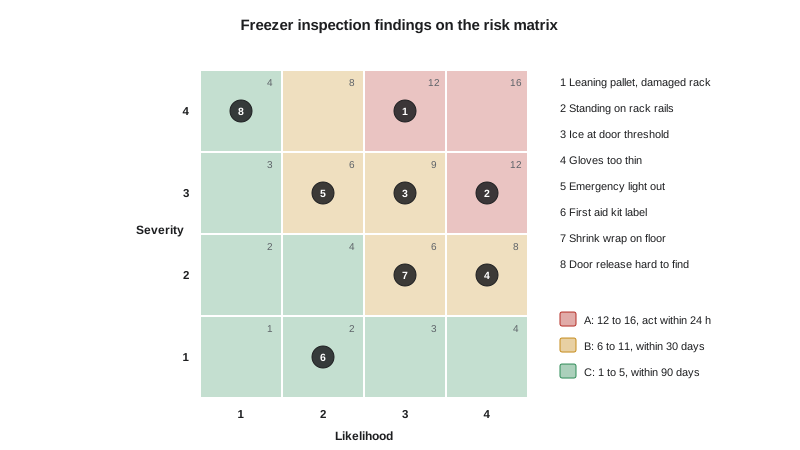
Back to Hana's question. Thirty-one findings cannot all be fixed at once, and treating them all as equally urgent means the serious ones get lost among the trivial. The committee ranks each finding by two things: how severe the harm could be, and how likely it is to happen. Both are rated from 1 to 4, and multiplying them gives a risk score from 1 to 16.
| Rating | Severity | Likelihood |
|---|---|---|
| 1 | Minor: first aid at most | Rare: could happen but unlikely in years |
| 2 | Moderate: medical treatment or a few days off work | Possible: could happen in the next year |
| 3 | Serious: lost time, fracture or lasting harm | Likely: could happen in the next few months |
| 4 | Severe: permanent disability or death | Almost certain: could happen any day |
Scores then sort findings into three classes, each with a target time for action. Class A, a score of 12 or more, means act immediately or within 24 hours. Class B, a score of 6 to 11, means act within 30 days. Class C, a score of 5 or less, means act within 90 days or at the next planned opportunity. The classes are a starting point. Inspectors can raise a finding's class when they have a good reason, such as a pattern of near misses, but they must explain why.
# Rank the freezer inspection findings by risk score and class.
findings = [
    ("pallet leaning on damaged rack, aisle 14", 4, 3),
    ("pickers standing on rack rails, no step stools", 3, 4),
    ("ice build-up at door threshold", 3, 3),
    ("gloves too thin for time spent inside", 2, 4),
    ("one emergency light not working", 3, 2),
    ("first aid kit missing label", 1, 2),
    ("shrink wrap on floor near wrapper", 2, 3),
    ("door release button hard to find in dark", 4, 1),
]
def cls(score):
    if score >= 12:
        return "A"
    if score >= 6:
        return "B"
    return "C"
ranked = sorted(findings, key=lambda f: -(f[1] * f[2]))
for what, sev, like in ranked:
    s = sev * like
    print(f"{cls(s)} {s:>2}  {what}")
counts = {}
for _, sev, like in findings:
    c = cls(sev * like)
    counts[c] = counts.get(c, 0) + 1
print("by class:", dict(sorted(counts.items())))A 12 pallet leaning on damaged rack, aisle 14
A 12 pickers standing on rack rails, no step stools
B 9 ice build-up at door threshold
B 8 gloves too thin for time spent inside
B 6 one emergency light not working
B 6 shrink wrap on floor near wrapper
C 4 door release button hard to find in dark
C 2 first aid kit missing label
by class: {'A': 2, 'B': 4, 'C': 2}Two findings came out as class A: the leaning pallet, already dealt with on the spot, and pickers standing on rack rails, which had been going on for months. Ice at the door threshold, thin gloves and the emergency light were class B. The door release button scored only 4, a class C, because nobody was likely to be trapped. But Leila argued that it should be raised to class B: if someone were trapped in a freezer at minus 25 degrees Celsius, the harm would be severe, and the button had not been tested in the dark. Hana agreed, and they recorded the reason.
Common ranking problems
Ranking is a judgement, and some patterns go wrong often enough to watch for:
- Ranking by how easy the fix is. A missing label is easy to fix and feels satisfying, but it is not more urgent than rack damage. Rank first, then think about fixes.
- Underrating familiar hazards. Pickers standing on rails had become normal. Inspectors who have worked in a zone for years often rate what they see every day as less likely than it is.
- Ignoring how many people are exposed. A hazard that affects every picker on every shift deserves more weight than the same hazard in a room one person enters once a month.
- Letting one person dominate. When a manager says 'that's a C' firmly, others may go along. The pair should rate independently and discuss differences.
Closing the inspection
Before leaving the zone, inspectors go back to the supervisor and summarize what they found, especially class A findings and anything done on the spot. They also mention what was working well. Leila made a point of telling the freezer lead that the pick paths were the clearest she had seen and that the new floor markings were working. Recognition is part of what makes the next inspection welcome.
Within two working days, inspectors write a short report: the date, time, zone and inspectors; the findings in class order with photos; immediate actions taken; and the recommendations they want the committee to make. The report goes to the supervisor, the site manager and every committee member, and is posted on the safety board. Findings and recommendations then go into the committee's tracking log, which lesson 9 covers in detail.
Following up
An inspection that finds hazards but never checks whether they were fixed teaches everyone that inspections do not matter. At the next visit to each zone, the first task is to check every open finding from the last one. At the freezer's next inspection three months later, Leila and Hana found that step stools had been bought and placed in every aisle, the door heater had been repaired and the gloves had been changed. The emergency light had been fixed but had failed again, which led to a recommendation to replace the whole unit rather than its battery.
Worked problem
Ranking a finding in the battery charging room
Show solution
- Finding: the eyewash station is behind a battery stand, about 20 m from the charging bays, and takes 25 seconds to reach.
- Severity: acid in the eyes could cause permanent damage, so severity is 4.
- Likelihood: splashes during watering happen a few times a year, so likelihood is 2.
- Score 8, class B. But the 10-second reach that eyewash guidance usually expects is far exceeded and acid splashes have happened.
Answer: The inspectors raise it to class A, record why, and recommend moving or adding an eyewash station next to the charging bays.
Inspecting behaviour without blaming people
Inspections often find people doing things that look unsafe: a picker without gloves, a driver going too fast, an operator reaching past a guard. It is tempting to record these as 'worker not following rules'. That kind of finding rarely leads to change, and it makes workers wary of the next inspection. The committee instead asks why. The picker without gloves had taken them off because they were wet and his hands were colder in them than without. The driver was speeding because dispatch times had been cut. The operator reached past the guard because the jam-clearing tool kept going missing.
Each of those reasons points to a fix that will last longer than a reminder: dry spare gloves at the freezer door, a review of dispatch targets, a tool tethered to the machine. Committee members record the behaviour, but the finding is written about the condition that produced it. Sam put it simply in the training session: 'If we write a person's name on a finding, we have probably stopped asking questions too early.'
Inspecting with the quarterly focus topic
The focus topic gives each inspection a second purpose. In the slips and trips quarter, Leila and Hana spent twenty minutes of the freezer visit doing nothing but walking the main routes slowly, looking at floor surfaces, lighting, changes in level and anything left in walkways. They found the ice at the door threshold this way, and also noticed that the floor markings at one intersection had worn away so pickers cut the corner through a reach truck lane. Across all eleven zones, the slips and trips quarter produced 46 findings, which the committee analyzed together. Nearly a third related to water or ice from doors, evaporators and cleaning, which led to one recommendation covering the whole site rather than 14 separate ones.
Common mistakes
MistakeArriving without telling the supervisor and starting to write.
InsteadOpen with the supervisor and ask what has changed or gone wrong.
MistakeAsking 'Are there any safety problems here?'
InsteadAsk workers to show how they do the job, and watch for gaps.
MistakeWriting vague findings like 'housekeeping poor'.
InsteadRecord where, what, why it matters, evidence and immediate action.
MistakeLeaving an immediate danger for the report.
InsteadMake it safe on the spot, with the supervisor, before moving on.
MistakeRanking by how easy the fix is.
InsteadRank by severity and likelihood, then plan fixes.
Summary and key terms
- Open with the supervisor, then look, listen and ask, focusing on how work is really done.
- Record each finding with where, what, why it matters, evidence and immediate action.
- Deal with immediate dangers on the spot with the supervisor.
- Rank findings by severity and likelihood into classes A, B and C with target times.
- Watch for familiar hazards, exposure and dominant voices when ranking.
- Close with the supervisor, report within two working days and check open findings at the next visit.
- Risk score
- Severity multiplied by likelihood, from 1 to 16.
- Class A finding
- A score of 12 or more, needing action immediately or within 24 hours.
- Class B finding
- A score of 6 to 11, needing action within 30 days.
- Class C finding
- A score of 5 or less, needing action within 90 days.
- Work as done
- How a task is actually performed, which may differ from the written procedure.
Practice problems
Work each problem on paper first, then reveal the answer to check.
Why open an inspection with the supervisor?
Show answer
To learn what has changed or gone wrong and to show the inspection is not an audit of them.
What are the five parts of a recorded finding?
Show answer
Where, what, why it matters, evidence and immediate action.
A hazard scores severity 3 and likelihood 3. What class is it?
Show answer
Class B, with a score of 9.
Why might inspectors raise a finding's class?
Show answer
For a good reason such as severe potential harm, a pattern of near misses or many people exposed, recorded in the report.
What is the first task at the next visit to a zone?
Show answer
Check every open finding from the last inspection.
Lesson quiz · 5 questions
Score 60% or more to complete this lesson.
Create a free account to save your progress, take quizzes and earn a certificate.