
HSE-405 · Lesson 8 of 12 · 21 min
Worker complaints, refusals and OSHA inspections
At 3:15 on a Sunday morning, Jasmine Clarke stopped her order picker in the middle of the freezer and refused to keep using it. The truck's mast had jerked twice while she was lifting at the top level, and the second time a case slid off the forks and fell past her into the aisle. She called the night supervisor, Owen Fraser, and told him she would not go up again until the truck had been checked. Owen looked at the truck, could not find anything wrong and asked if she was sure. She was.
What happened next was a refusal to work, and it raised questions that every safety committee in the United States should be ready to answer. What rights does a worker have to refuse dangerous work? How can workers raise concerns with OSHA, and what protects them when they do? What happens during an OSHA inspection, and who can take part? This lesson covers those questions and the role a voluntary committee can play.
The right to refuse
Federal law gives workers a limited right to refuse dangerous work. It is not written in the OSH Act itself but in OSHA's regulation at 29 CFR 1977.12(b)(2). A worker may refuse in good faith to do a task if four conditions are met: the worker has asked the employer to eliminate the danger, where possible, and the employer has not done so; the worker refused in good faith; a reasonable person would agree that there is a real danger of death or serious injury; and there is not enough time, because of the urgency, to have the danger eliminated through a regular OSHA inspection. Some states with their own OSHA-approved plans and some collective agreements give broader rights.
The federal right is narrower than the right in many other countries. It covers imminent danger of death or serious injury, not every hazard. Harrowgate Foods Inc.'s company standard for its Georgia sites therefore goes further than the law: any worker who believes a task is likely to cause injury can stop and ask for it to be checked, following a set of steps modeled on the refusal processes in Canadian provincial laws, without loss of pay and without fear of reprisal.
Harrowgate Foods Inc.'s stop-work steps
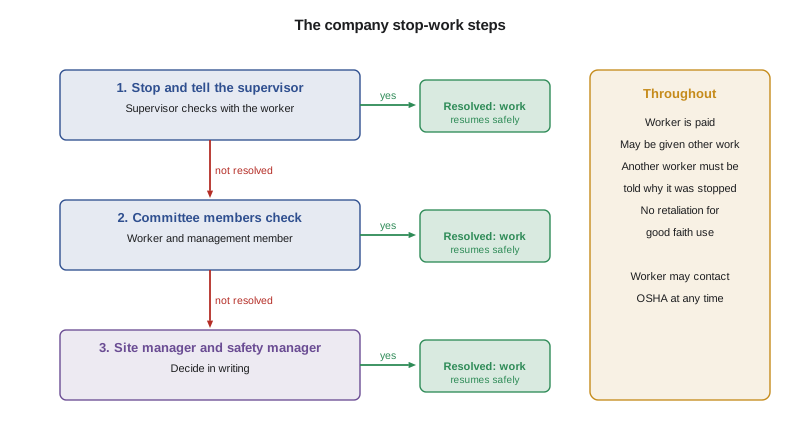
The company standard for its Georgia sites sets out steps that work alongside the federal right:
- Step 1: stop and tell the supervisor. The worker stops the task, makes the area safe if possible and tells the supervisor why. The supervisor checks the concern with the worker and either fixes it or explains why they believe the work is safe.
- Step 2: a committee member. If the worker is still concerned, a worker member and a management member of the committee check the situation with the worker and supervisor, and recommend what should happen.
- Step 3: the site manager and Elena. If the matter is still not resolved, the site manager and the safety manager decide, in writing. The worker is told of their right to contact OSHA at any time.
The worker is paid throughout and may be given other work. Another worker may not be asked to do the stopped task without being told why it was stopped. Nobody is disciplined for using the steps in good faith, even if the concern turns out to be unfounded.
The committee's part
Back in the freezer, Owen could not find a fault, and Jasmine still believed the truck was dangerous. That moved the matter to step 2. Owen called Leila, the worker member on shift, and as a management member of the committee he joined her. Together with Jasmine, they did several things:
- Listened first. Leila asked Jasmine to describe exactly what happened, in order, before anyone gave an opinion.
- Looked at the evidence. The fallen case was still in the aisle. The truck's fault log showed two hydraulic pressure alerts in the past hour.
- Tested safely. With the truck at floor level and the aisle clear, Ravi Patel, called in from maintenance, raised the mast slowly while everyone watched from a safe distance. On the third lift it jerked at about the same height.
- Agreed what to do. The truck was tagged out, Jasmine was moved to a ground-level picking task for the rest of the shift, and the truck went to the dealer for repair. A failing hydraulic valve was found.
The refusal was resolved at step 2. It took 50 minutes. Without the committee, it might have gone one of two bad ways: Owen might have insisted the truck was fine and asked another picker to use it, or Jasmine might have felt pressured into going back up.
Doing it well
Refusals are stressful for everyone. The worker is afraid of the hazard and often of what refusing will cost them. The supervisor is under pressure to keep work moving. Committee members feel the weight of a decision that could put someone in danger. Some practices help:
- Assume good faith. A refusal is not a challenge to the supervisor's authority. Treat it as a safety concern from the person closest to the hazard.
- Keep the worker involved. The worker takes part in every step of the investigation, not just the start.
- Make the area safe first. While the refusal is dealt with, nobody else should be exposed to the hazard.
- Record what happened. Write down the time, the concern, what was checked, what was found and what was decided, and sign it.
- Debrief afterwards. At the next meeting, the committee reviews the refusal: what went well, what could be better, and whether the hazard exists elsewhere.
Even when a refusal turns out to be unfounded, it is useful. It tells the committee that a worker was worried enough to stop, which usually means something needs explaining, training or fixing, even if the task itself was safe.
Complaints to OSHA
Workers can file a complaint with OSHA at any time about a hazard they believe violates a standard or poses a serious danger, online, by phone, by mail or in person. They can ask that their name not be revealed to the employer. OSHA may respond with an inspection or, for less serious matters, by contacting the employer and asking for a response. Harrowgate Foods Inc. tells workers about this right in orientation and on the safety board, and encourages them to use the internal routes as well, because they are usually faster.
Protection from retaliation
Section 11(c) of the OSH Act protects workers from retaliation for exercising their rights, including raising concerns, filing complaints, taking part in inspections and refusing dangerous work under the conditions above. A worker who believes they have been punished has 30 days to file a retaliation complaint with OSHA. The short deadline is one reason Harrowgate Foods Inc.'s committee makes sure workers know their rights in advance. Committee members themselves are protected for their safety activities.
OSHA inspections and the committee
When an OSHA compliance officer arrives, the committee has a role. Under 29 CFR 1903.8, a representative authorized by employees may accompany the compliance officer during the walkaround. At non-union workplaces such as Harrowgate Foods Inc.'s Georgia sites, the compliance officer can consult workers directly, and a worker member of the committee is a natural choice to accompany the inspection. A 2024 rule clarified who can serve as an employee representative, and drew legal challenges and debate, so the committee guide states the general principle: workers have a voice in inspections. Harrowgate Foods Inc.'s standard says that a worker member of the committee will be invited to accompany any OSHA inspection, and that the committee will receive a copy of any citations and the employer's response.
# Review of stop-work and refusal events across a year at the distribution site.
events = [
    ("order picker mast jerk", 2, True), ("freezer door won't open", 1, True),
    ("dock plate damaged", 1, True), ("wrapper guard missing", 1, True),
    ("ammonia smell in cooler", 2, True), ("pallet stack leaning", 1, True),
    ("cold gloves too thin", 2, False), ("battery room eyewash dry", 1, True),
]
for what, step, hazard in events:
    print(f"step {step}  {'hazard found' if hazard else 'no hazard'}  {what}")
resolved_1 = sum(1 for e in events if e[1] == 1)
found = sum(1 for e in events if e[2])
print(f"{len(events)} events, {resolved_1} resolved by the supervisor,"
f" {found} confirmed a real hazard")step 2 hazard found order picker mast jerk step 1 hazard found freezer door won't open step 1 hazard found dock plate damaged step 1 hazard found wrapper guard missing step 2 hazard found ammonia smell in cooler step 1 hazard found pallet stack leaning step 2 no hazard cold gloves too thin step 1 hazard found battery room eyewash dry 8 events, 5 resolved by the supervisor, 7 confirmed a real hazard
Eight stop-work events in a year, five resolved at the first step and three at the second. Seven found a real hazard. The eighth, the gloves, found that the gloves met the specification but pickers were spending longer in the freezer than the specification assumed, which led to a change in break timing rather than gloves.
Worked problem
A supervisor wants to give the stopped task to another worker
Show solution
- A worker refuses to clean a mixer at the sauces plant because the lockout device does not fit the new isolator.
- The supervisor believes the isolator can be locked with a padlock alone, and asks another worker to do the cleaning.
- The company standard does not allow the stopped task to be given to another worker without being told why it was stopped.
- The second worker hears the reasons and also refuses.
Answer: The matter goes to committee members, who find the padlock alone does not prevent the isolator being switched. A correct lockout device is fitted before cleaning resumes.
Preparing for refusals before they happen
The order picker refusal went well partly because the committee had prepared. Every member had a one-page refusal card in their locker and on the safety board, listing the steps, the questions to ask and the phone numbers they might need. The card also reminded members what not to do: do not promise an outcome before checking, do not discuss discipline, and do not leave the worker alone with the decision.
The committee also made sure every shift had trained members who could respond. After the training gaps found in lesson 4, the co-chairs set a rule that every shift, including weekends, would have at least one worker member and one management member who had completed the concerns and refusals module. Where a shift fell short, a trained member from another shift was on call by phone.
What the supervisor learned
Owen said afterwards that the order picker refusal had changed how he thought about refusals. His first reaction, when he could not see a fault, had been mild irritation: the dispatch deadline was two hours away and he was a picker short. Looking back, he realized that the truck's fault log had been available the whole time and he had not thought to check it. He now begins every safety concern by asking what records exist, such as fault logs, maintenance history and earlier concerns, before he decides whether the worker is right. He also told the committee that the most useful thing Leila did was ask Jasmine to tell the whole story before anyone interrupted, because the detail that the mast jerked at the same height both times was what led Ravi to the valve.
Workers who are less likely to speak up
Not every worker feels able to stop a task or call OSHA. Staffing agency workers, new workers and workers whose first language is not English are often less likely to use their rights, even when the danger is real. OSHA treats staffing agency and host employers as sharing responsibility for temporary workers' safety, and Harrowgate Foods Inc.'s committee tries to close the gap in practice. Orientation for every new and agency worker explains the stop-work steps and OSHA rights in plain language and in the main languages spoken at each site, and introduces the committee members on their shift.
Common mistakes
MistakeTreating a refusal as insubordination.
InsteadTreat it as a safety concern from the person closest to the hazard.
MistakeAsking another worker to do the task without telling them.
InsteadTell any other worker about the refusal and the reasons before they are asked.
MistakeDeciding without the worker present.
InsteadKeep the refusing worker involved in every step.
MistakeLeaving others exposed while the refusal is investigated.
InsteadMake the area safe first.
MistakeForgetting the refusal once it is resolved.
InsteadDebrief at the next meeting and check for the hazard elsewhere.
Summary and key terms
- Federal law gives a limited right to refuse when there is imminent danger and no time for an inspection.
- The company stop-work steps go from supervisor to committee members to the site manager and safety manager.
- Workers are paid throughout and protected from reprisal.
- Committee members listen, examine evidence, test safely and agree what to do.
- Assume good faith, keep the worker involved, make the area safe and record what happened.
- Workers can complain to OSHA at any time, have 30 days to file a retaliation complaint and have a voice in inspections.
- Right to refuse
- The limited federal right to refuse work posing an imminent danger of death or serious injury.
- Reasonable grounds
- A belief that a reasonable person in the worker's position could hold.
- Good faith
- An honest belief, without an ulterior motive.
- Retaliation
- Punishing a worker for exercising a safety right.
- Stop-work steps
- A set process for checking a concern when a worker stops a task.
Practice problems
Work each problem on paper first, then reveal the answer to check.
Name two of the four conditions for a protected refusal under 29 CFR 1977.12(b)(2).
Show answer
Any two of: asked the employer to fix it, good faith, a reasonable person would see real danger of death or serious injury, no time for an OSHA inspection.
What did the committee members find in the order picker refusal?
Show answer
A failing hydraulic valve, after the fault log and a safe test confirmed the problem.
Can another worker be given the refused task?
Show answer
Only after being told about the refusal and the reasons.
What happens to the refusing worker's pay?
Show answer
They continue to be paid and may be given other work.
How long does a worker have to file a retaliation complaint with OSHA?
Show answer
30 days.
Lesson quiz · 5 questions
Score 60% or more to complete this lesson.
Create a free account to save your progress, take quizzes and earn a certificate.