
HSE-405 · Lesson 3 of 12 · 20 min
Forming the committee: membership, co-chairs and terms of reference
The distribution centre committee's problems did not start with the cancelled meetings. They started with who was on it and why. Of its eight members, three of the four management members were the managers who were busiest during the afternoon truck rush, which is when the committee met. Two worker members worked only days, so nobody represented the night shift, where most of the pickers and all the agency workers were. One worker member had been on the committee for nine years and had stopped coming. Nobody could find the committee's terms of reference; Grace Whitfield, the distribution centre manager, eventually found a two-page document from 2016 in a shared drive, signed by a manager who had left.
Elena and Grace agreed to start over. They would rebuild the committee from the ground up: decide what it was for, who should be on it, how members would be chosen, how long they would serve, how it would make decisions and how it would connect to the rest of the site. This lesson follows that rebuild and draws out the choices any workplace faces when it forms or reforms a committee.
Start with purpose
A committee's terms of reference begin with its purpose. Elena drafted a one-sentence purpose that every member could remember: 'The committee helps the site find and fix hazards before they hurt anyone, by bringing workers and managers together to inspect, investigate, listen to concerns and recommend improvements, and by checking that recommendations are acted on.' Everything else in the terms of reference followed from that sentence. If a proposed activity did not help find or fix hazards, it did not belong.
The purpose also made clear what the committee was not. It was not a disciplinary body, not a forum for pay or scheduling disputes, and not a substitute for supervisors dealing with hazards they saw every day. Writing those limits down early saved arguments later.
How big should the committee be?
Nova Scotia's Act does not set a fixed number of members; it requires at least half to be non-management workers and leaves the size to the workplace. Common practice is to scale the committee to the workplace: large enough to cover every area and shift, small enough to make decisions. Six to twelve members is typical for workplaces of a few dozen to a few hundred workers.
Elena and Grace mapped the distribution centre by area and shift to decide how many seats were needed. The site had receiving, putaway, picking, loading, the freezer, maintenance and the office, across day, evening and night shifts. The goal was not one member per area and shift, which would have meant over twenty members, but enough members that every area and every shift had someone they could reach.
# Coverage check for a proposed committee at the distribution site.
areas = ["receiving", "putaway", "picking", "loading", "freezer", "maintenance", "office"]
shifts = ["day", "evening", "night"]
members = {
    "Sam (worker)":     {"areas": ["loading", "receiving"], "shifts": ["day"]},
    "Leila (worker)":   {"areas": ["picking", "freezer"],   "shifts": ["night"]},
    "Marco (worker)":   {"areas": ["putaway", "freezer"],   "shifts": ["evening"]},
    "Jasmine (worker)": {"areas": ["picking"],              "shifts": ["night"]},
    "Grace (mgmt)":     {"areas": ["office"],               "shifts": ["day"]},
    "Owen (mgmt)":      {"areas": ["loading", "picking"],   "shifts": ["night"]},
    "Ravi (mgmt)":      {"areas": ["maintenance"],          "shifts": ["day", "evening"]},
    "Hana (mgmt)":      {"areas": ["receiving", "putaway"], "shifts": ["evening"]},
}
workers = sum(1 for m in members if "worker" in m)
print(f"members {len(members)}, workers {workers}, at least half workers: {workers * 2 >= len(members)}")
for a in areas:
    who = [m.split()[0] for m, d in members.items() if a in d["areas"]]
    print(f"{a:<12} {', '.join(who) if who else 'NOBODY'}")
for sh in shifts:
    who = [m.split()[0] for m, d in members.items() if sh in d["shifts"]]
print(f"{sh:<12} {len(who)} members")members 8, workers 4, at least half workers: True receiving Sam, Hana putaway Marco, Hana picking Leila, Jasmine, Owen loading Sam, Owen freezer Leila, Marco maintenance Ravi office Grace day 3 members evening 3 members night 3 members
The new committee of eight covered every area and every shift, with two worker members and one management member on nights. Owen Fraser, an operations supervisor who worked nights, joined as a management member, replacing one of the day managers who had been too busy to attend. Grace stayed on because the distribution centre manager's presence showed the committee mattered, but she agreed to send a delegate with decision authority if she could not attend.
Choosing worker members
Worker members must be selected by the workers they represent, or by the union where there is one. They cannot be appointed by management, and they must not exercise management functions. In practice, the cleanest method in a non-union workplace is a call for volunteers followed by an election if there are more volunteers than seats. Nova Scotia's sample rules of procedure describe exactly that approach.
At the distribution centre, Elena posted a call for volunteers in English, French, Tagalog and Arabic, the main languages of the workforce, explaining what members do, how much time it takes and that members are paid for committee work. She also asked supervisors to tell their crews about it at shift start. Nine workers volunteered for four seats. The election ran over two days so every shift could vote, with ballot boxes in the lunchroom and the night break room. Sam was re-elected. Leila Haddad, a night picker, Marco Silva, an evening putaway driver, and Jasmine Clarke, a night picker who had joined the company six months earlier and had never been on a committee, were elected with him.
Agency workers raised a question. About a quarter of the night pickers at the distribution centre were supplied by a staffing agency. Were they workers who could vote and stand? Elena's view was that anyone who regularly works at the site is part of the workforce the committee protects and should be able to raise concerns with it. Agency workers were invited to vote. None stood for a seat that year, but the committee agreed to invite the agency's site coordinator to meetings as a guest so agency workers' concerns would have a route in.
Choosing management members
Management members should have enough authority to make or obtain decisions, enough knowledge of the operation to contribute, and enough time to take part. A committee whose management members cannot commit to anything without checking with someone else becomes a talking shop. On the other hand, a committee made up entirely of senior managers can intimidate worker members. The usual balance is a mix: one senior manager with authority, one or two supervisors who know the floor, and a specialist such as a maintenance lead.
At the distribution centre, the management members after the rebuild were Grace, Owen, Ravi Patel from maintenance and Hana Kim, the evening receiving supervisor. Elena attended as an adviser without a vote, which is a common arrangement for health and safety staff: they bring expertise and help the committee, but the committee belongs to the workplace, not to the safety department.
Co-chairs
Each committee has two co-chairs, one chosen by the worker members and one by the management members. They usually alternate chairing meetings and share the work between meetings: preparing agendas, following up recommendations, coordinating inspections and representing the committee to management and workers. The worker members chose Sam again; the management members chose Owen, partly because he worked nights and could be the co-chair night workers saw most often.
Co-chairs need more time than other members. Harrowgate Foods Ltd.'s standard gives each co-chair up to four hours a week of paid time for committee work, in addition to meetings and inspections, and both co-chairs at the main plant have an agreed half-day each week for it.
Terms and continuity
Members need long enough terms to learn the job and short enough terms to bring in new people. Two years is common, with terms staggered so that half the members change each year and the committee never loses all its experience at once. The nine-year member at the distribution centre had become disengaged partly because nobody had ever asked whether he wanted to continue. The new terms of reference set two-year terms, renewable once by election, after which a member steps off for at least a year.
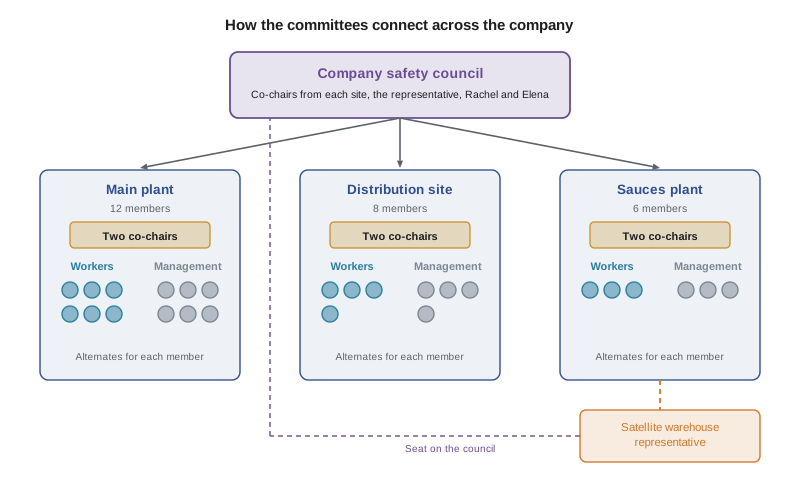
Alternates help with continuity. Each worker and management member at Harrowgate Foods Ltd. has a named alternate who receives the agenda and minutes and attends when the member cannot. Alternates take the same basic training. Over time, alternates become the natural candidates for full membership.
Decision-making and quorum
The terms of reference should say how the committee makes decisions and how many members must be present for a meeting to count. Most committees decide by consensus where they can and by vote where they must. Nova Scotia's sample rules suggest that a quorum is half the members, with at least one employer member, and that decisions on work refusals use a recorded vote. Harrowgate Foods Ltd. adopted a similar rule: quorum is half the members including at least one worker co-chair or management co-chair, and at least two worker members.
Consensus does not mean everyone must agree enthusiastically. It means everyone can live with the decision and nobody's serious concern has been brushed aside. When the committee cannot reach consensus on a recommendation, the minutes record both views and the recommendation can go forward with the disagreement noted. That is often more useful to the decision-maker than a recommendation watered down until everyone agrees.
What goes in the terms of reference
The rebuilt terms of reference at the distribution centre ran to four pages and covered:
- purpose and scope
- membership, including number of members, balance, how members are chosen, terms and alternates
- co-chairs and their duties
- meeting schedule, agenda, quorum and decision-making
- minutes: who takes them, how quickly they are circulated, where they are posted and how long they are kept
- inspections: schedule, areas, method and reporting
- investigations: when committee members take part and how
- concerns and complaints: how workers raise them and how the committee responds
- recommendations: format, tracking and expected response times
- training for members and alternates
- paid time and resources
- how the committee links to the company safety council and to other sites
- annual review of the terms of reference and the committee's effectiveness
Elena made a point of having the committee itself write and approve the terms of reference, with her help, rather than handing members a finished document. It took three meetings. It was worth it: when disagreements came up later, members pointed to rules they had written themselves.
Making the committee visible
A committee nobody knows about cannot hear concerns. The main plant's self-assessment had shown that many workers could not name a single member. The new terms of reference required a committee board at each site's main entrance and break rooms, with photos of members and alternates, their areas and shifts, how to reach them, the date of the next meeting, the latest minutes and the status of open recommendations. Members also introduced themselves at shift-start meetings after each election. At the sauces plant, members started wearing a small green sticker on their hard hats, an idea from the workers that cost almost nothing and made members easy to find on the floor.
Worked problem
Is this committee properly formed?
Show solution
- A committee at another food plant has ten members: six managers and four workers. The plant manager chose all ten. It meets on day shift only, and nobody can find its terms of reference.
- Balance: at least half the members must be non-management workers. Four of ten is not enough.
- Selection: worker members must be chosen by workers, not by the plant manager.
- Coverage: a day-only schedule with no night members leaves night workers without a route.
- Rules: without terms of reference, nobody knows the quorum, decision method or response times.
Answer: No. It needs at least five worker members chosen by workers, coverage of every shift, and written terms of reference approved by the committee.
Common mistakes
MistakeLetting management choose the worker members.
InsteadHave workers choose their own members, by volunteers and election or through the union.
MistakeFilling management seats with whoever is busiest and most senior.
InsteadChoose managers with authority, floor knowledge and time to take part.
MistakeLeaving whole shifts or areas unrepresented.
InsteadMap areas and shifts and make sure everyone has a member they can reach.
MistakeKeeping the same members for a decade with no review.
InsteadUse staggered two-year terms and alternates to keep continuity and bring in new people.
MistakeHanding the committee a finished terms of reference.
InsteadHave the committee write and approve its own terms, with support.
Summary and key terms
- Terms of reference start with a clear purpose: find and fix hazards before they hurt anyone.
- Size the committee to cover every area and shift; at least half must be non-management workers.
- Worker members are chosen by workers; management members need authority, knowledge and time.
- Two co-chairs, one from each side, share the work and need dedicated time.
- Staggered two-year terms and alternates give continuity.
- Quorum and decision rules prevent meetings of managers only and record disagreements honestly.
- Make members visible so workers know who to approach.
- Terms of reference
- The written rules that set out a committee's purpose, membership, procedures and responsibilities.
- Quorum
- The minimum number and mix of members who must be present for a meeting to make decisions.
- Alternate
- A named substitute who attends when a member cannot and receives the same training.
- Staggered terms
- Terms arranged so that only part of the committee changes at a time.
- Consensus
- A decision everyone can accept, with serious concerns addressed or recorded.
- Coverage map
- A check that every area and shift has at least one committee member.
Practice problems
Work each problem on paper first, then reveal the answer to check.
What proportion of committee members must be non-management workers?
Show answer
At least half.
How should worker members be chosen in a non-union workplace?
Show answer
By the workers, usually through a call for volunteers and an election.
Why are staggered terms useful?
Show answer
They keep experience on the committee while bringing in new members.
What should a quorum rule prevent?
Show answer
Meetings going ahead with only management members, or too few members to represent the workplace.
Give three things a committee board should show.
Show answer
Members and alternates with photos, areas and shifts, contact details, next meeting date, latest minutes and open recommendations.
Lesson quiz · 5 questions
Score 60% or more to complete this lesson.
Create a free account to save your progress, take quizzes and earn a certificate.