
HSE-405 · Lesson 2 of 12 · 20 min
Legal requirements across Canada
Before rebuilding the committees, Elena wanted every member at Harrowgate Foods Ltd. to understand what the law actually requires, and what it leaves to the workplace to decide. Too many committee arguments, she had found, came from people half-remembering a rule from another province or another job. This lesson sets out the legal framework for joint committees and representatives in Nova Scotia, compares it with other Canadian jurisdictions, and shows how Harrowgate Foods Ltd. turned the law into practical rules for its three sites.
Health and safety law in Canada is mostly provincial
In Canada, most workplaces are regulated by the province or territory where they operate. Each province has its own occupational health and safety act and regulations, and each sets its own rules for joint committees and representatives. A minority of workplaces, such as banks, airlines, interprovincial trucking, telecommunications and federal government departments, fall under federal jurisdiction and the Canada Labour Code. Harrowgate Foods Ltd. makes and distributes food within Nova Scotia, so its sites fall under Nova Scotia's Occupational Health and Safety Act.
The details differ from province to province, but the core model is the same everywhere: workplaces above a certain size must have a committee with worker and management members, smaller workplaces must have a representative, and committees and representatives have defined powers to inspect, investigate, receive concerns and make recommendations. Because many companies operate in more than one province, and because workers move between jobs, it is worth knowing both the Nova Scotia rules and the general pattern.
Nova Scotia: when a committee or representative is required
Under Nova Scotia's Act, an employer must establish a joint occupational health and safety committee at a workplace where 20 or more people are regularly employed. Where 5 to 19 people are regularly employed, the workers must select one or more health and safety representatives from among themselves. On construction projects, the constructor must establish a committee where 20 or more people are regularly employed on the project by one or more constructors.
The word workplace matters. Each of Harrowgate Foods Ltd.'s three sites is a separate workplace with well over 20 workers, so each needs its own committee. The satellite warehouse near Kentville, with 12 workers in a separate building a few kilometres from the sauces plant, is its own workplace with fewer than 20 workers, so it needs a representative rather than a committee. Elena considered whether the warehouse workers could simply be covered by the sauces plant committee, and decided the cleaner answer was a representative who also attends the sauces plant committee meetings as a guest.
Nova Scotia: membership and co-chairs
A Nova Scotia committee is made up of worker members and employer members. Worker members are selected by the workers they represent, or by the union where workers are unionized, and must not exercise management functions. The employer appoints its own members. At least half of the members must be workers who do not exercise management functions. The committee has two co-chairs: one chosen by the worker members and one chosen by the employer members. The law does not set an exact number of members; the committee's rules of procedure do, and the number should reflect the size and complexity of the workplace.
Nova Scotia: what the committee does
The Act gives the committee a broad set of duties. In plain terms, it is expected to:
- receive, investigate and promptly deal with concerns and complaints about health and safety from workers
- take part in identifying hazards and in workplace inspections
- make recommendations to the employer and workers about improving health and safety
- take part in, and critically review, investigations of accidents and incidents
- investigate work refusals where the supervisor and worker cannot resolve them
- advise on personal protective equipment and on the health and safety program
- take part in inspections and inquiries by health and safety officers
- maintain records of its meetings and activities
Nova Scotia: meetings, minutes, time and training
The committee must meet at least once a month unless the regulations or its own rules of procedure set a different schedule. The employer must post the most recent minutes in the workplace and keep minutes for at least five years. Committee members are entitled to time away from their regular work to attend meetings, carry out inspections and investigations and take training, and that time is paid at their regular rate. The employer must provide training so members can do their job, and must allow them to take it during working hours.
Nova Scotia: recommendations and responses
One of the most important provisions for a working committee is section 34 of the Act. When the committee or representative makes a written recommendation and asks for a written response, the employer must respond in writing within 21 days. The response must either accept the recommendation or give reasons for not accepting it. If a full response is not reasonably possible in 21 days, the employer must explain the delay and say when the response will come. If the committee considers the response or the delay unreasonable, the co-chairs must report it to an occupational health and safety officer. Lesson 9 shows how to use this provision well.
Other Canadian jurisdictions
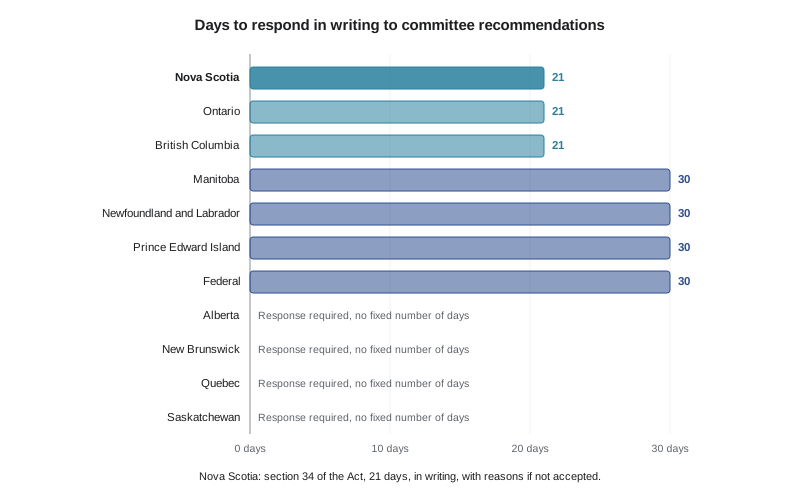
The general pattern across Canada is similar, but the thresholds, training requirements and response deadlines differ. Most provinces require a committee at 20 or more workers, although Saskatchewan sets the threshold at 10. Representative thresholds vary. Training requirements range from general duties to train, as in Nova Scotia, to specific requirements such as Ontario's certified members, who must complete approved certification training, and British Columbia's annual educational leave for committee members. The table compares employer response deadlines for committee recommendations, one of the clearest points of difference.
| Jurisdiction | Written response to committee recommendations |
|---|---|
| Nova Scotia | Within 21 days (section 34) |
| Ontario | Within 21 days |
| British Columbia | Within 21 days |
| Manitoba | Within 30 days |
| Newfoundland and Labrador | Within 30 days |
| Prince Edward Island | Within 30 days |
| Federal (Canada Labour Code) | Within 30 days |
| Alberta, New Brunswick, Quebec | No fixed number of days; duty to cooperate and respond |
| Saskatchewan | Response required, without a fixed number of days |
Under the Canada Labour Code, federally regulated employers have a slightly different structure. A workplace with 20 or more employees needs a workplace committee, a workplace with fewer than 20 needs a representative, and an employer with 300 or more employees must also have a policy committee that deals with company-wide issues. The federal model is worth knowing because the policy committee idea, a committee above the site committees, is one some provincially regulated employers adopt voluntarily.
Quebec has been modernizing its regime since 2021, phasing in committees and representatives across sectors that were previously not covered. Ontario's regime is often used as a reference because of its certified member requirement: at a workplace with 20 or more workers, at least one worker member and one management member must be certified, and certified members have a specific power to stop work in dangerous circumstances. Nova Scotia does not have certified members, but Harrowgate Foods Ltd. borrowed the idea of a structured core training program, as lesson 4 explains.
The legal register for the committees
Elena added a section on committees and representatives to Harrowgate Foods Ltd.'s legal register, listing each requirement, how it applied at each site, who owned it and what evidence showed it was met. Then she asked a simple question: which sites were meeting each requirement now? The answer explained part of the distribution site's problem.
# Committee requirements in Nova Scotia and whether each site meets them now.
reqs = ["committee or representative in place", "at least half are non-management workers",
        "co-chairs chosen by each side", "meets at least monthly", "minutes posted",
        "minutes kept 5 years", "members trained", "written responses within 21 days"]
status = {
    "main plant":   [1, 1, 1, 1, 1, 1, 0, 1],
    "distribution": [1, 1, 1, 0, 0, 1, 0, 0],
    "sauces plant": [1, 1, 1, 1, 1, 1, 0, 1],
    "warehouse":    [0, None, None, None, None, None, 0, None],
}
for site, s in status.items():
    applicable = [x for x in s if x is not None]
    met = sum(applicable)
    gaps = [r for r, x in zip(reqs, s) if x == 0]
print(f"{site:<13} {met}/{len(applicable)} met; gaps: {', '.join(gaps)}")main plant 7/8 met; gaps: members trained distribution 4/8 met; gaps: meets at least monthly, minutes posted, members trained, written responses within 21 days sauces plant 7/8 met; gaps: members trained warehouse 0/2 met; gaps: committee or representative in place, members trained
No site had a structured training program for members, which was a gap everywhere. The distribution site was missing monthly meetings, posted minutes and timely responses. The warehouse had no representative at all: when it opened two years earlier, nobody had thought about it. Elena arranged for the warehouse workers to select a representative within a month.
Law is the floor, not the goal
Whatever the legal requirements, Elena reminded the committees that the law sets a minimum. A committee can meet every legal requirement, post every set of minutes and still fail to find hazards or get them fixed. Equally, a committee can go well beyond the law: inspecting more often, involving night workers, tracking every recommendation in public. Harrowgate Foods Ltd. decided that its committee standard would meet the law at every site and then add the practices that the best committees use, which later lessons describe.
Worked problem
Committee or representative?
Show solution
- Harrowgate Foods Ltd. opens a new cross-dock building in Bedford with 14 workers on two shifts, five kilometres from the Dartmouth distribution centre.
- Is it a separate workplace? Yes: a separate building with its own workers and operations.
- How many people are regularly employed there? Fourteen, fewer than 20.
- What does the law require? Workers must select one or more health and safety representatives.
- Should the representative have a link to the distribution centre committee? Not required, but useful: the representative can attend its meetings as a guest and share its inspection and investigation support.
Answer: A health and safety representative selected by the workers, ideally attending the distribution centre committee as a guest.
Turning the law into a company standard
Legal requirements tell a committee what must happen. They rarely say how. Elena drafted a short company standard for committees that every site would follow, so that a worker moving from the main plant to the distribution centre would find the same basic arrangements. The standard set the size of each committee, the length of terms, the meeting schedule, the inspection schedule, how recommendations are written and tracked, how minutes are taken and posted, what training members receive and how the committees link to one another. Each site could add to the standard but not go below it.
The standard also created something the law does not require: a company safety council made up of the co-chairs from all three sites and the representative from the warehouse, meeting quarterly with Rachel and Elena. Its job was to deal with issues that crossed sites, such as purchasing standards for forklifts or a common approach to agency worker orientation, and to share what each committee was learning. Elena borrowed the idea from the federal policy committee model.
Unionized workplaces in Nova Scotia
Two of Harrowgate Foods Ltd.'s sites are not unionized, but the sauces plant's production workers are represented by a union. At that site, the union selects the worker members of the committee, as the Act provides. The collective agreement also has a short safety clause that repeats some legal requirements and adds a few, such as the union's right to send a member on any regulator inspection. Elena made sure the company standard did not conflict with the collective agreement, and asked the union's safety representative to review the draft before it was finalized.
Common mistakes
MistakeAssuming the rules from another province apply in Nova Scotia.
InsteadCheck the act and regulations for the province where the workplace is.
MistakeTreating one committee as covering several separate workplaces.
InsteadEach workplace needs its own committee or representative, depending on its size.
MistakeLetting written recommendations sit without a response.
InsteadRespond in writing within 21 days, accepting the recommendation or giving reasons.
MistakeTreating legal compliance as the goal.
InsteadUse the law as the minimum and build practices that make the committee effective.
MistakeForgetting small or new locations.
InsteadCheck every site, including satellites, when it opens and when headcount changes.
Summary and key terms
- Most Canadian workplaces are regulated by their province; federal workplaces fall under the Canada Labour Code.
- Nova Scotia requires a committee at 20 or more regularly employed workers and a representative at 5 to 19.
- At least half the members must be non-management workers; each side chooses a co-chair.
- Committees meet at least monthly, minutes are posted and kept five years, and members get paid time and training.
- Section 34 requires a written response to written recommendations within 21 days.
- Thresholds, training rules and response deadlines differ across provinces.
- Workplace
- A place where workers are regularly employed; each separate workplace is assessed for committee or representative requirements.
- Health and safety representative
- A worker selected by co-workers at a workplace of 5 to 19 workers to carry out the functions of a committee.
- Section 34
- The Nova Scotia provision requiring a written response to written committee recommendations within 21 days.
- Policy committee
- Under the Canada Labour Code, a company-wide committee required for employers with 300 or more employees.
- Certified member
- In Ontario, a committee member who has completed approved certification training and has specific powers.
Practice problems
Work each problem on paper first, then reveal the answer to check.
At what workplace size does Nova Scotia require a joint committee?
Show answer
20 or more regularly employed workers.
What is required at a Nova Scotia workplace with 5 to 19 workers?
Show answer
One or more health and safety representatives selected by the workers.
How long does an employer have to respond to a written recommendation in Nova Scotia?
Show answer
21 days, under section 34 of the Act.
Name a province with a different response deadline.
Show answer
Manitoba, Newfoundland and Labrador and Prince Edward Island require 30 days; Alberta, New Brunswick and Quebec set no fixed number of days.
Why did the satellite warehouse need a representative?
Show answer
It is a separate workplace with 12 workers, fewer than 20.
Lesson quiz · 5 questions
Score 60% or more to complete this lesson.
Create a free account to save your progress, take quizzes and earn a certificate.