
HSE-405 · Lesson 7 of 12 · 21 min
The committee's role in incident investigation
At 11:40 on a Thursday night, a reach truck at the distribution centre clipped the end of a rack in the cooler while backing out of an aisle. A case of glass jars fell from the second level and shattered beside a picker, Marco Silva's colleague Dev, who was cut on the hand and wrist by flying glass. He needed stitches at the hospital and was off work for four days. Owen Fraser, as night operations supervisor, started the investigation. As management co-chair of the committee, he also called Sam Pellerin at home the next morning. 'I want a worker member on this from the start,' he said. 'Can you or Leila come in?'
HSE-403 covers how to investigate incidents in depth: securing the scene, interviewing, finding causes and choosing corrective actions. This lesson is narrower. It is about what the committee does in investigations, why its involvement matters and how it uses investigations to learn across the workplace.
Why the committee takes part
Investigations led only by management often stop at the first cause that fits. A reach truck hit a rack, so the driver was careless, so the driver gets retrained. Worker members bring a different view. They know whether the aisle is always that tight, whether drivers are under time pressure, whether the rack end has been hit before, and whether pickers routinely work in aisles while trucks are moving. They are also more likely to be trusted by witnesses, who may not tell a supervisor what they would tell a co-worker.
Committee involvement also helps the investigation's findings stick. When a worker member has helped identify the causes and agreed the corrective actions, other workers are more likely to believe the investigation was fair and the fixes are real.
What the law says
Canadian jurisdictions give committees a role in investigations, though the details vary. In Nova Scotia, the employer is responsible for investigating accidents and incidents, and the committee's functions include taking part in investigations and receiving information about incidents so it can make recommendations. Serious injuries and certain dangerous occurrences must also be reported promptly to the Occupational Health and Safety Division. Under the Canada Labour Code, the federal workplace committee participates in all inquiries, investigations and studies about health and safety. Ontario requires a designated worker member to investigate critical injuries and fatalities. Harrowgate Foods Ltd.'s company standard follows the federal model: the committee takes part in every investigation of an injury that needs medical treatment and every serious near miss.
The committee's roles in an investigation
Committee involvement can take several forms. Harrowgate Foods Ltd. uses four, depending on the seriousness of the event.
| Event | Committee role | Who from the committee |
|---|---|---|
| Serious injury, fatality or high-potential near miss | Full member of the investigation team from the start | One worker member and one management member |
| Injury needing medical treatment | Member of the investigation team | One worker member, usually from the shift involved |
| First aid injury or ordinary near miss | Reviews the supervisor's investigation at the next meeting | Whole committee |
| All incidents | Reviews trends quarterly | Whole committee |
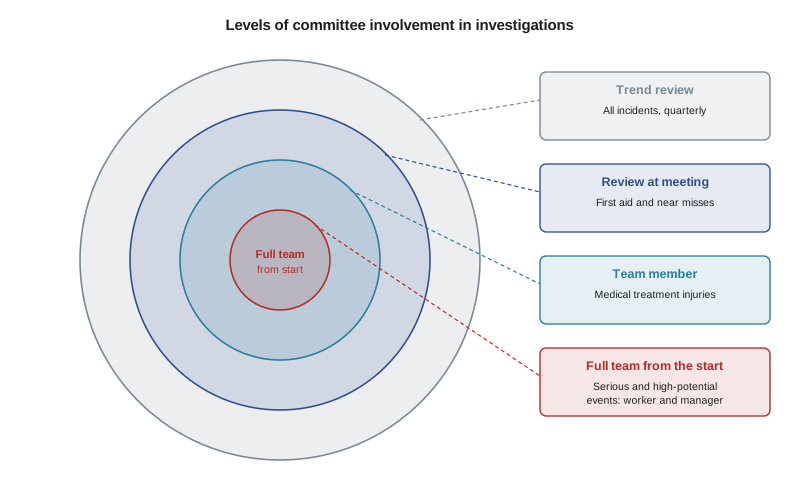
Dev's injury needed stitches and four days off, so it fell into the second row, and the reach truck striking a rack with people nearby made it a high-potential event as well. Owen therefore treated it as a first-row investigation. Leila, who worked nights in the cooler and knew the area, joined him on the team.
What worker members do on the team
Leila's role was not to watch Owen investigate. She was a full member of the team, with the same access to the scene, the witnesses, the records and the equipment. In practice she did several things Owen could not easily do himself:
- Interviewed witnesses alongside him, and in one case alone, when a picker asked to speak only to a worker member.
- Explained how work really happened in the cooler, including that pickers routinely worked in aisles while reach trucks put away stock, because the evening putaway had fallen behind for weeks.
- Found the history: three earlier rack strikes in the same aisle in six months, two never reported, which she learned about from drivers.
- Challenged the first explanation. When the reach truck driver's supervisor suggested retraining as the answer, Leila asked why an experienced driver had hit a rack he had passed thousands of times.
The answer to Leila's question came from measuring. The aisle had been narrowed by 20 cm two months earlier when a new rack row was added to make room for a new customer's products. Nobody had checked the reach truck's turning clearance against the new width. Drivers had been compensating, and two had already clipped the rack without anyone getting hurt.
Protecting witnesses and members
Investigations can make people nervous, and the committee helps make sure nobody is punished for telling the truth. Harrowgate Foods Ltd.'s standard says that investigations look for causes, not culprits, and that information from witnesses is used to prevent recurrence, not for discipline. Worker members are told that if they ever see an investigation being used to blame or punish, they should raise it with the co-chairs and, if needed, with the site manager or Elena.
The driver involved was understandably worried. Leila spoke with him early, explained what the investigation was for and made sure he had a chance to describe what happened before anyone drew conclusions. He gave the clearest account of how the narrowed aisle had changed the way drivers backed out.
From investigation to recommendation
The investigation team found several contributing causes: the aisle had been narrowed without a change review, pickers worked in aisles during putaway because putaway was behind, and earlier rack strikes had not been reported. The corrective actions followed:
- Widen the aisle back to its original width, or restrict that aisle to a narrower truck. The site chose to move the new rack row.
- Add aisle width and truck clearance to the change review checklist for any layout change.
- Separate picking and putaway in the cooler by time, with putaway finished before night picking starts, and add a light that shows when a truck is in an aisle.
- Make clear that rack strikes must be reported, with no discipline for an honest report.
Leila brought the investigation to the next committee meeting. The committee formally adopted the corrective actions as recommendations, which brought them into the committee's tracking and response process covered in lesson 9. That step matters. Corrective actions in an investigation report can be quietly dropped. Committee recommendations need a written response and are tracked until they are closed.
Learning from patterns
Individual investigations explain individual events. The committee's quarterly trend review asks what the incidents of the past three months have in common. Grace Chen, the site safety lead, prepared a summary for each review: every incident and near miss, sorted by zone, type, shift and cause.
# Quarterly trend review of incidents and near misses at the distribution site.
events = [
    ("cooler", "struck by", "night"), ("cooler", "struck by", "night"),
    ("freezer", "slip", "night"), ("docks", "struck by", "day"),
    ("cooler", "struck by", "evening"), ("pick modules", "strain", "night"),
    ("freezer", "slip", "night"), ("docks", "caught between", "day"),
    ("pick modules", "strain", "night"), ("cooler", "struck by", "night"),
    ("shipping", "cut", "evening"), ("freezer", "cold", "night"),
    ("pick modules", "strain", "evening"), ("docks", "struck by", "day"),
]
def count(i):
    out = {}
    for e in events:
        out[e[i]] = out.get(e[i], 0) + 1
    return sorted(out.items(), key=lambda x: -x[1])
print("total:", len(events))
print("by zone: ", count(0))
print("by type: ", count(1))
print("by shift:", count(2))
night = sum(1 for e in events if e[2] == "night")
print(f"night share: {night / len(events):.0%}")total: 14
by zone: [('cooler', 4), ('freezer', 3), ('docks', 3), ('pick modules', 3), ('shipping', 1)]
by type: [('struck by', 6), ('strain', 3), ('slip', 2), ('caught between', 1), ('cut', 1), ('cold', 1)]
by shift: [('night', 8), ('day', 3), ('evening', 3)]
night share: 57%The pattern was clear. More than half of the quarter's events happened on nights, though nights had about a third of the hours worked. The cooler had four struck-by events, all involving reach trucks. Strains in the pick modules were the next cluster. The committee recommended a review of night staffing and putaway timing across the whole site, not just the cooler, and asked for an ergonomics assessment of the pick modules.
Worked problem
Should the committee be involved in this investigation?
Show solution
- On the day shift, a pallet jack runs over a worker's toe at the docks. Safety boots prevent injury; first aid is not needed.
- The supervisor says it is too minor to involve the committee.
- Under the standard, a near miss with no injury is reviewed by the committee at its next meeting, unless it is high-potential.
- A loaded pallet jack over a foot could cause fractures, and the docks had two struck-by events this quarter.
Answer: Treat it as a high-potential near miss: a worker member joins the investigation now, and the event is added to the docks pattern for the trend review.
When the committee disagrees with the investigation
Most investigations at Harrowgate Foods Ltd. end with the team agreeing on causes and actions. Occasionally they do not. A few months after the rack strike, a sanitation worker at the main plant slipped on a wet floor and sprained her wrist. The supervisor's investigation concluded that she had not been wearing the approved non-slip boots, and recommended a reminder to all sanitation staff. The worker member on the team, Tomás, disagreed. The approved boots had been out of stock in her size for six weeks, the floor drain in that area had been partly blocked since the spring, and the sanitation schedule had been cut from three hours to two, so floors were still wet when production staff walked through.
The company standard deals with this. When committee members on an investigation team do not agree with its conclusions, they can attach a written statement of their own view to the report, and the disagreement goes to the next committee meeting. The committee then decides whether to make its own recommendations. In this case it did: it recommended restocking the boots and checking supply monthly, clearing the drain and adding it to the preventive maintenance schedule, and reviewing whether two hours was enough for sanitation. The site manager accepted the first two and asked for a trial to settle the third. The trial showed that the shorter schedule left floors wet on most nights, and the third hour was restored.
A disagreement handled this way is not a failure. It is the committee doing what it is for: making sure the people closest to the work are heard before conclusions are drawn.
Sharing lessons across sites
An investigation at one site often has lessons for others. The narrowed aisle at the distribution centre prompted the company safety council to ask every site whether racking had been changed in the past year without a clearance check. The main plant found one, in its packaging store, and fixed it before anyone was hurt. Elena now circulates a one-page summary of every serious investigation to all committees within a month, with the causes, the actions and a question for each committee to discuss: could this happen here?
The summaries are written for workers, not lawyers. They use plain language, a photo or simple diagram, and no names. Committees discuss them at their next meeting, and the minutes record each committee's answer to the question. Over the first year, the summaries led to eleven changes at sites other than the one where the incident happened.
Supporting the people involved
Investigations deal with events that affected real people. Dev was shaken after the glass broke beside him, and for weeks afterwards he avoided the cooler aisle where it happened. Leila checked in with him, made sure he knew about the employee assistance program and asked the supervisor to let him work in another zone until he felt ready. Committee members are not counsellors, but they are often the first to notice when a colleague is struggling after an incident, and they can make sure the support the company offers actually reaches people.
Common mistakes
MistakeInviting the committee in after the investigation is finished.
InsteadInvolve a worker member from the start for serious and high-potential events.
MistakeTreating the worker member as an observer.
InsteadGive them the same access and role as other team members.
MistakeStopping at 'driver error'.
InsteadAsk why an experienced person made the error and look for changes in the work.
MistakeLeaving corrective actions only in the investigation report.
InsteadAdopt them as committee recommendations so they are tracked and answered.
MistakeReviewing each incident alone.
InsteadLook for patterns by zone, type, shift and cause each quarter.
Summary and key terms
- Worker members bring knowledge of real work, trust from witnesses and credibility to findings.
- Nova Scotia gives committees a role in investigations; federal and Ontario rules are more specific.
- Involvement ranges from trend review for all incidents to full team membership for serious events.
- Worker members interview, explain real work, find history and challenge first explanations.
- Investigations seek causes, not culprits; witnesses must be protected.
- Corrective actions become committee recommendations, and quarterly trend reviews find patterns.
- High-potential event
- An incident or near miss that could reasonably have caused serious injury.
- Contributing cause
- A condition or decision that helped an incident happen.
- Trend review
- A regular look at incidents together to find patterns.
- Change review
- A check of the safety effects of a change before it is made.
- Corrective action
- A step taken to prevent an incident happening again.
Practice problems
Work each problem on paper first, then reveal the answer to check.
Name two things worker members bring to investigations.
Show answer
Knowledge of how work really happens and trust from witnesses.
What was the underlying cause of the rack strike in the cooler?
Show answer
The aisle had been narrowed without checking reach truck clearance.
Why adopt corrective actions as committee recommendations?
Show answer
So they get a written response and are tracked until closed.
What did the trend review show about nights?
Show answer
More than half of the events happened on nights, with about a third of the hours.
When should a near miss be treated as high-potential?
Show answer
When it could reasonably have caused serious injury.
Lesson quiz · 5 questions
Score 60% or more to complete this lesson.
Create a free account to save your progress, take quizzes and earn a certificate.