
HSE-405 · Lesson 10 of 12 · 21 min
Running effective meetings and minutes
The main plant committee's meetings used to last two hours and achieve very little. The agenda was handed out at the door. The first forty minutes went on reading last month's minutes aloud. The plant manager, who attended as a guest, spoke for much of the rest. Worker members rarely said anything, and when they did, it was usually to raise a concern that had already been raised at the previous meeting. The minutes recorded who attended and summarized the discussion in a few vague lines. Members left tired, and two resigned within a year.
Meetings are where the committee's work comes together. Inspection reports, investigations, concerns, refusals and recommendations are all discussed and decided there. A well-run meeting turns this work into decisions in an hour. A poorly run one wastes everyone's time and teaches members that the committee is a talking shop. This lesson covers the practical skills of running a good committee meeting and recording it well.
What the law and the terms of reference require
Nova Scotia's Act requires committees to meet at least once a month unless the Director of Occupational Health and Safety sets a different schedule, to keep minutes, and to make them available to workers and to officers. Nova Scotia's committee guide recommends that minutes be posted where workers can see them and kept for at least five years. The guide also includes sample rules of procedure covering agendas, quorum, decision-making and minutes. Harrowgate Foods Ltd.'s terms of reference, adapted from those sample rules, require the agenda to be circulated five working days before each meeting and the minutes to be circulated within four working days after it.
Before the meeting
Most of what makes a meeting work happens before it starts. The co-chairs meet for half an hour a week before each meeting to build the agenda. They gather the inspection reports and investigations completed since the last meeting, the tracking log, new concerns, responses received and anything members have asked to add. They decide what needs a decision, what needs discussion and what can simply be reported in writing.
The agenda goes to every member, alternate and regular guest five working days ahead, with the papers attached. Members are expected to read them before the meeting. That one change at the main plant ended the reading of minutes aloud: the previous minutes are now approved in two minutes, with only corrections discussed.
A standard agenda
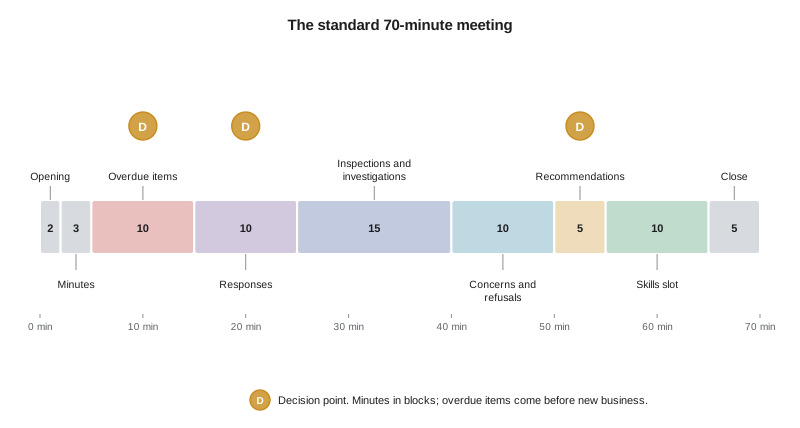
The distribution centre committee uses the same agenda structure every month, with time limits for each item. Having the same structure means members know what to expect and nothing important is forgotten.
| Item | Purpose | Time |
|---|---|---|
| 1. Opening and quorum | Confirm a quorum is present, including worker members | 2 min |
| 2. Previous minutes | Approve, with corrections only | 3 min |
| 3. Overdue items from the tracking log | Discuss each overdue response or action and agree next steps | 10 min |
| 4. Responses received | Review each written response and decide if it is acceptable | 10 min |
| 5. Inspections and investigations | Key findings and proposed recommendations | 15 min |
| 6. New concerns and refusals | Review the concern log and any refusals since the last meeting | 10 min |
| 7. Recommendations to send | Agree the wording of new recommendations | 5 min |
| 8. Skills slot | Ten minutes of practice on a real piece of committee work | 10 min |
| 9. Other business and close | Confirm actions, owners and the next meeting | 5 min |
The order matters. Overdue items come early, before new business, so they are dealt with while members are fresh and cannot be pushed off the end of the meeting. The skills slot from lesson 4 comes near the end, after the decisions are made.
During the meeting
Co-chairs share the chairing, usually alternating each month. The chair's job is to keep the meeting on time, make sure everyone is heard and make sure each item ends with a clear outcome. Sam and Owen, who alternate at the distribution centre, agreed on some habits:
- Start and finish on time. A meeting that starts ten minutes late tells members their time does not matter.
- Hear worker members first on each item. Managers tend to speak first and with authority, which can stop others from contributing. Asking worker members first, as Owen learned in training, changes the discussion.
- One item, one outcome. Each item ends with a decision, an action with an owner and a date, or a clear note that it is for information only.
- Park side issues. When a discussion wanders, the chair writes the new topic on a 'parking lot' sheet and comes back to it at the end or at the next meeting.
- Keep guests to their item. Guests such as the plant manager attend for specific items and are welcome, but they do not run the meeting.
Making decisions
Most committee decisions are made by consensus: discussion continues until everyone can accept the outcome, even if it is not their first choice. Consensus takes longer than a vote but produces decisions that both worker and management members will support. Voting is a poor fit for a joint committee, because it can turn the meeting into a contest between two sides.
When consensus cannot be reached, the terms of reference set out what happens. The co-chairs can send the recommendation with a note that members disagreed and why, as lesson 9 described. Or the item can be held over for a month while more information is gathered. What the committee should not do is let disagreement quietly drop an issue from the agenda.
Dealing with difficult moments
Committee meetings sometimes become tense. A worker member may be angry about a recommendation that was rejected. A manager may feel criticized when an inspection finds problems in their area. A guest may try to dominate. The chair's job is to keep the discussion on the safety issue and away from personalities. Useful phrases include 'Let's focus on what we can recommend', 'What would it take to fix this?' and 'Can we hear from someone who works in that area?'
Sometimes a member needs a private word after the meeting. When a supervisor attending as a guest dismissed a concern raised by Jasmine with 'that's not a real problem', Sam took him aside afterwards and explained that the comment had made it harder for new members to speak. The supervisor apologized to Jasmine at the next meeting, which did more for the committee's culture than a dozen posters.
Minutes that work
Minutes are the committee's official record. They show what the committee found, what it recommended, what responses it received and what it did. They are read by workers on the safety board, by managers and sometimes by inspectors. The main plant's old minutes summarized discussion in a few lines and were useless as a record. The new standard requires minutes to record:
- Who attended, including whether a quorum was present and which alternates stood in.
- Each agenda item with a short factual summary, not a transcript.
- Decisions and recommendations, worded exactly as agreed.
- Actions, each with an owner and a due date.
- Disagreements, briefly, where members did not reach consensus.
- The date of the next meeting.
Minutes avoid naming workers who raised concerns unless they agree, and never include medical details about anyone. They are written in plain language so that any worker reading the safety board can understand them.
# Check a draft set of minutes against the standard before circulating.
minutes = {
    "attendance": ["Sam", "Owen", "Leila", "Marco", "Grace", "Ravi", "Hana"],
    "worker_members_present": 3,
    "items": 9,
    "actions": [
        ("send yard lighting recommendation", "Sam", "2026-06-20"),
        ("check eyewash move", "Ravi", None),
        ("follow up dock plate response", "Owen", "2026-06-18"),
        ("book refusal training for nights", "", "2026-06-30"),
    ],
    "next_meeting": "2026-07-14",
    "days_after_meeting": 3,
}
problems = []
if minutes["worker_members_present"] < 2:
    problems.append("quorum not met: need 2 worker members")
for what, owner, due in minutes["actions"]:
    if not owner:
        problems.append(f"no owner: {what}")
    if not due:
        problems.append(f"no due date: {what}")
if not minutes["next_meeting"]:
    problems.append("next meeting date missing")
if minutes["days_after_meeting"] > 4:
    problems.append("circulated late")
print("ready to circulate" if not problems else "fix before circulating:")
for p in problems:
print(" -", p)fix before circulating: - no due date: check eyewash move - no owner: book refusal training for nights
Two problems: the eyewash check has no due date and the refusal training has no owner. Owen fixed both before the minutes went out. A simple check like this, done by the person taking minutes, stops actions from drifting because nobody knew they were responsible.
Posting and sharing
Minutes are posted on the safety board at each site within a day of being approved, and sent by email to members, alternates and the site manager. At the distribution centre, they are also shown on the break room screen for a week, with a one-paragraph summary at the top in plain language: what the committee found this month, what it recommended and what got fixed. The summary is translated into the main languages spoken at the site.
Worked problem
Getting a meeting back on track
Show solution
- Twenty minutes into the meeting, discussion of a near miss at the docks has turned into an argument about whether drivers from one carrier are careless.
- The chair, Sam, notices the meeting is behind and the discussion is about people, not conditions.
- He says: 'Let's park the carrier question for now. What happened at the dock, and what would stop it happening again?'
- Members agree that the dock lights failed to show the trailer was not secured. A recommendation to test dock lights weekly is agreed.
Answer: The chair moved the discussion from blame to conditions, reached a decision and put the carrier issue in the parking lot for a separate conversation with the transport manager.
Meetings across shifts
A monthly meeting at 10 a.m. suits day workers and excludes everyone else. Night members either came in on their day off or missed meetings, and Leila had attended only half of them in her first year. The distribution centre committee now holds its meeting at 3 p.m., at the overlap between day and evening shifts, and pays night members who attend as working time, with a matching early finish on their next shift. A video link lets a member join from home if needed, though the terms of reference require the co-chairs and at least half of members to be in the room. Attendance by night members went from about 50 per cent to over 90 per cent within three months.
Inviting guests well
Guests can make meetings more useful: the maintenance manager to explain a delayed repair, a supplier to discuss a new piece of equipment, an ergonomist to present an assessment. They can also derail them. The co-chairs invite guests for specific items, tell them in advance how long they have and what the committee wants to know, and schedule their item early so they can leave. The plant manager at the main plant now attends one meeting a quarter for a fifteen-minute slot to respond to the committee directly, rather than sitting through every meeting.
Reviewing the meeting itself
Every few months, the co-chairs spend the last five minutes of a meeting asking members how the meetings are working. They use three questions: what is working, what is not, and what should we change? At the main plant, the answers led to shorter inspection reports at meetings, with details in the papers rather than read out, and to rotating the minute-taking role so that one member did not carry it alone. Two years after the old two-hour meetings, the main plant committee's meetings ran for 70 minutes, and no member had resigned in eighteen months.
Between meetings
Not everything can wait a month. The co-chairs speak at least weekly, usually for fifteen minutes on a Monday, to check urgent items, overdue responses and anything that came up over the weekend. Urgent recommendations are agreed by the co-chairs and confirmed at the next meeting. Members share inspection reports and concerns through a shared folder rather than saving them for the meeting. The monthly meeting then becomes a place to make decisions, not to hear news for the first time.
Common mistakes
MistakeHanding out the agenda at the door.
InsteadCirculate it with papers five working days ahead.
MistakeReading the previous minutes aloud.
InsteadApprove them quickly, discussing only corrections.
MistakeLeaving overdue items to the end.
InsteadDeal with them early, before new business.
MistakeLetting managers speak first on every item.
InsteadHear worker members first.
MistakeRecording actions without owners or dates.
InsteadCheck every action has both before circulating.
Summary and key terms
- Nova Scotia requires monthly meetings and minutes made available to workers; the company adds timing rules for agendas and minutes.
- Co-chairs build the agenda ahead and circulate it with papers five working days before.
- A standard agenda puts overdue items early and ends with a skills slot.
- Chairs start on time, hear worker members first and end each item with an outcome.
- Decisions are made by consensus where possible, and disagreement is recorded rather than dropped.
- Minutes record attendance, decisions, actions with owners and dates, and are posted promptly.
- Agenda
- The list of items for a meeting, circulated in advance.
- Quorum
- The minimum number of members, including worker members, needed for a valid meeting.
- Consensus
- A decision everyone can accept, even if it is not their first choice.
- Parking lot
- A list of side issues to come back to later.
- Minutes
- The official record of a meeting's decisions and actions.
Practice problems
Work each problem on paper first, then reveal the answer to check.
When should the agenda be circulated under the terms of reference?
Show answer
Five working days before the meeting, with papers.
Why put overdue items early on the agenda?
Show answer
So they are dealt with while members are fresh and cannot be pushed off the end.
Why hear worker members first?
Show answer
Managers speaking first can stop others contributing.
Why is voting a poor fit for a joint committee?
Show answer
It can turn the meeting into a contest between two sides.
What two problems did the minutes check find?
Show answer
An action without a due date and an action without an owner.
Lesson quiz · 5 questions
Score 60% or more to complete this lesson.
Create a free account to save your progress, take quizzes and earn a certificate.