
HSE-405 · Lesson 2 of 12 · 21 min
Federal OSHA and state requirements for safety committees
Before rebuilding the committees, Elena wanted every member at Harrowgate Foods Inc. to understand what the law requires, what it does not, and why the company was running committees anyway. Too many committee arguments, she had found, came from people half-remembering a rule from another state or another job. This lesson sets out the federal position on safety committees, the states that do require them, the labor law limits on how committees can be set up, and how Harrowgate Foods Inc. turned all of that into practical rules for its three sites in Georgia.
No federal requirement for safety committees
The OSH Act does not require private employers to have safety committees, and federal OSHA has no general standard requiring them. A handful of OSHA standards involve workers in specific ways, such as the process safety management standard's requirement for employee participation, but there is no federal rule that a general industry employer must have a joint committee.
That does not mean OSHA is indifferent to worker involvement. OSHA's Recommended Practices for Safety and Health Programs, published in 2016, treat worker participation as one of seven core elements of an effective program, alongside management leadership, hazard identification and assessment, hazard prevention and control, education and training, program evaluation and improvement, and communication and coordination for host employers, contractors and staffing agencies. The Recommended Practices suggest that workers take part in developing the program, reporting hazards, investigating incidents and evaluating results. A committee is one common way of doing that, though not the only one.
OSHA's Voluntary Protection Programs, which recognize sites with strong safety management systems, also expect meaningful employee involvement. Many VPP sites use committees, and the updated VPP manual that took effect in June 2026 aligns the program's elements with the Recommended Practices.
States that require safety committees
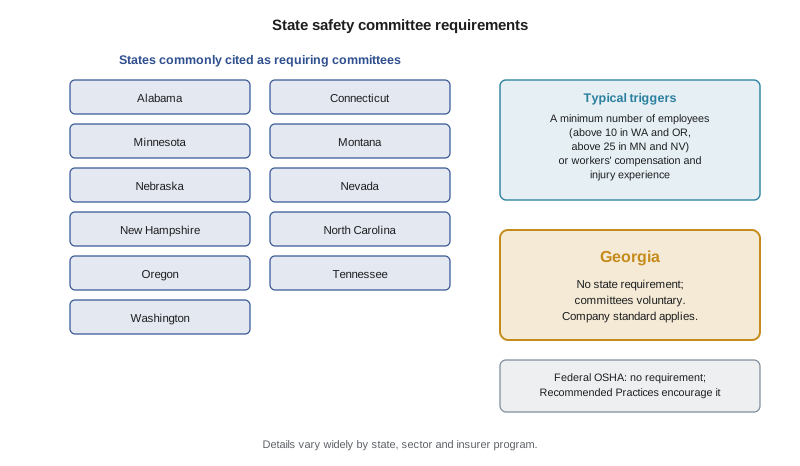
Several states require some private employers to have safety committees, usually through their state OSHA plan or their workers' compensation law. Lists vary slightly depending on how strictly a requirement is defined, but states commonly cited as having safety committee requirements include Alabama, Connecticut, Minnesota, Montana, Nebraska, Nevada, New Hampshire, North Carolina, Oregon, Tennessee and Washington. The details differ a great deal.
- Washington and Oregon require safety committees for many employers, generally those with more than ten employees, with smaller employers allowed to hold regular safety meetings instead. Both states set rules on membership, meetings, minutes and inspections.
- Minnesota requires committees for employers with more than 25 employees, and for smaller employers with high injury rates, as part of its workplace safety law, which also requires a written AWAIR (A Workplace Accident and Injury Reduction) program.
- Nevada requires a committee for employers with more than 25 employees as part of its written safety program requirement.
- Several other states tie committee requirements to workers' compensation, for example requiring them for employers with a poor experience modification rate, or offering premium discounts for employers that have committees.
Georgia, where Harrowgate Foods Inc. operates, does not require private employers to have safety committees. Georgia has no state plan for private employers, so federal OSHA enforces the OSH Act there. Because Harrowgate Foods Inc. sells to customers across the country and has acquired a plant in another state in the past, Elena included a short summary of other states' requirements in the company's committee guide, so managers transferred between sites would know to check local rules.
Labor law limits: section 8(a)(2) and Electromation
Any American employer setting up a committee of workers and managers needs to know about section 8(a)(2) of the National Labor Relations Act. It makes it unlawful for an employer to dominate or interfere with the formation or administration of a labor organization, or to support one financially. The law was written in the 1930s to stop companies from creating company unions to avoid real ones. The difficulty is that labor organization is defined broadly: any organization or committee in which employees participate and which exists to deal with the employer about grievances, wages, hours or conditions of work. Safety is a condition of work.
In Electromation, decided in 1992, the National Labor Relations Board found that action committees set up by an employer to discuss attendance, pay progression and other issues were unlawful employer-dominated labor organizations. The next year, in a case involving DuPont, the Board found that several of a company's safety committees were unlawful too, because management controlled them and they dealt with the employer as a group on conditions of work. Other committees in the same company were lawful because they worked differently.
These cases do not make safety committees illegal. They show how to set them up safely. The Board's decisions and later guidance point to several practices that reduce the risk:
- keep the committee focused on safety and health, and stay away from wages, hours, discipline and other bargaining subjects
- have worker members chosen by workers, through volunteers or elections, not hand-picked by management
- avoid management controlling the agenda, membership or outcome
- give the committee real functions, such as inspecting and investigating, rather than using it as a channel to bargain with management
- where a union represents workers, involve the union in setting up the committee and choosing members
Elena worked with Harrowgate Foods Inc.'s employment lawyer to write committee charters that followed these practices. The lawyer's main advice was simple: if a topic would normally be part of contract negotiations, it does not belong on the committee's agenda.
Workers' rights that support participation
Even without a committee requirement, federal law gives workers rights that a committee should understand and protect. Section 11(c) of the OSH Act prohibits retaliation against workers who raise safety concerns, report injuries, file complaints with OSHA or take part in inspections, and a worker who believes they have suffered retaliation generally has 30 days to file a complaint with OSHA. OSHA's recordkeeping rule requires employers to have a reasonable procedure for reporting injuries and prohibits discouraging reports. Workers may request an OSHA inspection and may have a representative accompany the OSHA inspector during the walkaround; in 2024 OSHA issued a rule clarifying who can serve as that representative, which drew legal challenges and debate. Lesson 8 covers complaints, refusals and inspections in more detail.
The committee register
Because no law set the rules for Harrowgate Foods Inc.'s committees in Georgia, Elena wrote them into a company standard and added them to the company's register of legal and other requirements as other requirements. Then she checked each site against the standard.
# Company committee standard in Georgia and whether each site meets it now.
reqs = ["committee or representative in place", "at least half are non-management workers",
        "worker members chosen by workers", "meets at least monthly", "minutes posted",
        "minutes kept 5 years", "members trained", "written responses within 21 days"]
status = {
    "main plant":   [1, 1, 1, 1, 1, 1, 0, 1],
    "distribution": [1, 1, 0, 0, 0, 1, 0, 0],
    "sauces plant": [1, 1, 1, 1, 1, 1, 0, 1],
    "warehouse":    [0, None, None, None, None, None, 0, None],
}
for site, s in status.items():
    applicable = [x for x in s if x is not None]
    met = sum(applicable)
    gaps = [r for r, x in zip(reqs, s) if x == 0]
print(f"{site:<13} {met}/{len(applicable)} met; gaps: {', '.join(gaps)}")main plant 7/8 met; gaps: members trained distribution 3/8 met; gaps: worker members chosen by workers, meets at least monthly, minutes posted, members trained, written responses within 21 days sauces plant 7/8 met; gaps: members trained warehouse 0/2 met; gaps: committee or representative in place, members trained
The distribution site had a further problem besides missed meetings and late responses: two of its four worker members had been asked to join by the site manager rather than chosen by workers. With the employment lawyer's advice in mind, Elena arranged an election. No site had a structured training program, and the satellite warehouse had no representative at all. The workers there elected one within a month.
Law is the floor, not the goal
Whatever the legal requirements, Elena reminded the committees that the law sets a minimum. A committee can meet every legal requirement, post every set of minutes and still fail to find hazards or get them fixed. Equally, a committee can go well beyond the law: inspecting more often, involving night workers, tracking every recommendation in public. Harrowgate Foods Inc. decided that its committee standard would meet the law at every site and then add the practices that the best committees use, which later lessons describe.
Worked problem
Which rule applies?
Show solution
- Harrowgate Foods Inc. opens a new cross-dock building in Locust Grove with 14 workers on two shifts, a few miles from the McDonough distribution center.
- Does Georgia or federal OSHA require a committee? No.
- Does the company standard apply? Yes: it requires a committee at 20 or more workers and an elected safety representative at 5 to 19.
- How should the representative be chosen? By election among the workers, to keep the arrangement clear of section 8(a)(2) problems.
- Should the representative link to the distribution center committee? Yes: attending its meetings as a guest gives access to inspection and investigation support.
Answer: An elected safety representative under the company standard, attending the distribution center committee as a guest.
Turning the law into a company standard
With no law to set the rules, Elena drafted a company standard for committees that every site would follow, so that a worker moving from the main plant to the distribution center would find the same basic arrangements. The standard set the size of each committee, how worker members are elected, the length of terms, the meeting schedule, the inspection schedule, how recommendations are written and tracked, how minutes are taken and posted, what training members receive and how the committees link to one another. Each site could add to the standard but not go below it.
The standard also created a company safety council made up of the co-chairs from all three sites and the warehouse representative, meeting quarterly with Rachel and Elena. Its job was to deal with issues that crossed sites, such as purchasing standards for forklifts or a common approach to staffing agency worker orientation, and to share what each committee was learning. The employment lawyer reviewed its charter too, to make sure it stayed on safety and did not become a forum for dealing with the company on wages or hours.
Why run committees when the law does not require them
Some managers at Harrowgate Foods Inc. asked the obvious question: if Georgia and federal OSHA do not require committees, why spend paid time on them? Elena gave four answers. First, the evidence that active committees improve safety does not depend on whether a law requires them. Second, a national grocery customer's supplier audit asks how workers are involved in safety, and a working committee is the clearest answer. Third, the company's management system, built on ISO 45001, requires consultation and participation of workers, and committees are the main way the company meets that requirement. Fourth, and most important to her, the spiral conveyor injury at the main plant and the dock leveler injury at the distribution center had both been foreseen by workers who had no effective way to be heard.
Rachel added a fifth reason in her own words at a managers' meeting: 'OSHA is a floor. If we only do what OSHA makes us do, we will have the injury record of a company that only does what OSHA makes it do.' The committee standard went into effect at all three sites the following month.
Committees where workers are unionized
Although Harrowgate Foods Inc.'s Georgia sites are not unionized, the company's committee guide includes a short section for unionized workplaces, because the company could acquire one. Where a union represents workers, the employer generally has a duty to bargain with the union over mandatory subjects, and safety and health conditions are usually among them. Setting up a committee without the union's involvement could raise both section 8(a)(2) and duty-to-bargain issues. Many collective agreements include a joint safety committee clause that sets out membership, meetings and duties. In that case the agreement, not a company standard, is the starting point.
Common mistakes
MistakeAssuming another state's committee rules apply in Georgia.
InsteadCheck federal law, the state's law and the company standard for each site.
MistakeLetting management hand-pick worker members.
InsteadHave workers choose their own members to avoid section 8(a)(2) problems.
MistakePutting wages, hours or discipline on the committee's agenda.
InsteadKeep the committee focused on safety and health.
MistakeTreating legal compliance as the goal.
InsteadUse the law as the minimum and build practices that make the committee effective.
MistakeForgetting small or new locations.
InsteadCheck every site, including satellites, when it opens and when headcount changes.
Summary and key terms
- Federal OSHA does not require safety committees, but its Recommended Practices make worker participation a core element.
- About a dozen states require committees for some employers; Georgia does not.
- Washington and Oregon generally require committees above ten employees; Minnesota and Nevada above 25.
- Section 8(a)(2) of the NLRA bars employer-dominated labor organizations; Electromation and DuPont show the risks.
- Keep committees focused on safety, with worker members chosen by workers.
- Section 11(c) protects workers who raise concerns; a company standard can set committee rules where law does not.
- Workplace
- A place where workers are regularly employed; each separate workplace is assessed for committee or representative requirements.
- Safety representative
- A worker elected by co-workers at a small site to carry out the functions of a committee under the company standard.
- Section 8(a)(2)
- The National Labor Relations Act provision that bars employers from dominating or supporting a labor organization.
- Recommended Practices
- OSHA's 2016 guidance on safety and health programs, with worker participation as a core element.
- Electromation
- A 1992 National Labor Relations Board decision finding employer-created action committees unlawful.
Practice problems
Work each problem on paper first, then reveal the answer to check.
Does federal OSHA require private employers to have safety committees?
Show answer
No.
Name two states that require safety committees for some employers.
Show answer
For example Washington, Oregon, Minnesota, Nevada, Montana or Tennessee.
What does section 8(a)(2) of the NLRA prohibit?
Show answer
Employer domination of or interference with a labor organization, including some committees.
Give two practices that reduce section 8(a)(2) risk.
Show answer
Keep the committee on safety only, have workers choose worker members, avoid management control of agenda and outcomes, involve the union where there is one.
How long does a worker generally have to file an 11(c) retaliation complaint?
Show answer
30 days.
Lesson quiz · 5 questions
Score 60% or more to complete this lesson.
Create a free account to save your progress, take quizzes and earn a certificate.