
HSE-395 · Lesson 5 of 12 · 22 min
Violent incidents and an armed intruder
▶ Video coming soon A video version of this lesson is on the way.
Hospitals are open, busy places where people arrive in pain, fear, grief and anger, sometimes affected by drugs, alcohol or mental illness, and sometimes carrying conflicts in with them from outside. Most violence in healthcare is the everyday kind covered in the workplace violence course: a confused patient who strikes out, a family member who shouts and threatens. This lesson covers the rarer, larger events that are called as emergency codes: a violent situation that needs a team response, a hostage taking, a person with a weapon or an active attacker, a bomb threat or suspicious package, and a lockdown of the building. The focus is on what every worker does to protect themselves, their patients and their colleagues until police take control.
A violent situation: the team response
A Code White at Northbridge brings a trained team to help staff manage a person whose behaviour is becoming violent or is already out of control, when staff on the unit cannot safely manage the situation alone. The team includes security officers and trained clinical staff, and its aims are to keep everyone safe, calm the situation where possible and use the least restrictive approach that works. The workplace violence course covers prevention, de-escalation and the Code White process in detail. For this lesson, the key points are when to call and what everyone else does.
- Call early, when the situation is escalating and you need help to keep it safe, not after someone has been hurt.
- Keep yourself at a safe distance with a clear exit, and move other patients and visitors away.
- Staff who are not on the response team keep the area clear and look after other patients.
- If the person has a weapon, or the situation moves beyond what the team can manage safely, the response changes to a weapon code and police are called.
A person with a weapon or an active attacker
A Code Silver is called when a person has a weapon, or is using one, and is a threat to others. It is the most dangerous code a hospital calls, and it is one where the usual instinct of healthcare workers, to go toward people who need help, can get them killed. The Ontario Hospital Association publishes Code Silver guidance that many Ontario hospitals, including Northbridge, use as the basis for their procedure. The core message for staff is to get to safety and let police deal with the attacker.
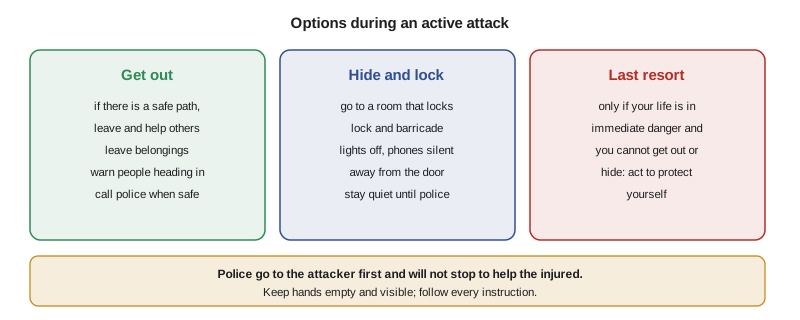
The options are not steps to take in order. Each worker chooses the one that best fits where they are and what they know at that moment, and may change as the situation changes.
- Get out: if there is a safe path away from the attacker, take it. Leave belongings behind. Help others leave if you can, and warn people who are heading toward the danger. Once safe, call police with what you know.
- Hide and lock: if you cannot get out safely, get into a room that locks or can be barricaded, ideally one without windows in the door. Lock the door, block it with heavy furniture, turn off lights, silence phones and alarms on equipment where it is safe to do so, stay away from the door and stay quiet. Do not open the door until police tell you it is safe, using a method you can confirm.
- As a last resort: only if your life is in immediate danger and you cannot get out or hide, act to protect yourself. This is a decision no one can make for you, and no one is expected to put themselves at risk to confront an attacker.
When police arrive, their first job is to find and stop the attacker. Officers will not stop to help the injured or answer questions, and they may not know who the attacker is. Keep your hands empty and visible, follow their instructions exactly, avoid sudden movements and do not run toward them. Medical teams follow once police have made the area safe.
Patients who cannot leave
The hardest question for healthcare workers is what to do about patients who cannot get out or hide by themselves, such as a patient under anesthesia, a patient on a ventilator, or a resident with dementia. There is no rule that requires a worker to stay with a patient at the cost of their own life. In practice, most staff will try to protect their patients, and good planning makes that possible: in areas such as operating rooms, critical care, the birthing unit and Maple Court, the plan is to shelter in place, locking unit doors and staying in rooms with patients, because the patients cannot be moved quickly.
Northbridge looked at each area's ability to lock down. Security and the unit managers listed every room where staff and patients could shelter, and checked whether the doors could be locked from inside and how long it took to secure the unit.
# Lockdown readiness by area: rooms that lock from inside
areas = {
    # area: (rooms checked, lock from inside, seconds to secure unit doors)
    "Emergency dept":  (30, 12,  40),
    "4 West":          (24,  4, 150),
    "ICU":             (12,  8,  30),
    "Birthing unit":   (14, 10,  20),
    "Maple Court":     (28,  6,  90),
    "Clinic wing":     (22, 20,  60),
}
for name, (rooms, locking, secs) in areas.items():
    share = locking / rooms
    flag = []
    if share < 0.5:
        flag.append("few lockable rooms")
    if secs > 60:
        flag.append("slow to secure")
print(f"{name:16}{locking:3}/{rooms:<3} lock {secs:4} s {', '.join(flag)}")Emergency dept 12/30 lock 40 s few lockable rooms 4 West 4/24 lock 150 s few lockable rooms, slow to secure ICU 8/12 lock 30 s Birthing unit 10/14 lock 20 s Maple Court 6/28 lock 90 s few lockable rooms, slow to secure Clinic wing 20/22 lock 60 s
4 West and Maple Court stood out: few rooms locked from the inside, and the unit doors took a long time to secure because they had to be closed and locked one by one with keys. The hospital installed inside thumb-turn locks on the staff rooms, medication rooms and family rooms on both units, and added a single switch at the nursing station that locks the main unit doors. The emergency department also had few rooms that locked from inside, but its doors could be secured in 40 seconds and its treatment areas already sit behind badge-controlled doors, so the hospital added locks only to its two family rooms. Not every patient room needs a lock; what matters is that every group of staff and patients is close to somewhere they can shelter.
A hostage situation
A Code Purple is called when someone is being held against their will, often a staff member or patient held by a person with a weapon or by force, or a parent who has barricaded themselves in a room with a child.
Staff do not negotiate or try to rescue the hostage. The steps are:
- Get yourself and others away from the area, and keep others out.
- Call the emergency number with the location, the number of hostages and hostage takers if known, any weapons seen, and any demands.
- Security keeps the area contained from a safe distance until police arrive, and police take command.
- Give police any information that helps: floor plans, who is in the area, the patient's diagnosis and needs, and any history with the hostage taker.
Bomb threats and suspicious packages
Most bomb threats are hoaxes, but each must be treated as real until proven otherwise. Threats usually come by phone, but can also arrive by email, social media or a note.
If you receive a threat by phone:
- Stay calm and keep the caller talking as long as possible. Do not hang up.
- Use the bomb threat checklist kept by every phone on the main switchboard and in clinical areas. Ask where the bomb is, when it will go off, what it looks like, why it was placed, and who the caller is.
- Note exact words, the caller's voice, accent and manner, background noises, the time and the number shown on the display.
- After the call, do not hang up the line if your phone system allows it to be traced, and call the emergency number from another phone.
A Code Black starts a search by staff, who know their areas and are best placed to spot something that does not belong. Staff look for objects that are unusual for the area, without touching or moving anything. Radios and phones should not be used within a few metres of a suspicious item, because some devices can be triggered by radio signals. If something is found, staff move away, keep others away, and report it; police and bomb disposal experts deal with it. The decision to evacuate is made by the incident commander with police.
A suspicious package found without a threat is handled the same way: do not touch it, move away, keep others away, report it, and let the experts decide. Signs that a package may be suspicious include no return address, excessive postage or tape, oily stains or wires, an odd smell, a misspelled name or a title instead of a name, and a package delivered by hand by someone who left in a hurry.
Lockdown
A lockdown restricts movement into, out of and within the building to protect the people inside. It may be called for an armed person nearby, a violent event in the community, an infant abduction or a large crowd gathering. In a full lockdown, all entrances are secured and staffed by security, no one enters or leaves without authorization, and units secure their own doors. In a partial lockdown, only some entrances or areas are closed. Staff on duty stay on their units and follow the instructions from the incident command centre, and staff arriving for work go to a designated entrance.
After a violent incident
When police have ended the threat, the work is not over. Police may treat the building as a crime scene and keep people in place to give statements. The hospital must account for all staff, patients and visitors, care for the injured, restore services, and tell families what has happened. The emotional impact on staff can be severe and long-lasting, even for those who were not physically hurt. Northbridge's plan includes immediate psychological first aid, a confidential debrief led by trained people, access to the employee and family assistance program, and follow-up over the following weeks, along with time off and changes to duties where needed.
Worked problem
A weapon in the emergency waiting room
Ade Okonkwo, a triage nurse, sees a man in the emergency waiting room pull a knife and threaten another patient's family member. There are about 20 people in the waiting room. Security is at the ambulance entrance. What should Ade do?
Show solution
- Ade does not approach the man. He moves behind the locked triage door and calls 5555, or presses the personal alarm that signals security and the switchboard.
- He gives the four parts: Code Silver; emergency department waiting room; a man with a knife threatening people, about 20 people in the room, description of the man; his name and phone.
- Staff in the department lock the doors between the waiting room and treatment areas, direct people in nearby areas away from the waiting room, and shelter patients who cannot move.
- Ade stays somewhere safe, tells police what he saw when they arrive, follows their instructions, and later takes part in the debrief and support offered.
Answer: Get to safety, call the weapon code with clear details, secure the treatment areas and shelter patients, and leave the person with the weapon to police.
Common mistakes
MistakeApproaching a person with a weapon to calm them down.
InsteadGet to safety and call the code; trained police deal with weapons.
MistakeOpening a locked door during a lockdown because someone knocks.
InsteadWait until police confirm it is safe, using a method you can verify.
MistakeRunning toward arriving police officers for help.
InsteadKeep hands empty and visible, follow instructions and stay still.
MistakePicking up a suspicious package to move it outside.
InsteadDo not touch it; move away, keep others away and report it.
MistakeUsing a radio or phone right next to a suspicious item.
InsteadMove several metres away before using any radio or phone.
Summary and key terms
- A team response helps staff manage a person whose behaviour has become violent; call early.
- A Code Silver is called for a person with a weapon or an active attacker; staff get out if they can, hide and lock if they cannot, and act only as a last resort.
- Police go to the attacker first; keep hands visible and follow instructions.
- Areas with patients who cannot move plan to shelter in place, with lockable rooms and fast ways to secure unit doors.
- In a hostage situation, staff move away, call for help and give police information; they do not negotiate.
- Bomb threats and suspicious packages: keep the caller talking, use the checklist, search without touching, and keep radios away.
- After an incident, account for everyone and support staff over the following weeks.
- Active attacker
- A person who is actively trying to harm people in a building, usually with a weapon.
- Lockdown
- Restricting movement into, out of and within a building to protect the people inside.
- Shelter in place
- Staying in a secure location rather than moving.
- Bomb threat checklist
- A form for recording the details of a threatening call.
- Suspicious package
- An item that is out of place or shows signs that it could be dangerous.
- Psychological first aid
- Early, practical support for people after a distressing event.
Practice problems
Work each problem on paper first, then reveal the answer to check.
What are the three options for staff during an active attack?
Show answer
Get out (run), hide and lock (hide), and act to protect yourself only as a last resort (fight).
What will police do first when they arrive at an active attacker event?
Show answer
Find and stop the attacker; they will not stop to help the injured.
Why do areas such as the ICU and operating rooms plan to shelter in place?
Show answer
Their patients cannot be moved quickly, so staff lock down and stay with them.
What should you do if you receive a bomb threat by phone?
Show answer
Stay calm, keep the caller talking, use the checklist, note details, and call the emergency number from another phone.
Name three signs of a suspicious package.
Show answer
Any three of no return address, excess postage or tape, stains or wires, odd smell, misspelled name or title only, hurried hand delivery.
What changes did Northbridge make on 4 West after the lockdown check?
Show answer
Inside thumb-turn locks on staff, medication and family rooms, and a single switch to lock the unit doors.
Lesson quiz · 5 questions
Score 60% or more to complete this lesson.
Create a free account to save your progress, take quizzes and earn a certificate.