
HSE-395 · Lesson 1 of 12 · 24 min
Emergencies in healthcare facilities
▶ Video coming soon A video version of this lesson is on the way.
Most workplaces have one basic plan for an emergency: get everyone out. A hospital cannot work that way. On any night at Northbridge Community Hospital there are patients on ventilators in the ICU, patients under anesthesia in an operating room, newborns in the birthing unit, people recovering from surgery who cannot stand, and residents of Maple Court who live with dementia and may not understand what an alarm means. Walking them all out of the building would take hours, and moving some of them would kill them. Hospitals are also the place the community runs to when something goes wrong outside: a highway pileup, a heat wave, an outbreak. So a hospital has to keep working through an emergency, often while other people are arriving for help. This lesson explains what makes emergencies in healthcare different, how facilities plan for them, and the rules that shape that planning.
What counts as an emergency
In emergency planning, an emergency is any event that threatens people, property or the ability to deliver care, and that needs a response beyond normal daily operations. Some emergencies start inside the building: a fire in a linen room, a chemical spill in the laboratory, a patient missing from a locked unit, a violent incident in the emergency department, a burst water main. Others start outside and arrive at the door: a bus crash, a tornado, a train derailment that releases a chemical, a wildfire that fills the air with smoke, a pandemic. Some never involve an injury at all but stop the hospital from working, such as a cyberattack that takes down the electronic health record, a long power failure, or a shortage of a critical supply.
Planners group emergencies into broad families:
- Natural hazards: severe storms, tornadoes, floods, extreme heat and cold, wildfires and wildfire smoke, earthquakes.
- Technological hazards: power, water, gas, medical gas or IT failures, fires, hazardous material releases, building failures.
- Human-caused hazards: violence, an armed intruder, bomb threats, hostage situations, infant abduction, civil unrest, sabotage and cyberattacks.
- Health and medical hazards: mass casualty incidents, infectious disease outbreaks and pandemics, contaminated patients arriving from a chemical, biological, radiological or nuclear event, and sudden surges of patients of any kind.
Why healthcare is different
Five features make emergency response in a hospital or long-term care home harder than in an office or a factory.
First, many of the people in the building cannot save themselves. A patient who is sedated, attached to monitors, pinned in traction or confused by delirium depends entirely on staff. In a long-term care home most residents need help to move, and many cannot follow instructions in an emergency. This is why healthcare buildings are designed so that people can stay inside during most fires, and why staff are trained to move patients sideways to safety rather than out of the building.
Second, care cannot stop. An emergency does not cancel the insulin due at 0800, the dialysis run or the woman in labour. Every emergency plan has to say how essential care continues, which services can be paused, and how staff will be redeployed.
Third, the hospital is part of the community's response. When there is a disaster in the region, the hospital must be ready to receive casualties, often with little warning, at the same time as it handles any damage to its own building and staff. Planning must assume that some staff will be unable to come in, because they are affected too.
Fourth, hospitals are complex and full of hazards: oxygen and other medical gases, flammable liquids, hazardous drugs, radioactive materials, high-voltage equipment, and thousands of people moving in and out every day. A small event, such as a power interruption, can quickly affect many systems.
Fifth, the building is open. Visitors, patients and contractors come and go around the clock, so the people in the building on any shift include many who have never seen the fire exits or heard the emergency codes.
The four phases of emergency management
Emergency management is usually described as a cycle of four phases. The work in each phase supports the next.
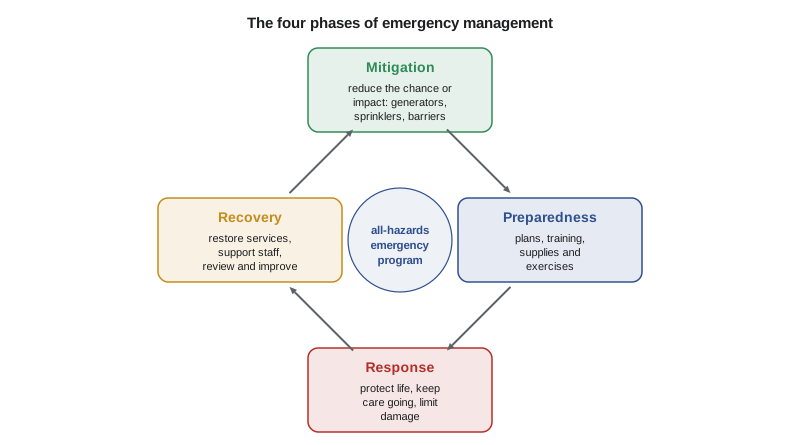
- Mitigation means reducing the chance that a hazard will happen or the harm it will cause if it does. Sprinklers, backup generators, a second water supply, flood barriers around the basement, secure doors on the birthing unit and backups of the clinical system held offsite are all mitigation.
- Preparedness means getting ready to respond: writing plans and procedures, assigning roles, stocking supplies, training staff and testing everything with drills and exercises.
- Response means the actions taken during the event to protect life, keep care going and limit damage, from pulling a fire alarm to opening the hospital's emergency operations centre.
- Recovery means returning to normal: repairing systems, catching up on postponed surgery, supporting staff who were affected, and reviewing what happened so the next response is better.
Most of the work of emergency management happens long before an emergency, in mitigation and preparedness. The quality of a hospital's response on the day mostly reflects the quality of the planning, training and testing that came before.
The all-hazards approach
No hospital can write a separate, detailed plan for every possible event. Instead, facilities use an all-hazards approach: one core plan that covers the functions needed in almost any emergency, with shorter annexes for specific hazards. The core functions are the same whether the cause is a tornado or a cyberattack: alerting staff, taking command, communicating inside and outside the building, protecting patients and staff, keeping essential care going, managing beds and staff, getting supplies, and recovering afterwards. The annexes then add what is special about each hazard, such as decontamination for a chemical release or isolation for an outbreak.
The all-hazards approach also shapes training. Staff learn a small number of general skills, such as how to call an emergency, where to go, how to move a patient, and who is in charge, that they will use in many different events. The specific emergency codes, covered in the next lesson, are the shortcuts that link a type of event to those skills.
The hazard vulnerability analysis
To decide which hazards deserve the most attention, a facility carries out a hazard and risk assessment. In Canada it is often called a hazard identification and risk assessment (HIRA); in the United States, hospitals usually call it a hazard vulnerability analysis (HVA). Both ask the same questions for each hazard: how likely is it, how much harm would it do to people, property and services, and how well prepared are we? Hazards that are likely, harmful and poorly prepared for rise to the top of the list.
Grant Ellison, the emergency preparedness coordinator at Northbridge, leads the analysis each year with a group that includes Sarah MacLeod for nursing, Tom Bergstrom for maintenance, the security supervisor, Joanne Pelletier from Occupational Health and Safety, the laboratory, pharmacy, Maple Court and Northbridge Home Care. Each hazard gets a score from 1 to 3 for probability and for each type of impact, and a preparedness score that lowers the risk when the hospital is well prepared. Grant keeps the scores in a short script so the group can see the ranking change as they talk.
# Northbridge hazard vulnerability analysis (simplified)
# scores 1 (low) to 3 (high); preparedness 1 (poor) to 3 (good)
hazards = [
    # name, probability, human, property, services, preparedness
    ("Ice storm",               3, 2, 2, 3, 2),
    ("Extended power failure",  2, 3, 2, 3, 2),
    ("Cyberattack on systems",  2, 2, 1, 3, 1),
    ("Mass casualty, highway",  2, 3, 1, 2, 2),
    ("Respiratory outbreak",    3, 2, 1, 3, 2),
    ("Fire in patient area",    1, 3, 3, 2, 3),
    ("Tornado",                 1, 3, 3, 3, 1),
    ("Water main failure",      2, 2, 2, 3, 1),
    ("Armed intruder",          1, 3, 1, 2, 2),
    ("Chemical spill, lab",     2, 1, 1, 1, 3),
]

def risk(p, h, pr, s, prep):
    impact = (h + pr + s) / 9          # 0 to 1
    gap = (4 - prep) / 3               # 1 when poorly prepared
    return round(100 * (p / 3) * impact * gap)

ranked = sorted(hazards, key=lambda r: -risk(*r[1:]))
for name, *scores in ranked:
print(f"{name:26}{risk(*scores):4}")Ice storm 52 Water main failure 52 Cyberattack on systems 44 Respiratory outbreak 44 Extended power failure 40 Tornado 33 Mass casualty, highway 30 Armed intruder 15 Fire in patient area 10 Chemical spill, lab 7
The top of the list surprised some members. An ice storm was expected near the top, since one hits the region most winters, but a water main failure scored just as high: the hospital had never tested a plan for losing water, and almost every service depends on it. A cyberattack on the clinical systems ranked third for the same reason: the downtime procedures existed on paper but had not been used in years. A tornado is unlikely in any given year, but because Northbridge had never practised for one, it still outranked a highway mass casualty, which the emergency department drills for regularly. A fire in a patient area, by contrast, would be very serious, but Northbridge drills for fire constantly and has sprinklers throughout, so it ranked near the bottom. The group chose three priorities for the coming year: a water outage annex, a full downtime drill for the clinical systems, and tornado shelter areas for each unit.
The hazard analysis is not a one-time exercise. It is reviewed every year and after any real event, near miss or major change, such as the opening of a new wing, and it should be shared with the community's emergency planners so that the hospital's plans fit theirs.
The emergency program
The analysis feeds an emergency management program. The program has several parts:
- A leader and a committee with the authority to plan, spend and test, reporting to senior leadership.
- The hazard analysis, reviewed regularly.
- An emergency response plan (often called an emergency operations plan) based on the all-hazards approach, with hazard-specific annexes and an incident management structure.
- Policies and procedures for key functions such as evacuation, sheltering in place, tracking patients and staff, emergency staffing, and keeping essential services running.
- A communication plan with contact lists for staff, other hospitals, emergency services, public health and the families of patients.
- Supplies and equipment, such as evacuation sleds, emergency food and water, generator fuel, and caches of PPE.
- Training for everyone at orientation and regularly after that, with more training for people with special roles.
- Testing, through drills and exercises, and a process to learn from every exercise and real event.
The rules
In Ontario, several sets of rules shape a hospital's emergency program. The Occupational Health and Safety Act requires employers to protect workers, which includes preparing for foreseeable emergencies, and Regulation 67/93 requires written measures and procedures for worker health and safety, developed with the JHSC. The Ontario Fire Code requires an approved fire safety plan, staff training and regular fire drills in hospitals and care facilities. Long-term care homes such as Maple Court must have written emergency plans under the Fixing Long-Term Care Act, 2021 and its regulation, covering hazards such as fires, community disasters, missing residents, loss of essential services and outbreaks, with the plans tested regularly and developed with community partners. Accreditation Canada's standards include emergency and disaster management, and the Emergency Management and Civil Protection Act links the hospital to municipal and provincial emergency plans.
The rules matter, but they set a floor, not a ceiling. A program that exists only to pass an inspection usually fails in a real event, because the plans are too long to use, the contact lists are out of date and staff have never practised. The test of a program is whether a nurse on 4 West at three in the morning knows what to do in the first five minutes.
Roles for every worker
Every worker has an emergency role, even if it is simply to stay with their patients and follow instructions. Northbridge's plan sets out what is expected of everyone:
- Know the emergency codes, how to call one, and the number to dial.
- Know the location of the fire alarm pull stations, extinguishers, exits, oxygen shut-off valves and evacuation equipment in your work area.
- Know your unit's role in each code and your own role on your shift.
- Report to your manager or the person in charge when an emergency is called, and do not leave your area unless you are assigned elsewhere.
- Keep your contact information current, so the hospital can call you in.
- Have a plan at home, so that your own family is safe if you are called in or cannot leave.
That last point is easy to forget. During a regional disaster, staff with no plan for their children, pets or older relatives often cannot come in, or come in but cannot concentrate. Northbridge encourages every worker to have a family emergency kit and a plan for who will care for dependants if they are held at work.
Worked problem
The night the power flickered
At 0230 on a stormy night, the power at Northbridge flickers and goes out for nine seconds before the generators take over. Lights and red outlets come back, but several monitors restart, two elevators stop between floors and the pneumatic tube system stops. Amira Haddad is the charge nurse on 4 West. Which parts of emergency management does this short event touch, and what should happen afterwards?
Show solution
- Mitigation worked: the generators and the essential power system came on within the expected time, which is why ventilators and critical equipment on red outlets kept running.
- Response: Amira checks every patient on oxygen, suction or pumps, confirms that critical equipment is on red outlets, calls maintenance about the elevators, and follows the unit's procedure for a utility failure.
- Preparedness gaps showed: monitors that restarted were plugged into ordinary outlets, and one patient's pump had a low battery because its charger was unplugged.
- Recovery and review: maintenance checks the generator transfer log, the elevators are inspected, and the event goes into the emergency program's review so the outlet and battery problems are fixed across the hospital.
Answer: A short power failure tests mitigation (generators), response (checking patients and equipment) and preparedness (outlets and batteries); the review afterwards turns the gaps into fixes.
Common mistakes
MistakePlanning only for fire, because fire drills are required.
InsteadUse an all-hazards approach and a hazard analysis to cover the events most likely to hurt your facility.
MistakeWriting a plan so long that no one can use it.
InsteadKeep a short core plan with quick-reference cards, and put details in annexes.
MistakeAssuming everyone can leave the building in an emergency.
InsteadPlan for patients and residents who cannot move without help, and for defending in place.
MistakeTreating the hazard analysis as a once-only task.
InsteadReview it every year and after real events, near misses and major changes.
MistakeForgetting that staff are affected by community disasters too.
InsteadEncourage family plans and expect that some staff will not be able to come in.
Summary and key terms
- Hospitals and long-term care homes must keep caring for patients during emergencies, because many people inside cannot save themselves and the community depends on them.
- Emergencies come from natural, technological, human-caused and health hazards, inside or outside the building.
- Emergency management is a cycle of mitigation, preparedness, response and recovery.
- An all-hazards plan covers the common functions of any response, with annexes for specific hazards.
- A hazard analysis ranks hazards by probability, impact and preparedness to set priorities.
- Ontario hospitals plan under the OHSA, Regulation 67/93, the Fire Code, the Fixing Long-Term Care Act, 2021 for homes, and Accreditation Canada standards.
- Every worker has an emergency role and should have a plan at home.
- All-hazards approach
- Planning around the functions needed in any emergency, with annexes for specific hazards.
- Hazard vulnerability analysis
- A ranking of hazards by probability, impact and preparedness, also called a hazard identification and risk assessment.
- Mitigation
- Actions that reduce the chance of a hazard or the harm it causes.
- Preparedness
- Plans, training, supplies and exercises that get a facility ready to respond.
- Emergency response plan
- The core plan that sets out how a facility responds to emergencies, also called an emergency operations plan.
- Recovery
- Restoring services and learning from an event after the response.
Practice problems
Work each problem on paper first, then reveal the answer to check.
Name the four phases of emergency management.
Show answer
Mitigation, preparedness, response and recovery.
Give two reasons why a hospital cannot simply evacuate in every emergency.
Show answer
Many patients cannot move without help or would be harmed by moving, and the hospital must keep providing care and may be receiving casualties.
What three things does a hazard vulnerability analysis consider for each hazard?
Show answer
Probability, impact (on people, property and services) and preparedness.
Why did the tornado rank high at Northbridge even though it is unlikely?
Show answer
Because the impact would be severe and the hospital was poorly prepared, which raised the risk score.
Which Ontario law requires long-term care homes to have written emergency plans?
Show answer
The Fixing Long-Term Care Act, 2021 and its regulation.
What should every worker know about emergencies in their own work area?
Show answer
The codes and how to call them, the location of alarms, extinguishers, exits, oxygen shut-offs and evacuation equipment, and their own role.
Lesson quiz · 5 questions
Score 60% or more to complete this lesson.
Create a free account to save your progress, take quizzes and earn a certificate.