
HSE-395 · Lesson 2 of 12 · 23 min
Emergency codes and how they are called
▶ Video coming soon A video version of this lesson is on the way.
When something goes wrong in a hospital, the first few minutes decide a great deal. A fire that is reported within a minute can be contained in one room; a fire noticed ten minutes later may fill a corridor with smoke. A patient in cardiac arrest who gets help in two minutes has a far better chance than one who waits five. Emergency codes exist to get the right people moving in the right direction as fast as possible, with as few words as possible. This lesson explains the codes used at Northbridge, how to call one, what you are expected to do when you hear one, and why many hospitals are changing the way codes are announced.
What an emergency code does
An emergency code is a short, standard announcement that tells everyone in the building three things: what kind of emergency is happening, where it is, and, by implication, what they should do. Each type of code is linked to a procedure. When a fire is announced, staff on the affected unit carry out the fire procedure, staff on nearby units prepare to receive patients, the fire response team goes to the location, and everyone else stays put, closes doors and keeps corridors clear. One announcement sets off dozens of coordinated actions.
Codes also save time when time matters most. A worker who finds a fire does not need to explain the situation to a dozen departments; one call to the emergency number reaches the switchboard, which announces the code, notifies the response team and calls the fire department.
The codes at Northbridge
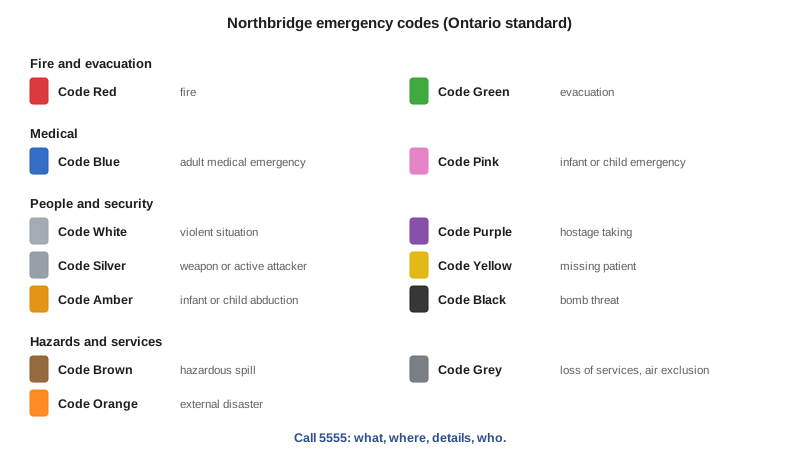
Most Ontario hospitals use the standard set of colour codes recommended by the Ontario Hospital Association, so that staff who work at more than one hospital, and paramedics and police who come into many hospitals, hear the same codes everywhere. Northbridge Community Hospital and Maple Court use this standard set:
- Code Red: fire.
- Code Green: evacuation, which may be precautionary or immediate.
- Code Blue: cardiac arrest or medical emergency in an adult.
- Code Pink: cardiac arrest or medical emergency in an infant or child.
- Code Orange: external disaster bringing many casualties; Code Orange CBRN for casualties exposed to chemical, biological, radiological or nuclear agents.
- Code Yellow: missing patient or resident.
- Code Amber: infant or child abduction.
- Code White: violent or behavioural situation.
- Code Purple: hostage taking.
- Code Silver: person with a weapon or active attacker.
- Code Black: bomb threat or suspicious package.
- Code Brown: hazardous spill inside the facility.
- Code Grey: loss or failure of essential services, such as power, water, medical gases or elevators, and air exclusion when outside air must be shut out.
Some Ontario hospitals add their own local codes for events such as flooding, information technology failures or severe weather. Northbridge decided not to add any, because every extra code is one more thing for staff to remember and one more chance for confusion with a neighbouring hospital. Flooding and system failures are announced as Code Grey with a plain description.
Colour codes or plain language?
The argument for colour codes is that they are short and discreet. A colour code can be announced without alarming patients and visitors, which matters for events such as a violent patient or a missing child, where panic or a crowd could make things worse. Codes are also deeply familiar to experienced staff.
The argument for plain language is that it is understood by everyone. Visitors, contractors, students and agency staff may not know the codes, and in an active attacker event, the people most at risk are often visitors in public areas who have no idea what Code Silver means. Studies and reviews of real events have found staff confusing codes, especially when hospitals use different colours for the same event. Agencies and professional groups, including emergency nursing organizations, now generally support plain-language alerts, sometimes keeping a small number of familiar medical codes such as Code Blue.
Ontario's standard codes reduce the problem of different colours at different hospitals, which is one reason many Ontario hospitals keep them. Some hospitals now add a plain-language description to colour codes, for example Code Silver, person with a weapon, main entrance, and Northbridge does this for any code where the public needs to act, such as Code Silver and Code Green.
How to call a code
At Northbridge, any worker who sees an emergency calls the internal emergency number, 5555, from any hospital phone. On a mobile phone, staff call the switchboard number printed on the back of their badge. For a fire, the worker also pulls the nearest fire alarm, which sends the signal to the switchboard and the fire department automatically.
The switchboard operator needs four things, in this order:
- What: the type of emergency, using the code or plain words if you are not sure of the code.
- Where: the exact location, with building, floor, unit and room number or a landmark, such as cafeteria, near the cashiers.
- Details: anything the responders need to know, such as a person with a knife, a spill of about 4 L (1 gal) of formalin, or a resident who left 20 minutes ago wearing a blue coat.
- Who: your name and the number you are calling from, so the operator can call back.
The caller then stays on the line until the operator has repeated the information back, unless doing so would put them in danger. The operator announces the code overhead, usually three times, sends it to the pagers and phones of the response team, and calls outside services, such as the fire department or police, as the procedure requires. When the emergency is over, the person in charge tells the switchboard, which announces an all clear for the code and the location. Until the all clear, staff keep following the procedure.
Northbridge's switchboard uses a script to build each announcement from the information the caller gives, so that every announcement has the same parts in the same order.
# Build a standard overhead announcement (Ontario colour codes)
CODES = {
    "fire": "Code Red", "evacuation": "Code Green", "adult medical": "Code Blue",
    "child medical": "Code Pink", "violent person": "Code White",
    "person with weapon": "Code Silver", "hazardous spill": "Code Brown",
    "loss of services": "Code Grey", "missing patient": "Code Yellow",
}
PUBLIC_ACTION = {"person with weapon", "evacuation"}

def announce(kind, location, detail=""):
    code = CODES[kind]
    text = f"{code}, {location}"
    if kind in PUBLIC_ACTION and detail:
        text += f". {detail}"
    return " ... ".join([text] * 3)

print(announce("fire", "4 West, room 412"))
print(announce("person with weapon", "main entrance",
               "Avoid the main entrance, go to a safe area and lock doors"))
print("All clear, Code Red, 4 West")Code Red, 4 West, room 412 ... Code Red, 4 West, room 412 ... Code Red, 4 West, room 412 Code Silver, main entrance. Avoid the main entrance, go to a safe area and lock doors ... Code Silver, main entrance. Avoid the main entrance, go to a safe area and lock doors ... Code Silver, main entrance. Avoid the main entrance, go to a safe area and lock doors All clear, Code Red, 4 West
What to do when you hear a code
Hearing a code is as important as calling one. For each code, the plan sets out three kinds of response:
- The unit where the emergency is: staff carry out the procedure for that code, starting with the steps that protect life.
- The response team: designated people go to the location, such as the fire response team, the Code Blue team, the Code White team or security.
- Everyone else: staff stay in their area unless assigned, keep phones and elevators free, keep corridors and doors clear, prepare to help or receive patients, and listen for updates. They do not go to look.
Curious staff who go to the scene of a code are a real problem. At a cardiac arrest in a crowded corridor, extra people block the team and the equipment. At a fire, they can be cut off by smoke. At a violent incident, they become extra targets. Northbridge's rule is simple: go only if it is your role, or if you are asked.
Each unit at Northbridge has a code flip chart near the nursing station, with one tabbed page for each code, showing the steps for that unit and the roles for each shift. Staff also carry a code card on their badge. The flip chart for 4 West lists, for example, who closes doors during a fire, who checks the oxygen zone valve, who brings the evacuation sleds, and who meets the fire response team at the elevator.
Mass notification and the limits of the overhead page
Overhead announcements are only one way to spread an alert. They cannot be heard in every room, they are often switched off or turned down in intensive care units, operating rooms and patient rooms at night, and they mean nothing to staff who are off site. Hospitals therefore use several channels together:
- Overhead paging in public areas and units.
- Pagers, phones and secure messaging apps for response teams and managers.
- Mass notification systems that send texts, calls and emails to all staff, including those at home, for events such as calling in extra staff.
- Visual alerts, such as strobe lights and screens, for areas where sound is a problem and for people who are hard of hearing.
- Desktop alerts that pop up on hospital computers.
Northbridge tests its mass notification system every month by sending a short message that staff must acknowledge. The first test after the system was set up showed that 27 of every 100 phone numbers were wrong or out of date. Staff are now reminded to update their contact information twice a year, and managers check it during the annual performance review.
Codes beyond the main hospital
Maple Court uses the same codes as the hospital, which matters because the two buildings share staff and a response team. At night, Maple Court has far fewer staff on each home area than the hospital has on a unit, so its procedures say exactly which hospital teams come through the connecting corridor for each code, and how long they should take. Code Red and Code Green in particular depend on that help, because a handful of night staff cannot move 24 residents alone.
Northbridge Home Care staff work in clients' homes, where there is no switchboard and no response team. Their emergency procedure is to call 911 for any fire, medical emergency or threat, get themselves to safety, and then call the home care coordinator, who starts the agency's own response and checks on other staff working nearby. Their phones carry a short emergency card with the same what, where, details and who format, because a caller who is frightened often forgets to give an address.
Talking to patients and visitors during a code
Patients and visitors hear codes too, and an unexplained announcement can be frightening, especially for people who are already unwell or anxious. Staff should answer questions calmly and honestly without adding detail that could cause panic: there is a situation on another floor and the team is dealing with it; we will tell you if we need you to do anything. During a fire or evacuation, the message is short and clear: stay in your room with the door closed, or come with me now. Staff should never say that a code is just a drill unless they know it is.
Worked problem
The missing resident on a busy morning
At 0915, Lina Santos notices that Walter Duff, a resident of Birch at Maple Court who lives with dementia, is not in his room, the lounge or the dining room. The last time anyone saw him was at breakfast, about 40 minutes ago. What should Lina do, and what should she tell the switchboard?
Show solution
- Lina tells the charge nurse right away and does a quick search of the nearest rooms and bathrooms, following the missing resident procedure, but does not spend long searching alone.
- She calls 5555 and gives the four parts: Code Yellow; Maple Court, Birch; Walter Duff, 84, about 175 cm, grey hair, wearing a green cardigan and slippers, last seen at breakfast about 0835, has dementia and may head for the farm road; her name and the Birch phone number.
- The switchboard announces the code with the description, and every department searches its own assigned areas, including stairwells, exits and the grounds, and reports back.
- Lina stays with the other residents while the charge nurse coordinates the search of Birch, and the nurse in charge calls the police if he is not found within the time set in the procedure.
Answer: Report quickly, call 5555 with what, where, details and who, give a full description, and let the code bring the whole building into the search.
Common mistakes
MistakeSearching or fighting the problem alone before calling for help.
InsteadCall the code early; a false alarm costs far less than a late call.
MistakeGiving a vague location such as on the second floor.
InsteadGive building, floor, unit and room number or a clear landmark.
MistakeGoing to the scene of a code to see what is happening.
InsteadGo only if it is your role or you are asked; stay in your area and keep corridors clear.
MistakeRelying on the overhead page alone.
InsteadUse pagers, phones, mass notification and visual alerts as well.
MistakeTreating the code as over when the noise stops.
InsteadKeep following the procedure until the all clear is announced.
Summary and key terms
- Emergency codes tell everyone what is happening and where, and start a set of coordinated actions.
- Ontario hospitals usually use the standard Ontario Hospital Association colour codes, such as Code Red for fire and Code Silver for a person with a weapon.
- Plain language is understood by visitors and new staff; colour codes are short and discreet. Many hospitals combine the two for public safety events.
- To call a code, dial the emergency number and give what, where, details and who.
- When a code is called, the affected unit acts, the response team goes, and everyone else stays in place.
- Overhead pages are backed up by pagers, phones, mass notification and visual alerts, which must be tested.
- Emergency code
- A short, standard announcement for a type of emergency, linked to a procedure.
- Plain-language alert
- An emergency announcement in everyday words, giving the type of event, location and instructions.
- All clear
- The announcement that an emergency is over and normal work can resume.
- Response team
- The designated staff who go to the location of a code.
- Mass notification
- A system that sends alerts by text, phone and email to many people at once.
- Code flip chart
- A tabbed chart on each unit with the steps and roles for each code.
Practice problems
Work each problem on paper first, then reveal the answer to check.
What three things does an emergency code tell people?
Show answer
What kind of emergency it is, where it is, and by implication what they should do.
What four pieces of information should you give the switchboard?
Show answer
What the emergency is, where it is, important details, and who you are with your call-back number.
What is Code Silver?
Show answer
A person with a weapon or an active attacker.
Give one argument for colour codes and one for plain language.
Show answer
Colour codes are short and discreet; plain language is understood by visitors and new staff.
Why should staff not go to see a code they are not part of?
Show answer
They block responders, may be put in danger and leave their own area uncovered.
Why does Northbridge test its mass notification system every month?
Show answer
To find wrong or out-of-date contact information and make sure the system works; the first test found 27 of every 100 numbers were wrong.
Lesson quiz · 5 questions
Score 60% or more to complete this lesson.
Create a free account to save your progress, take quizzes and earn a certificate.