
HSE-395 · Lesson 3 of 12 · 22 min
Fire safety in healthcare
▶ Video coming soon A video version of this lesson is on the way.
Fires in hospitals and care homes are less common than they were fifty years ago, thanks to sprinklers, fire-resistant materials, smoke-free rules and better building design. But when they happen, they are dangerous in a way that fires in most buildings are not, because so many people inside cannot escape by themselves. Fire safety in healthcare therefore has two goals at once: prevent fires, and make sure that if one starts, the people in the building, especially patients and residents, are protected where they are while the fire is controlled. This lesson covers how fires start in healthcare settings, how buildings are designed to contain them, and what every worker does when the fire alarm sounds.
How fires start in healthcare
Every fire needs three things: fuel, heat (an ignition source) and oxygen. Remove any one and the fire cannot start or continue. Hospitals have plenty of all three.
- Fuel: linen, mattresses, paper, packaging, alcohol-based hand rub and skin prep solutions, flammable liquids in laboratories and pharmacies, plastics in equipment, and waste.
- Heat: electrical faults in equipment, overloaded power bars and damaged cords, heating and cooking appliances, lighting, electrosurgical units and lasers in operating rooms, and smoking materials.
- Oxygen: the air, plus piped and bottled medical oxygen, which is in use in almost every patient area.
Oxygen deserves special attention. It does not burn, but it makes everything else burn faster and hotter. In an oxygen-enriched atmosphere, such as under a drape near a patient receiving oxygen, inside an oxygen tent, or in a room with a leaking connection, materials that would only smoulder in normal air can burst into flame, and a small spark can start a fire. Hair, gowns and bedding near a patient's face can hold extra oxygen for some time after it has been turned off.
The most common causes of fires in healthcare facilities are cooking, electrical problems and smoking. Patients who smoke while on oxygen, or who hide smoking materials in their rooms, are a known risk on medical units and in long-term care. Laundry dryers, where lint builds up, and kitchens are other common places for fires to start.
Surgical fires
Operating rooms bring the three parts of the fire triangle closer together than anywhere else. The oxidizer is oxygen or nitrous oxide, sometimes delivered at high concentration near the patient's face. The ignition sources are electrosurgical devices, lasers, fibre-optic light cables and drills. The fuels are alcohol-based skin preps, drapes, gauze, the patient's hair and even the patient's own tissues and gases. Surgical fires are rare but devastating, often causing serious burns to the patient's airway or face.
The surgical team prevents fires by managing each side of the triangle:
- Oxidizer: use the lowest oxygen concentration that keeps the patient safe, especially for procedures on the head, neck and upper chest; avoid open delivery of oxygen under drapes where possible; arrange drapes so oxygen does not build up near the surgical site.
- Ignition: keep electrosurgical tips in a holster when not in use; never let a light cable rest on drapes; use lasers and electrosurgery only when needed and at the lowest effective power.
- Fuel: let alcohol-based prep solutions dry completely for the time stated on the label, and prevent them from pooling under the patient or soaking into drapes and hair; moisten sponges and gauze used near ignition sources.
Before each operation with a high fire risk, the team does a fire risk assessment as part of the surgical safety checklist and agrees who will do what if a fire starts: stop the flow of oxygen, remove burning materials from the patient, put out the fire with saline or water, and care for the patient.
How healthcare buildings contain fire
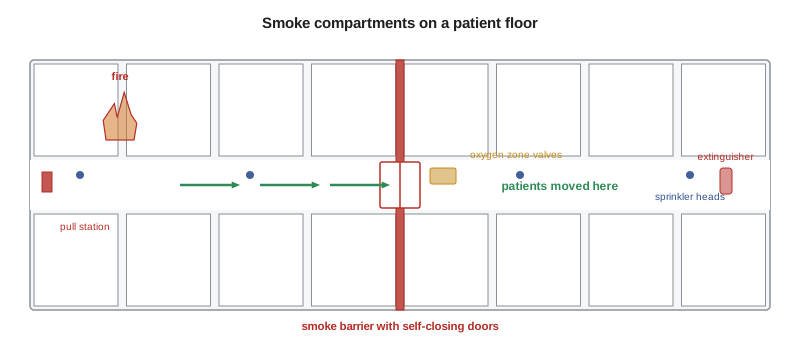
Healthcare buildings are designed around a strategy usually called defend in place. Instead of relying on everyone getting out, the building is divided into compartments that hold back fire and smoke long enough for staff to move patients sideways to a safe area on the same floor, and for the fire department to put the fire out.
The main features are:
- Fire and smoke compartments: fire-rated walls and floors divide the building into sections, and each floor of patient areas has at least two smoke compartments, so patients can be moved horizontally away from the fire.
- Fire doors and smoke barrier doors: doors in these walls close automatically when the alarm sounds, released by magnetic hold-opens. A door that is wedged open or blocked by a cart defeats the whole design.
- Sprinklers: automatic sprinklers control or put out most fires before they spread beyond the room where they started. Each head opens on its own when heated, so only the sprinklers over the fire discharge.
- Fire alarm and detection: smoke and heat detectors and manual pull stations sound the alarm, release door hold-opens, shut down some air handling units, recall elevators and signal the fire department.
- Exits and evacuation routes: protected stairwells and exits lead outside or to another part of the building.
In Ontario, the Fire Code sets out these features and requires every hospital and long-term care home to have an approved fire safety plan, staff training and regular fire drills, and to inspect and test fire protection systems. After deadly fires in seniors' residences, Ontario required automatic sprinklers in long-term care homes and retirement homes, with a final deadline of January 1, 2025.
Keeping the protection working
The building can only protect people if everyday habits do not undo it. Many of the problems found in fire inspections are simple:
- Fire doors wedged open, or blocked by beds, carts and linen hampers so that they cannot close.
- Equipment stored in corridors, which narrows exit routes and blocks the movement of beds.
- Items stored within 45 cm (18 in) of sprinkler heads, which stops the spray from reaching the fire.
- Missing or damaged ceiling tiles, which let smoke and heat bypass the sprinklers and spread above the ceiling.
- Extension cords and power bars used as permanent wiring, or patient equipment plugged into household power bars.
- Extinguishers and pull stations blocked, missing or overdue for inspection.
- Exit signs out and exit doors locked or chained in ways not approved in the fire plan.
Tom Bergstrom checks these items during the monthly JHSC inspection, and the 4 West inspection last spring found two wedged fire doors, a ceiling tile missing outside room 409 and a linen cart parked in front of the extinguisher. None of these would have caused a fire, but all of them would have made a fire worse.
RACE: what to do if you find a fire
Northbridge, like most healthcare facilities in North America, teaches the RACE sequence for responding to a fire:
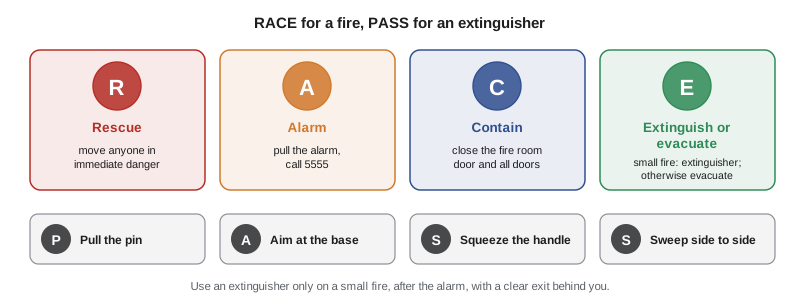
- Rescue: move anyone in immediate danger away from the fire, starting with the person in the room where the fire is. Do not put yourself in danger to do it.
- Alarm: pull the nearest fire alarm and call the emergency number, giving the exact location. Shout to alert people nearby.
- Contain: close the door to the room on fire, and close all doors in the area. A closed door holds back smoke and heat for many minutes and is one of the most effective things you can do.
- Extinguish or evacuate: if the fire is small, such as a wastebasket, and you are trained and have a clear exit behind you, use an extinguisher. Otherwise, move patients away from the fire, beyond the next set of fire doors, as directed by the person in charge.
Some hospitals order the first two steps differently, or teach the steps in a different language, but the content is the same: protect people, raise the alarm early, close doors, then fight a small fire or move away.
Using an extinguisher
Portable extinguishers are for small fires only, in their early stages. A fire that is larger than a wastebasket, that is spreading, or that is producing thick smoke is beyond what an extinguisher can handle. Before using one, make sure the alarm has been raised, that you have a clear way out behind you, and that you know which type of extinguisher you have.
- Multipurpose dry chemical (ABC) extinguishers are the most common in hospitals and work on ordinary materials, flammable liquids and electrical fires.
- Carbon dioxide extinguishers are used near sensitive electrical equipment because they leave no residue.
- Water mist extinguishers made of non-magnetic materials are used in and near MRI rooms, because a steel extinguisher would be pulled into the magnet.
- Wet chemical (Class K) extinguishers are used in commercial kitchens for cooking oil fires.
Use the PASS sequence: pull the pin; aim the nozzle at the base of the fire, not the flames; squeeze the handle; sweep from side to side across the base. Most extinguishers empty in 10 to 20 seconds, so if the fire is not out quickly, leave, close the door and let the fire response team and fire department take over.
When the alarm sounds on your unit
When the fire alarm sounds, staff on the unit where the fire is follow RACE. On other units, the procedure is different: staff close all doors, clear corridors of equipment, check that patients are safe, prepare to receive patients from the affected area, and listen for announcements. Elevators are recalled and must not be used unless the fire department directs otherwise.
The oxygen zone valves on each unit control the oxygen supply to a group of rooms. Turning one off can stop oxygen feeding a fire, but it also cuts oxygen to every patient in that zone. At Northbridge, only the charge nurse or a respiratory therapist decides to close a zone valve, after making sure that patients who need oxygen are switched to portable cylinders.
Northbridge runs fire drills on every unit and every shift. After each drill, the unit records how long key steps took. Sarah MacLeod reviews 4 West's drills each quarter.
# 4 West fire drills: seconds from alarm to each step
drills = [
    # shift, alarm to doors closed, to corridor clear, to staff at
    # meeting point, oxygen check done
    ("day",     45,  95, 120, 150),
    ("evening", 60, 130, 150, 200),
    ("night",   90, 210, 180, 260),
    ("day",     40,  80, 110, 140),
    ("night",   75, 190, 170, 240),
]
TARGETS = (60, 120, 180, 180)
STEPS = ("doors closed", "corridor clear", "at meeting point", "oxygen check")

for shift, *times in drills:
    late = [s for s, t, goal in zip(STEPS, times, TARGETS) if t > goal]
    print(f"{shift:8}" + "  ".join(f"{t:4}" for t in times),
"late: " + (", ".join(late) if late else "none"))day 45 95 120 150 late: none evening 60 130 150 200 late: corridor clear, oxygen check night 90 210 180 260 late: doors closed, corridor clear, oxygen check day 40 80 110 140 late: none night 75 190 170 240 late: doors closed, corridor clear, oxygen check
The pattern was clear: both night drills missed the targets for closing doors, clearing the corridor and completing the oxygen check, and the evening drill missed two of them. With fewer staff, the night team had to clear the equipment stored in the corridor before they could close the smoke barrier doors and move beds. The fix was not more training but less clutter: the unit found storage rooms for the two lift slings, the vital signs machine and the extra chairs that lived in the corridor, and the next night drill cleared the corridor in 110 seconds.
Worked problem
The fire in room 412
During a night shift, Amira Haddad smells smoke and sees flames coming from a wastebasket beside the bed of the patient in room 412, who is on oxygen by nasal prongs and cannot walk without help. The patient's roommate is asleep. What should Amira do, in order?
Show solution
- Rescue: she turns off the oxygen flowmeter at the bedside and, with help from the nurse she calls, moves the patient in bed and the roommate out of the room into the corridor and toward the smoke barrier doors.
- Alarm: she shouts for help, pulls the alarm by the exit and has a colleague call 5555 with the location, room 412 on 4 West.
- Contain: she closes the door to room 412 behind her, and staff close all patient room doors on the unit.
- Extinguish or evacuate: the fire is still small, so a trained colleague with a clear exit uses the ABC extinguisher through a partly opened door; if it had spread, staff would have moved patients beyond the smoke barrier doors and waited for the fire response team.
Answer: Rescue the people at risk, raise the alarm, close doors to contain the fire and smoke, and only then fight a small fire or move patients beyond the fire doors.
Common mistakes
MistakeFighting a fire before raising the alarm.
InsteadAlways pull the alarm and call the emergency number early, even if you plan to use an extinguisher.
MistakeLeaving the door to the fire room open while moving patients.
InsteadClose the door; it holds back smoke and heat for many minutes.
MistakeWedging fire doors open or parking carts in front of them.
InsteadKeep fire doors free to close and corridors clear.
MistakeUsing a steel extinguisher near the MRI scanner.
InsteadUse only the non-magnetic extinguishers kept for the MRI area.
MistakeUsing an elevator during a fire alarm.
InsteadUse stairs or horizontal evacuation unless the fire department directs otherwise.
Summary and key terms
- Fire needs fuel, heat and oxygen, and medical oxygen makes fires start more easily and burn faster.
- Surgical fires are prevented by managing the oxidizer, the ignition source and the fuel, including letting alcohol preps dry.
- Healthcare buildings defend patients in place with compartments, fire doors, sprinklers and alarm systems.
- The Ontario Fire Code requires approved fire safety plans, training, drills and sprinklers in long-term care homes.
- RACE: rescue, alarm, contain, extinguish or evacuate. PASS: pull, aim, squeeze, sweep.
- Everyday habits, such as clear corridors and closed fire doors, keep the building protection working.
- Fire triangle
- The three things a fire needs: fuel, heat and oxygen.
- Oxygen-enriched atmosphere
- Air with more oxygen than normal, in which materials ignite more easily and burn faster.
- Defend in place
- A strategy in which the building protects occupants where they are while a fire is controlled.
- Smoke compartment
- A section of a floor enclosed by smoke barriers, so people can be moved away from smoke on the same floor.
- RACE
- Rescue, alarm, contain, extinguish or evacuate: the steps when you find a fire.
- PASS
- Pull, aim, squeeze, sweep: the steps for using an extinguisher.
Practice problems
Work each problem on paper first, then reveal the answer to check.
What are the three sides of the fire triangle?
Show answer
Fuel, heat (ignition) and oxygen.
Name one fire prevention step for each side of the triangle in an operating room.
Show answer
Oxidizer: lowest safe oxygen and good drape arrangement; ignition: holster electrosurgical tips and keep light cables off drapes; fuel: let alcohol preps dry fully.
Why must fire doors never be wedged open?
Show answer
They are part of the compartments that hold back fire and smoke; an open door lets smoke into the next compartment.
What do the letters RACE stand for?
Show answer
Rescue, alarm, contain, extinguish or evacuate.
Which extinguisher should be used near an MRI scanner?
Show answer
A non-magnetic extinguisher, such as a water mist extinguisher made for MRI areas.
What did 4 West change to speed up its night fire drills?
Show answer
It removed equipment stored in the corridor, so the night team could close doors and move beds faster.
Lesson quiz · 5 questions
Score 60% or more to complete this lesson.
Create a free account to save your progress, take quizzes and earn a certificate.