
HSE-395 · Lesson 4 of 12 · 22 min
Evacuating patients and residents
▶ Video coming soon A video version of this lesson is on the way.
Moving patients out of harm's way is one of the hardest things a healthcare team ever has to do. A unit full of people who are frail, confused, attached to equipment or unable to stand cannot simply follow the exit signs. Every move takes staff, equipment and time, and a badly planned evacuation can injure patients and staff or lose track of who went where. This lesson explains the levels of evacuation, how staff decide who moves first, the equipment and techniques used, how patients and their records are tracked, and what is different in long-term care and home care.
Levels of evacuation
Evacuation in healthcare is planned in stages, from the smallest move that will keep people safe to the largest. Each stage takes more time and resources than the one before, so staff use the smallest that is enough.
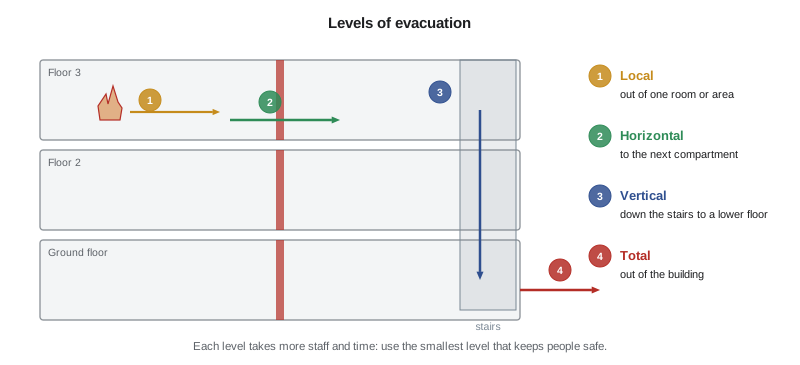
- Level 1, local: people are moved out of one room or area, such as the room where a fire started, to a safe part of the same unit.
- Level 2, horizontal: people are moved through the smoke barrier or fire doors into the next compartment on the same floor. This is the most common evacuation in a hospital fire, and the building is designed for it.
- Level 3, vertical: people are moved to another floor, usually down the stairs, when a whole floor is threatened.
- Level 4, total: everyone leaves the building, to an assembly area and then to other units, hospitals or care homes. This is rare and usually ordered by senior leaders with emergency services, for events such as a major fire, structural damage, a flood, a gas leak or a wildfire.
At Northbridge, a precautionary Code Green means prepare to evacuate: staff get patients ready, gather equipment and records, and wait for the order. An immediate Code Green means move now. The decision to evacuate a whole floor or building is made by the incident commander, often with the fire department, but staff in immediate danger always move away from it without waiting for an order.
Sheltering in place
The opposite of evacuation is sheltering in place: staying inside and protecting people where they are. It is the right choice when moving would be more dangerous than staying, such as during a tornado, when smoke or a chemical cloud is outside, or when the danger is a short way off and the building can hold. Sheltering in place may mean moving patients away from windows to an inner corridor, closing doors and windows, shutting off outside air, or locking down the building. The decision between sheltering and evacuating is one of the first made in many emergencies, and the plan must support both.
Who moves first
In a real evacuation there is rarely enough staff to move everyone at once, so the order matters. The first rule never changes: move people in immediate danger first, starting with anyone in the room or area where the fire or hazard is. After that, plans differ, and each facility must decide its own order in advance and train staff on it.
Northbridge's plan for horizontal evacuation follows a common approach:
- First, anyone in immediate danger.
- Next, patients who can walk, guided in groups by one staff member, who also take some of the load off staff. Some can help push a wheelchair or carry a light item.
- Then patients who use wheelchairs or can sit, moved in wheelchairs or chairs.
- Last, patients who cannot get out of bed or are attached to critical equipment, who need the most staff and time per person. They are moved in their beds, on evacuation sleds or on stretchers, depending on the route.
The logic is to clear the area of as many people as possible quickly, while the most dependent patients are prepared for their move. In critical care, the plan is different: each patient needs a nurse, a respiratory therapist or a physician to keep life support going during the move, so critical care units plan patient by patient with portable ventilators, monitors and oxygen.
Many hospitals use a simple mobility code for each patient, recorded on the whiteboard or in the census, so that staff know at a glance what each person needs. Northbridge uses three categories: A for ambulatory (can walk with little or no help), W for wheelchair (can sit and be moved in a chair), and B for bed (needs a bed, stretcher or sled). The charge nurse updates them at each shift change, along with notes such as needs oxygen, bariatric, or confused, needs escort.
How long will it take?
Planning an evacuation means knowing roughly how long it will take with the staff on hand. Sarah MacLeod used a simple model for 4 West: each category of patient takes a certain number of staff minutes to move to the next compartment, and the total is divided by the number of staff available.
# Rough estimate: horizontal evacuation of 4 West (32 beds)
# staff-minutes needed to move one patient to the next compartment
MINUTES = {"A": 1.5, "W": 3.0, "B": 8.0}   # B = bed, stretcher or sled
census = {"A": 9, "W": 11, "B": 12}

def evac_minutes(staff):
    work = sum(MINUTES[k] * n for k, n in census.items())
    return work / staff

for shift, staff in [("day", 12), ("evening", 9), ("night", 6),
                     ("night + 4 helpers", 10)]:
print(f"{shift:18}{staff:3} staff about {evac_minutes(staff):5.1f} min")day 12 staff about 11.9 min evening 9 staff about 15.8 min night 6 staff about 23.8 min night + 4 helpers 10 staff about 14.2 min
The model is rough, but it made the point at a staff meeting. With six night staff, moving every patient to the next compartment would take more than 20 minutes, much longer than the smoke barrier is meant to buy before the fire department arrives and controls the fire. With four extra helpers from the hospital's fire response team, the time fell to about 14 minutes. The model also showed why bed-bound patients dominate: they were 12 of 32 patients but needed most of the staff time. The unit used the results to confirm that the fire response team would send four people to any fire on a patient floor at night, and to make sure evacuation sleds were stored on the unit, not in the basement.
Moving patients safely
Evacuation does not suspend the rules of safe patient handling. Staff who injure their backs in the first few minutes cannot move the next patient. Northbridge trains staff in a few methods suited to emergencies:
- Moving patients in their beds: the fastest way to move a patient horizontally on a level floor, as long as the bed fits through the doors and the brakes and side rails work. Two staff move most beds; bariatric beds need more people or a powered bed mover.
- Evacuation sleds: padded sheets with straps, stored under or beside mattresses or in wall cabinets, onto which a patient is slid and then pulled along the floor or, with practice, down stairs. They let one or two staff move a person who cannot walk without lifting them.
- Evacuation chairs: lightweight chairs with tracks that let one or two trained staff take a seated person down stairs in a controlled way.
- Wheelchairs and transport chairs for people who can sit.
- Blanket drags and two-person carries: last-resort methods for when there is no equipment and no time, taught so staff know them but used only in true emergencies.
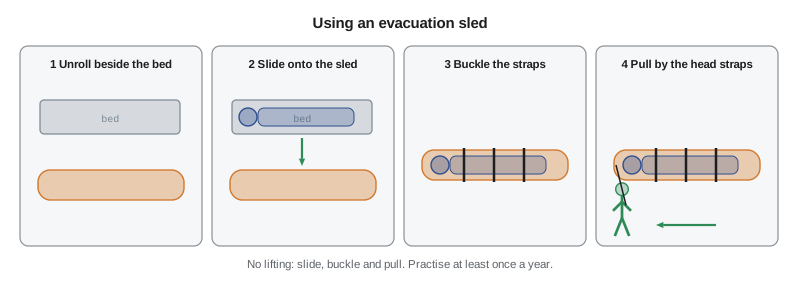
Equipment only helps if staff can use it under stress. When Northbridge held its first sled drill on 3 East, half the staff had never unrolled one, and it took more than four minutes to get a volunteer onto a sled and through the doors. After two practice sessions it took under two minutes. Sleds now appear in the annual skills day for every inpatient unit.
Elevators are not used during a fire unless the fire department says it is safe, so vertical evacuation means stairs. Moving a bed-bound patient down stairs is slow, needs several people, and is dangerous for patients and staff. This is one reason why horizontal evacuation is preferred, and why vertical evacuation is a decision made by the incident commander rather than a unit.
Keeping track of patients
In any evacuation, the hospital must know where every patient is at all times. Families will call, physicians will need to find their patients, and the people receiving patients must know who they are and what care they need. Losing track of a patient during an evacuation has happened in real events, sometimes with serious results.
- Every patient keeps an identification wristband on. Patients without one are banded before they move if at all possible.
- Each unit has evacuation tracking sheets that record each patient's name, identifier, where they went and when, and who took them. In a total evacuation, each patient also gets a tracking tag.
- Essential information goes with the patient: medication administration records, allergies, code status, current orders and any critical items, such as insulin, an epinephrine auto-injector, glasses, hearing aids and dentures. Downtime forms are used if the electronic record is unavailable.
- The receiving unit or facility checks each patient in and confirms their arrival to the incident command centre.
- Staff account for themselves, too, by reporting to the person in charge at the assembly point.
Long-term care and residents with dementia
Evacuation in long-term care has its own challenges. Many residents need help to move, staff numbers are low at night, and residents with dementia may be frightened by alarms and strangers, may resist being moved, or may try to go back to their rooms. Maple Court's plan takes these into account:
- Each home area has a resident evacuation list with mobility codes and notes, updated weekly and kept at the nursing station and in the emergency box.
- Residents are moved in the familiar company of staff they know where possible, with calm, simple instructions and reassurance.
- A staff member stays with residents who have been moved, so that no one wanders back toward the danger.
- Residents' medications, glasses, hearing aids, mobility aids and comfort items go with them.
- Night staffing plans assume that help will come from the hospital's response team, and the times are tested in night drills.
Ontario's long-term care regulation requires homes to plan for evacuation and to test their emergency plans, including arrangements with the community partners who would receive residents. Maple Court's plan lists two other homes and a community centre as receiving sites, with agreements reviewed each year.
Home care clients
Northbridge Home Care cannot evacuate clients from their homes, but it can help them plan. Nurses review each client's personal emergency plan during admission: who would help them leave in a fire, whether they have working smoke alarms, how they would manage without power if they use oxygen concentrators or other powered equipment, and whether they are registered with the local power utility and emergency services as a person who needs extra help. During regional events, such as a wildfire or flood, the agency uses its list of high-risk clients to check on them and to help emergency services find those who need help to leave.
Worked problem
Code Green on Cedar
At 0300, a water pipe bursts in the ceiling above the Cedar home area at Maple Court. Water is pouring into the corridor and the electrical room nearby. Maintenance says power to the area may need to be shut off. There are 24 residents: 5 can walk with help, 10 use wheelchairs and 9 need beds or lifts. Three staff are on the home area. What should happen?
Show solution
- The nurse in charge calls 5555 for Code Grey (loss of services) and a precautionary Code Green for Cedar, so that maintenance, security and the hospital's response team come.
- Residents nearest the water and the electrical room are moved first, away from the hazard, while the others are woken gently and prepared.
- When the evacuation is confirmed, staff move the five residents who can walk in a group with one escort to the Oak lounge, then the ten in wheelchairs, then the nine bed-bound residents in their beds or on sleds, with the response team's help.
- A staff member records each resident's name and destination on the tracking sheet, medications and records go with them, and one person stays with the moved residents so no one wanders back.
Answer: Call the code early, move the people nearest the hazard first, then ambulatory, wheelchair and bed-bound residents with help, tracking every resident and keeping someone with those who have been moved.
Common mistakes
MistakeEvacuating the whole building when moving to the next compartment would be enough.
InsteadUse the smallest level of evacuation that keeps people safe.
MistakeUsing an elevator to move patients during a fire.
InsteadMove horizontally first; use stairs only when the incident commander orders a vertical evacuation.
MistakeMoving patients without recording where they went.
InsteadUse tracking sheets and send records and medications with each patient.
MistakeStoring evacuation sleds in the basement or never practising with them.
InsteadKeep sleds on the unit and practise with them at least once a year.
MistakeLeaving moved residents with dementia alone.
InsteadKeep a staff member with them so they do not wander back toward danger.
Summary and key terms
- Evacuation is planned in levels: local, horizontal, vertical and total. Use the smallest level that is enough.
- Sheltering in place is sometimes safer than moving.
- Move people in immediate danger first, then follow the facility plan, usually ambulatory, wheelchair, then bed-bound patients.
- Simple time estimates show how much help a unit needs to evacuate, especially at night.
- Beds, sleds, evacuation chairs and wheelchairs move patients without lifting, but staff must practise with them.
- Every patient must be tracked, with their records, medications and essential items going with them.
- Long-term care and home care need plans that account for dementia, low staffing and clients living at home.
- Horizontal evacuation
- Moving people to the next fire or smoke compartment on the same floor.
- Vertical evacuation
- Moving people to another floor, usually down the stairs.
- Total evacuation
- Moving everyone out of the building to other sites.
- Shelter in place
- Staying inside and protecting people where they are.
- Evacuation sled
- A padded sheet with straps for sliding a person who cannot walk along the floor or down stairs.
- Tracking sheet
- A record of each patient moved, where they went, when and with whom.
Practice problems
Work each problem on paper first, then reveal the answer to check.
Name the four levels of evacuation.
Show answer
Local, horizontal, vertical and total.
Which level of evacuation is most common in a hospital fire?
Show answer
Horizontal evacuation to the next compartment on the same floor.
Who moves first in any evacuation?
Show answer
Anyone in immediate danger.
Using the 4 West model, why do bed-bound patients take most of the staff time?
Show answer
Each needs about 8 staff minutes to move, compared with 1.5 for someone who can walk.
What should go with a patient who is evacuated?
Show answer
Identification, medication records, allergies, code status, orders and essential items such as insulin, glasses, hearing aids and dentures.
Why should a staff member stay with residents with dementia after they are moved?
Show answer
So they do not become frightened or wander back toward the danger.
Lesson quiz · 5 questions
Score 60% or more to complete this lesson.
Create a free account to save your progress, take quizzes and earn a certificate.