
HSE-395 · Lesson 11 of 12 · 22 min
Extreme weather and community disasters
▶ Video coming soon A video version of this lesson is on the way.
Northbridge sits in country where the weather can turn dangerous in every season: ice storms and blizzards in winter, spring floods, summer tornadoes and heat waves, and in recent years, weeks of wildfire smoke drifting from fires hundreds of kilometres away. Weather emergencies are different from most hospital emergencies in two ways. They usually come with some warning, so there is time to prepare. And they hit the whole community at once, so the hospital faces damage to its own building, staff who cannot get to work, and a rise in patients, all at the same time. This lesson covers how hospitals prepare for and respond to extreme weather and other community-wide disasters.
Watching the weather
Environment and Climate Change Canada issues weather alerts in three levels: special weather statements, watches when conditions are favourable for a hazard such as a tornado or severe thunderstorm, and warnings when the hazard is happening or about to happen. Alerts are broadcast on radio, television, cell phones through the national public alerting system, and weather apps.
At Northbridge, the switchboard and the administrator on call monitor alerts, and the emergency plan links each type of alert to actions. A winter storm watch sets off a review of staffing and supplies; a tornado watch puts units on alert to review their shelter plans; a tornado warning for the area brings an immediate overhead announcement and sheltering.
Tornadoes and severe storms
Tornadoes give little warning, often only minutes. Hospitals cannot evacuate in that time, so they shelter in place. The aim is to get people away from windows and outside walls, into interior corridors and rooms on the lowest floors, with as many walls as possible between them and the outside.
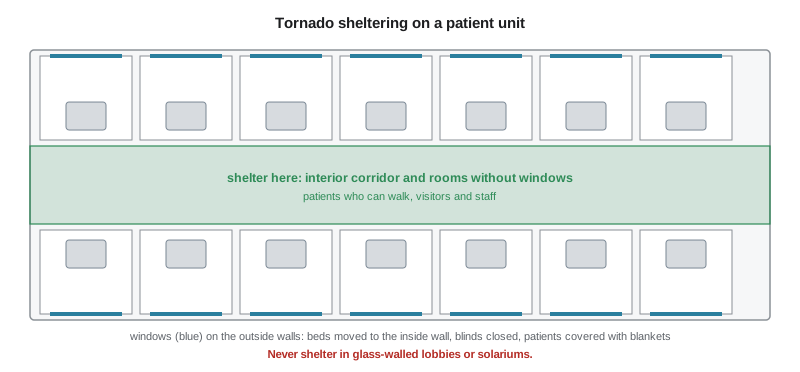
When a tornado warning is announced, staff:
- Move patients who can walk, visitors and staff into interior corridors and rooms without windows, such as utility rooms and stairwells.
- For patients who cannot be moved quickly, move beds away from windows toward the inside wall, close blinds and curtains, and cover patients with extra blankets and pillows to protect against flying glass and debris.
- Close patient room doors and fire doors.
- Keep away from glass-walled areas, such as lobbies, solariums and skylights.
- Stay sheltered until the all clear, then check for injuries and damage and report.
Maple Court and the outpatient clinics have their own shelter plans, and Northbridge's hazard analysis showed that the hospital had never practised one. The first tornado drill, in June, showed that two units did not know which of their rooms were interior, and the solarium on 3 East was full of patients and visitors when the drill was called. Each unit now has its shelter areas marked on its floor plan and on the Code Orange and Code Green pages of its flip chart.
Winter storms, ice and extreme cold
Ice storms and blizzards rarely damage the hospital itself, but they cut power lines, block roads and keep staff and patients at home. The 1998 ice storm in eastern Ontario, Quebec and the northeastern United States left millions without power, some for weeks, and hospitals in the area ran on generators while caring for people who came in from cold homes. Extreme cold adds risks of frozen pipes, failed heating and staff who cannot start their cars.
The biggest problem in a winter storm is usually staffing. Staff on the night shift cannot leave until relief arrives, and relief cannot get in. Sarah MacLeod uses a quick calculation when a blizzard is forecast, to see how many staff 4 West will need to keep or bring in for the next day.
# 4 West: staffing for a forecast blizzard
needed = {"day": 12, "evening": 9, "night": 6}
expected_in = {"day": 5, "evening": 5, "night": 4}   # staff who live close
holdover = {"day": 3, "evening": 2, "night": 0}       # stay from previous shift
sleepover = {"day": 2, "evening": 1, "night": 1}      # staying at the hospital

for shift in ("day", "evening", "night"):
    have = expected_in[shift] + holdover[shift] + sleepover[shift]
    gap = needed[shift] - have
    print(f"{shift:8}need {needed[shift]:2}  have {have:2}  "
+ (f"short {gap}" if gap > 0 else "covered"))day need 12 have 10 short 2 evening need 9 have 8 short 1 night need 6 have 5 short 1
Even with holdovers and staff sleeping over, 4 West would be two short on days and one short on evenings and nights, and every other unit had similar gaps. The plan for a forecast storm includes asking staff who live close by or have suitable vehicles to come in early, setting up sleeping rooms in empty clinic areas, offering meals, arranging rides from a volunteer group with four-wheel-drive vehicles, and limiting holdovers to safe lengths under the fatigue policy so that staff who stay are not working dangerously long hours. Managers must also think about staff who are caring for children at home when schools close.
Weather also changes the patients who arrive. During long power failures, people who use home oxygen concentrators, ventilators, dialysis or powered wheelchairs, and people whose homes are too cold, come to the emergency department because they have nowhere else to go. Plans include a space and staff to care for these people, who are not acutely ill but cannot stay at home, in cooperation with municipal warming centres.
Heat
Heat waves are among the deadliest weather events in North America, even though they cause no visible damage. During the June 2021 heat dome in British Columbia, hundreds of people died, most of them older people alone in homes without air conditioning. Hospitals need to protect patients and residents who are vulnerable to heat, as well as staff.
- Many patients and residents are at higher risk from heat: older adults, people with heart, lung or kidney disease, people with dementia who may not drink enough, and people taking medications that affect sweating or fluid balance, such as diuretics and some psychiatric drugs.
- Units without full air conditioning, such as some areas of older buildings, need cooling plans: portable air conditioners, cooled rooms where patients can spend time, fans used carefully, and close monitoring of temperatures in rooms and medication refrigerators.
- Residents need regular offers of fluids, lighter clothing and bedding, and checks for signs of heat illness.
- Staff working in hot areas, such as kitchens, laundries and units without air conditioning, need breaks, water and attention to signs of heat stress.
Ontario's long-term care regulation requires homes to have a heat-related illness prevention and management plan, air conditioning in resident areas, and temperature monitoring in resident rooms and common areas. Maple Court's plan sets actions at set temperatures and humidex levels.
Wildfire smoke
Wildfire smoke can travel thousands of kilometres. In 2023, smoke from fires in Canada brought some of the worst air quality ever recorded to cities in Ontario, Quebec, Minnesota and the northeastern United States. Smoke contains fine particles that worsen asthma, lung disease and heart disease, and it can come into buildings through air handling systems.
When the air quality health index reaches high levels, Northbridge may call a Code Grey for air exclusion. Maintenance switches air handling units to recirculate inside air and closes outside air dampers where safe, increases filtration, and keeps doors closed. Staff close windows, limit outdoor activities for residents and patients, and watch patients with lung and heart disease closely. Staff who work outside, such as security and grounds staff, get respirators and limits on outdoor work.
Floods
Spring floods from rivers and heavy rain can reach hospital basements, where electrical rooms, generators, kitchens and supplies are often located. Flooding of basements has knocked out power and generators in hospitals in major storms, forcing evacuations. Northbridge's flood plan includes barriers for the basement entrances, pumps, moving critical supplies off the basement floor when a flood is forecast, and a decision point for shutting down and protecting electrical equipment.
Planning for a changing climate
Hospitals have traditionally planned for the weather of the past, using records of how often floods, heat waves and storms have happened. Climate scientists and public health agencies in both countries now expect heat waves, heavy rainfall, wildfire smoke and some kinds of severe storms to become more frequent or more intense in many regions. Northbridge's hazard analysis now considers these trends, not only past events: the group raised its probability scores for extreme heat and wildfire smoke, and the maintenance department added cooling capacity and better air filters to its long-term capital plan. Planning ahead in this way is mitigation, the cheapest phase of emergency management.
The hospital in a community disaster
In a community-wide disaster, the hospital is not working alone. It is part of a regional response that includes paramedics, police, fire, public health, municipal emergency management, other hospitals and long-term care homes, community agencies and volunteers.
In Ontario, municipalities lead the local response under the Emergency Management and Civil Protection Act, with Emergency Management Ontario coordinating provincial support, and Ontario Health and the Ministry of Health coordinating the health system. Northbridge's liaison officer connects with the municipal emergency operations centre during a disaster.
Mutual aid agreements with other hospitals and homes let facilities share staff, supplies and beds when one is overwhelmed, and agree in advance how patients will be transferred. Home care agencies keep lists of high-risk clients and work with emergency services to check on them. The hospital's public information officer coordinates messages with the municipality and public health, so the public hears one consistent story.
After the storm
Recovery from a weather disaster often takes longer than the event. Roads reopen before power is restored, and power is restored before every home is warm and safe. The hospital may see a second wave of patients in the days after a storm: carbon monoxide poisoning from generators and barbecues used indoors, injuries from clearing ice and fallen trees, falls on ice, and people whose chronic conditions worsened while they could not get care or medications. Staff may have damage at home, children out of school and long commutes on damaged roads.
Northbridge's recovery checklist covers inspecting the building and roof, servicing the generators and refuelling them, restocking supplies, rescheduling postponed surgery and clinics, checking on home care clients who missed visits, and supporting staff, including flexible schedules and time to deal with problems at home. The emergency program then reviews the response, as it does after every activation, and updates the plan.
Worked problem
The ice storm
An ice storm is forecast to hit Northbridge overnight, with up to 30 mm (1.2 in) of freezing rain, widespread power failures likely and roads expected to be impassable by morning. What should the hospital do in the 12 hours before the storm arrives?
Show solution
- The administrator on call and the emergency preparedness coordinator review the forecast, put the plan on alert, and open a small command team with staffing, maintenance and logistics.
- Staffing asks staff who live close or have suitable vehicles to plan to come in, sets up sleeping rooms, arranges meals and contacts the volunteer drivers; managers plan safe holdovers within the fatigue policy.
- Maintenance tops up generator fuel, tests the generators, checks the heating and clears drains, while logistics orders extra supplies, food and medications for several days.
- Northbridge Home Care calls high-risk clients to check their plans for power failures, the emergency department prepares space for people who rely on powered equipment at home, and the liaison officer connects with the municipality's warming centre plans.
Answer: Use the warning time: activate the plan early, secure staff, fuel and supplies, check on high-risk clients, prepare for people seeking power and warmth, and connect with community partners.
Common mistakes
MistakeWaiting until a storm hits to think about staffing.
InsteadPlan staffing, sleepovers and transport when the storm is forecast.
MistakeSheltering from a tornado in a glass-walled lobby or solarium.
InsteadUse interior corridors and rooms away from windows.
MistakeLetting staff work unsafe hours during a storm because relief cannot come.
InsteadPlan holdovers within the fatigue policy and use sleeping rooms and rest breaks.
MistakeKeeping outside air dampers open during heavy wildfire smoke.
InsteadCall air exclusion, recirculate inside air and increase filtration.
MistakeTreating the hospital as separate from the community response.
InsteadConnect with municipal emergency management, health partners and mutual aid agreements.
Summary and key terms
- Weather emergencies usually give warning and affect the whole community at once.
- Weather alerts are linked to actions in the emergency plan, from reviews at a watch to immediate sheltering at a warning.
- For tornadoes, shelter in interior spaces away from windows, and protect patients who cannot be moved.
- Winter storms mainly strain staffing; plan sleepovers, transport and safe holdovers.
- Heat waves threaten older and medically fragile people; cooling, fluids and monitoring are essential.
- Wildfire smoke calls for air exclusion and protection of people with lung and heart disease.
- In a community disaster, the hospital works with municipal emergency management, health partners and mutual aid.
- Weather watch
- An alert that conditions are favourable for a hazard such as a tornado.
- Weather warning
- An alert that a hazard is happening or about to happen.
- Holdover
- Staff staying on after their shift until relief arrives.
- Air exclusion
- Shutting off outside air to keep smoke or chemicals out of the building.
- Mutual aid agreement
- An agreement between organizations to share staff, supplies or beds in an emergency.
- Warming site
- A public space, often called a warming centre, where people can stay warm during extreme cold or power failures.
Practice problems
Work each problem on paper first, then reveal the answer to check.
What is the difference between a watch and a warning?
Show answer
A watch means conditions are favourable for the hazard; a warning means it is happening or about to happen.
How should staff protect a patient who cannot be moved during a tornado warning?
Show answer
Move the bed away from the window toward the inside wall, close blinds and curtains, and cover the patient with blankets and pillows.
From the 4 West calculation, how short would each shift be in the blizzard?
Show answer
Two short on days, and one short on evenings and nights.
Which patients are most at risk during a heat wave?
Show answer
Older adults, people with heart, lung or kidney disease, people with dementia, and people on medications that affect sweating or fluid balance.
What does air exclusion involve?
Show answer
Recirculating inside air, closing outside air dampers where safe, increasing filtration and keeping doors and windows closed.
Why do people who use home oxygen or dialysis come to hospital during long power failures?
Show answer
Their equipment needs power and they may have nowhere else to go.
Lesson quiz · 5 questions
Score 60% or more to complete this lesson.
Create a free account to save your progress, take quizzes and earn a certificate.