
HSE-372 · Lesson 9 of 12 · 21 min
Mechanical demolition and equipment
Most of the Norwood Block came down by machine. A high-reach excavator with a long boom and a set of interchangeable attachments nibbled the building from the top down, a standard excavator with a breaker and a grapple handled the slab and foundations, a skid-steer loader pushed debris on the ground floor, and a crane lifted off the rooftop unit and the steel that was cut free. Machines keep workers away from the most dangerous parts of the work, out of the way of falling material and unstable structure. They also bring their own hazards: tip-over, falling debris onto the cab, struck-by and crushing injuries to people on the ground, attachments that fail, and machines working on floors and slabs that may not carry them.
This lesson covers the machines and attachments used in demolition, how they are protected and set up, how exclusion zones keep people clear, and the rules for cranes and other lifting equipment on a demolition site.
The machines
- High-reach excavators have long, multi-section booms, often 20 to 40 m (65 to 130 ft) or more, for demolishing tall structures from the ground. They carry counterweights, wide or extendable undercarriages, and attachments sized for the reach.
- Standard excavators fitted for demolition, with breakers, crushers, shears, pulverizers and sorting grapples, do most of the work on low buildings and foundations.
- Skid-steer and compact track loaders clear debris, often working on floors inside the building.
- Remote-controlled demolition robots are compact tracked machines operated from a distance, used inside buildings, on upper floors with weight limits and in hazardous areas.
- Cranes lift off equipment, steel members and sections cut free, and occasionally carry a wrecking ball, which is now rare.
- Trucks haul debris away and are a struck-by hazard at the loading area.
Attachments
- Hydraulic breakers hammer concrete and masonry apart. They produce noise, vibration and silica dust.
- Crushers and pulverizers squeeze concrete apart and separate reinforcing steel, with less noise and vibration than breakers.
- Shears cut steel beams, columns, pipes and reinforcing cold, which avoids torch cutting and its lead fume and fire hazards.
- Grapples pick up and sort debris, and pull walls and members down in a controlled way.
- Multi-processors carry interchangeable jaws for crushing, cutting and shearing.
Every attachment has a weight and an operating force that the machine must be rated for, and attachments on high-reach booms are limited by the boom's capacity at full reach. Quick couplers that attach the tool to the boom must be locked and checked each time a tool is changed; a tool that drops off the boom is a falling object weighing a tonne or more.
Protecting the operator
Debris falls during mechanical demolition, and the operator sits closest to it. Demolition machines are fitted with:
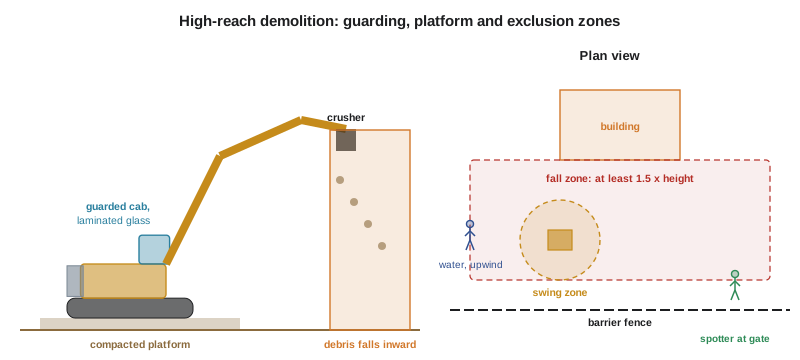
- Falling object protective structures (FOPS) and front guards over the cab and windscreen, rated for the demolition work, and roll-over protection where tip-over is possible.
- Impact-resistant glazing, such as laminated or polycarbonate windows, which do not shatter into the cab.
- Sealed, pressurized cabs with filtered air to keep the operator out of the dust, as covered in lesson 6.
- Cameras and mirrors that let the operator see around the machine and up to the attachment.
- Seat belts worn at all times.
Setting up the machine
A demolition excavator is only as stable as the ground under it. The Norwood Block plan set up each machine on firm, level ground, on a working platform of compacted debris or crushed stone where needed, and well away from the basement walls and the edge of any excavation. Machines working near the basement stayed back at least the distance Helen specified, because a heavy machine near the edge of a basement can push a wall in or cave the soil. The high-reach excavator's tracks were extended to their widest setting before the boom was raised. The machine's manufacturer's limits on reach, height, attachment weight and wind were followed, and the operator checked the machine's stability indicators throughout.
Machines working on upper floors or slabs need an engineer to confirm the floor can carry them, with shoring added underneath where needed. On the Norwood Block, only a compact track loader was allowed on the ground floor slab, and only in the areas Helen marked, and no machine went onto the 1978 second floor.
Exclusion zones
People on the ground are the most common victims of demolition equipment. They are struck by swinging booms, run over by tracked machines reversing, hit by debris falling from the attachment, or caught when a wall or member falls farther than expected.
- Fall zone around the structure. No one stands within the area a wall or structure could fall into. A common rule of thumb is a distance at least equal to the height of the part being demolished, with more where the structure could fall unpredictably. On the Norwood Block, the exclusion zone during high-reach work extended at least one and a half times the height of the building from the face being demolished.
- Machine zone. No one enters the area within the swing radius of the machine and its attachment, plus a margin, while the machine is working. Anyone who needs to enter, such as the water hose worker or a signaller, does so only by making eye contact with the operator and getting a clear signal that the machine has stopped and the attachment is lowered.
- Physical barriers. Exclusion zones are marked with fencing, barriers and signs, not just tape, and a spotter keeps watch at entry points during high-risk stages.
- Communication. Operators and ground workers agree hand signals or use radios. When the operator loses sight of a ground worker, the machine stops.
Cranes and the wrecking ball
Cranes on a demolition site follow the same rules as on any construction site: a qualified operator, a lift plan, a competent rigger and signaller, the crane set up on firm ground, and load chart limits respected. Lifting a member that is still attached to the structure is especially hazardous, because its weight is unknown until it is free and it can swing when it releases. Members are cut free with the crane already supporting them and the load estimated conservatively. The wrecking ball, once common, is rarely used today; where it is, CSA S350, the Code of Practice for Safety in Demolition of Structures, which the Manitoba regulation makes enforceable limits its use and requires an engineered procedure.
Daily checks and maintenance
Demolition is hard on machines. Hydraulic hoses, pins, couplers, guards and glass take impacts and vibration all day. Each operator does a pre-shift inspection that covers the attachment and coupler, hydraulic hoses and fittings, the guards and glazing, tracks and undercarriage, fire extinguisher, seat belt, lights and alarms, and cab pressurization and filters. Defects are reported and fixed before work, and a machine with a cracked guard or a damaged coupler is taken out of service. Machines are refuelled in a designated area away from debris and hot work, and kept clean of debris that could catch fire on hot surfaces.
Checking the wrecking ball limit
Prairie Wrecking Ltd. used a wrecking ball once, years ago, on a brick chimney. Owen uses a short program to show the crew how the limit works.
# Wrecking ball limits (invented crane data).
rated_load_kg = 12000          # crane rated load at the boom length and operating angle in use
line_breaking_strength_kg = 40000
ball_kg = 4500

limit_rated = 0.50 * rated_load_kg
limit_line = 0.25 * line_breaking_strength_kg
limit = min(limit_rated, limit_line)
print(f"50% of rated load: {limit_rated:,.0f} kg ({limit_rated*2.2046:,.0f} lb)")
print(f"25% of line breaking strength: {limit_line:,.0f} kg ({limit_line*2.2046:,.0f} lb)")
print(f"Governing limit: {limit:,.0f} kg ({limit*2.2046:,.0f} lb)")
print(f"Ball of {ball_kg:,} kg allowed?", "yes" if ball_kg <= limit else "no -- use a lighter ball or a larger crane")50% of rated load: 6,000 kg (13,228 lb) 25% of line breaking strength: 10,000 kg (22,046 lb) Governing limit: 6,000 kg (13,228 lb) Ball of 4,500 kg allowed? yes
In this case the ball is within the limit set by the crane's rating but heavier than the limit set by the line, so the line governs and a lighter ball or a stronger line is needed. The point of both limits is the same: a swinging ball puts dynamic loads on the crane and the line far above its static weight.
Worked problem
The ground worker in the swing zone
Show solution
- During the second-floor wall demolition, the high-reach operator is crushing the west wall. A labourer walks into the exclusion zone to pick up a length of conduit that has fallen near the fence.
- The spotter at the gate sees him and radios the operator, who stops the machine and lowers the attachment.
- Gord Pelletier stops the work and talks with the labourer, who thought the debris was far enough from the wall to be safe. It was inside the fall zone of the wall section being crushed.
- Gord reviews the zone with the crew: the fence marks the zone, nobody crosses it while the machine is working, and anyone who needs to enter radios the operator and waits for the stop signal.
- The fence is moved out to cover a gap the labourer had used, and the next morning's briefing repeats the rule with the exact distance.
Answer: Exclusion zones only work if they are physical, watched and respected. Entry happens only after the operator has stopped and confirmed it.
Demolition robots inside buildings
Remote-controlled demolition robots changed interior demolition. They are compact, tracked machines with a boom and a small breaker, crusher or shear, light enough to work on many suspended floors and small enough to fit through doorways and into elevators. The operator walks behind or beside the machine with a remote control, typically several metres away, out of the zone where debris falls.
Robots bring their own hazards. The operator must stay outside the machine's reach and out of the line of fire if a hose bursts or the attachment throws debris. The machine can tip if it works on a slope, on debris or at the edge of an opening, and its outriggers must be set on firm ground. Its weight, including the attachment, must be within the floor's allowable load. And because the operator stands on the same floor as the work, the operator is exposed to dust, noise and falling material in a way that an operator in a sealed cab is not, so respirators, hearing protection and a clear exit route are part of the setup.
On the Halvorsen Building renovation, a robot with a small breaker removed the old terrazzo washroom floors on the third floor after hours, with Helen confirming the slab could carry it and a temporary shore line placed under the work area on the second floor. The operator stood behind a portable screen, wore a powered respirator and double hearing protection, and kept the remote control's emergency stop within reach.
Refuelling, fire and machines
Machines and debris together are a fire risk. Hot exhaust and engine surfaces can ignite dust, paper, wood and plastic packed around them, especially after a long shift in a demolition. Operators clean debris out of engine compartments and off exhaust systems at the end of each shift, refuel only in the designated area with the engine off, and keep an extinguisher on every machine. A machine that catches fire on an upper floor of a building under demolition is very hard to reach, so prevention is the only practical defence.
Common mistakes
MistakeStanding close to watch the machine pull a wall down.
InsteadStay outside the fall zone and the machine's swing radius, behind the barrier.
MistakeChanging an attachment without checking that the coupler is locked.
InsteadCheck and test the coupler lock every time a tool is changed.
MistakeDriving a heavy machine onto an upper floor because it seems solid.
InsteadUse machines on floors only where an engineer has confirmed the floor can carry them.
MistakeSetting up close to a basement wall to reach farther.
InsteadKeep machines back from basement walls and excavation edges as the plan requires.
MistakeLifting a steel member with the crane after it has been cut free and dropped.
InsteadRig and support the member with the crane before it is cut free, with the load estimated conservatively.
Summary and key terms
- Demolition uses high-reach and standard excavators, loaders, remote-controlled robots and cranes, with breakers, crushers, shears, grapples and multi-processors.
- Operators are protected by falling object guards, impact-resistant glazing, pressurized filtered cabs, cameras and seat belts.
- Machines are set up on firm, level ground, back from basement walls and edges, and on upper floors only where an engineer confirms the floor can carry them.
- Fall zones and machine swing zones are physically marked and watched, and nobody enters until the operator stops and signals.
- Cranes follow the usual lift planning rules, with members rigged before they are cut free; wrecking balls need an engineered procedure under CSA S350.
- High-reach excavator
- An excavator with a long multi-section boom used to demolish tall structures from the ground.
- Shear
- An attachment that cuts steel cold by hydraulic force.
- Pulverizer
- An attachment that crushes concrete and separates reinforcing steel.
- FOPS
- Falling object protective structure, a guard over the operator's cab rated to resist falling debris.
- Quick coupler
- A device that attaches an excavator tool to the boom and must be locked and checked at every change.
- Swing radius
- The area the machine's upper structure, boom and attachment can reach as it rotates.
Practice problems
Work each problem on paper first, then reveal the answer to check.
Why are shears preferred over torch cutting for steel in demolition?
Show answer
They cut cold, avoiding lead fume from painted steel and the fire risk of hot work.
Name four features that protect a demolition machine operator.
Show answer
Any four of falling object guards, impact-resistant glazing, a pressurized filtered cab, cameras and mirrors, and a seat belt.
What is a common rule of thumb for the fall zone around a structure being demolished?
Show answer
At least the height of the part being demolished, with more where it could fall unpredictably.
How should a ground worker enter a machine's working area?
Show answer
Only after making eye contact or radio contact with the operator and getting a clear signal that the machine has stopped and the attachment is lowered.
Why is a member rigged to the crane before it is cut free?
Show answer
Its weight is uncertain and it can drop or swing when released, so the crane must support it before the cut.
Lesson quiz · 5 questions
Score 60% or more to complete this lesson.
Create a free account to save your progress, take quizzes and earn a certificate.