
HSE-372 · Lesson 12 of 12 · 20 min
Protecting the public, noise and emergency planning
The Norwood Block sat on a busy corner. A bus stop stood on the north sidewalk, a coffee shop was across the street, the Halvorsen Building's tenants used the lane, and houses began half a block to the east. Every day of the demolition, hundreds of people walked, drove and cycled within a few metres of a building being torn apart. None of them had been to the site orientation, none wore hard hats, and most never gave the site a second look. Protecting them was as much a part of the job as protecting the crew. So was planning for the day something went wrong: a wall that fell the wrong way, a fire in the debris, a gas leak, a worker trapped under a collapse.
This lesson covers protecting the public from falling debris, dust, noise and vibration; managing traffic and access around the site; working with neighbours; and planning for emergencies on a demolition. It closes the course with a look back at how the pieces fit together.
Hoarding, covered walkways and closed sidewalks
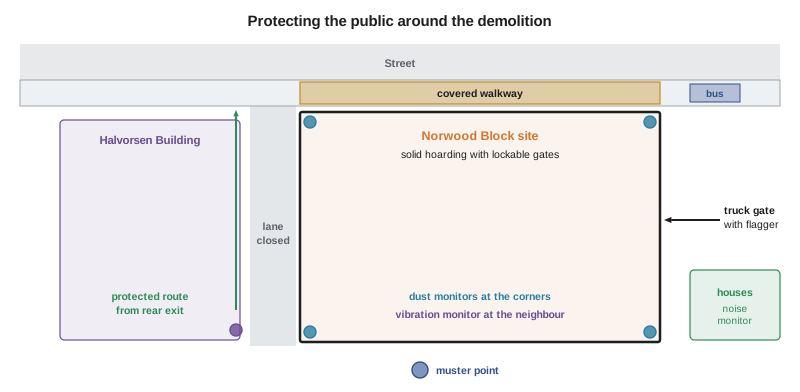
The City of Winnipeg required a permit to occupy the sidewalk and part of the street with hoarding during the demolition. Manitoba's regulation requires the employer to protect people who are not workers from the hazards of the work, and CSA S350, the Code of Practice for Safety in Demolition of Structures, which the Manitoba regulation makes enforceable sets out practice for protecting the public, including hoarding and covered ways. On the Norwood Block, the plan put a solid plywood hoarding about 2.4 m (8 ft) high around the site perimeter, with lockable gates. Along the north sidewalk, where people had to keep walking past the building, a covered walkway with a solid roof strong enough to stop falling debris ran the length of the building, lit at night and kept clear of obstructions. During the riskiest work, such as taking down the parapet and pulling down the north wall, the sidewalk was closed completely and pedestrians were directed across the street with signs and a flagger.
Traffic and access
Trucks hauling debris were the main traffic hazard. Each truck backed into the site through a single gate, guided by a flagger who stopped pedestrians and cyclists on the sidewalk while the truck crossed it. Trucks were covered before leaving so debris could not blow off, and their wheels were cleaned at a gravel pad and wash point so mud and dust were not tracked onto the street. Deliveries and truck movements were scheduled outside the busiest times, such as the start and end of the school day at a school two blocks away. The lane closure, the street occupancy and the truck route were all set out in a traffic management plan approved by the City of Winnipeg.
Dust at the boundary
Dust from demolition can carry silica, lead and, if abatement was incomplete, asbestos. The plan controlled dust at the source, as covered in lesson 6, and checked it at the boundary. Real-time dust monitors at the four corners of the site measured airborne particles continuously and sent alerts to Owen's phone if levels rose above an action level set in the plan. When an alert came, the crew increased water, slowed the work or stopped it until the cause was fixed. On windy days, Gord stopped the dustiest work when wind blew toward the bus stop or the houses. The street and sidewalk were swept with a water truck or a vacuum sweeper, not dry brooms.
Noise
Demolition is one of the noisiest construction activities. Hydraulic breakers, crushers, falling debris, trucks and backup alarms can all reach well over 100 dBA close up. Noise affects workers' hearing, which is covered in HSE-370, and it affects neighbours' sleep, work and health.
Most municipalities, including Winnipeg, have bylaws that limit construction noise to certain hours, and the City of Winnipeg's permit for the Norwood Block set those hours. The plan put the noisiest work, such as breaking the foundations, in the middle of the day, used crushers instead of breakers where possible, kept machines turned off when idle, fitted broadband backup alarms that are less intrusive than tonal beepers where the site rules allowed, and placed the bins and loading area away from the houses. A noise monitor at the nearest houses recorded levels throughout.
Vibration and the neighbours
Breaking foundations and dropping heavy debris send vibration through the ground. It can crack plaster and masonry in nearby buildings, disturb sensitive equipment and alarm occupants even when it causes no damage. Lesson 2 described the condition survey and vibration limits at the Halvorsen Building. The monitor at its footing sent an alert if vibration passed the alert level, and stopped the breaking if it passed the stop level. Twice during the foundation work, the alert level was reached; both times, Gord changed from the breaker to the crusher for that section, and the readings dropped.
Working with neighbours
Neighbours who know what is coming are much more tolerant than neighbours who are surprised. Before demolition, Tallgrass delivered a notice to every building within a block, explaining the schedule, the working hours, the lane closure, the dust and noise controls and a contact number answered during working hours. The Halvorsen Building's manager got a weekly look-ahead. Complaints were logged, answered the same day and reviewed at the weekly site meeting, and some led to changes, such as moving the truck wash away from a restaurant's patio.
Planning for emergencies
Demolition emergencies can develop fast and look different from emergencies on other sites. The Norwood Block emergency response plan covered the most likely and the most severe events, with a specific response for each.
- Unplanned collapse. Stop all work, clear everyone from the area and the fall zone of anything still standing, account for every worker at the muster point, call 911 if anyone is missing or hurt, and do not let untrained people dig into a collapse. The fire department's technical rescue team handles structural collapse rescue, and the structural engineer advises them on what is still unstable.
- Fire. Demolition debris, dust and hot work make fires likely, and buildings under demolition have lost their fire separations and sprinklers. The plan kept a fire hose and extinguishers at hand, set hot work rules, kept debris piles away from the hoarding, and kept the fire department's access route clear.
- Gas leak. If a gas smell or a detector alarm suggested a leak, from a line missed in the isolation or a neighbour's line, the crew shut down all equipment and ignition sources, evacuated the area and upwind, and called the gas utility and 911 from a safe distance.
- Hazardous material release. If a suspect material not in the report was disturbed, work stopped, the area was isolated and the hygienist was called. If abatement containment failed, the abatement plan's emergency procedures applied.
- Injury and medical emergency. First aid kits and trained first aiders were on site, the address and directions for ambulances were posted, and the route from the muster point to the street was kept clear.
- Public injury or near miss. Any incident involving the public was treated as serious: secure the scene, give first aid, call 911 if needed, notify the client and the City of Winnipeg, and investigate.
Each emergency needs someone in charge, a way to raise the alarm, a muster point, a headcount, a call list and a way to brief the fire department when they arrive. Owen kept a laminated card with the call list and the site address on every crew lead's hard hat, and the plan was practised in a drill during the first week of demolition.
Reporting
Serious incidents are reported to the Branch as the regulation requires, including any structural collapse, serious injury or dangerous occurrence, and the scene is preserved for investigation. Injuries are also reported to the Workers Compensation Board of Manitoba (WCB). Tallgrass's own procedure required every incident and near miss to be reported to Owen the same day, so that the cause could be found and fixed before it caused something worse.
Estimating noise at the houses
Before the foundation work, Owen estimates the noise at the nearest houses from the breaker, using the rule that sound from a point source drops by about 6 dB for each doubling of distance.
# Noise from a hydraulic breaker at the nearest houses (invented data).
import math
L_ref = 95.0          # dBA measured 10 m (about 33 ft) from the breaker
r_ref = 10.0          # m
houses_m = 70.0       # distance to nearest houses
barrier = 5.0         # estimated reduction from the solid hoarding, dB

L_free = L_ref - 20 * math.log10(houses_m / r_ref)
L_with = L_free - barrier
print(f"At {houses_m:.0f} m ({houses_m*3.281:.0f} ft): about {L_free:.0f} dBA without the hoarding")
print(f"With the hoarding: about {L_with:.0f} dBA")
crusher_reduction = 10.0
print(f"Using a crusher instead of the breaker: about {L_with - crusher_reduction:.0f} dBA")At 70 m (230 ft): about 78 dBA without the hoarding With the hoarding: about 73 dBA Using a crusher instead of the breaker: about 63 dBA
The estimate shows why the noise plan matters: even at 70 m (230 ft), the breaker is loud enough to bother neighbours, and switching to a crusher for most of the work makes a bigger difference than the hoarding alone.
Looking back at the course
The Norwood Block came down in fourteen weeks without a lost-time injury, without a complaint that went unanswered and without damage to the Halvorsen Building. The renovation inside the Halvorsen Building finished on schedule with its tenants still at work. None of that was luck. It came from following the order of work: surveying before planning, planning before notifying, abating and clearing before demolishing, isolating before cutting, keeping the structure stable at every stage, controlling the edges and the debris, and protecting the people outside the hoarding as carefully as the people inside it.
Worked problem
The dust alert on a windy afternoon
Show solution
- During the foundation breaking, the dust monitor at the north-east corner sends an alert to Owen's phone. The wind has shifted and is now blowing from the site toward the bus stop.
- Owen walks to the breaking area and sees that the water hose worker has moved to refill the water tank, so the breaker has been running dry for a few minutes.
- He signals the operator to stop. The water supply is restored, and the hose worker repositions upwind.
- With water back on, the monitor reading drops below the action level within minutes. Gord decides to break only the sections farthest from the street until the wind drops.
- The event is logged, and the plan changes: the breaker stops automatically whenever the water hose worker leaves, and a second water supply is set up so refills do not interrupt the spray.
Answer: Boundary monitoring tells you when controls have slipped. Respond fast, fix the control, and change the plan so it does not happen again.
Common mistakes
MistakeLeaving the sidewalk open during work that could drop debris over it.
InsteadUse a covered walkway for routine work and close the sidewalk during the riskiest work.
MistakeLetting trucks back across the sidewalk without a flagger.
InsteadUse a flagger to stop pedestrians and cyclists while trucks cross.
MistakeIgnoring a dust or vibration alert because the work is almost done.
InsteadStop or change the work, find the cause and fix the control.
MistakeLetting workers dig into a collapse to find a trapped co-worker.
InsteadClear the area, account for everyone, call 911 and let the trained rescue team work with the engineer.
MistakeSurprising neighbours with noise and closures.
InsteadTell them in advance, give them a contact and answer complaints quickly.
Summary and key terms
- The public is protected with hoarding, covered walkways, closed sidewalks during the riskiest work and a city permit for occupying the sidewalk and street.
- Trucks use a controlled gate with a flagger, are covered and cleaned, and follow a traffic management plan.
- Dust, noise and vibration are controlled at the source and checked at the boundary, with action levels that trigger a response.
- Neighbours get advance notice, a contact, and quick answers to complaints.
- The emergency plan covers collapse, fire, gas leaks, hazardous material releases, injuries and public incidents, with someone in charge, a muster point, a headcount and a call list, practised in a drill.
- Hoarding
- A solid temporary fence or barrier around a construction or demolition site.
- Covered walkway
- A protected pedestrian route with a roof strong enough to stop falling debris.
- Traffic management plan
- A plan, usually approved by the city, for truck routes, lane closures, sidewalk occupancy and flagging around a site.
- Action level
- A monitoring result, such as a dust or vibration reading, that triggers a set response before a limit is reached.
- Muster point
- The place where everyone gathers in an emergency so a headcount can be taken.
- Technical rescue
- Specialized rescue, such as from a structural collapse or trench, carried out by trained fire department teams.
Practice problems
Work each problem on paper first, then reveal the answer to check.
When was the north sidewalk closed completely during the Norwood Block demolition?
Show answer
During the riskiest work, such as taking down the parapet and pulling down the north wall.
What did the site do when a boundary dust monitor sent an alert?
Show answer
Increased water, slowed or stopped the work until the cause was fixed, and changed the work if the wind was blowing toward the public.
Name four noise controls used on the Norwood Block.
Show answer
Any four of scheduling noisy work mid-day, crushers instead of breakers, turning off idle machines, broadband backup alarms, placing bins away from houses and noise monitoring.
What should the crew do after an unplanned collapse?
Show answer
Stop work, clear the area and fall zones, take a headcount at the muster point, call 911 if anyone is missing or hurt, and let the fire department's technical rescue team work with the engineer.
About how much does sound from a point source drop for each doubling of distance?
Show answer
About 6 dB.
Lesson quiz · 5 questions
Score 60% or more to complete this lesson.
Create a free account to save your progress, take quizzes and earn a certificate.