
HSE-372 · Lesson 1 of 12 · 22 min
Demolition and renovation: the hazards and who controls them
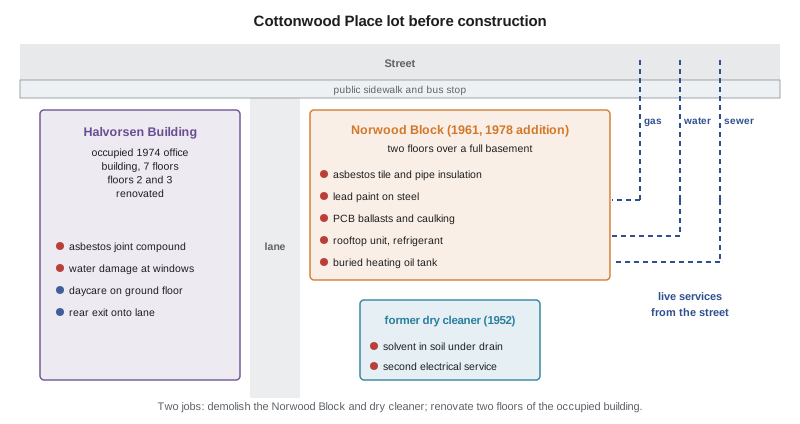
Before the first shovel went into the ground at Cottonwood Place, something else had to come out of it. The corner lot that Tallgrass Construction bought in Winnipeg, Manitoba was not empty. It held the Norwood Block, a two-storey commercial building from 1961 with shops at street level, offices upstairs and a full basement, and behind it a small single-storey building that had been a dry cleaner from 1952 until the 1990s. Both had to be taken down, cleared of hazardous materials and removed to the footing level before excavation could start. At the same time, Tallgrass won a second contract next door: renovating the second and third floors of the Halvorsen Building, the occupied 1974 office building on the west side of the site, while the tenants on the other floors kept working.
This course follows both jobs: the demolition of the Norwood Block and the renovation inside the Halvorsen Building. Together they cover almost every hazard that makes demolition and renovation some of the most dangerous work in construction. Demolition reverses the logic of building. On a new building, the structure gets stronger every day as it is completed. On a demolition, the structure gets weaker every day as parts are removed, and it can fail in ways that nobody planned. Renovation adds a second problem: the work happens inside buildings full of materials that were legal and normal when they were installed but are now known to be hazardous, often hidden behind finishes, above ceilings and inside walls.
This lesson maps the work, the main groups of hazards, the rules that apply and the people who control them. It builds on HSE-370 Construction Site Safety Essentials, which introduced the Cottonwood Place site, its people and the hazards that injure construction workers most often.
Why demolition and renovation are different
Most construction work starts from a design. The structure is drawn, calculated and built in a known sequence, and everyone can look at the drawings to see what is supposed to be there. Demolition and renovation start from an existing building, and existing buildings rarely match their drawings. The original drawings may be missing or wrong. Walls may have been moved, openings cut, floors added, and services rerouted over sixty years of tenants. Materials may have deteriorated: steel corrodes, wood rots, concrete cracks and reinforcing rusts. Loads may have changed. A wall that looks like a partition may be carrying a floor that a previous owner added without a permit.
Three features make this work especially hazardous.
- Unknown structure. Workers do not always know what is holding up what. Removing the wrong member, or removing members in the wrong order, can bring down part of a building, sometimes onto the workers doing the removal.
- Hidden hazardous materials. Asbestos, lead paint, polychlorinated biphenyls (PCBs), mercury, mould and contaminated soil are common in buildings built before the 1980s. They are often invisible until the work disturbs them, and by then workers may already have been exposed.
- Live services in a dead building. Electrical, gas, water and sewer services may still be live in parts of a building that looks abandoned. Some services feed neighbouring buildings. A crew cutting into a wall can hit a live conductor or a gas line that everyone believed was off.
Renovation adds two more. The building is often occupied, so dust, noise, fumes and blocked exits affect people who are not workers. And renovation jobs are often small, fast and done by crews who do not think of themselves as demolition workers, even though removing a ceiling, a wall or a floor is exactly that.
The main groups of hazards
Each later lesson covers one or two of these groups in depth.
Structural collapse
Partial or total collapse is the hazard that kills demolition workers most often in large incidents. It happens when load-bearing members are removed before the loads they carry, when debris piled on a floor overloads it, when a wall is left standing on its own without bracing, when a neighbouring structure loses support, or when a weakened element fails without warning. Lessons 2, 8 and 9 cover the engineering survey, the sequence of demolition and mechanical demolition.
Hazardous materials
Asbestos is the best known, but buildings of the Norwood Block's age also contain lead paint, PCBs in light ballasts and caulking, mercury in lamps and thermostats, ozone-depleting refrigerants in air conditioning units, and sometimes fuel oil tanks and contaminated soil. The old dry cleaner adds chlorinated solvents in the soil and possibly in the floor slab. Silica dust is released whenever concrete, block, brick or plaster is broken, cut or crushed. Mould grows wherever water has been getting into a building. Lessons 3, 4, 5 and 6 cover these materials.
Live services
Electricity, natural gas, water, steam and sewer lines must be located, isolated and confirmed dead before the parts of the building they serve are disturbed. Lesson 7 covers services and isolation.
Falls and falling material
Demolition creates openings faster than any other work: stairs are removed, floors are opened for debris, walls are taken down and roof decks are stripped. Debris falls inside the building, down chutes and over the edge. Lesson 11 covers chutes, floor openings and falls.
Equipment
High-reach excavators, skid-steer loaders, mini-excavators inside buildings, demolition robots, cranes and trucks all work close to people on demolition sites, often in dust and noise that make it hard to see and hear. Lesson 9 covers mechanical demolition and equipment.
Effects on the public and occupants
Demolition sites border sidewalks, streets and neighbouring buildings. Renovation happens inside buildings that people are still using. Dust, noise, vibration, falling debris and blocked exits all reach people who never agreed to be near the work. Lessons 10 and 12 cover occupied buildings and public protection.
The rules that apply
In Manitoba, the Workplace Safety and Health Act sets the general duties of everyone on the site, and the Workplace Safety and Health Regulation (Man. Reg. 217/2006) sets specific requirements. Part 33 (Demolition Work) of the Workplace Safety and Health Regulation covers demolition directly: safe work procedures, the stability of the structure and of adjoining structures, the removal of hazardous materials before demolition, pushing and pulling down structures, pre-stressed concrete and the use of explosives. The regulation makes CSA S350, the Code of Practice for Safety in Demolition of Structures, which the Manitoba regulation makes enforceable, so its detailed practices carry the force of law on a Manitoba demolition. Part 37 (Asbestos) of the Workplace Safety and Health Regulation covers asbestos: an inventory of asbestos-containing material prepared by a competent person, a control plan, removal before demolition, worker training and notice to the Branch at least 5 and no more than 10 days before the work starts. Part 36 covers other chemical and biological hazards such as lead, PCBs, mould and silica, and the general rules on fall protection, equipment, noise and hazardous products apply as they do on any construction site.
Who controls the hazards
Several organizations shared the Norwood Block demolition, and each had a part to play.
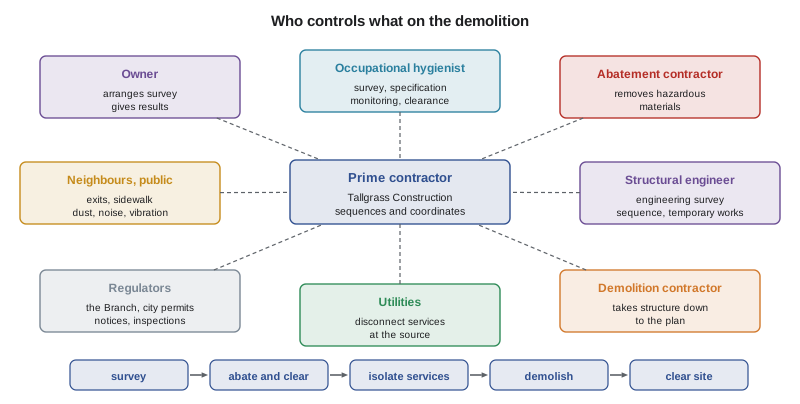
- The building owner is responsible for knowing what is in its building. Before any work, the owner must arrange the hazardous materials survey and give the results to the contractors. Tallgrass's client, the developer of Cottonwood Place, owned the Norwood Block and hired Keystone Environmental Ltd. to do the survey.
- The occupational hygienist from Keystone Environmental Ltd., Anika Rao, surveyed the buildings, took samples, wrote the hazardous materials report, designed the abatement specifications and monitored the air during and after abatement.
- The abatement contractor, Clearline Abatement Ltd., removed the asbestos and other hazardous materials before demolition, under supervisor Jamal Wright.
- The structural engineer, Helen Kowal of Morrow Structural Engineering Ltd., reviewed the building, wrote the engineering survey of the structure and the adjoining Halvorsen Building, and approved the demolition sequence.
- The demolition contractor, Prairie Wrecking Ltd., took the buildings down under demolition superintendent Gord Pelletier.
- Tallgrass as prime contractor coordinated all of them. Superintendent Carla Mendes and safety coordinator Owen Hartley set the order of work, made sure abatement was cleared before demolition started, managed the utility disconnections, protected the sidewalk and the lane, and checked that each contractor followed its plan.
The order of work
A safe demolition follows the same order almost every time, and the most common serious mistakes come from doing steps out of order.
- Gather information. Collect drawings, past renovation records, the owner's asbestos inventory if one exists, and utility records.
- Survey the building. The hygienist surveys for hazardous materials. The engineer surveys the structure and the neighbouring buildings.
- Plan. Write the demolition plan, the abatement plan, the utility isolation plan, the traffic and public protection plan and the emergency plan.
- Notify. Give the required notices to the Branch, the City of Winnipeg for permits, and the utilities.
- Abate. Remove asbestos and other hazardous materials, with air monitoring, until the hygienist confirms the building is clear for demolition.
- Isolate services. Have the utilities disconnect and confirm electrical, gas, water and sewer services outside the building line.
- Demolish. Take the structure down in the planned sequence, keeping it stable at every stage.
- Clear the site. Remove debris, break out foundations as planned and deal with any contaminated soil before excavation.
On the Norwood Block, this took about fourteen weeks: three for surveys and planning, five for abatement, one for utility work, three for demolition and two for foundations and soil. The schedule was tight, and the hardest part of Carla's job was resisting pressure to start demolition before the abatement was cleared.
A hazard register for the Norwood Block
Owen keeps a simple hazard register for the demolition. Each row lists a hazard, the stage of work where it matters, the control and who owns it. Before each phase starts, he runs a short program that lists any hazard still marked open for that phase.
# Norwood Block hazard register (invented data).
register = [
    # (hazard, phase, control, owner, status)
    ("Asbestos floor tile and pipe wrap", "abatement", "remove under plan, air clearance", "Clearline", "closed"),
    ("PCB light ballasts", "abatement", "inspect labels, remove and store as PCB waste", "Clearline", "closed"),
    ("Buried heating oil tank", "foundations", "locate, empty, remove under permit", "Prairie Wrecking", "open"),
    ("Live gas service", "utilities", "utility removes meter and caps at main", "Tallgrass", "closed"),
    ("Live electrical service", "utilities", "utility disconnects at pole, test dead", "Tallgrass", "closed"),
    ("Second floor added in 1978", "demolition", "engineer to confirm load path", "Morrow", "open"),
    ("Public sidewalk on north side", "demolition", "covered walkway and hoarding", "Tallgrass", "closed"),
]
phase = "demolition"
order = ["abatement", "utilities", "demolition", "foundations"]
open_items = [r for r in register if r[4] == "open" and order.index(r[1]) <= order.index(phase)]
print(f"Open items that must be closed before {phase} starts: {len(open_items)}")
for hazard, ph, control, owner, status in open_items:
print(f" {hazard} ({ph}): {control} -- owner: {owner}")Open items that must be closed before demolition starts: 1 Second floor added in 1978 (demolition): engineer to confirm load path -- owner: Morrow
The program flags the 1978 second-floor addition. The old drawings showed a one-storey building, but the survey found that the second floor had been added later on new steel columns that sat on the original basement walls. Helen Kowal had not yet confirmed how those loads reached the ground, so demolition could not start until she did. The buried oil tank is still open too, but it belongs to the foundations phase, so it does not hold up demolition.
Worked problem
Who owns the hazard in the lane?
Show solution
- The lane between the Norwood Block and the Halvorsen Building is about 6 m (20 ft) wide. The demolition contractor wants to use it to load trucks.
- Owen asks who controls each hazard in the lane. The demolition work and the trucks belong to Prairie Wrecking Ltd.. The lane itself is a public lane controlled by the City of Winnipeg, which issues the permit to close it.
- The Halvorsen Building's rear exit opens onto the lane, and its tenants use it as a fire exit. That exit is controlled by the building owner, and keeping it usable is a fire code requirement.
- At the coordination meeting, Tallgrass agrees to get the lane closure permit and to build a protected walkway from the rear exit to the street. Prairie Wrecking Ltd. agrees to load trucks only at the east end of the lane and to stop loading if anyone needs the exit.
- The agreement goes into the demolition plan and the site logistics plan, and the building owner signs off on the exit route.
Answer: Hazards that cross property lines and employers need a single coordinator. The prime contractor arranges it and each party commits in writing to the part it controls.
Common mistakes
MistakeAssuming the old drawings show what is really in the building.
InsteadTreat drawings as a starting point; the surveys confirm what is actually there.
MistakeStarting demolition while abatement is still being finished to save time.
InsteadDemolition starts only after the hygienist confirms the work area is clear of the hazardous materials that would be disturbed.
MistakeBelieving a vacant building has no live services.
InsteadServices stay live until the utilities disconnect them and the disconnection is confirmed by testing.
MistakeThinking a small renovation is not demolition work.
InsteadRemoving ceilings, walls or floors is demolition; the same hazards and many of the same rules apply.
MistakeLeaving neighbours and tenants out of the plan.
InsteadPlan for the public and occupants from the start: exits, dust, noise, vibration and falling debris.
Summary and key terms
- Demolition weakens a structure as work proceeds, and existing buildings rarely match their drawings.
- The main hazard groups are structural collapse, hazardous materials, live services, falls and falling material, equipment, and effects on the public and occupants.
- In Manitoba, Part 33 of the Workplace Safety and Health Regulation covers demolition and makes CSA S350 enforceable, and Part 37 covers asbestos, including notice to the Branch.
- The owner arranges the hazardous materials survey; the hygienist, abatement contractor, structural engineer and demolition contractor each control their part; the prime contractor coordinates.
- The order of work is information, surveys, plans, notices, abatement and clearance, utility isolation, demolition and site clearing.
- Demolition
- Taking down a structure or part of a structure, including removing walls, floors, ceilings and roofs during renovation.
- Abatement
- The controlled removal, enclosure or encapsulation of hazardous materials such as asbestos before other work disturbs them.
- Occupational hygienist
- A specialist who identifies, measures and controls workplace health hazards such as asbestos, lead and silica.
- Hazardous materials survey
- An inspection and sampling of a building to find asbestos, lead, PCBs, mercury and other hazardous materials before work.
- Engineering survey
- An assessment by a competent person or engineer of the condition and stability of a structure and its neighbours before demolition.
- Clearance
- Confirmation by the hygienist, often based on visual inspection and air sampling, that abatement is complete and the area can be reoccupied or demolished.
Practice problems
Work each problem on paper first, then reveal the answer to check.
Why does a structure become more dangerous as demolition proceeds?
Show answer
Each removal takes away strength and changes load paths, so the remaining structure can become unstable in ways nobody planned.
Name four hidden hazardous materials common in buildings from the 1950s to the 1970s.
Show answer
Any four of asbestos, lead paint, PCBs in ballasts or caulking, mercury in lamps and thermostats, ozone-depleting refrigerants, fuel oil tanks, contaminated soil and mould.
Who arranges the hazardous materials survey before demolition?
Show answer
The building owner, usually by hiring an occupational hygienist or environmental consultant.
Why did the 1978 addition hold up the demolition of the Norwood Block?
Show answer
The engineer had not confirmed how the added floor's loads reached the ground, so the safe demolition sequence was not yet known.
What is the correct order of the main steps of a demolition?
Show answer
Information, surveys, plans, notices, abatement and clearance, utility isolation, demolition, then site clearing.
Lesson quiz · 5 questions
Score 60% or more to complete this lesson.
Create a free account to save your progress, take quizzes and earn a certificate.