
HSE-372 · Lesson 7 of 12 · 20 min
Services, utilities and isolation
Buildings are full of energy. Electricity arrives through overhead or buried cables at hundreds or thousands of volts. Natural gas arrives under pressure. Water mains carry enough pressure to flood a basement in minutes, and sewer lines carry gases that are toxic and flammable. Inside, the energy is distributed through panels, risers, pipes and ducts that run through walls, floors and ceilings. When a building is demolished or renovated, every one of those services has to be found, isolated and confirmed safe before the parts of the building it runs through are disturbed. A vacant building is not a dead building; it is often still connected to the street.
This lesson covers how services are located, disconnected and confirmed on the Norwood Block demolition, how live services that must stay on are protected, and how the Halvorsen Building renovation isolated circuits and systems while the rest of the building kept running.
What the rules require
Part 33 (Demolition Work) of the Workplace Safety and Health Regulation and the general duties of the Workplace Safety and Health Regulation require the employer to identify above-ground and below-ground services, including electrical lines, gas pipes and telecommunication lines, and to have them disconnected, capped or otherwise controlled before demolition. Water and sewer lines are shut off because they can burst or flood when disturbed. The regulation's lockout rules apply to any machinery or system where unexpected energy could hurt a worker, and work near overhead power lines must keep the minimum safe distances set in the regulation unless the utility has de-energized or protected the line. CSA S350, the Code of Practice for Safety in Demolition of Structures, which the Manitoba regulation makes enforceable sets out the practice in detail.
Step 1: find every service
On the Norwood Block, Tallgrass started with records and finished with testing.
- Utility records. Manitoba Hydro, which supplies both electricity and natural gas in Winnipeg provided the locations of the electrical service and the gas meter and service line. the City of Winnipeg Water and Waste Department provided the water service and sewer connection records. The telephone and cable companies provided their service records.
- One-call locate. Before any digging at the property line, Tallgrass requested locates through Click Before You Dig Manitoba, and the utilities marked their buried lines on the ground with paint and flags.
- Private locates. Utility locates stop at the property line or the meter. Lines on the private side, such as the feed to the dry cleaner, an old abandoned water line and site lighting cables, were found by a private locating contractor with electromagnetic and ground-penetrating radar equipment.
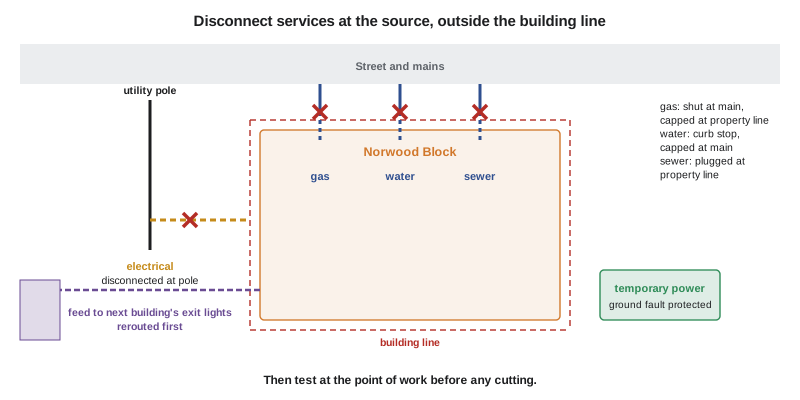
- Inside the building. Tasha Brooks, Tallgrass's electrical foreman, traced every panel, riser and feeder, and found one surprise: a cable from the Norwood Block's main panel ran across the lane in a buried conduit to feed exterior lights on the Halvorsen Building. Cutting the Norwood power would have left the neighbour's rear exit dark.
- Services that serve others. Shared services, through-lines and services that cross the site to feed neighbours must be found and rerouted before demolition, not after.
Step 2: disconnect at the source
The safe principle is that services are disconnected outside the building line, at the street, the property line or the utility's equipment, by the utility or by a qualified contractor working under the utility's rules. Disconnecting inside the building leaves live services running into the structure being demolished.
- Electricity. Manitoba Hydro, which supplies both electricity and natural gas in Winnipeg disconnected the electrical service at its pole on the lane and removed the meter. Tasha's crew then tested the main panel and every feeder to confirm they were dead.
- Gas. The gas utility shut the service off at the main in the street, removed the meter, and cut and capped the service line at the property line. Gas service lines are never cut by the demolition crew.
- Water. the City of Winnipeg Water and Waste Department shut off the service at the curb stop, and a licensed plumber cut and capped the line at the main as the City of Winnipeg permit required.
- Sewer. The sewer connection was plugged and capped at the property line so that debris and groundwater would not enter the sewer and sewer gas would not escape into the excavation.
- Telephone and cable. The telecommunications companies disconnected and removed their drops.
- Fire protection. The sprinkler system and fire alarm were taken out of service only when the building was fully empty and the abatement was finished, with the fire department notified. Until then, they stayed live.
Step 3: confirm, record and mark
A disconnection request is not proof that a service is off. Every disconnection on the Norwood Block was confirmed.
- Electrical. Tasha tested each conductor at the main panel and at the far end of each feeder with a voltage tester that she checked on a known live source before and after, the test-before-touch method. Only then were the panels tagged as dead.
- Gas. The utility's cut and cap was confirmed visually and with a combustible gas detector at the cap and in the basement.
- Water. The plumber opened the lowest faucet to confirm no flow and checked that the pressure gauge read zero.
- Records. Owen kept a services register listing each service, who disconnected it, when, how it was confirmed, and the paperwork from the utility.
- Marking. Each disconnected point was tagged, and the services register was posted in the site office and reviewed at the start of demolition.
Temporary services for the demolition
Demolition still needs power for tools, lights and pumps, and water for dust control. Those services must be separate from the building's old services, so that nobody is tempted to use an old outlet that might or might not be live. On the Norwood Block, a temporary power pole on the site's south side fed a construction panel with ground fault protection for all outlets, and water for dust control came from a metered hydrant connection approved by the City of Winnipeg Water and Waste Department. Temporary cords and hoses were routed where the excavator and debris would not reach them.
Hidden services in renovation
In the Halvorsen Building renovation, the building stayed live. The challenge was to isolate only what the work touched while keeping the rest of the building running.
- Electrical circuits. Tasha's crew identified every circuit in the renovation area from the panel schedules, which were partly wrong, and confirmed each one with a circuit tracer. Circuits to be removed were locked out at the panel with a personal lock and tag for each worker, and tested dead at the point of work. Circuits passing through the area to serve other floors were identified, labelled and protected.
- Embedded services in concrete. Before cutting or coring the slabs, the crew scanned the concrete with ground-penetrating radar to locate conduit, pipes and reinforcing. Concrete slabs can also contain post-tensioning tendons, high-strength steel cables under very high tension, and cutting one can release enormous energy and weaken the slab. The Halvorsen slabs were conventionally reinforced, which the scan confirmed, but the procedure would have been the same either way.
- Plumbing and heating. Lines to be cut were isolated at valves, drained and confirmed empty before cutting, and valves were locked closed.
- Fire protection. Taking any part of the sprinkler or alarm system out of service in an occupied building requires a fire protection impairment procedure: notifying the building owner, the monitoring company and the fire department, posting a fire watch where needed, and restoring the system as soon as possible.
- Ventilation. The building operator shut down and sealed the supply and return ducts in the renovation area, so the air system did not move dust through the building.
Overhead and buried lines near the site
The north side of the Cottonwood Place site has overhead power lines along the street. During demolition, the high-reach excavator and the crane that lifted off the rooftop unit worked near those lines. The demolition plan marked the minimum approach distance for the line voltage, required a dedicated spotter whenever equipment worked within a set distance of the lines, and arranged for the utility to cover the nearest span with insulating line hose during the rooftop lift. HSE-370 lesson 7 covers approach distances in detail.
A services register check
Owen keeps the services register as a short list and runs a check before demolition starts: every service must be disconnected outside the building, confirmed by testing and backed by paperwork.
# Services register for the Norwood Block (invented data).
services = [
    # (service, disconnected_by, location, confirmed, paperwork)
    ("electrical", "utility", "pole on lane", True, True),
    ("gas", "utility", "main in street, capped at property line", True, True),
    ("water", "licensed plumber", "curb stop and main", True, True),
    ("sewer", "licensed plumber", "plugged at property line", True, False),
    ("telephone", "telecom company", "drop removed", True, True),
    ("exterior lights feed to next building", "electrician", "rerouted to that building's panel", False, False),
]
ready = True
for svc, who, where, confirmed, paper in services:
    issues = []
    if not confirmed: issues.append("not confirmed by test")
    if not paper: issues.append("no paperwork on file")
    status = "OK" if not issues else "HOLD: " + ", ".join(issues)
    ready = ready and not issues
    print(f"{svc:34} {status}")
print("\nClear to start demolition:", "yes" if ready else "no")electrical OK gas OK water OK sewer HOLD: no paperwork on file telephone OK exterior lights feed to next building HOLD: not confirmed by test, no paperwork on file Clear to start demolition: no
The check holds the demolition: the sewer cap paperwork is not on file and the neighbour's light feed has not been rerouted and confirmed. Owen chases both before the start date. The neighbour feed turns out to be the more important one, because it lights the Halvorsen Building's rear fire exit.
Worked problem
The panel that was supposed to be dead
Show solution
- Two days after the utility disconnection, a Prairie Wrecking Ltd. worker starts cutting conduit off the basement wall with a reciprocating saw. Tasha Brooks had tested the main panel, but the worker is cutting near a smaller subpanel in the dry cleaner.
- The saw blade bites into a cable and there is a flash. The worker is not hurt, because the saw has an insulated body and he is wearing gloves, but the cable was live.
- Work stops. Tasha traces the cable: the dry cleaner had its own separate electrical service from a different pole on the lane, which no record showed.
- The utility disconnects the second service. Tasha tests every panel and cable in both buildings again, and the services register is updated with the second service.
- At the next meeting, the plan changes: no cutting of any cable or conduit until Tasha has tested that specific cable at the point of work, and every panel carries a dated test tag.
Answer: Disconnection at the street is not enough on its own. Test at the point of work, because old buildings can have more than one service and records can be wrong.
Common mistakes
MistakeAssuming a vacant building has no live services.
InsteadServices stay live until the utility disconnects them and testing confirms it.
MistakeCutting a gas line inside the building to save waiting for the utility.
InsteadGas is shut off and capped outside the building line by the utility, never by the demolition crew.
MistakeTesting the main panel only.
InsteadTest each cable at the point of work, because buildings can have more than one service.
MistakeUsing an old building outlet for a demolition tool.
InsteadUse a separate temporary power supply with ground fault protection.
MistakeCoring a slab without scanning it first.
InsteadScan for conduit, pipes and post-tensioning tendons before cutting or coring.
Summary and key terms
- Manitoba requires services to be identified and disconnected, capped or controlled before demolition, with lockout and power line distances applying.
- Services are found from utility records, one-call and private locates, and tracing inside the building, including lines that serve neighbours.
- Services are disconnected at the source, outside the building line, by the utility or a qualified contractor, and each disconnection is confirmed by testing and recorded.
- Temporary power and water for demolition are separate from the old building services.
- In renovation, isolate only what the work touches: lock out circuits, scan slabs, drain and lock pipes, follow fire protection impairment procedures and seal ventilation.
- Building line
- The outside edge of the building; services are disconnected outside it before demolition.
- One-call locate
- A free service that marks buried utility lines on the ground before digging.
- Private locate
- Locating of buried lines on private property, beyond the utility's meter or property line, by a hired contractor.
- Test before touch
- Checking that a conductor is dead with a tester verified on a known live source before and after the test.
- Post-tensioning tendon
- A high-strength steel cable in a concrete slab or beam held under very high tension.
- Fire protection impairment
- Taking any part of a sprinkler, alarm or other fire protection system out of service, which requires notification and compensating measures such as a fire watch.
Practice problems
Work each problem on paper first, then reveal the answer to check.
Why are services disconnected outside the building line?
Show answer
So no live service runs into the structure being demolished.
Who disconnects a natural gas service before demolition?
Show answer
The gas utility, which shuts it off and caps the line outside the building.
How did the surprise light feed matter to the neighbour?
Show answer
It powered the exterior lights at the neighbour's rear fire exit, so cutting it would have left the exit dark.
What lesson did the live dry cleaner subpanel teach?
Show answer
Old buildings can have more than one service, so each cable must be tested at the point of work before it is cut.
What steps make up a fire protection impairment procedure?
Show answer
Notify the owner, the monitoring company and the fire department, post a fire watch where needed, and restore the system as soon as possible.
Lesson quiz · 5 questions
Score 60% or more to complete this lesson.
Create a free account to save your progress, take quizzes and earn a certificate.