
HSE-372 · Lesson 4 of 12 · 21 min
Asbestos in demolition and renovation
Asbestos is a group of naturally occurring mineral fibres that were added to thousands of building products for most of the twentieth century because they are strong, flexible, resistant to heat and chemicals, and cheap. They were mixed into insulation, fireproofing, floor tiles, ceiling tiles, plaster, joint compound, cement pipes and boards, roofing, caulking and gaskets. Asbestos use in buildings fell sharply from the late 1970s, and Canada banned the import, sale and use of asbestos and asbestos products in 2018, but millions of buildings built before then still contain it. When those buildings are renovated or demolished, the asbestos is disturbed, and that is when it becomes dangerous.
This lesson explains why asbestos is hazardous, how the rules classify asbestos work by risk, and how abatement crews remove it safely. It follows the removal of the Norwood Block's pipe insulation and floor tile by Clearline Abatement Ltd., and the smaller jobs in the Halvorsen Building renovation.
How asbestos harms people
Asbestos is hazardous when its fibres become airborne and are breathed in. The fibres are far too small to see, and they can stay in the air for hours. Once in the lungs, many are cleared, but some lodge deep in the lung tissue or work their way to the lining around the lungs, where the body cannot break them down. Over years and decades they cause disease.
- Asbestosis is scarring of the lung tissue that makes breathing progressively harder. It follows heavy exposure over years.
- Lung cancer risk rises with asbestos exposure, and much more steeply in people who also smoke.
- Mesothelioma is a cancer of the lining of the chest or abdomen that is almost always caused by asbestos. It can follow relatively low exposures and is nearly always deadly.
- Pleural plaques and thickening are changes to the lining of the lungs that show past exposure and can reduce lung function.
Two facts make asbestos especially dangerous for construction workers. The diseases appear 15 to 40 years or more after exposure, so a worker who was exposed in their twenties may not become ill until retirement, long after anyone remembers the job. And there is no known safe level of exposure for cancer; every exposure adds to the risk. Asbestos-related diseases are one of the largest causes of accepted work-related death claims in Canada and a major cause of occupational cancer in the United States, and many of the people affected worked in construction and the building trades.
Where asbestos hides in buildings like the Norwood Block
- Thermal system insulation: pipe and boiler insulation, duct wrap, tank insulation. Often friable and high in asbestos content.
- Surfacing materials: sprayed fireproofing on steel, troweled acoustic plaster, textured ceiling coatings. Friable and easily damaged.
- Floor tile and mastic: especially 230 mm (9 in) tiles and black mastic adhesive. Non-friable when intact.
- Drywall joint compound and some plasters, mostly with low asbestos content but widely spread.
- Ceiling tiles in some older suspended ceilings.
- Cement products: pipes, siding, roofing shingles and flat boards. Non-friable unless cut, broken or ground.
- Roofing: felts, flashing cements and coatings.
- Caulking, glazing putty, gaskets and fire doors.
- Vermiculite loose-fill insulation, much of which came from a mine contaminated with asbestos.
How the rules classify asbestos work
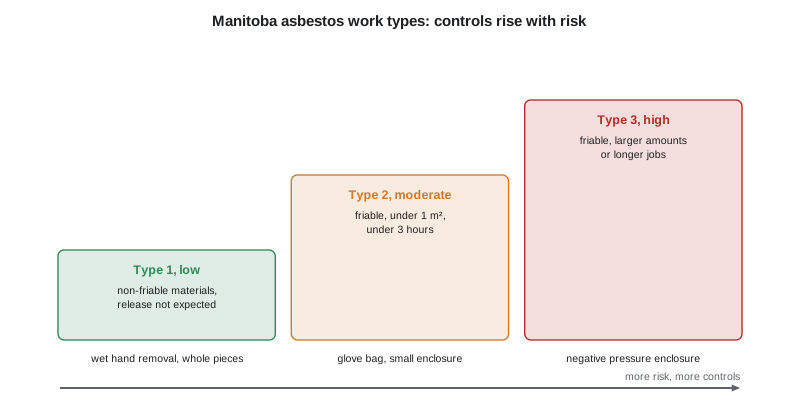
Manitoba's guidance sorts asbestos work into three types by risk, and the controls increase with each type.
- Type 1 (low risk): work with non-friable materials where fibre release is not expected when the recommended procedures are followed, such as removing intact vinyl floor tile with hand tools or drilling a few small holes in cement board with a wet method.
- Type 2 (moderate risk): work with friable materials where fibre release may occur, involving less than 1 m² (about 10 ft²) of friable material and taking less than three hours, such as removing a short section of pipe insulation in a glove bag or removing a few ceiling tiles.
- Type 3 (high risk): work with friable materials where significant fibre release is expected, larger amounts or longer jobs, such as removing sprayed fireproofing or a whole system of pipe insulation. Type 3 work is done inside a sealed enclosure under negative air pressure with full decontamination facilities.
Manitoba applies the occupational exposure limit for asbestos set by the American Conference of Governmental Industrial Hygienists (ACGIH), 0.1 fibres per cubic centimetre of air averaged over eight hours, and requires exposure to be kept as low as reasonably achievable. In practice, abatement controls are chosen so that workers' exposure, with respirators, stays far below that limit, and air outside the work area stays near background.
Removing friable insulation: the enclosure
The Norwood Block's basement pipe insulation was the highest-risk work in the building. Clearline Abatement Ltd. removed it inside a full enclosure built to Anika's specification.
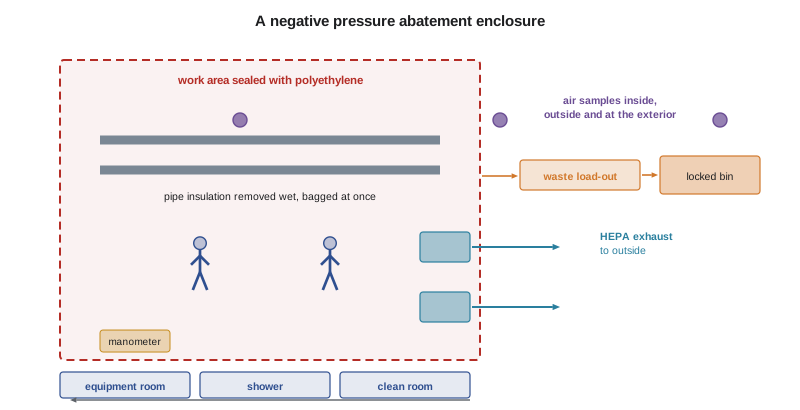
- Isolate the area. The basement boiler room was sealed off with two layers of heavy polyethylene sheeting on the walls and floor, and every opening, drain, duct and doorway was sealed. The ventilation system had already been shut down and its openings sealed.
- Negative air. Machines with high-efficiency particulate air (HEPA) filters drew air out of the enclosure and exhausted it outside, keeping the enclosure at a lower pressure than the rest of the building so that any leak flowed inward. A manometer showed the pressure difference continuously, and the supervisor logged it.
- Decontamination unit. Workers entered and left through a connected unit with three rooms: a clean room where they changed into disposable coveralls, a shower room, and an equipment room next to the work area. They left the work area through the equipment room, removed their coveralls there, showered with their respirator still on, and only removed the respirator in the shower. A separate waste load-out route took bagged waste out through its own wash station.
- Wet removal. The insulation was soaked with amended water, water with a wetting agent, before removal, and kept wet throughout. Workers cut it off in pieces with hand tools and placed it straight into labelled, heavy-gauge bags, which were sealed, washed and double-bagged.
- Respirators. Workers wore powered air-purifying respirators with HEPA filters, fit tested, selected for the expected fibre levels.
- Air monitoring. Anika's technician sampled the air inside the enclosure, at the decontamination unit, outside the enclosure and at the building exterior every shift. If outside samples rose above the action level in the specification, work stopped until the cause was found.
- Final cleaning and clearance. After removal, the crew wet-wiped and HEPA-vacuumed every surface, applied a lockdown sealant, and Anika inspected and took clearance air samples before the enclosure came down.
Removing non-friable materials
The floor tile and mastic were lower risk, but not risk-free. Breaking, grinding or sanding tile turns it into dust. Clearline Abatement Ltd. removed it by wetting it, prying tiles up whole with hand tools and placing them into bags, and removed the black mastic with a low-odour chemical remover instead of grinding. The area was isolated with barriers and signs, workers wore half-face respirators with P100 or HEPA filters and disposable coveralls, and Anika took air samples to confirm the method kept fibres low. The drywall with asbestos joint compound in the 1978 offices was wetted and removed in whole sheets wherever possible, without power tools.
Small asbestos jobs in the renovation
In the Halvorsen Building, the renovation found asbestos in two places the report had identified: a short run of pipe insulation in a ceiling space, and the joint compound in some corridor walls. Neither needed a full enclosure. The pipe insulation was removed in a glove bag, a sealed plastic bag with built-in sleeves fitted around the pipe so that the insulation is cut and dropped inside without escaping, under the moderate-risk procedures. The corridor wall openings were cut with hand tools, wet, inside a small polyethylene enclosure with a HEPA vacuum at the cut, while the corridor was closed to tenants after hours. Small jobs like these cause many exposures because crews treat them casually; the procedures exist precisely because small jobs are frequent.
Waste, transport and disposal
Asbestos waste is double-bagged or wrapped in heavy polyethylene, labelled, kept in a locked container and transported to a landfill approved to accept it, with paperwork that tracks it from the site to the landfill. Waste must never go into general demolition debris or recycling, because crushing concrete or sorting debris with asbestos in it spreads fibres to workers who have no protection.
Checking an exposure result
Anika's technician takes personal air samples on two workers each shift and calculates their time-weighted average exposure for the day. A short program combines samples from different parts of the shift and compares the result with the limit and with the protection provided by the respirator.
# Time-weighted average asbestos exposure for one shift (invented sample results).
samples = [  # (minutes, f/cc)
    (120, 0.30),   # wet stripping of pipe insulation
    (90, 0.45),    # bagging and cleanup
    (60, 0.05),    # setting up and breaks outside the enclosure
    (210, 0.00),   # time not working with asbestos
]
total = sum(m for m, c in samples)
twa = sum(m * c for m, c in samples) / 480   # eight-hour average
print(f"Minutes sampled: {total}")
print(f"8-hour TWA outside the respirator: {twa:.3f} f/cc")
limit = 0.1
apf = 1000   # assigned protection factor of the powered respirator used (from the specification)
inside = twa / apf
print(f"Above the 0.1 f/cc limit without a respirator? {'yes' if twa > limit else 'no'}")
print(f"Estimated exposure inside the respirator: {inside:.5f} f/cc")Minutes sampled: 480 8-hour TWA outside the respirator: 0.166 f/cc Above the 0.1 f/cc limit without a respirator? yes Estimated exposure inside the respirator: 0.00017 f/cc
The result shows why respirators are essential inside the enclosure: the air the workers move through is above the eight-hour limit during stripping, even with wet methods. With a powered respirator and its assigned protection factor, the estimated exposure inside the facepiece is a tiny fraction of the limit. The calculation also shows why the respirator must fit and be worn every minute in the work area; the protection factor only applies when it does.
Worked problem
Pressure lost in the enclosure
Show solution
- Midway through a shift, the manometer at the Norwood Block enclosure shows the pressure difference falling to almost zero. The alarm on the negative air machine sounds.
- Jamal Wright stops stripping and has the crew keep the removed material wet and bag what is loose. Nobody leaves through the decontamination unit until the cause is known.
- He checks the machines: one HEPA unit has tripped its breaker, and the second cannot hold the pressure alone because a seal at the ceiling has torn.
- The crew resets the breaker, repairs the torn sheeting with tape and new poly, and the pressure returns. Anika's technician takes an extra air sample outside the enclosure.
- The outside sample comes back at background levels. Jamal records the event in the log, and the crew resumes. The next day, Clearline adds a third negative air machine as a backup.
Answer: Negative pressure is what keeps a leak flowing inward. When it is lost, stop disturbing the material, find and fix the cause, and confirm with air sampling before restarting.
Common mistakes
MistakeThinking a short exposure on a small job does not matter.
InsteadThere is no known safe level for cancer; small jobs follow the procedures every time.
MistakeRemoving floor tile or mastic with a grinder or sander.
InsteadWet the tile, pry it up whole with hand tools and use a chemical remover for mastic.
MistakeTaking off the respirator before showering in the decontamination unit.
InsteadRemove the coveralls in the equipment room and the respirator only in the shower.
MistakePutting asbestos waste in the general demolition bin.
InsteadDouble-bag, label and lock it, and send it to an approved landfill with tracking paperwork.
MistakeContinuing to strip insulation when the enclosure loses negative pressure.
InsteadStop, keep material wet, fix the cause and confirm with air sampling.
Summary and key terms
- Asbestos fibres breathed in can cause asbestosis, lung cancer and mesothelioma, decades later; there is no known safe level for cancer.
- Asbestos hides in insulation, fireproofing, floor tile and mastic, joint compound, ceiling tiles, cement products, roofing, caulking and vermiculite.
- Manitoba sorts asbestos work into Type 1, 2 and 3 by risk and applies the ACGIH limit of 0.1 f/cc.
- Friable removal uses sealed enclosures under negative pressure, wet methods, HEPA filtration, a three-room decontamination unit, respirators and air monitoring.
- Non-friable materials are removed whole and wet without power tools, and all asbestos waste is double-bagged, labelled and sent to an approved landfill.
- Mesothelioma
- A cancer of the lining of the chest or abdomen almost always caused by asbestos exposure.
- Negative pressure enclosure
- A sealed work area kept at lower air pressure than its surroundings by HEPA-filtered exhaust, so leaks flow inward.
- HEPA filter
- A high-efficiency particulate air filter that captures very small particles such as asbestos fibres.
- Glove bag
- A sealed plastic bag with built-in sleeves fitted around a pipe so a small section of insulation can be removed without releasing fibres.
- Amended water
- Water mixed with a wetting agent so it soaks into asbestos materials and keeps fibres from becoming airborne.
- Decontamination unit
- A connected set of rooms, usually equipment room, shower and clean room, through which abatement workers enter and leave the work area.
Practice problems
Work each problem on paper first, then reveal the answer to check.
Why are asbestos diseases often not linked to the job that caused them?
Show answer
They appear 15 to 40 years or more after exposure, long after the job is forgotten.
Describe Manitoba's three types of asbestos work.
Show answer
Type 1 is low-risk work with non-friable materials; Type 2 is moderate-risk work with less than 1 m² of friable material for under three hours; Type 3 is high-risk work with larger amounts or longer jobs, done in an enclosure.
Why is an enclosure kept under negative pressure?
Show answer
So that any leak draws clean air inward instead of letting contaminated air escape.
In what order does a worker leave an enclosure through the decontamination unit?
Show answer
Equipment room to remove coveralls, then the shower with the respirator still on, removing it in the shower, then the clean room.
Why must asbestos never go into general demolition debris?
Show answer
Crushing, sorting or recycling debris with asbestos in it releases fibres to unprotected workers.
Lesson quiz · 5 questions
Score 60% or more to complete this lesson.
Create a free account to save your progress, take quizzes and earn a certificate.