
HSE-352 · Lesson 1 of 12 · 24 min
Who works alone and why it matters
At most fuel stations and convenience stores there are hours when only one worker is on site. It might be the last hour before closing, the first hour after opening, a quiet Sunday afternoon or the whole of an overnight shift. During those hours, the worker is the cashier, the attendant, the cleaner, the stocker and the first responder all at once, and there is no one beside them to help if something goes wrong.
Working alone is not illegal, and it is not always dangerous. Thousands of people work alone safely every night. But working alone changes the risk of everything else that can happen at work. A slip on ice, a sudden illness, a fire at the pumps or an angry customer is a bigger problem when no one else is there to call for help, to give first aid or to notice that something is wrong. This course is about planning for those hours so that the worker is never truly on their own, even when they are the only person in the building.
This course follows the invented Northfield Fuel and Market in Red Deer, Alberta, from HSE-350 and HSE-351, and a second, new site its owners are opening on the highway at the edge of town. It builds on HSE-341, which covers robbery prevention, store design and de-escalation in detail; here we focus on what is special about being the only worker on shift.
What working alone means
In workplace safety law, a worker is usually said to be working alone when they are the only worker at the work site and help is not readily available if they are injured, become ill or face an emergency. Alberta's OHS Code uses this idea: it applies when a worker is alone and assistance is not readily available (checked in 2026). Two things matter in that definition: being by yourself, and how quickly someone could help.
That means a worker can be working alone even with other people around. A cashier in a busy store at 2 a.m. may have customers coming and going, but customers are not co-workers: they are not trained, they have no duty to help, and some of them may be the risk. On the other hand, two workers at the same site who can see or hear each other and check on each other are usually not working alone, even if they are in different parts of the building.
Distance and time count too. A worker who is alone but can be reached by a co-worker in a minute or two is in a very different position from one whose nearest help is 40 minutes away down a highway. When we judge how risky lone work is, we ask how long it would take for help to arrive if the worker could not call for it themselves.
Who works alone at a station
Almost every role at a fuel station involves some time alone. At Northfield, Leah Morin listed them when she started planning for the new site:
- The late cashier: Ben works the evening shift and is alone from 9 p.m. until the store closes at midnight, then cashes out and locks up.
- The opener: Raj Patel or Leah opens at 5:30 a.m., alone, in the dark for much of the year, and does the outside walk-around before the first customers arrive.
- Weekend and holiday staff: on quiet Sunday mornings, one worker covers the store until the second arrives at 10 a.m.
- The fuel driver: Mike, who drives for the fuel hauler, often delivers at night or early in the morning, alone, standing at the fill ports at the edge of the lot.
- Cleaners and contractors: a cleaning contractor comes in after closing, and repair technicians sometimes work on dispensers or the car wash alone.
- The overnight cashier at the new 24-hour site, who will be alone for most of the night.
Each of these people faces different hazards. The opener faces dark corners and ice; the late cashier faces cash-handling and robbery risk; the driver faces fuel, traffic and long distances from help; the cleaner faces chemicals and an empty, locked building. A good working alone program starts by listing who works alone, when and doing what, before anything else.
Some workers should not work alone at all, or only in limited ways. Young workers, new workers in their first weeks, and workers with a medical condition that could suddenly stop them from calling for help all need more protection. Grace, who is 17, works weekend days at Northfield; under Northfield's policy she is never the only worker on site, and the rules for young workers in the next lesson explain why that line is drawn.
Why lone work is riskier
Working alone does not create new hazards so much as it removes the safety net that normally catches people when things go wrong. Four things change when someone is alone:
- No one notices. If a worker faints in the back room or falls from a step stool, no one may know until the next customer finds an empty counter, or until the next shift arrives.
- No one helps in the first minutes. First aid in the first few minutes matters most for bleeding, cardiac arrest, choking and severe allergic reactions. A lone worker who is badly hurt may not be able to help themselves.
- No one backs you up. A second worker can call 911 while the first deals with a fire, can watch the door while the till is counted, and is a witness who discourages some offenders.
- Decisions are harder. A worker alone has no one to ask whether a strange smell is serious, whether to refuse a sale, or whether to go out to a car that seems to be in trouble.
Night makes all of these worse. There are fewer customers and less traffic, so fewer people pass by who might notice trouble. Help can be further away. Workers are tired. And some crimes, including robbery and assault, are more common late at night in many places.
What the evidence shows
Studies of workplace violence in North America have long found that retail workers who handle cash, work at night and work alone are among the groups at highest risk of robbery-related violence. Convenience stores and gas stations come up again and again in these studies. Public health agencies and safety regulators in both Canada and the United States have pointed to the same set of risk factors: handling cash, working alone or in small numbers, working late at night or early in the morning, and working in places where the public comes and goes.
Two cases in Western Canada changed the law. In March 2005, Grant De Patie, a 24-year-old gas station attendant in Maple Ridge, British Columbia, was killed when he tried to stop a driver leaving without paying for $12.30 of gas; he was dragged by the car for about 7.5 km. In October 2017, Ki Yun Jo, a gas station worker in Thorsby, Alberta, was killed in a gas-and-dash incident. Both deaths led to mandatory prepayment for fuel in their provinces, and both are covered in Lesson 6. They are a reminder that the hazards of lone and late-night work at a station are not only about robbery: a fuel theft can kill a worker who tries to stop it.
The point of the evidence is not to frighten anyone. Most shifts are uneventful. But serious incidents are rare enough that a worker can go years without one and come to believe the risk is not real. A planned program protects workers in the one night out of thousands when something does go wrong.
Counting lone-worker hours
Before Leah can plan, she needs to know how much lone work there is. A simple way is to go through the staff schedule hour by hour and count how many workers are on site in each hour. Every hour with exactly one worker is a lone-worker hour. Splitting those hours into time bands shows where the risk is concentrated, because an hour alone at 2 a.m. is not the same as an hour alone at 2 p.m.
The program below does that for one week of Northfield's schedule. The schedule is illustrative, and the hours are rounded to whole hours to keep the example short.
# Count lone-worker hours in one week of an illustrative schedule.
# Each shift is (day, worker, start hour, end hour), 24-hour clock.
shifts = []
for day in ["Mon", "Tue", "Wed", "Thu", "Fri", "Sat", "Sun"]:
    shifts += [(day, "opener", 5, 13), (day, "late", 15, 24)]
    if day != "Sun":
        shifts.append((day, "day", 7, 15))
    else:
        shifts.append((day, "day", 10, 15))
    shifts.append((day, "mid", 13, 21))

def band(hour):
    if hour >= 23 or hour < 5:
        return "late night (11 p.m.-5 a.m.)"
    if hour < 7 or hour >= 21:
        return "early or late (5-7 a.m., 9-11 p.m.)"
    return "day (7 a.m.-9 p.m.)"

alone = {}
for day in ["Mon", "Tue", "Wed", "Thu", "Fri", "Sat", "Sun"]:
    for hour in range(24):
        on = [w for d, w, s, e in shifts if d == day and s <= hour < e]
        if len(on) == 1:
            b = band(hour)
            alone[b] = alone.get(b, 0) + 1

total = sum(alone.values())
for b, h in sorted(alone.items(), key=lambda x: -x[1]):
    print(f"{b:38} {h:3} h alone ({100 * h / total:.0f}%)")
print(f"{'total lone-worker hours a week':38} {total:3} h")early or late (5-7 a.m., 9-11 p.m.) 28 h alone (74%) late night (11 p.m.-5 a.m.) 7 h alone (18%) day (7 a.m.-9 p.m.) 3 h alone (8%) total lone-worker hours a week 38 h
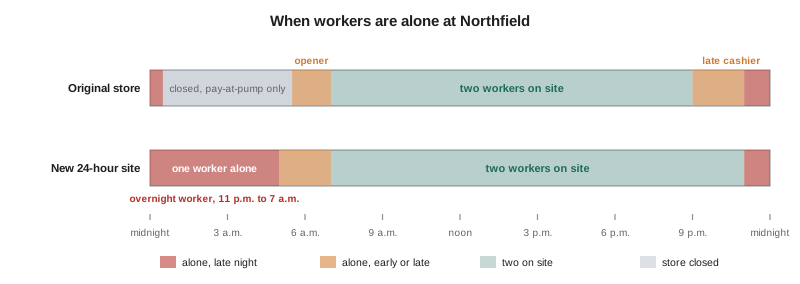
In this schedule, 38 hours a week are worked alone. Three-quarters of them fall in the early morning and late evening, and only the last hour before midnight falls in the late-night band, because the store is closed from midnight to 5 a.m. The hidden 3 hours in the day band come from Sunday mornings, when the opener is alone until the day worker arrives at 10. The picture changes completely at the new site, which will be open all night: there, a single overnight worker from 11 p.m. to 7 a.m. adds 56 lone-worker hours a week, 42 of them in the late-night band. A count like this helps a manager see where to put effort first and makes a good starting point for the hazard assessment in Lesson 3.
What a working alone program contains
Working alone rules differ between provinces and states, as the next lesson shows. But good programs look much the same everywhere. They usually contain:
- A hazard assessment of the lone work: who works alone, when, doing what, and what could go wrong (Lesson 3).
- Ways to remove or reduce lone work where possible, such as changing the schedule, closing earlier or moving tasks to busier hours.
- Controls for the hazards that remain: store design, barriers, cash limits, prepayment and safe work procedures (Lessons 6, 7 and 8).
- A way to stay in contact: scheduled check-ins, a lone worker device or app, or both (Lessons 4 and 5).
- A plan for what happens when contact is lost or an emergency happens (Lessons 10 and 11).
- Training, so that workers know the procedures and why they matter.
- Looking after the worker: fatigue, getting home safely and support after an incident (Lesson 9).
- Regular review, because schedules, staff and neighbourhoods change.
The capstone in Lesson 12 puts all of these together into a written program for the new 24-hour site.
Removing lone work first
The best control for a hazard is to remove it, and working alone is no exception. Before setting up check-ins and devices, it is worth asking whether the lone work needs to happen at all. Some options:
- Schedule a second worker in the highest-risk hours, even if only for part of them.
- Move tasks that take the worker outside or into the back, such as restocking, cleaning washrooms, emptying garbage or receiving deliveries, into hours when two people are on.
- Close the store or switch to a night window at a set time, while leaving pay-at-the-pump fuel available.
- Schedule fuel deliveries in daylight when the site is staffed.
- Arrange for cleaners and contractors to come in when staff are present, or have them follow the same check-in procedure.
Not all of this is always possible. A 24-hour station exists because people want fuel and coffee at 3 a.m. But even small changes help. When Leah moved the outside garbage run from 11:30 p.m. to 8:30 p.m., before Tyler went home, Ben no longer had to go out behind the building alone at the darkest and quietest time of his shift.
For supervisors: knowing your lone workers
Supervisors should keep an up-to-date list of who works alone, when and where, including contractors and drivers. Check it whenever the schedule changes, when a new worker starts, when store hours change and when a task is added. Talk to the workers who do the lone shifts: they know which moments feel unsafe, which corners are dark and which customers worry them. That conversation is often the most useful part of the hazard assessment, and workers who are asked are much more likely to follow the procedures that come out of it.
Worked problem
Spotting hidden lone work
Leah believes no one works alone on weekday afternoons, because two people are always scheduled from 7 a.m. to 9 p.m. Tyler mentions that on weekdays he often spends 20 minutes in the walk-in cooler restocking while the day cashier takes a break outside, and that the car wash technician comes on Tuesdays and works alone in the wash bay. Is there lone work she has missed?
Show solution
- While Tyler is in the cooler and the cashier is outside on a break, neither can see or hear the other. For those 20 minutes, both are effectively working alone, and the store is unattended.
- The car wash technician works alone in the bay, out of sight of the store, with machinery and chemicals. Even though staff are on site, no one is checking on them.
- Fixes: stagger breaks so that the cashier stays inside while someone is in the cooler; give the cooler a clear door window or a call button; ask the technician to sign in at the counter, say how long they expect to be, and check in when they leave.
Answer: Yes: breaks and back-room tasks create short periods of lone work, and the contractor works alone. Both need to be in the program.
Common mistakes
MistakeThinking a worker is not alone because customers are in the store.
InsteadCustomers are not co-workers; count only people who can and will help.
MistakePlanning only for the overnight cashier.
InsteadList every lone worker, including openers, drivers, cleaners and contractors.
MistakeAssuming no incidents means no risk.
InsteadSerious events are rare; plan for the night when one happens.
MistakeStarting with devices and apps.
InsteadFirst ask whether the lone work can be removed or moved to safer hours.
MistakeForgetting short periods alone, such as breaks or back-room tasks.
InsteadLook at what people actually do, not just the schedule.
Summary and key terms
- A worker is working alone when they are the only worker on site and help is not readily available.
- Openers, late cashiers, overnight staff, fuel drivers, cleaners and contractors can all work alone.
- Working alone removes the safety net: no one notices, no one helps in the first minutes and no one backs you up.
- Night, cash and public access increase the risk.
- Count lone-worker hours by time band to see where the risk is concentrated.
- A working alone program includes assessment, controls, contact, emergency plans, training, care for the worker and review.
- Remove or reduce lone work first, where possible.
- Working alone
- Being the only worker at a work site when help is not readily available.
- Lone worker
- A worker who works alone for all or part of a shift.
- Lone-worker hour
- An hour of the schedule in which exactly one worker is on site.
- Working alone program
- The written assessment, controls, procedures and training that protect lone workers.
- Help readily available
- Help that can reach the worker quickly enough to make a difference in an emergency.
Practice problems
Work each problem on paper first, then reveal the answer to check.
Give the two parts of the usual definition of working alone.
Show answer
The worker is the only worker at the site, and help is not readily available if they are hurt, ill or in an emergency.
Why do customers not count as company for a lone worker?
Show answer
They are not trained, have no duty to help, and some may be the source of the risk.
Name four kinds of workers at a station who may work alone.
Show answer
For example, the opener, the late or overnight cashier, the fuel driver, cleaners and contractors.
What four things change when a worker is alone?
Show answer
No one notices a problem, no one helps in the first minutes, no one backs them up and decisions are harder.
Why count lone-worker hours by time band?
Show answer
Because an hour alone late at night carries more risk than an hour alone in the day, so the count shows where to focus.
Give two ways to remove or reduce lone work.
Show answer
For example, schedule a second worker in high-risk hours, move outside tasks to staffed hours or schedule deliveries in daylight.
Lesson quiz · 5 questions
Score 60% or more to complete this lesson.
Create a free account to save your progress, take quizzes and earn a certificate.