
HSE-352 · Lesson 12 of 12 · 23 min
Capstone: a working alone program for the 24-hour site
This final lesson brings the course together. Northfield's new 24-hour site on the highway is ready to open, with one worker on site alone every night from 11 p.m. to 7 a.m. Leah Morin has to turn everything in the previous eleven lessons into a single written working alone program that the overnight workers, the contacts, the managers and an inspector could all pick up and understand. We follow her as she writes it, checks it and plans how to keep it alive.
The program also has to satisfy Alberta's requirements for working alone and for late-night retail (Lesson 2): a hazard assessment, an effective communication system with contact at intervals set by the hazards, prepayment, a violence and harassment prevention plan with the extra retail items, a monitored personal emergency transmitter, and a time lock safe and high-value item limits from 11 p.m. to 5 a.m.
The structure of the program
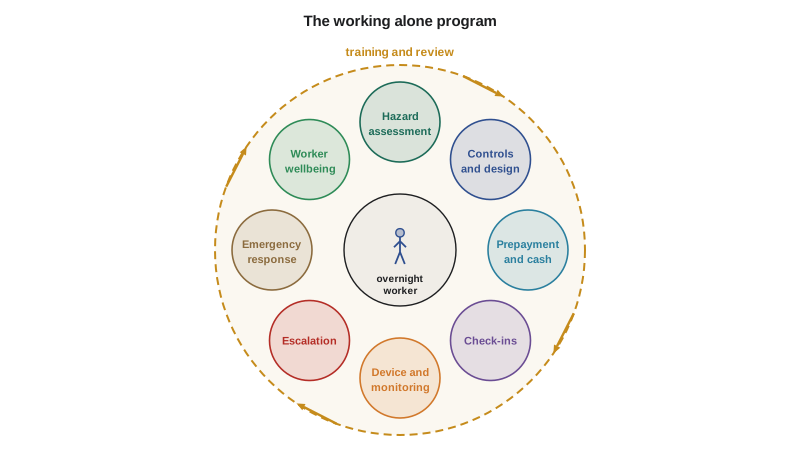
Leah used a structure that follows the course, so that each part answers one question:
- Purpose and scope: who the program covers (the overnight worker, the opener and closer, contractors and drivers at night) and when.
- Roles: the owners, the site manager, the overnight workers, the contact (the monitoring centre), the on-call managers and the backup store.
- Hazard assessment: the lone work, the hazards, the risk scores before and after controls (Lesson 3).
- Controls: what has been removed or changed, the store design, prepayment, cash and high-value goods, and the routines for opening, closing and trips outside (Lessons 6, 7 and 8).
- Communication: the check-in schedule, methods, words, duress signal and log (Lesson 4).
- Devices: the device, its settings, the monitoring arrangement and the response plan (Lesson 5).
- Escalation: the steps, the site card and the on-call list (Lesson 10).
- Emergency responses: robbery, violence, medical, fire and weather (Lesson 11).
- Worker wellbeing: scheduling, breaks, getting home and support after incidents (Lesson 9).
- Training: who is trained in what, when, and how it is recorded.
- Review: when and how the program is checked and updated.
Each section is short, a page or less, written in plain language, with the details that change often, such as phone numbers and the on-call rota, kept in an appendix that can be updated without rewriting the program.
The controls, in priority order
The assessment in Lesson 3 found five hazards scoring high or very high before controls. Leah listed the controls for the new site in the order of the hierarchy, so that it is obvious that the program does not rest on devices alone:
- Eliminated or moved: garbage runs, ice and stock deliveries, pump and skimmer checks, cooler restocking and the outside walk-around all happen on the day shift; fuel deliveries are scheduled for daylight.
- Substituted: pay-at-the-pump only between 1 a.m. and 5 a.m., with the store locked and the night window in use; smaller bags of ice.
- Engineering: a single front entrance at night, the night window, clear windows, the counter visible from the road, low shelving and mirrors, lighting to at least 20 lux across the lot (about 2 foot-candles), cameras with an entrance monitor, a time lock safe locked 11 p.m. to 5 a.m., a drop slot, a lockable back office as a safe room, bollards and height markers.
- Administrative: prepayment at all hours, a $100 register limit, high-value goods limits, opening and closing routines, the never-chase rule, refusal of entry after hours, check-ins, the escalation procedure, schedules that limit fatigue, and training.
- Devices and equipment: a wearable lone worker device with SOS, two-way voice, fall and no-motion alerts, monitored around the clock; fixed panic buttons at the counter and in the office; an AED and first aid kit; ice grips and high-visibility vests for any outside task.
The check-in schedule
The check-in schedule comes straight from the residual risks in the assessment. Leah set hourly check-ins from 11 p.m. to 1 a.m. and from 5 a.m. to 7 a.m., every 30 minutes in the highest-risk band from 1 a.m. to 5 a.m., plus check-ins at the start and end of the shift, before and after the planned breaks, and on arriving home. The device's automatic alerts cover the gaps between check-ins. The program below builds the schedule for a standard night and counts the contacts the monitoring centre should expect, so that the centre can staff and plan for it.
# Build the standard overnight check-in schedule for the new site.
def clock(m):
    h, mm = divmod(m, 60)
    h %= 24
    return f"{(h - 1) % 12 + 1}:{mm:02d} {'a.m.' if h < 12 else 'p.m.'}"

START, END = 23 * 60, 31 * 60            # 11 p.m. to 7 a.m., minutes from midnight of day 1
bands = [(23 * 60, 25 * 60, 60), (25 * 60, 29 * 60, 30), (29 * 60, 31 * 60, 60)]
checks = {START: "start of shift, inside, doors checked"}
for a, b, step in bands:
    for t in range(a, b, step):
        checks.setdefault(t, f"scheduled ({step}-min band)")
breaks = [(1 * 60 + 24 * 60 + 15, 20, "meal break"), (4 * 60 + 24 * 60 + 40, 15, "break")]
for t, length, what in breaks:
    checks[t] = f"start of {what}, night window on"
    checks[t + length] = f"end of {what}"
checks[END] = "end of shift, locking up"
checks[END + 30] = "home safe (expected about 7:30 a.m.)"

for t in sorted(checks):
    print(f"{clock(t):>10}  {checks[t]}")
print(f"{len(checks)} contacts expected per standard night")11:00 p.m. start of shift, inside, doors checked 12:00 a.m. scheduled (60-min band) 1:00 a.m. scheduled (30-min band) 1:15 a.m. start of meal break, night window on 1:30 a.m. scheduled (30-min band) 1:35 a.m. end of meal break 2:00 a.m. scheduled (30-min band) 2:30 a.m. scheduled (30-min band) 3:00 a.m. scheduled (30-min band) 3:30 a.m. scheduled (30-min band) 4:00 a.m. scheduled (30-min band) 4:30 a.m. scheduled (30-min band) 4:40 a.m. start of break, night window on 4:55 a.m. end of break 5:00 a.m. scheduled (60-min band) 6:00 a.m. scheduled (60-min band) 7:00 a.m. end of shift, locking up 7:30 a.m. home safe (expected about 7:30 a.m.) 18 contacts expected per standard night
The schedule gives 18 contacts on a standard night. That sounds like a lot, but each one takes a few seconds on the app, and the breaks and the trip home are covered as well as the clock times. Leah printed the schedule on the inside of the counter, where the worker can see it but customers cannot, and gave a copy to the monitoring centre with the response plan. Nights with a planned event, such as an unavoidable delivery, add event check-ins before and after (Lesson 4).
Checking the program before opening
Before the site opened, Leah checked the program against the requirements and against the list of what a complete program contains. She used a simple audit: for each item, is it written down, is it in place at the site, and has it been tested or trained? An item that is written but not in place, or in place but not tested, is a gap.
# Audit the program before opening: written, in place, tested or trained.
items = {
    "hazard assessment":            (True,  True,  True),
    "prepayment at all hours":      (True,  True,  True),
    "time lock safe and signs":     (True,  True,  True),
    "night window 1-5 a.m.":        (True,  True,  False),
    "lighting at least 20 lux":     (True,  True,  True),
    "cameras and entrance monitor": (True,  True,  True),
    "check-in schedule and log":    (True,  True,  True),
    "duress signal":                (True,  True,  False),
    "device and response plan":     (True,  True,  True),
    "escalation and site card":     (True,  True,  False),
    "safe room":                    (True,  False, False),
    "fatigue-aware schedule":       (True,  True,  True),
    "post-incident support":        (True,  True,  False),
    "training records":             (True,  True,  True),
}
labels = ("written", "in place", "tested")
complete = 0
for name, flags in items.items():
    missing = [l for l, f in zip(labels, flags) if not f]
    if missing:
        print(f"GAP  {name:30} not {' / not '.join(missing)}")
    else:
        complete += 1
print(f"{complete} of {len(items)} items complete")GAP night window 1-5 a.m. not tested GAP duress signal not tested GAP escalation and site card not tested GAP safe room not in place / not tested GAP post-incident support not tested 9 of 14 items complete
Nine of fourteen items are complete. The night window had been installed but never used in a practice run. The duress signal had been chosen but not practised. The escalation procedure had not been tested end to end, and the site card had never been read to a real dispatcher. The safe room had a lock on order but not yet fitted. And the post-incident support arrangements were written but no one had checked that the employee assistance program would take calls from the new site's staff. Leah fixed each gap in the week before opening: two practice nights with the night window and the duress signal, a planned missed check-in with the monitoring centre that stopped short of calling police, the lock fitted, and a call to the assistance program. The audit took an afternoon and found five gaps that could each have mattered on the wrong night.
Training the team
Leah ran training in three parts. First, every overnight worker, the openers and closers, and the on-call managers read the program and talked through it with her, in a session of about two hours. Second, each overnight worker did at least three supervised shifts before working alone, practising check-ins, the device, the night window, the cash routine, and walk-throughs of a robbery, a medical emergency and a fire. Third, the monitoring centre's supervisors reviewed the response plan and the site card with her by phone. Every session was recorded with the date and the names of those trained. Refreshers are planned every year and after any change.
Keeping the program alive
A program is not finished when it is written. Stores, staff, neighbourhoods and rules change, and a program that is not reviewed slowly drifts away from what really happens at night. Leah set out when the program is reviewed:
- Every week: the supervisor reads the check-in log, the device test records and the cash drop records, and walks the site for design problems (Lessons 4, 5, 7 and 8).
- Every month: a test of the whole device chain, and a look at the store from outside at night.
- Every few months: a planned missed check-in to test escalation.
- Every year: a full review of the hazard assessment and the program with the workers, and refresher training.
- After every incident, near miss or escalation: a short review, and changes where needed.
- Whenever something changes: new hours, a new worker, a renovation, new rules, or a rise in incidents in the area.
The review keeps the program meeting Alberta's expectation that hazard assessments are repeated at reasonable intervals and when conditions change, and that the violence and harassment prevention plan is kept current (checked in 2026).
The first review
Three months after the new site opened, Leah held the first review with the overnight workers, Raj and the monitoring centre. The log showed check-ins on time 97 percent of the time, two escalations (both false alarms, one a flat device and one a worker in the cooler), no robberies and one threatening customer, handled through the night window with the panic device. The workers asked for one change: a second chair in the back office, so that breaks could be taken away from the counter with the night window on. The cooler escalation led to a wired button inside the cooler and a signal booster. Each change was recorded, the program was updated, and the next review was booked.
For supervisors: your role in the program
Supervisors make the program real. They schedule the shifts, read the logs, run the tests, notice when a worker is struggling, and respond first when something goes wrong. The single most useful habit is to talk to the lone workers regularly and listen to what they say about the night. They see what the program misses, and they will tell you if they believe you will act.
Worked problem
A change in the neighbourhood
Six months after opening, a bar opens across the highway from the new site, staying open until 2 a.m. In its first month, the overnight worker reports three intoxicated customers trying to come in between 2 a.m. and 3 a.m., one of whom became threatening. What should happen to the program?
Show solution
- This is a change that triggers a review. Leah updates the hazard assessment: the likelihood of an assault by an intoxicated customer rises from 2 to 3 for the hours after 1 a.m.
- She looks at controls from the top: the night window already runs from 1 a.m. to 5 a.m., so she checks that it is being used every night and that the door stays locked.
- She shortens the check-in interval to 20 minutes between 2 a.m. and 3 a.m., briefs the monitoring centre, and asks local police whether they can add the site to their patrol route at bar closing.
- She records the changes, tells the overnight workers what has been done, and books a review in a month to see whether incidents have fallen.
Answer: Treat it as a trigger for review: update the assessment, confirm the night window, shorten check-ins at closing time, involve police, record and review again.
Common mistakes
MistakeWriting a long program no one reads.
InsteadKeep each section short and plain, with changing details in an appendix.
MistakeRelying mainly on the lone worker device.
InsteadList controls in hierarchy order, starting with elimination and design.
MistakeOpening before testing the escalation procedure.
InsteadAudit what is written, in place and tested, and fix the gaps first.
MistakeReviewing only after a serious incident.
InsteadReview weekly, monthly, yearly and whenever something changes.
MistakeLeaving the workers out of the review.
InsteadReview with the lone workers; they see what the program misses.
Summary and key terms
- A working alone program pulls together the assessment, controls, communication, devices, escalation, emergency responses, wellbeing, training and review.
- List controls in hierarchy order so that the program does not rest on devices alone.
- Build the check-in schedule from the residual risk, including breaks and the trip home.
- Audit each item as written, in place and tested before opening.
- Train in stages, with supervised shifts before working alone, and keep records.
- Keep the program alive with weekly, monthly and yearly checks and reviews after incidents and changes.
- Working alone program
- The written set of assessments, controls, procedures and training protecting lone workers.
- Program audit
- A check that each part of the program is written, in place and tested.
- Review trigger
- An event, such as an incident or a change, that calls for a review of the program.
- Appendix
- A part of the program for details that change often, such as contacts.
- Supervised shift
- A shift worked with an experienced worker before working alone.
Practice problems
Work each problem on paper first, then reveal the answer to check.
Name six sections of a working alone program.
Show answer
For example, purpose and scope, roles, hazard assessment, controls, communication, devices, escalation, emergency responses, wellbeing, training and review.
Why list controls in hierarchy order?
Show answer
To show the program removes and reduces hazards first and does not rely only on devices.
What three questions does the program audit ask of each item?
Show answer
Is it written, is it in place and has it been tested or trained?
How many supervised shifts did Northfield require before working alone?
Show answer
At least three.
Give three events that should trigger a review.
Show answer
For example, an incident or near miss, new hours, a new worker, a renovation, new rules or a change in the neighbourhood.
Why put phone numbers and the on-call rota in an appendix?
Show answer
So they can be updated often without rewriting the program.
Lesson quiz · 5 questions
Score 60% or more to complete this lesson.
Create a free account to save your progress, take quizzes and earn a certificate.