
HSE-350 · Lesson 6 of 12 · 23 min
Portable containers and refuelling safety
Most fuel leaves a station inside a vehicle's tank, which is designed for it. Some leaves in portable containers for lawn mowers, snowblowers, boats, generators, chainsaws and stranded cars. Containers bring their own hazards. A container can build up a static charge and spark while it is being filled. The wrong container can leak, burst or be mistaken for something to drink. And a full container rolling around in the back of a car is a fire waiting for a spark. This lesson covers approved containers, how to fill them safely, the rules on size and number, and the related rules for fuelling vehicles: engines off, no topping off and attending the nozzle.
Approved containers
Fire codes allow gasoline and other flammable liquids to be dispensed only into approved containers. In Canada, portable plastic containers for gasoline, kerosene and diesel are made to CSA B376, which covers their strength, leak resistance and labelling; metal safety cans are made to other recognized standards. Approved containers are labelled with the fuel they are for and are colour coded by custom: red for gasoline, yellow for diesel and blue for kerosene. The colour helps prevent a customer pouring the wrong fuel into equipment, but it is the label and the standard mark that make a container approved, not the colour.
Unapproved containers turn up at every station: milk jugs, drink bottles, windshield washer jugs, pails with lids, glass jars and old paint cans. They are thin, they dissolve or crack, they have no proper cap, they cannot be identified as containing fuel, and some look like something to drink. Fire codes ban filling them, and the cashier should refuse. Selling an approved container is the easy solution, and Northfield keeps red, yellow and blue ones in stock near the till.
How big, and how many
Fire codes limit the size of portable containers that may be filled at a dispenser, and provincial rules for transporting dangerous goods limit how much fuel a person may carry in a vehicle without special requirements. The limits differ, so the station should check its fire code and post the rule. Northfield's posted rule, based on its fire code and its insurer's advice, is approved containers of up to 25 L each, filled one at a time on the ground.
The station may also have its own limits, for example on how many containers a customer may fill at once, because each container is another chance of a spill or a static spark. The program below checks a customer's request against Northfield's rule and works out how long filling takes at a typical dispenser flow rate.
# Check a container request against the posted rule and estimate filling time (illustrative).
MAX_EACH = 25.0      # litres, Northfield's posted limit per container
FLOW = 38.0          # litres per minute, maximum dispenser flow for gasoline in Canada
request = [("red jerry can, CSA B376", 20.0, True), ("red jerry can, CSA B376", 20.0, True),
           ("milk jug", 4.0, False), ("yellow can, diesel, CSA B376", 25.0, True),
           ("red can, approved", 30.0, True)]
ok_total = 0.0
for name, size, approved in request:
    if not approved:
        verdict = "REFUSE: not an approved container"
    elif size > MAX_EACH:
        verdict = f"REFUSE: larger than {MAX_EACH:.0f} L limit"
    else:
        verdict = "ok, fill on the ground"
        ok_total += size
    print(f"{name:32}{size:5.0f} L  {verdict}")
print(f"Total allowed: {ok_total:.0f} L, about {ok_total / FLOW * 60:.0f} s of pumping at full flow")red jerry can, CSA B376 20 L ok, fill on the ground red jerry can, CSA B376 20 L ok, fill on the ground milk jug 4 L REFUSE: not an approved container yellow can, diesel, CSA B376 25 L ok, fill on the ground red can, approved 30 L REFUSE: larger than 25 L limit Total allowed: 65 L, about 103 s of pumping at full flow
The customer can fill the two approved jerry cans and the diesel can, but not the milk jug, and not the oversized can. Containers fill quickly: at the maximum gasoline flow rate allowed by federal regulations for retail dispensers, 38 L per minute, a 20 L can fills in about half a minute. That speed is one reason containers overflow, and one reason the customer must hold the nozzle and watch, rather than walk away.
Filling a container safely
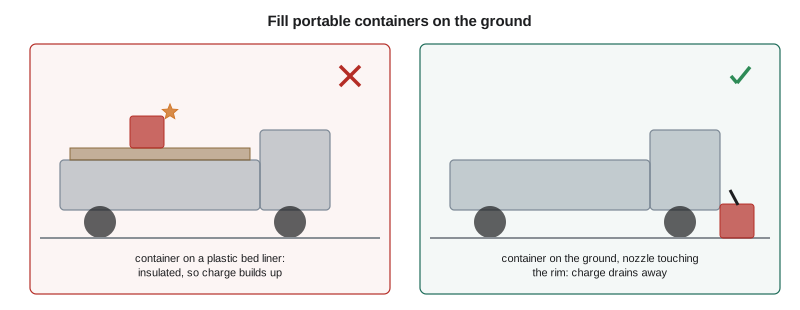
The rule that matters most is to fill containers on the ground. A container on the ground is connected to earth through the pavement, so static charge built up by the flowing fuel drains away. A container in a truck bed, especially on a plastic bed liner, or on carpet in a trunk, is insulated, so the charge builds up until it sparks, often to the nozzle. Several serious fires have started exactly this way.
- Take the container out of the vehicle and set it on the ground, a safe distance from the vehicle and other people.
- Remove the cap and touch the nozzle to the container before starting the flow, then keep the nozzle in contact with the rim or opening throughout filling. The contact gives static a path to drain.
- Fill slowly, by hand, without the hold-open latch, and stop at about 95% full to leave room for expansion.
- Replace the cap tightly, wipe off any spilled fuel, and let any spill evaporate or absorb it before loading.
- Secure the container upright in the vehicle, away from the passenger compartment if possible, and do not leave it in a hot vehicle.
Engines off, no smoking, attend the nozzle
Fire codes and dispenser signs set a few simple rules for anyone fuelling a vehicle. Stop the engine. Do not smoke or use any flame. Stay at the nozzle and outside the vehicle (Lesson 5). Do not top off: once the nozzle clicks off automatically, stop. Topping off overfills the tank, spills fuel on the ground and the customer's shoes, and can flood the vehicle's vapour control system, which then vents fuel. Do not let children operate the pump. And never fuel a vehicle with a person smoking inside or with an obvious leak.
The automatic shut-off in the nozzle works by sensing when fuel covers a small hole near its tip. It stops the flow when the tank is full, or when fuel splashes back, which is why some vehicles click off repeatedly. It is reliable but not perfect: it can fail if the nozzle is not inserted fully, if the vehicle's fill neck is damaged, or if the nozzle is jammed open with an object. Customers sometimes wedge the nozzle trigger with a cap or glove when no latch is provided; this is dangerous and the cashier should ask them to stop.
Special vehicles and equipment
- Motorcycles and small engines: small tanks fill in seconds and overflow easily; fill slowly.
- Boats on trailers: portable boat tanks should be removed and filled on the ground; fixed tanks should be filled with the boat on the trailer, the engine off and people out of the boat.
- Vehicles with roof racks or modified tanks: watch for leaks.
- Farm and construction equipment: some stations do not allow it on the forecourt; diesel lanes may be better.
- Leaking vehicles: refuse to fuel a vehicle that is visibly leaking fuel, and ask the driver to move it away from the pumps if it is safe to do so.
When customers argue
Most customers comply once they understand the rule. Some do not. A customer in a hurry may insist on filling a can in the truck bed, or argue that a milk jug is fine for one trip. The cashier does not need to win the argument. They control the pump. Explain briefly, offer an approved container, and if the customer refuses, do not authorize the pump or stop it. If the customer becomes aggressive, step back and follow the guidance in HSE-341: stay inside, do not argue, and call for help if needed.
For supervisors: make the safe way the easy way
Stock approved containers near the till at a fair price. Post the container rule at every pump with a simple picture of a can on the ground. Train cashiers on the intercom script for container problems. And log refusals; a pattern of the same customers or the same problem tells you where more signs or a conversation are needed.
Worked problem
The landscaper's cans
Early on a summer morning, a landscaping crew pulls up with a trailer holding six red cans and starts filling them where they sit on the trailer deck. Two cans are an approved type; four are old cans with missing spout caps. What should Raj do?
Show solution
- Stop or decline to authorize the pump and speak to the crew over the intercom or in person, calmly.
- Ask them to take the cans off the trailer and fill them one at a time on the ground, with the nozzle touching the can.
- Explain that cans with missing caps or damaged spouts cannot be filled; offer approved replacements from the store.
- Check that each can is within the posted size limit.
- Once the cans are filled and capped, make sure any spill is cleaned up before the trailer leaves.
Answer: Stop the filling on the trailer, have the crew fill only approved, capped cans one at a time on the ground, offer replacements for the damaged cans, and clean up any spill.
Containers brought back to the station
Customers sometimes bring back containers that leak, have cracked spouts, or hold fuel they no longer want, such as old mixed gasoline for a two-stroke engine or fuel contaminated with water. Do not accept unwanted fuel into the station's tanks or garbage, and do not pour it down a drain. Tell the customer where their municipality accepts household hazardous waste. If a leaking container is left on the forecourt, treat it as a small spill: move it upright onto absorbent, away from the pumps and drains, wearing nitrile gloves, and arrange disposal through the company's procedure. Never put a fuel container, even an empty one, in the store's garbage compactor or cardboard baler, because the vapour left inside can ignite.
Containers also matter inside the store. Approved containers for sale should be stored empty, with caps on, and away from heat. Small engine fuel sold pre-mixed in cans, starter fluid, fuel line antifreeze and windshield washer fluid are flammable products and belong on shelving away from heaters and the coffee machine, in quantities the fire code allows for retail display. If a customer drops and breaks one inside the store, treat it as a spill, ventilate and keep ignition sources away until it is cleaned up.
For supervisors: check the container display
Once a month, look at the approved containers on sale. Are all sizes the station allows in stock, in all three fuel types? Are the labels and standard marks visible? Are any damaged, missing caps or faded from sitting in a sunny window? A customer who cannot buy the right container at the till is the customer most likely to argue for a milk jug at the pump.
Common mistakes
MistakeFilling a container in a truck bed or trunk.
InsteadTake it out and fill it on the ground with the nozzle touching the container.
MistakeAccepting milk jugs or drink bottles for fuel.
InsteadRefuse and offer an approved, labelled container.
MistakeFilling a container to the brim.
InsteadStop at about 95% to leave room for expansion.
MistakeTopping off after the nozzle clicks off.
InsteadStop at the first automatic shut-off.
MistakeLetting a customer wedge the nozzle trigger open.
InsteadAsk them to hold the nozzle; stop the pump if needed.
Summary and key terms
- Fuel may be dispensed only into approved, labelled containers; colour is a custom, not an approval.
- Containers in Canada are made to CSA B376 or recognized metal standards; Northfield allows up to 25 L each.
- Fill containers on the ground, nozzle touching the container, filled by hand to about 95%.
- Engines off, no smoking, stay at the nozzle and outside the vehicle, and do not top off.
- Refuse to fill unapproved containers or leaking vehicles; the cashier controls the pump.
- Stock approved containers and post the rules so the safe way is easy.
- Approved container
- A portable container made and labelled to a recognized standard for the fuel it holds.
- Jerry can
- A common name for a portable fuel container.
- Topping off
- Adding more fuel after the nozzle has shut off automatically.
- Automatic shut-off
- The mechanism in a nozzle that stops flow when fuel reaches its tip.
- Flame mitigation device
- A screen in a container spout that stops a flame entering the container.
- Bed liner
- A plastic lining in a pickup truck bed; it insulates containers from ground.
Practice problems
Work each problem on paper first, then reveal the answer to check.
Why must containers be filled on the ground?
Show answer
So static from the flowing fuel drains to ground instead of building up and sparking.
What does the colour of a fuel container indicate?
Show answer
By custom, the fuel: red gasoline, yellow diesel, blue kerosene; the label and standard mark make it approved.
Name three unapproved containers customers bring.
Show answer
Any three of: milk jugs, drink bottles, washer fluid jugs, pails, glass jars, paint cans.
What is Northfield's posted container size limit?
Show answer
25 L per container.
How full should a portable container be filled?
Show answer
To about 95%, to leave room for expansion.
Why is topping off a problem?
Show answer
It overfills the tank, spills fuel and can flood the vehicle's vapour control system.
What should the cashier do if a customer refuses to take a can out of the truck bed?
Show answer
Not authorize or stop the pump, explain briefly, and avoid arguing; call for help if aggressive.
How does a nozzle know when to shut off?
Show answer
Fuel covering a small sensing hole near the tip stops the flow.
Lesson quiz · 5 questions
Score 60% or more to complete this lesson.
Create a free account to save your progress, take quizzes and earn a certificate.