
HSE-350 · Lesson 10 of 12 · 23 min
Customer and forecourt safety
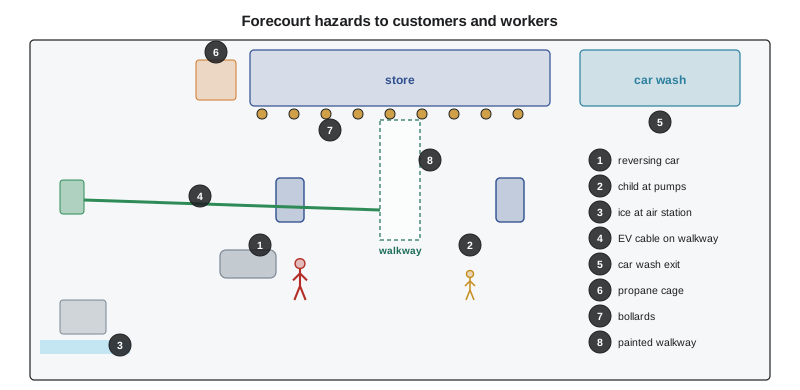
The forecourt is a car park, a pedestrian area, a fuelling area and sometimes a playground, all at once. Vehicles pull in and out, reverse around the islands, and queue for the pumps. Drivers get out and walk between cars, often looking at a phone or a payment screen. Children run from the car to the store. Trucks with trailers squeeze into the diesel lane. In winter, ice and snow cover everything; in summer, spilled fuel and oil make the surface slick. Electric vehicle chargers have added cables and a new kind of fire. A car wash, an air pump and a propane cage add their own hazards. This lesson covers the safety of customers and workers on the forecourt, and what the cashier can do about it.
Vehicles and pedestrians
Most forecourt injuries to customers come from vehicles and from slips and trips, not from fuel. The layout of a good station separates traffic: clear entry and exit lanes, one-way flow around the islands where possible, painted walkways from the pumps to the store, curbs and bollards protecting the dispensers and the store front, and lighting that shows pedestrians to drivers at night. The station cannot redesign itself every year, but it can keep the markings painted, the lights working, the walkways clear and the islands free of clutter.
- Reversing vehicles: drivers reverse to line up with the fill neck on the correct side and often do not see pedestrians behind them. Keep walkways and islands clear so pedestrians are not forced between cars.
- Children: children can be hard for drivers to see. Encourage customers to keep children in the car or holding hands, and never let children operate the pump.
- Distracted pedestrians: customers walking while using phones step out from between cars. Clear lines of sight help.
- Speeding through the lot: some drivers use the station as a shortcut. Speed bumps and clear signs help; report repeat problems to the police.
- Large vehicles: trucks, buses, motorhomes and vehicles towing trailers need room; direct them to the diesel lane or outer islands.
- The store front: bollards in front of the store windows and door stop vehicles that jump the curb, a common incident at convenience stores.
Slips and trips
HSE-106 covers slips, trips and falls in depth. On a forecourt, the surfaces that matter are the concrete around the dispensers, the walkway to the store door, the entrance mat, the air and water station, and the area around the car wash. Fuel and oil drips make concrete slippery, especially when wet; diesel is the worst. Ice forms quickly on concrete under a canopy that keeps snow off but lets the wind in, and meltwater dripping from the canopy edge refreezes overnight. Customers walking from a warm car in ordinary shoes are poorly equipped.
- Check surfaces at opening and through the shift (Lesson 1), and more often in freezing rain and after snow.
- Salt or sand walkways and the areas around the pumps and air station; clear snow from walkways and the curb ramp.
- Absorb fuel and oil drips with absorbent and sweep it up; do not wash fuel into drains.
- Keep entrance mats flat and change them when soaked.
- Mark wet floors inside the store and keep the area by the door dry.
- Wear winter boots with good tread, or slip-on ice cleats outdoors.
Overfills and topping off
Customer behaviour causes most small spills: topping off, walking away from a running nozzle, a nozzle that does not seat properly in an unusual fill neck, or a hose pulled taut that pops the nozzle out of the vehicle. The cashier sees these from the window and can stop the pump. Small spills, under a litre or two, are cleaned up by the cashier with absorbent from the spill kit at the island. Larger spills follow the procedure in Lesson 11 and HSE-351. Either way, keep vehicles from driving through the spill and keep ignition sources away until it is cleaned up.
Drive-offs and theft of fuel
Customers who drive off without paying, or with the nozzle still attached, are a loss and sometimes a hazard, but chasing them is far more dangerous than the loss. Lesson 7 covered drive-offs with the nozzle. For drive-offs without paying, the rule is the same: do not chase, do not step in front of the vehicle, and record what you can see safely. Many stations reduce drive-offs with prepayment, especially at night, and some provinces and states require prepayment during certain hours; HSE-352 covers those rules.
The program below analyses Northfield's drive-off log for the year, by time of day and by type, and works out the losses. The data are invented. The point of the analysis is to decide on controls, such as prepayment at certain hours or better camera coverage, not to blame cashiers.
# Drive-off log analysis by time of day and type (invented one-year data).
log = [  # (hour, type, value in dollars)
    (7, "no pay", 62), (8, "nozzle", 0), (12, "no pay", 48), (16, "no pay", 85), (17, "nozzle", 0),
    (19, "no pay", 70), (21, "no pay", 91), (22, "no pay", 77), (22, "no pay", 66), (23, "no pay", 88),
    (23, "nozzle", 0), (2, "no pay", 74), (3, "no pay", 95), (4, "no pay", 58), (14, "no pay", 40),
]
bands = {"5-11": range(5, 12), "12-17": range(12, 18), "18-23": range(18, 24), "0-4": range(0, 5)}
print(f"{'hours':8}{'events':>8}{'no pay':>8}{'loss $':>8}")
for band, hrs in bands.items():
    ev = [e for e in log if e[0] in hrs]
    nopay = [e for e in ev if e[1] == "no pay"]
    print(f"{band:8}{len(ev):>8}{len(nopay):>8}{sum(v for _, _, v in nopay):>8}")
night = [e for e in log if e[0] >= 21 or e[0] < 5]
print(f"Share of no-pay losses between 21:00 and 05:00: "
f"{sum(v for h, t, v in night if t == 'no pay') / sum(v for _, t, v in log if t == 'no pay'):.0%}")hours events no pay loss $ 5-11 2 1 62 12-17 4 3 173 18-23 6 5 392 0-4 3 3 227 Share of no-pay losses between 21:00 and 05:00: 64%
Almost two-thirds of the year's no-pay losses happened between 9 p.m. and 5 a.m., when the store is either closed with pay-at-the-pump only or has a single cashier. That supports what Leah suspected: prepayment at the pump after 9 p.m. would remove most of the losses and remove the temptation for a cashier alone at night to go outside and confront someone. The three nozzle drive-offs were spread through the day and are a separate issue, solved by the breakaways.
Electric vehicle chargers
Northfield added two fast chargers in 2025, as many stations have. Chargers bring new hazards. The cables are heavy, and drivers leave them lying across walkways and parking spaces, where they become trip hazards and get run over and damaged. A damaged cable or connector can expose live parts carrying several hundred volts of direct current. And although electric vehicle fires are not more frequent than fires in fuel-powered vehicles, a lithium-ion battery fire behaves differently: it can reignite hours later, gives off toxic gases, and needs large amounts of water to cool, which only the fire department can supply. HSE-322 covers lithium-ion hazards in depth.
- Check the chargers on forecourt checks: cables hung up on their holders, no cuts or crushed sections, connectors not cracked or wet, screen working.
- If a cable or connector is damaged, take the charger out of service using the app or the station's procedure, put a sign on it, and report it to the charger operator. Do not touch exposed parts.
- If a charging vehicle is smoking, hissing or on fire: stop the charger if it can be done safely from its emergency stop, get people away, call 911 and tell them it is an electric vehicle, and keep everyone back. Do not try to put out a battery fire with a portable extinguisher.
- Keep the charging spaces for charging and clear of snow; drivers otherwise drag cables across snowbanks and ice.
Car washes
Automatic car washes are a frequent source of minor injuries: customers slipping on the wet, often icy floor at the exit, getting out of the car inside the bay, or being struck by the moving equipment. Workers who clean, unjam or maintain the equipment can be caught in it unless it is locked out (HSE-210). In winter, the bay doors are closed to keep the equipment from freezing, and idling cars waiting inside or queuing at the door can raise carbon monoxide levels, especially with poor ventilation (Lesson 4).
- Customers stay in their car with the engine running only as the wash instructions say, and never get out in the bay.
- Keep the exit clear of ice with heated slabs, salt or sand; water from the wash freezes on the apron.
- Lock out the car wash before anyone enters the bay to clear a jam or clean the brushes.
- Make sure the bay ventilation runs when doors are closed, and watch for headaches or dizziness in staff working there.
Air, water and propane
The air pump and water hose are trip and slip hazards: hoses left on the ground, water freezing around the stand in winter. Keep hoses coiled and the area salted. The propane cage holds full and empty cylinders; it must stay locked, away from the store door and drains, and protected from vehicles. HSE-353 covers propane exchange in detail.
For supervisors: the forecourt from the customer's side
Once a month, walk the forecourt as a customer would. Pull in, fuel, walk to the store and back, use the air pump, look at the chargers. Where did you have to walk between cars? Where was the surface slippery? Where were signs missing or faded? Where would a child be hidden from a reversing driver? You will see things from that side that the till never shows.
Worked problem
A cable across the walkway
On a snowy afternoon, Grace sees that a driver has left a charging cable stretched across the walkway to the store, and the connector is lying in slush. What should she do?
Show solution
- If the vehicle is still charging, ask the driver, if they are in the store, to move the cable or end the session.
- If the session has ended and no one is with the vehicle, hang the cable on its holder, holding it by the cable, not the connector pins, and only if it is undamaged.
- Check the connector: if it is cracked or the cable is crushed, take the charger out of service, put up a sign and report it to the charger operator.
- Clear and salt the walkway around the chargers so drivers do not drag cables through snow.
- Record the problem and suggest a sign asking drivers to return cables to the holder.
Answer: Remove the trip hazard safely, check for damage, take a damaged charger out of service and report it, and clear the area so it does not happen again.
Lighting and visibility at night
Good lighting on the forecourt does three jobs at once: it lets drivers see pedestrians, it lets customers see ice, spills and curbs, and it lets the cashier see the pumps. A single failed canopy light can leave a dark patch around a dispenser where a spill or a person is hard to see. Report failed lights the same day, and keep windows clear of posters so light from the store also reaches the forecourt. Lighting also deters crime, which HSE-341 and HSE-352 cover.
Common mistakes
MistakeAssuming the forecourt's main hazard to customers is fire.
InsteadVehicles and slips cause most injuries; keep walkways, lighting and surfaces safe.
MistakeWashing fuel and oil drips into the drain.
InsteadAbsorb and sweep them up; drains lead to sewers or the environment.
MistakeChasing a customer who drove off without paying.
InsteadDo not chase; record what you can see safely; consider prepayment at high-risk hours.
MistakeFighting an electric vehicle battery fire with a portable extinguisher.
InsteadGet people away, call 911 and tell them it is an electric vehicle.
MistakeEntering the car wash bay to clear a jam with the equipment live.
InsteadLock out the car wash first.
Summary and key terms
- Most forecourt injuries come from vehicles and slips and trips, not fuel.
- Keep walkways, markings, lighting and bollards in good order and the islands free of clutter.
- Check and treat surfaces often in winter; absorb fuel and oil drips rather than washing them into drains.
- Do not chase drive-offs; use data to choose controls such as prepayment at night.
- Check EV charger cables and connectors; take damaged chargers out of service; leave battery fires to the fire department.
- Car washes bring slips, moving equipment and carbon monoxide; lock out before entering the bay.
- Drive-off
- A customer leaving without paying or with the nozzle still in the vehicle.
- Bollard
- A sturdy post that protects equipment, buildings or pedestrians from vehicles.
- Prepayment
- Requiring payment before fuel is dispensed.
- Fast charger
- An electric vehicle charger that supplies high-voltage direct current.
- Thermal runaway
- An uncontrolled heating reaction in a battery cell that can lead to fire.
- Apron
- The paved area at the entry or exit of a car wash or around the islands.
Practice problems
Work each problem on paper first, then reveal the answer to check.
What causes most forecourt injuries to customers?
Show answer
Vehicles and slips and trips, not fuel.
Name three layout features that separate vehicles and pedestrians.
Show answer
Any three of: clear entry and exit lanes, one-way flow, painted walkways, curbs and bollards, good lighting.
Why is ice common under a canopy?
Show answer
Wind blows under it and meltwater drips from the edge and refreezes.
What should be done with small fuel drips on the forecourt?
Show answer
Absorb and sweep them up, not wash them into drains.
In the drive-off analysis, when did most no-pay losses occur?
Show answer
Between 9 p.m. and 5 a.m.
What should be done with a damaged EV charger cable?
Show answer
Take the charger out of service, sign it and report it; do not touch exposed parts.
Why should staff not fight an EV battery fire?
Show answer
It needs large amounts of water to cool, can reignite and gives off toxic gases.
What must happen before someone enters a car wash bay to clear a jam?
Show answer
The car wash must be locked out.
Lesson quiz · 5 questions
Score 60% or more to complete this lesson.
Create a free account to save your progress, take quizzes and earn a certificate.