
HSE-350 · Lesson 3 of 12 · 23 min
Properties of gasoline, diesel and other fuels
Every safety rule at a fuel station follows from a few physical facts about the fuels. Gasoline gives off flammable vapour even on the coldest day. The vapour is heavier than air, so it flows along the ground and collects in low spots. It only burns when it is mixed with air in a narrow range of concentrations, but that range is easy to reach near an open fill port, a spill or an overflowing tank. Diesel is much harder to ignite but still burns fiercely once it does. This lesson explains these properties in plain terms, so the rules in the rest of the course make sense rather than being a list to memorize.
HSE-330 covers flammable atmospheres in depth for oil and gas work, and HSE-105 covers how fires start and behave. This lesson focuses on the fuels a station handles: gasoline, diesel, ethanol blends, diesel exhaust fluid, and the propane and lubricants sold in the store.
The fire triangle and the fuels
A fire needs three things: fuel, oxygen and an ignition source. At a fuel station, oxygen is everywhere and fuel is the product, so most of the safety effort goes into two things: keeping fuel and vapour contained, and keeping ignition sources away from any vapour that escapes. Liquid fuel itself does not burn; it is the vapour above the liquid that ignites. That is why the properties that matter most are the ones that describe the vapour.
- Flash point: the lowest temperature at which a liquid gives off enough vapour to form an ignitable mixture with air at its surface. Below the flash point, the vapour is too thin to ignite; above it, a spark can light it.
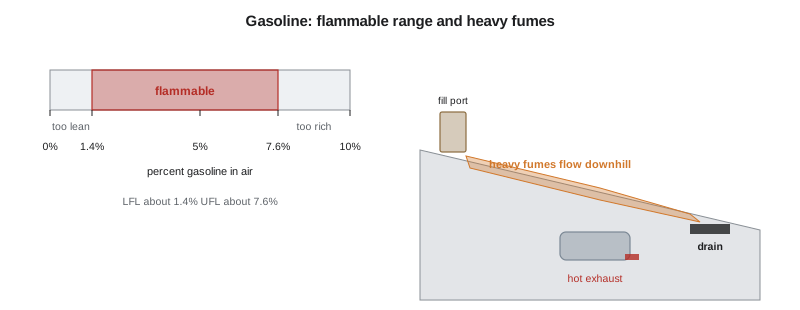
- Flammable range (explosive limits): the range of vapour concentrations in air that can burn. Below the lower flammable limit (LFL, also called the lower explosive limit, LEL), the mixture is too lean; above the upper limit (UFL or UEL), too rich. Between them, it burns.
- Vapour density: the weight of the vapour compared with air. A vapour density above 1 means the vapour is heavier than air and sinks.
- Autoignition temperature: the temperature at which the vapour ignites without a spark or flame, for example on a very hot exhaust part.
Gasoline
Gasoline is a blend of hundreds of hydrocarbons, most of them light enough to evaporate readily. Its flash point is about −43 °C (−45 °F), so it gives off ignitable vapour in any weather a station will see. Its flammable range is narrow, roughly 1.4% to 7.6% vapour in air, but the lower limit is low: only about one part in seventy of the air needs to be gasoline vapour to burn. Gasoline vapour is about three to four times heavier than air. It spills off the edge of a fill port, rolls across the forecourt, and collects in drains, pits, low ground and the inside of vehicles and containers. Its autoignition temperature is roughly 250 °C to 300 °C (480 °F to 570 °F), low enough that a hot exhaust or catalytic converter can light a pool of spilled gasoline.
Because of these properties, gasoline is a Class I flammable liquid in fire codes: the most closely controlled class. In WHMIS and in the Hazard Communication Standard it is classified as a flammable liquid category 1 and carries health hazard classes as well, because it contains benzene and can cause cancer, genetic damage and lung damage if swallowed and inhaled into the lungs (Lesson 4).
Diesel
Diesel fuel is heavier and less volatile than gasoline. Its flash point is above 52 °C (126 °F) for the common grades in Canada and the United States, so at normal temperatures it does not give off enough vapour to ignite with a spark. Fire codes therefore class it as a combustible liquid rather than a flammable one. That does not make it harmless. Diesel heated above its flash point, sprayed as a fine mist from a leaking high-pressure line, or soaked into a rag or absorbent can burn readily, and a diesel fire is hard to put out. Diesel on a forecourt is also very slippery and is a major cause of slips, and it irritates the skin with repeated contact.
Some stations sell a winter diesel blended with kerosene to keep it flowing in the cold. Kerosene's flash point is lower than diesel's, so winter blends may have a lower flash point than summer diesel, though still well above typical air temperatures.
| Property | Gasoline | Diesel |
|---|---|---|
| Flash point | About −43 °C (−45 °F) | Above 52 °C (126 °F) |
| Flammable range in air | About 1.4% to 7.6% | About 0.6% to 7.5% (when heated above flash point) |
| Vapour density (air = 1) | About 3 to 4 | Above 4 |
| Autoignition temperature | About 250 °C to 300 °C (480 °F to 570 °F) | About 210 °C to 260 °C (410 °F to 500 °F) |
| Fire code class | Class I flammable liquid | Class II combustible liquid |
| Main health concerns | Vapour inhalation, benzene, aspiration if swallowed, skin irritation | Skin irritation, aspiration if swallowed, mist inhalation |
Look closely at the autoignition temperatures. Diesel's is lower than gasoline's. Diesel is hard to light with a spark because it gives off little vapour, but once its vapour reaches a hot surface it can ignite without a spark at all. This is why fuel leaking onto a hot engine or exhaust is dangerous whatever the fuel.
Ethanol blends
Most gasoline sold in Canada contains some ethanol, usually up to 10% (E10), because federal and provincial renewable fuel rules require an average ethanol content. A few stations sell E85, which is up to 85% ethanol, for flex-fuel vehicles. Ethanol mixes with water, so ethanol blends are more sensitive to water in tanks, and ethanol fires burn with a pale, almost invisible flame in daylight, which makes them harder to see. Firefighters use alcohol-resistant foam on large ethanol fires, because ordinary foam breaks down.
For the cashier, ethanol blends change little in daily work. Spills are handled the same way, and the same ignition rules apply. The main points are to make sure customers use the right nozzle, since E85 and E15 must not go into vehicles that are not designed for them, and to remember that an ethanol fire may be hard to see.
Other products at the station
- Diesel exhaust fluid (DEF): a solution of urea in water used by modern diesel engines to reduce emissions. It is not flammable and has low toxicity, but it corrodes some metals, is slippery when spilled, and crystallizes into a white crust. It must never go into a fuel tank, and fuel must never go into a DEF tank; both mistakes cause expensive engine damage.
- Propane: sold in cylinders through an exchange cage. Propane is a gas stored as a liquid under pressure; its vapour is heavier than air and very flammable. HSE-353 covers propane in detail.
- Motor oil, antifreeze and windshield washer fluid: sold in the store. Windshield washer fluid is usually methanol and water and is both flammable and toxic if swallowed; antifreeze is toxic and tastes sweet, a danger to children and pets.
- Kerosene and heating oil: sold from a separate dispenser at some rural stations, into approved containers.
Where vapour goes
Because gasoline vapour is heavier than air, it behaves almost like a liquid you cannot see. It spills over the rim of a tank opening, flows downhill and pools in the lowest places nearby. Wind thins it out and carries it away, but on a still day it can travel several metres across the ground before it mixes enough to fall below the lower flammable limit. This is why the ignition rules apply to an area around the dispensers and fill ports, not just to the nozzle itself, and why drains, pits, sumps and basements near a spill are so dangerous.
The program below takes vapour readings from a hypothetical gas detector carried around a small spill and checks each against gasoline's flammable range. Detectors used for flammable gas read in percent of the lower explosive limit (%LEL), not percent vapour, so the program converts between the two. A reading of 100% LEL means the mixture has reached the lower flammable limit. Common alarm settings are 10% and 20% LEL; the readings are illustrative.
# Convert gas detector readings (%LEL) to % fuel in air and check against gasoline's flammable range.
LFL, UFL = 1.4, 7.6          # % gasoline in air (typical values)
readings = [("at the fill port opening", 160), ("on the ground beside the spill", 85),
            ("at the drain grate", 120), ("1 m above the spill", 12), ("at the store door", 0)]
for place, lel_pct in readings:
    fuel = lel_pct / 100 * LFL
    if fuel >= UFL:
        state = "too rich, but can become flammable as it mixes"
    elif fuel >= LFL:
        state = "FLAMMABLE"
    elif lel_pct >= 20:
        state = "high alarm: evacuate area, no ignition sources"
    elif lel_pct >= 10:
        state = "low alarm: caution"
    else:
        state = "below alarm"
print(f"{place:34}{lel_pct:>5}% LEL = {fuel:4.2f}% in air {state}")at the fill port opening 160% LEL = 2.24% in air FLAMMABLE on the ground beside the spill 85% LEL = 1.19% in air high alarm: evacuate area, no ignition sources at the drain grate 120% LEL = 1.68% in air FLAMMABLE 1 m above the spill 12% LEL = 0.17% in air low alarm: caution at the store door 0% LEL = 0.00% in air below alarm
The readings tell the story of heavy vapour. Right at the fill port and at the drain, the mixture is above the lower flammable limit and would ignite with a spark. On the ground beside the spill it is close to the limit and well past any alarm. A metre above the spill it is far lower, and at the store door the detector reads nothing. A person standing upright might smell fuel but feel safe, while the vapour at their feet and in the drain is ready to burn. Most stations do not carry gas detectors; the lesson here is about behaviour: treat the ground around a spill and any drain nearby as the danger zone, and keep ignition sources well away.
For supervisors: read the SDS with your team
The safety data sheet for gasoline and diesel from your supplier lists the exact flash point, flammable limits, exposure limits and first aid for the products you sell. Sit down with new staff and go through sections 2 (hazards), 4 (first aid), 5 (firefighting), 6 (accidental release) and 9 (physical properties). Point out the numbers in this lesson on the actual sheet. It takes fifteen minutes and makes the SDS a working tool rather than a binder on a shelf.
Worked problem
Why can a winter spill still burn?
On a −25 °C (−13 °F) morning, a customer spills about a litre of gasoline beside a pump. Grace says it is too cold for it to catch fire. Is she right?
Show solution
- Compare the temperature with gasoline's flash point: about −43 °C (−45 °F). −25 °C is well above it.
- So the spilled gasoline is still giving off ignitable vapour, although more slowly than in summer.
- The vapour is heavier than air and will stay low around the spill and run into any drain.
- A spark, a running engine or a cigarette could ignite it, and the spill must be treated exactly as in summer: stop dispensing nearby, keep ignition sources away, contain and absorb it.
Answer: No. Gasoline's flash point is about −43 °C (−45 °F), so it gives off flammable vapour even at −25 °C. The spill is just as able to ignite and must be handled the same way.
Common mistakes
MistakeBelieving gasoline will not burn in cold weather.
InsteadGasoline gives off flammable vapour down to about −43 °C (−45 °F).
MistakeTreating diesel spills as harmless because diesel is hard to ignite.
InsteadDiesel can still burn when heated or misted, and it makes the forecourt very slippery.
MistakeChecking for vapour at head height.
InsteadGasoline vapour is heavier than air; the danger is at ground level and in drains.
MistakeAssuming an ethanol fire will be obvious.
InsteadEthanol blends can burn with a pale, hard-to-see flame.
MistakeLetting a customer put DEF in a fuel tank or fuel in a DEF tank.
InsteadCheck that the right product goes into the right tank; both mistakes damage engines.
Summary and key terms
- Liquid fuel does not burn; its vapour does, when mixed with air within the flammable range.
- Gasoline has a flash point of about −43 °C (−45 °F) and a flammable range of about 1.4% to 7.6%.
- Gasoline vapour is three to four times heavier than air, so it flows along the ground and collects in low places.
- Diesel is a combustible liquid with a flash point above 52 °C (126 °F), but it burns when heated or misted and is very slippery.
- Ethanol blends behave like gasoline but can burn with a nearly invisible flame.
- The SDS for each product gives the exact properties and first aid.
- Flash point
- The lowest temperature at which a liquid gives off enough vapour to ignite.
- Lower flammable limit (LFL)
- The lowest concentration of vapour in air that can burn; also called the lower explosive limit (LEL).
- Vapour density
- The weight of a vapour compared with air; above 1 means it sinks.
- Autoignition temperature
- The temperature at which vapour ignites without a spark or flame.
- Flammable liquid
- In fire codes, a liquid with a flash point below about 38 °C (100 °F), such as gasoline.
- Combustible liquid
- In fire codes, a liquid with a higher flash point, such as diesel.
Practice problems
Work each problem on paper first, then reveal the answer to check.
What three things does a fire need?
Show answer
Fuel, oxygen and an ignition source.
What is the flash point of gasoline, roughly?
Show answer
About −43 °C (−45 °F).
What is gasoline's approximate flammable range?
Show answer
About 1.4% to 7.6% vapour in air.
Why does gasoline vapour collect in drains?
Show answer
It is three to four times heavier than air, so it flows downhill and pools.
Why is diesel classed as a combustible rather than a flammable liquid?
Show answer
Its flash point is above 52 °C (126 °F), so it gives off little vapour at normal temperatures.
What is unusual about an ethanol fire?
Show answer
The flame can be pale and hard to see in daylight.
What does a reading of 100% LEL mean?
Show answer
The vapour has reached the lower flammable limit and can ignite.
Name two sections of an SDS a new worker should read.
Show answer
Any two of: hazards, first aid, firefighting, accidental release, physical properties.
Lesson quiz · 5 questions
Score 60% or more to complete this lesson.
Create a free account to save your progress, take quizzes and earn a certificate.