
HSE-350 · Lesson 11 of 12 · 24 min
Emergency planning and the attendant's role in incidents
At most fuel stations, the person on duty when something goes badly wrong is a cashier, often young, often alone or with one colleague, and often at night. The fire department is minutes away, the manager is at home, and the customers are looking to the person behind the counter. That person cannot be expected to solve the emergency, but they can do the few things that matter most in the first minutes: stop the fuel, call for help, get people away from danger, and give the responders the information they need. This lesson brings together the emergency procedures from earlier lessons into a plan for the station and sets out the cashier's role in each kind of incident.
HSE-105 covers emergency planning, fire safety plans, evacuation and drills in general, and HSE-106 covers first aid. HSE-341 covers robbery and aggressive customers, HSE-351 covers spill response and reporting in depth, and HSE-352 covers working alone. This lesson focuses on how those pieces fit together at a fuel station.
The station's emergency plan
Alberta's OHS Code requires employers to have an emergency response plan for situations that may require rescue or evacuation, and the fire code requires a fire safety plan for buildings and facilities such as fuel-dispensing stations. A fuel station's plan does not need to be long, but it must be specific to the site and known by everyone who works there.
- How to stop the fuel: where the emergency shut-off switches are and how to reset them.
- How to raise the alarm: 911, the station's address and a description that responders can find, and the people to call afterwards.
- How to evacuate: routes and assembly points away from the canopy, tanks and fill ports, upwind if possible; who checks the washrooms and the back office.
- What to do in each type of incident: fire, spill, vehicle strike, delivery incident, medical emergency, robbery, severe weather, power failure, gas or vapour odour inside the building.
- Equipment: extinguishers, spill kits, first aid kit, AED if provided, flashlight, emergency card.
- Information for responders: a site plan showing tanks, fill ports, vents, the emergency shut-off, utility shut-offs and drains.
- Training and drills: how often, and how they are recorded.
The first minutes
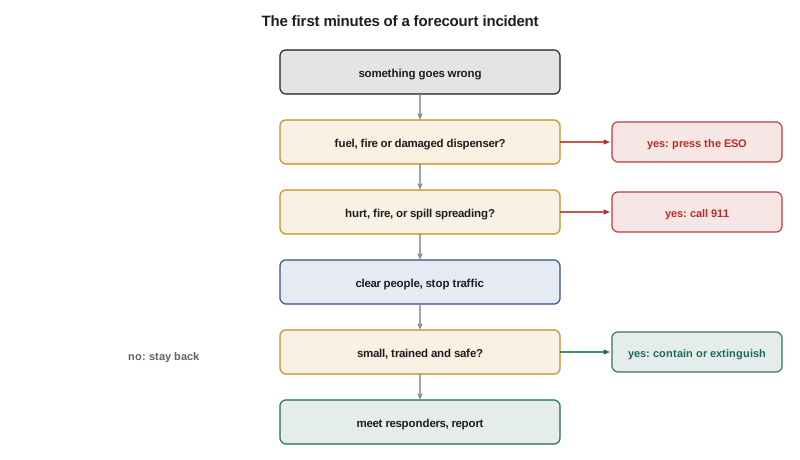
In nearly every forecourt incident, the cashier's first actions follow the same pattern. Memorize it, because in an emergency people do what they have practised, not what they have read.
- Stop: press the emergency shut-off if fuel, fire or a damaged dispenser is involved.
- Call: 911 for fire, injury, a spill that is spreading or reaching a drain, a vehicle in a dispenser, or violence.
- Clear: tell customers by intercom or in person to move away, upwind, to the assembly point; stop vehicles entering.
- Contain: only if safe and trained, contain a spill with absorbent or put out a small fire.
- Inform: meet the responders, tell them what happened, what is shut off, where the tanks and fill ports are, and whether anyone is missing or hurt.
- Report: tell the manager, record the incident, and make the reports required by law.
Spills
Spills are the most common forecourt incident after drive-offs. Most are small and are handled by the cashier with the island spill kit: a container of absorbent, pads, a broom and dustpan, bags and gloves. Larger spills follow the station's spill procedure, which HSE-351 covers in full. The size thresholds and reporting rules vary; the cashier needs to know three things: when they can clean up a spill themselves, when to call 911 or the fire department, and who must be told.
| Spill | Example | Cashier's response |
|---|---|---|
| Small, contained | A litre or two from topping off, on the island | Stop the pump; nitrile gloves; absorbent; sweep and bag; dispose as the company procedure says; record |
| Medium | Tens of litres from a damaged hose or overfilled container | Press ESO; keep people and vehicles away; protect drains with absorbent socks or drain covers; call the manager; follow the spill procedure; may need the fire department |
| Large or spreading | Hundreds of litres, a tank overfill, fuel entering a drain or leaving the site | Press ESO; evacuate the forecourt; call 911; protect drains only if safe; do not try to clean up; report as required |
Drains are the critical point. Fuel that enters a storm drain can travel to a creek or river, and fuel that enters a sanitary sewer can build up vapour in the sewer and cause explosions far from the station. Many stations have drain covers or absorbent socks in the spill kit for exactly this reason, and an oil-water separator on the forecourt drains. Protecting the drain is often the single most valuable thing the cashier can do with a medium spill.
Medical emergencies
Medical emergencies at stations range from a customer fainting at the pump to a heart attack in the store, a diabetic emergency, an overdose in the washroom, a burn from a fire, or a person struck by a vehicle. The cashier's role is to call 911, give first aid within their training, and keep the person safe from traffic. HSE-106 covers first aid. Many stations now keep an automated external defibrillator (AED), and some keep naloxone for opioid overdoses, especially stations with public washrooms; if yours does, know where it is and be trained to use it. Washroom checks on a schedule, and a way to open a locked washroom door from outside, help in overdose emergencies.
Robbery and violence
HSE-341 covers robbery and aggressive customers in depth. The key points at a fuel station are the same as at any store: cooperate, do not resist, do not chase, keep hands visible, and call police when it is safe. Do not press the emergency shut-off during a robbery unless there is a fire or fuel hazard, since cutting the pumps may provoke the robber. After the robber leaves, lock the door if safe, call 911, and protect any evidence. HSE-352 covers working alone and the rules some provinces and states set for late-night shifts, including prepayment and lone-worker check-ins.
Severe weather and power failures
Storms, extreme cold, wildfire smoke and floods all affect fuel stations, which are often expected to stay open when people need fuel most. Know the plan for each.
- Thunderstorms: stop deliveries while lightning is close; keep staff off the forecourt except for urgent tasks (Lesson 5).
- High winds: secure signs and displays; watch for damaged canopy panels and debris; close the forecourt if the canopy is damaged.
- Extreme cold: keep walkways clear; watch for frostbite in staff on the forecourt; check that the fill port caps and spill buckets are not full of ice.
- Wildfire smoke and nearby wildfires: follow air quality advice; be ready to stop dispensing and evacuate if ordered.
- Floods: water can enter tanks through fill ports and vents; stop dispensing and call the fuel company if the forecourt floods.
- Power failure: dispensers stop; when power returns, check that the tank gauge, alarms and dispensers have reset correctly before resuming sales; use flashlights, not candles.
Drills
A plan nobody has practised does not work. Northfield runs short drills each quarter, rotating through scenarios: a fire at a pump, a delivery spill, a medical emergency in the store, a power failure. A drill takes ten minutes during a quiet period: the cashier talks through and does each step, presses the inside ESO (with customers warned and pumps checked afterwards), finds the extinguishers and spill kit, and practises the 911 call script without dialling. The program below tracks which staff have done which drill in the last 12 months, so Leah can see the gaps.
# Drill coverage over the last 12 months (invented records).
staff = ["Leah", "Raj", "Tyler", "Grace", "Ben", "Sofia", "Amira", "Joel"]
drills = ["pump fire", "delivery spill", "medical", "power failure"]
done = {
    "Leah": {"pump fire", "delivery spill", "medical", "power failure"},
    "Raj": {"pump fire", "delivery spill", "medical"},
    "Tyler": {"pump fire", "medical"},
    "Grace": {"pump fire"},
    "Ben": {"pump fire", "delivery spill", "power failure"},
    "Sofia": set(),
    "Amira": {"medical", "power failure"},
    "Joel": {"pump fire", "delivery spill"},
}
for d in drills:
    missing = [s for s in staff if d not in done[s]]
    print(f"{d:15}{len(staff) - len(missing)}/{len(staff)} done   missing: {', '.join(missing) or 'none'}")
full = [s for s in staff if done[s] == set(drills)]
print("Everyone has done the pump fire drill:", all("pump fire" in done[s] for s in staff))
print("Staff with all four drills:", ", ".join(full))pump fire 6/8 done missing: Sofia, Amira delivery spill 4/8 done missing: Tyler, Grace, Sofia, Amira medical 4/8 done missing: Grace, Ben, Sofia, Joel power failure 3/8 done missing: Raj, Tyler, Grace, Sofia, Joel Everyone has done the pump fire drill: False Staff with all four drills: Leah
Only Leah has done all four drills, and Sofia, the new hire, has done none, which is expected and will be fixed in her orientation (Lesson 12). More worrying are the gaps for regular staff: Grace, who works weekend days alone in the mornings, has done only the pump fire drill, and Tyler, who works most evenings, has not practised a delivery spill, although evening deliveries are common. Leah schedules both before the end of the month. The drill most often missed is the power failure, which matters because the restart after a power cut is when tank alarms and dispenser faults are easiest to miss.
For supervisors: debrief every incident
After every incident, however small, spend five minutes with the people involved. What happened? What went well? What was hard? Was anything missing, such as a spill kit that was empty, a phone number that was not posted, or a switch that was blocked? Record it, fix what can be fixed, and tell the rest of the team. A culture where small incidents are talked about openly is the best preparation for a big one.
Worked problem
A spill reaching the drain
A customer's hose pops out of a pickup's fill neck and sprays diesel across the island before the customer releases the trigger. Perhaps 20 L (5 gal) of diesel is on the concrete and flowing toward a storm drain at the edge of the canopy. Tyler is alone. What should he do?
Show solution
- Press the emergency shut-off to stop all the pumps, and tell the customer over the intercom to stay away from the spill and not start the truck.
- Grab the spill kit and protect the drain first: put the drain cover or absorbent socks across the drain and around the leading edge of the spill.
- Keep vehicles from driving through the spill; ask customers to wait or use cones to close the affected lanes.
- Call the manager; if diesel has entered the drain, or the spill is growing, call the fire department and follow the reporting procedure.
- Spread absorbent from the edges inward, sweep and bag it as the procedure says; only then reset the ESO and reopen the unaffected pumps.
- Record the spill, the amount, what was done and who was told.
Answer: Stop the fuel, protect the drain before anything else, keep vehicles out of the spill, call the manager and, if fuel reached the drain, the fire department, then absorb, record and report.
Common mistakes
MistakeKeeping the emergency plan in the office binder.
InsteadPost the key steps, numbers and the ESO location at the till and train everyone.
MistakeStarting to clean up a spill before protecting the drain.
InsteadProtect drains first; fuel in a drain spreads the hazard far from the station.
MistakePressing the ESO during a robbery with no fuel or fire hazard.
InsteadCooperate and keep calm; cutting the pumps may provoke the robber.
MistakeRestarting after a power cut without checking the tank gauge and dispensers.
InsteadCheck alarms, gauge and dispensers before resuming sales.
MistakeSkipping drills because the station is too busy.
InsteadRun short drills in quiet periods and track who has done them.
Summary and key terms
- The cashier's role in an emergency is to stop the fuel, call for help, clear people away, contain only if safe, inform responders and report.
- The station's plan must be site-specific: shut-offs, alarms, evacuation, incident procedures, equipment, responder information and drills.
- Small spills are cleaned up with the spill kit; protect drains first in larger spills; large spills need 911.
- Medical emergencies: call 911, give first aid within training, protect the person from traffic; know where the AED and naloxone are.
- In a robbery, cooperate and do not press the ESO unless there is a fuel or fire hazard.
- Short, regular drills, tracked by person and scenario, make the plan work.
- Emergency response plan
- A written plan for responding to emergencies at a workplace.
- Assembly point
- A safe place where people gather after evacuating.
- Spill kit
- A container of absorbent, drain covers, gloves, bags and tools for cleaning up spills.
- Drain cover
- A mat placed over a drain to stop spills entering it.
- Oil-water separator
- A tank in the drain system that traps oil and fuel before water leaves the site.
- AED
- Automated external defibrillator, a device that can restart a heart in cardiac arrest.
Practice problems
Work each problem on paper first, then reveal the answer to check.
What are the six steps of the first minutes of a forecourt incident?
Show answer
Stop, call, clear, contain if safe, inform responders, report.
Name five things a station emergency plan should cover.
Show answer
Any five of: stopping fuel, raising the alarm, evacuation, incident procedures, equipment, responder information, training and drills.
Why are drains so important in a spill?
Show answer
Fuel can travel through them to waterways or build up vapour in sewers far from the station.
When should the cashier call 911 for a spill?
Show answer
When it is large or spreading, reaching a drain or leaving the site, or there is fire or injury.
Why should the ESO not be pressed during a robbery without a fuel hazard?
Show answer
Cutting the pumps may provoke the robber; cooperate instead.
What should be checked after a power failure?
Show answer
That the tank gauge, alarms and dispensers have reset correctly.
In the drill records, which drill was missed most?
Show answer
The power failure drill.
What is the purpose of debriefing small incidents?
Show answer
To learn what went well and what was missing, fix problems and prepare for larger incidents.
Lesson quiz · 5 questions
Score 60% or more to complete this lesson.
Create a free account to save your progress, take quizzes and earn a certificate.