
HSE-350 · Lesson 1 of 12 · 25 min
The fuel station workplace
A fuel station looks simple from the driver's seat: pull up, pay, pump, drive away. For the people who work there it is a more complicated workplace. Underneath the forecourt are tanks holding tens of thousands of litres of gasoline and diesel. Above it, a canopy shelters dispensers that pump a highly flammable liquid into vehicles driven by strangers, some of them distracted, some in a hurry and a few looking for trouble. Tanker trucks arrive to refill the tanks while customers keep fuelling. Inside, the convenience store has all the hazards of a small retail store, often run by one or two people, open early, late or around the clock.
This course is the first of four in the fuel stations track. It covers the hazards that make a fuel station different from other stores: the fuels themselves, ignition sources and static electricity, portable containers, emergency shut-off and fire response, fuel deliveries, tanks and overfill prevention, and the safety of customers on the forecourt. The next three courses go deeper into topics this one only introduces. HSE-351 covers fuel spills, underground storage tanks, leak detection and spill reporting. HSE-352 covers working alone and late-night safety, including the rules some provinces and states have for overnight shifts and prepayment. HSE-353 covers propane cylinder exchange and refilling.
Some topics are taught fully in other courses and this course points to them. HSE-105 covers fire safety, fire extinguishers and emergency planning. HSE-103 covers hazard recognition and risk assessment. HSE-106 covers slips, trips and falls. HSE-330 covers flammable atmospheres, gas detection and static electricity in oil and gas work. HSE-340 covers the hazards of the store itself, such as stocking, box cutters, coolers and spills, and HSE-341 covers robbery and aggressive customers. HSE-322 covers lithium-ion batteries, which matter here because many stations now have electric vehicle chargers.
Meet Northfield Fuel and Market
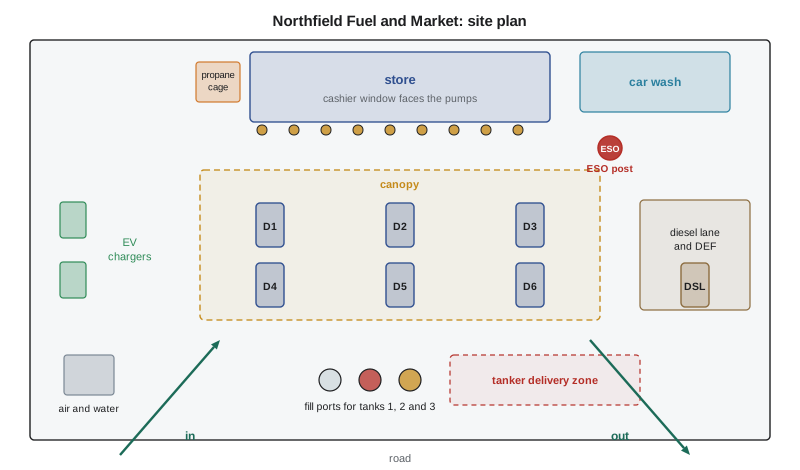
Throughout this course we follow Northfield Fuel and Market, an invented station on a busy road on the north side of Red Deer, Alberta. It is owned by the same company as Northfield Market, the grocery store in the retail courses, and shares its safety lead, Marco Delgado, who visits weekly. The station has six dispensers under a canopy, giving twelve fuelling positions, plus a diesel lane for pickups and small trucks, a diesel exhaust fluid pump, two electric vehicle fast chargers added in 2025, a touchless car wash, an air and water station and a propane cylinder exchange cage. The store sells snacks, drinks, coffee, tobacco, lottery tickets and some automotive products, and is open from 5 a.m. to midnight, with pay-at-the-pump fuel available around the clock.
Under the forecourt are three underground storage tanks: regular gasoline, 50,000 L (13,200 gal); premium gasoline, 25,000 L (6,600 gal); and diesel, 40,000 L (10,600 gal). A tanker delivers about three times a week. The station employs 18 people, most of them part time. Leah Morin is the manager and Raj Patel is the assistant manager. Tyler, who is 19, works most evenings; Grace, who is 17, works weekend days; Ben works the late shift until midnight; and Sofia is a new hire whose orientation is the capstone of this course. Mike is a driver for the fuel hauler who delivers most loads.
How fuel stations differ
Fuel stations come in many forms, and the form changes the hazards and the worker's job.
- Full-serve: an attendant pumps fuel for the customer. The attendant spends much of the shift on the forecourt, close to fuel vapour, vehicle traffic and the weather.
- Self-serve with an attendant: customers pump their own fuel, and a cashier inside watches the forecourt, controls the pumps, and can stop them in an emergency. This is the most common type in Canada and the United States, and the type Northfield is.
- Unattended or cardlock: no staff on site at certain hours or at all. Common for commercial cardlock sites used by truck fleets and farmers, and for pay-at-the-pump sales at night. Fire codes add requirements, such as signs, emergency instructions and communication with a monitoring service, where no attendant is present.
- Truck stops and travel centres: large sites with high-volume diesel lanes, scales, restaurants and parking, and heavy truck traffic.
- Marinas and airports: special fuels and rules beyond this course.
Self-service is normal across Canada, although a few places have historically required full service and many stations still offer it on request. The fire code and provincial rules decide what a self-serve station must have, such as an attendant able to see the dispensers and reach the emergency shut-off.
What the station worker does
At an attended self-serve station like Northfield, the cashier is also the forecourt safety officer. Their job includes watching the dispensers, authorizing pumps, stopping a pump when something goes wrong, handling small spills, keeping an eye on deliveries, checking the forecourt, answering customers' questions and taking charge in an emergency until the fire department arrives. In between, they sell coffee and lottery tickets, stock the cooler, clean the washrooms, empty the garbage and take in deliveries of store goods. The safety part of the job is easy to forget on a busy shift, which is why this course spends time on it.
For supervisors: the cashier's view of the forecourt
The cashier can only control what they can see. Stand behind the counter at the start of a shift and look out: can you see every fuelling position, the fill ports and the propane cage? Are any views blocked by posters, displays, ice machines or stacked cases? Can the cashier reach the emergency shut-off button quickly? Many stations have cameras and a monitor at the till, but a camera does not replace a clear window. Fix blind spots, because a fire at a pump you cannot see is a fire you will not stop in time.
How workers and customers get hurt
Fuel station injuries fall into two groups. The first is the everyday injuries of any small store: strains from lifting cases of drinks and boxes of stock, slips on wet floors and on ice and fuel on the forecourt, cuts from box cutters and broken glass, and needle-stick injuries from garbage and washrooms. These are by far the most common. The second is the rare but serious events that make fuel stations different: fires at the dispenser, vehicles driving into dispensers or people, fuel spills, exposure to fuel vapour, and robbery and violence, which HSE-341 and HSE-352 cover.
Fires at the pump are rare, but they happen, and the causes are well studied. Many start when static electricity builds up on a person who gets back into the vehicle during fuelling, then touches the nozzle; others start when portable containers are filled in a truck bed or trunk, from smoking, or from vehicle faults. Lesson 5 explains the science and Lesson 6 the rules for containers. A vehicle driving away with the nozzle still in the tank is far more common than a fire; the breakaway coupling on the hose is designed for exactly that (Lesson 7).
| Hazard | Examples at a fuel station | Where in this course |
|---|---|---|
| Fire and explosion | Static ignition during fuelling, smoking, filling containers in vehicles, spills reaching ignition sources | Lessons 3, 5, 6 and 7 |
| Fuel exposure | Breathing vapour while fuelling or handling spills, skin contact with gasoline, benzene | Lesson 4 |
| Deliveries | Tanker traffic, hose and connection problems, overfills, product mix-ups | Lessons 8 and 9 |
| Vehicles and pedestrians | Cars reversing, drive-offs with the nozzle, children on the forecourt | Lesson 10 |
| Slips, trips and lifting | Ice, fuel and oil on the forecourt, wet floors, cases of drinks | Lessons 1 and 10 (and HSE-106, HSE-340) |
| Violence and lone work | Robbery, aggressive customers, late shifts alone | Lesson 11 (and HSE-341, HSE-352) |
| Spills and environment | Overfilled tanks, leaking vehicles, damaged hoses | Lesson 11 (and HSE-351) |
Northfield's injury record
Leah keeps an injury and incident log. Last year the station's 18 workers worked about 31,000 hours between them. There were two recordable injuries: Tyler slipped on ice near the air station and sprained his wrist, and Raj strained his back lifting a stack of drink cases. Raj's injury kept him off work for four days. The log also lists near misses and other incidents: three drive-offs with the nozzle still in the vehicle, a small fuel spill when a customer topped off a tank, a customer smoking at a pump, and a tanker delivery where the driver started connecting the hose to the wrong fill port before noticing the colour code.
The program below works out the station's injury rates per 200,000 hours, the base used in both countries for comparing workplaces of different sizes, and lists the incidents by type. With so few hours, a single injury changes the rate a lot, so Leah looks at the near misses as closely as the injuries.
# Injury rates per 200,000 hours and incident counts (illustrative station data).
hours = 31000
recordable = 2
lost_time = 1
base = 200000
print(f"Recordable injury rate: {recordable * base / hours:.1f} per 200,000 h")
print(f"Lost-time injury rate:  {lost_time * base / hours:.1f} per 200,000 h")
print(f"One more injury would raise the recordable rate to {(recordable + 1) * base / hours:.1f}")
incidents = ["drive-off", "drive-off", "drive-off", "spill from topping off",
             "smoking at pump", "wrong fill port started", "slip on ice", "lifting strain"]
counts = {}
for i in incidents:
    counts[i] = counts.get(i, 0) + 1
for kind, n in sorted(counts.items(), key=lambda kv: -kv[1]):
print(f"{kind:24}{n}")Recordable injury rate: 12.9 per 200,000 h Lost-time injury rate: 6.5 per 200,000 h One more injury would raise the recordable rate to 19.4 drive-off 3 spill from topping off 1 smoking at pump 1 wrong fill port started 1 slip on ice 1 lifting strain 1
A recordable rate of about 13 per 200,000 hours sounds high next to a large employer's rate, but it rests on just two injuries; a third would push it to about 19. That is why small workplaces should not chase the rate from year to year. The more useful information is in the incidents. Three drive-offs in a year mean the breakaways are doing their job, and also that the cashier should know the right response (Lesson 7). The topping-off spill and the smoker point to customer behaviour on the forecourt (Lesson 10). The wrong fill port is a near miss that could have mixed gasoline into the diesel tank, a serious problem covered in Lesson 8.
The hierarchy of controls at a fuel station
As in every workplace, the best controls remove or engineer out the hazard, and procedures and personal protective equipment come last. HSE-103 explains the hierarchy. At a fuel station, much of the engineering is built into the equipment: nozzles that shut off automatically when the tank is full, hoses with breakaway couplings, shear valves that close if a dispenser is knocked over, an emergency shut-off that stops every pump at once, tanks with overfill devices and leak detection, vapour recovery and canopy lighting. The worker's job is mostly to keep those controls working, to use them when needed, and to manage the people on the forecourt.
- Eliminate or substitute: pay-at-the-pump reduces how often the cashier must go out to the forecourt; ordering stock in smaller cases reduces lifting.
- Engineering: automatic nozzles, breakaways, shear valves, emergency shut-off, bollards that protect dispensers, good lighting, heated or salted walkways in winter.
- Administrative: delivery procedures, forecourt checks, rules for containers, spill response, training and supervision.
- Personal protective equipment: gloves for handling spills, safety glasses, winter boots with good tread, a high-visibility vest on the forecourt.
Worked problem
The first forecourt check of the day
At 5 a.m., Raj opens the station after a cold night. List what he should check on the forecourt before the first customers arrive, and why.
Show solution
- Lighting: canopy and lot lights all working, so customers and staff can see hazards and the cashier can see the pumps.
- Walking surfaces: ice, snow, fuel or oil near the dispensers, store door and air station; salt or sand and clean up as needed.
- Dispensers: hoses not kinked, cracked or leaking, nozzles in their holsters, breakaways connected, no damage from overnight drive-offs, display working.
- Emergency shut-off: button visible, sign in place, nothing blocking the path to it.
- Spill kit and extinguishers: present, full and accessible.
- Fill ports and propane cage: covers closed and locked, nothing leaking, cage locked.
- Anything left overnight: abandoned containers, needles or garbage near the pumps, a vehicle parked at a pump.
Answer: Lighting, walking surfaces, dispensers and hoses, the emergency shut-off, spill kits and extinguishers, fill ports and the propane cage, and anything left overnight. Each check catches a hazard before a customer or worker meets it.
Common mistakes
MistakeTreating a fuel station as just a small store.
InsteadRecognize the forecourt hazards: fuel, ignition, deliveries, vehicles and emergencies.
MistakeLetting displays and posters block the cashier's view of the pumps.
InsteadKeep a clear view of every fuelling position, the fill ports and the propane cage.
MistakeJudging safety only by the injury rate in a small workplace.
InsteadTrack near misses and incidents too; they show where serious events are likely.
MistakeAssuming the equipment takes care of safety by itself.
InsteadCheck that breakaways, shut-offs, nozzles and lights work, and know how to use them.
MistakeLeaving the forecourt check until a customer reports a problem.
InsteadCheck the forecourt at opening and regularly through the shift.
Summary and key terms
- A fuel station combines a small retail store with a forecourt full of fuel, vehicles and customers.
- The cashier at an attended self-serve station is also the forecourt safety officer.
- Everyday injuries are slips, strains and cuts; rare but serious events include fires, spills, vehicle strikes and robbery.
- Many pump fires come from static, containers filled in vehicles and smoking; drive-offs are more common than fires.
- Much of the safety is built into the equipment; the worker keeps it working and manages people on the forecourt.
- A forecourt check at opening and through the shift catches hazards early.
- Forecourt
- The outdoor area of a fuel station with the dispensers, where customers park to fuel.
- Dispenser
- The pump unit with hoses and nozzles that delivers fuel to vehicles.
- Canopy
- The roof over the dispensers.
- Underground storage tank (UST)
- A tank buried under the site that stores fuel for the dispensers.
- Attended self-serve
- A station where customers pump their own fuel while an attendant supervises and controls the pumps.
- Cardlock
- A fuel site, usually for commercial customers, where fuel is bought with a card and no attendant is present.
Practice problems
Work each problem on paper first, then reveal the answer to check.
Name four types of fuel station.
Show answer
Any four of: full-serve, attended self-serve, unattended or cardlock, truck stop or travel centre, marina or airport.
What makes the cashier the forecourt safety officer at an attended self-serve station?
Show answer
They watch the pumps, control and stop them, handle small spills and take charge in emergencies.
What are the most common injuries at fuel stations?
Show answer
Slips, lifting strains, cuts and needle-sticks, the everyday injuries of a small store.
Name three common causes of fires at the pump.
Show answer
Static discharge after re-entering the vehicle, filling containers in a vehicle, and smoking.
Why should a small station not rely only on its injury rate?
Show answer
A single injury changes the rate a lot; near misses and incidents give better information.
Give two engineering controls built into fuel station equipment.
Show answer
Any two of: automatic nozzles, breakaway couplings, shear valves, emergency shut-off, overfill devices, bollards.
Why does the cashier need a clear view of the forecourt?
Show answer
They can only stop a pump or respond to a problem they can see.
Name four items on an opening forecourt check.
Show answer
Any four of: lights, walking surfaces, hoses and nozzles, emergency shut-off, spill kit and extinguishers, fill ports, propane cage, leftover items.
Lesson quiz · 5 questions
Score 60% or more to complete this lesson.
Create a free account to save your progress, take quizzes and earn a certificate.