
HSE-350 · Lesson 2 of 12 · 24 min
Law, codes and responsibilities at a fuel station in Canada
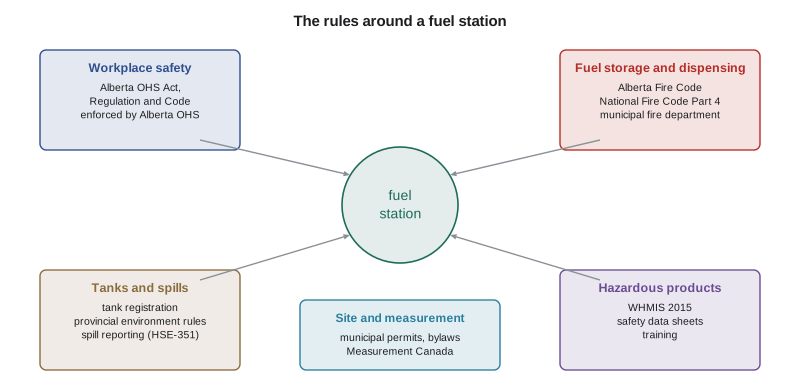
A fuel station sits where several sets of rules meet. Occupational health and safety law protects the workers. Fire codes control how fuel is stored and dispensed, and where the emergency shut-off goes. Environmental law controls the tanks and what happens when fuel escapes. Local bylaws and permits cover the site itself. Weights and measures rules make sure the pumps are honest. A cashier does not need to know every clause, but they should know which rules shape their job, who enforces them, and what their own duties and rights are. This lesson maps those rules for Northfield Fuel and Market.
None of the clause references in this lesson replace the current text of the law. Codes are updated every few years and local governments adopt them with changes, so the site's owner and manager should always check the edition that applies to them.
Occupational health and safety
In Alberta, the Occupational Health and Safety Act, Regulation and Code apply to Northfield Fuel and Market. The Act sets out the duties of employers, supervisors and workers, including the employer's duty to ensure the health and safety of workers so far as reasonably practicable, to assess hazards and control them, and to provide training. Workers have the right to know the hazards of their work, the right to participate through a health and safety committee or representative, and the right to refuse dangerous work without reprisal. The Code has detailed requirements on hazard assessment, chemical hazards and exposure limits, working alone, violence and harassment, first aid and personal protective equipment. Alberta Occupational Health and Safety enforces them.
Alberta also requires a written hazard assessment for each job, a joint health and safety committee at workplaces with 20 or more workers, or a health and safety representative at workplaces with 5 to 19 workers, and specific controls for people who work alone. With 18 workers, Northfield needs a representative; Raj fills that role.
Fire codes: the rules for fuel
The rules for how fuel is stored and dispensed come from the fire code. Most provinces base their fire codes on the National Fire Code of Canada, whose Part 4 covers flammable and combustible liquids and includes a section on fuel-dispensing stations. Alberta adopts it as the Alberta Fire Code, and the municipality's fire department, here Red Deer's fire prevention staff, inspects and enforces it. The fire code covers dispenser location and protection, the emergency shut-off, hoses and nozzles, attended and unattended self-service, filling of portable containers, smoking and ignition sources, signs, fire extinguishers and storage tanks. In some provinces a technical safety authority also has a role: in Ontario, for example, retail fuel outlets are licensed and inspected by the Technical Standards and Safety Authority under its Liquid Fuels Handling Code.
Two fire code requirements matter to the cashier every shift. The first is the emergency shut-off: a clearly marked switch that stops all the dispensers at once, placed where the attendant can reach it but at a safe distance from the pumps. Lesson 7 covers its placement and use. The second is the rule for attended self-service: the code requires a trained attendant on duty who can see the dispensers, communicate with customers and operate the emergency shut-off. The attendant must also be able to control the pumps, so that a pump is not left running for someone doing something dangerous.
Tanks, spills and the environment
Underground and aboveground fuel tanks are regulated to prevent leaks into soil and groundwater. In Alberta, retail fuel tanks are registered with the Petroleum Tank Management Association of Alberta, and installation, leak detection, overfill protection, record keeping and removal follow the fire code and provincial requirements. Federal rules under the Canadian Environmental Protection Act apply only to tanks on federal land or owned by the federal government. Spills that reach soil, water or drains must be reported to the province. HSE-351 covers tanks, leak detection and spill reporting in detail; this course covers what the cashier needs to know about deliveries and overfills.
A note on operator training: Alberta does not use the US system of Class A, B and C tank operators, but the fire code and tank rules still expect site staff to know how to respond to alarms, spills and overfills. Northfield trains every cashier on the tank alarm panel and the spill kit as part of orientation.
Chemical hazards: fuel as a hazardous product
Gasoline and diesel are hazardous products under WHMIS 2015. The station must have current safety data sheets for each fuel and for the store's other hazardous products, such as windshield washer fluid, motor oil, antifreeze, propane and cleaning chemicals, and workers must be trained on the hazards and the precautions. Fuel pumped into a customer's vehicle is a consumer transaction, but the employer still has to protect workers from exposure to the fuel during spills, deliveries and maintenance (Lesson 4).
Who is responsible for what
Several parties share responsibility at a fuel station, and the boundaries matter when something goes wrong.
| Party | Main responsibilities |
|---|---|
| Owner or operator (the company) | Equipment in safe condition and inspected, tanks registered and tested, procedures, training, enough staff, emergency plans, records |
| Manager and supervisors | Make sure procedures are followed, train and supervise workers, check the forecourt, fix or report hazards, investigate incidents |
| Cashiers and attendants | Follow procedures, watch and control the pumps, respond to spills and emergencies, report hazards, use PPE |
| Fuel hauler and driver | Safe delivery: truck, hoses, bonding, connecting to the right tank, staying with the delivery, cleaning up spills from the delivery |
| Maintenance contractors | Safe work on dispensers, tanks and electrical systems, permits for hot work and tank work, isolating equipment |
| Customers | Follow the posted rules: engine off, no smoking, stay outside the vehicle, approved containers on the ground |
Customers do not work for the station, but the station is responsible for what happens on its property. The cashier cannot force a customer to follow the rules, but can refuse to authorize a pump, stop a pump, ask a customer to stop doing something dangerous, and call the police or fire department. Posted signs, such as no smoking, turn off engine and no filling of unapproved containers, are required by fire codes and also give the cashier something to point to.
Contractors who work on dispensers, tanks or electrical equipment are employers in their own right under Alberta law, but the station still has duties to coordinate with them, tell them about site hazards and make sure their work does not endanger workers or customers. Hot work, such as welding or cutting near fuel, needs a permit and special precautions; HSE-333 covers permit-to-work systems.
Your rights as a worker
Whatever the jurisdiction, workers at a fuel station have the same core rights. You have the right to know the hazards of your job and to be trained before you face them, which at a station means knowing the fuels, the emergency shut-off, the spill kit and what to do in a robbery before your first shift alone. You have the right to raise safety concerns and to take part in fixing them, through the safety representative, committee or meeting. And you have the right to refuse or stop work you reasonably believe is dangerous, such as being asked to clean up a large spill without training or to keep the pumps running while vapour is spreading toward a drain, without being punished for it. Use these rights by speaking up early, to your manager first; most problems at a small station are fixed in a conversation.
Workers also have duties. Follow the procedures you have been trained on, use the equipment and protective gear provided, report hazards and injuries, and do not put yourself or others at risk. A cashier who sees a hose leaking and says nothing because it is nearly the end of the shift has not met that duty, however busy the night has been.
Records the station keeps
A small station generates a surprising number of safety records, and inspectors ask for them. The program below is Leah's checklist of required and recommended records, with how often each is updated, and flags anything overdue as of an inspection date. The list and intervals are typical examples for a station like Northfield, not a legal checklist for any one place.
# Check safety records against their review intervals (illustrative list and dates).
from datetime import date
today = date(2026, 10, 15)
records = [  # name, last updated, interval in days
    ("tank inventory reconciliation", date(2026, 10, 14), 1),
    ("leak detection test results", date(2026, 9, 30), 31),
    ("fire extinguisher monthly check", date(2026, 9, 2), 31),
    ("emergency shut-off test", date(2026, 8, 10), 92),
    ("staff training records", date(2026, 6, 1), 365),
    ("safety data sheets reviewed", date(2025, 8, 20), 365),
    ("emergency plan reviewed", date(2026, 2, 1), 365),
    ("spill kit inventory", date(2026, 10, 1), 31),
]
for name, last, days in records:
    age = (today - last).days
    status = "OVERDUE" if age > days else "ok"
    print(f"{name:34}{age:>5} days old  (every {days:>3})  {status}")
print("Overdue:", sum(1 for _, last, d in records if (today - last).days > d))tank inventory reconciliation 1 days old (every 1) ok leak detection test results 15 days old (every 31) ok fire extinguisher monthly check 43 days old (every 31) OVERDUE emergency shut-off test 66 days old (every 92) ok staff training records 136 days old (every 365) ok safety data sheets reviewed 421 days old (every 365) OVERDUE emergency plan reviewed 256 days old (every 365) ok spill kit inventory 14 days old (every 31) ok Overdue: 2
Two records are overdue. The fire extinguisher monthly check is 43 days old, so one monthly inspection was missed, and the safety data sheet review is more than a year old, so the sheets may be out of date. Neither is dramatic, but both are the kind of finding an inspector writes up, and both are easy to fix. Leah moves the extinguisher check onto the opening checklist so it is not forgotten.
For supervisors: know who to call
Post a short list beside the till: 911 for fire, injury or a major spill; the fuel company's emergency line; the tank and dispenser service contractor; the provincial spill reporting line; the manager's phone; and Alberta OHS for serious injuries, which must be reported. A cashier alone at night should never have to search for a number.
Worked problem
Who is responsible?
During a delivery, Mike the driver connects the hose, then goes to sit in his cab while the tank fills. Ben, the cashier, sees fuel starting to pool around the fill port. Who is responsible for what?
Show solution
- The driver is responsible for staying with the delivery and watching it; leaving the hose is a breach of the hauler's procedure and of safe practice.
- Ben's first job is to stop the spill growing: alert the driver at once, or use the truck's emergency stop if trained to, and stop customer traffic near the spill.
- Ben should not let customers keep fuelling near the spill, and may need to stop the dispensers with the emergency shut-off if vapour or fuel reaches them.
- The driver cleans up the delivery spill with the truck's spill kit and the station's; both report it to their own managers.
- Leah reports the spill if it meets the reporting threshold, records it, and raises the driver's conduct with the hauler.
Answer: The driver should have stayed with the delivery and must clean up and report; Ben protects people and stops the spill growing; Leah reports and follows up with the hauler. Responsibilities are shared, but everyone acts.
Common mistakes
MistakeAssuming the fuel hauler is responsible for everything during a delivery.
InsteadThe station still controls its forecourt and must protect workers and customers.
MistakeThinking customers are not the station's concern because they are not employees.
InsteadThe station is responsible for safety on its property and can stop pumps and refuse service.
MistakeUsing an old copy of the fire code.
InsteadCheck which edition the local fire department enforces.
MistakeLetting record checks slide because nothing has happened.
InsteadPut routine checks on the opening or weekly checklist so they are not missed.
MistakeLeaving emergency numbers in the manager's office.
InsteadPost them at the till where the cashier on duty can see them.
Summary and key terms
- Alberta OHS law, the Alberta Fire Code, tank and environmental rules, WHMIS and local bylaws all apply to a station.
- The fire code sets the rules for dispensers, the emergency shut-off, attended self-service and portable containers.
- Tanks are registered and regulated to prevent leaks; spills must be reported to the province.
- Fuels are hazardous products, so SDS and training are required.
- Owners, managers, cashiers, drivers, contractors and customers share responsibility, but the station controls its site.
- Keep routine records current and post emergency numbers at the till.
- Fire code
- The adopted code that sets fire safety rules for buildings and operations, including fuel storage and dispensing.
- Authority having jurisdiction
- The body that enforces a code locally, usually the fire department.
- Attended self-service
- Self-service fuelling supervised by a trained attendant who can control the pumps.
- Safety data sheet (SDS)
- A document describing a hazardous product's hazards and safe handling.
- Class C operator
- In US tank rules, an employee on site trained to respond to alarms and emergencies.
- Hot work
- Welding, cutting, grinding or other work that can ignite flammable materials.
Practice problems
Work each problem on paper first, then reveal the answer to check.
Name four sets of rules that apply to a fuel station.
Show answer
Any four of: OHS law, fire code, tank and environmental rules, hazard communication, local permits and bylaws, weights and measures.
Who usually enforces the fire code at a fuel station?
Show answer
The local fire department, as the authority having jurisdiction.
What must an attendant at a self-serve station be able to do under the fire code?
Show answer
See the dispensers, communicate with customers, control the pumps and operate the emergency shut-off.
Why must a station have safety data sheets for gasoline and diesel?
Show answer
They are hazardous products and workers must be informed and trained.
What is the fuel driver responsible for during a delivery?
Show answer
A safe delivery: equipment, bonding, the right tank, staying with the delivery and cleaning up delivery spills.
What can a cashier do about a customer breaking forecourt rules?
Show answer
Refuse or stop the pump, ask them to stop, and call police or the fire department if needed.
Name two records an inspector may ask a station for.
Show answer
Any two of: tank inventory and leak detection, extinguisher checks, shut-off tests, training records, SDS, emergency plan.
Why post emergency numbers at the till?
Show answer
So the cashier on duty, possibly alone, can call quickly without searching.
Lesson quiz · 5 questions
Score 60% or more to complete this lesson.
Create a free account to save your progress, take quizzes and earn a certificate.