
HSE-331 · Lesson 8 of 12 · 28 min
Well control basics for every worker
A blowout is the uncontrolled flow of formation fluids from a well. It is the event every drilling crew trains to prevent, because a blowout can kill the people on the floor in seconds, ignite into a fire that destroys the rig, release toxic gas over a wide area and take weeks to bring under control. Well control is the set of equipment, practices and skills that keep formation fluids in the rock or, if they enter the well, circulate them out safely. Detailed well control is the job of drillers, rig managers and well site supervisors, who hold the certificates discussed in Lesson 3. But every worker on a lease needs to understand the basics: what pressures are involved, how a kick shows itself, what happens when the well is shut in and what to do when the alarm sounds. This lesson gives that awareness level of knowledge. It is not a well control course and does not qualify anyone to operate well control equipment.
Pressure in the well
Rock deep underground holds fluids, water, oil and gas, under pressure, called formation pressure or pore pressure. In most areas formation pressure increases with depth at about the rate of a column of salt water, called normal pressure. Some zones are overpressured, holding fluids at higher pressure than a water column would, and some are underpressured or depleted.
The drilling fluid in the well exerts hydrostatic pressure on the bottom of the hole and on every formation it passes. Hydrostatic pressure depends only on the fluid's density and the true vertical depth, not on the hole's diameter or the measured length of a horizontal section. As long as the hydrostatic pressure of the mud is greater than the formation pressure at every depth, formation fluids stay in the rock. That margin is the primary barrier of well control. If the mud is too heavy, however, it can fracture weaker formations and be lost into the rock, which reduces the column and can let a kick in elsewhere. The driller and mud engineer therefore keep the mud weight within a window between formation pressure and fracture pressure.
# Hydrostatic pressure in SI units: P (kPa) = 0.00981 x density (kg/m3) x TVD (m)
tvd = 2900.0                     # m, Pinecrest Montney wells (invented)
formation_gradient = 11.3        # kPa/m, slightly overpressured (illustrative)
formation_p = formation_gradient * tvd

for density in (1080, 1150, 1200, 1250):
    hydro = 0.00981 * density * tvd
    margin = hydro - formation_p
    state = "overbalanced" if margin > 0 else "UNDERBALANCED - kick possible"
    print(f"Mud {density} kg/m3: hydrostatic {hydro:,.0f} kPa, "
          f"formation {formation_p:,.0f} kPa, margin {margin:+,.0f} kPa  {state}")

# Swabbing: pulling pipe fast can reduce bottom-hole pressure.
swab_loss = 1500                 # kPa, illustrative
hydro = 0.00981 * 1200 * tvd
print(f"With 1200 kg/m3 mud and {swab_loss} kPa swab: margin {hydro - swab_loss - formation_p:+,.0f} kPa")Mud 1080 kg/m3: hydrostatic 30,725 kPa, formation 32,770 kPa, margin -2,045 kPa UNDERBALANCED - kick possible Mud 1150 kg/m3: hydrostatic 32,716 kPa, formation 32,770 kPa, margin -54 kPa UNDERBALANCED - kick possible Mud 1200 kg/m3: hydrostatic 34,139 kPa, formation 32,770 kPa, margin +1,369 kPa overbalanced Mud 1250 kg/m3: hydrostatic 35,561 kPa, formation 32,770 kPa, margin +2,791 kPa overbalanced With 1200 kg/m3 mud and 1500 kPa swab: margin -131 kPa
The program shows how narrow the margin can be. The two lightest muds are underbalanced, the second only barely, and would let formation fluid in. The two heavier muds are overbalanced, but pulling pipe too fast can swab the well, reducing bottom-hole pressure enough to wipe out the margin of an otherwise safe mud weight. Real wells are planned by engineers using measured data; these numbers are illustrative.
How kicks happen
A kick occurs when formation pressure exceeds the pressure in the wellbore at some depth. The common causes are well known:
- Insufficient mud weight for the formation being drilled, often when drilling into an unexpected overpressured zone.
- Failing to keep the hole full during a trip, so that the mud level drops and hydrostatic pressure falls.
- Swabbing, where pulling pipe too fast reduces pressure below the bit.
- Lost circulation, where mud is lost into a weak or fractured zone and the column drops.
- Gas-cut mud, where gas entering the mud reduces its density.
- Drilling into an adjacent well or a zone charged by injection or a nearby fracture, a growing concern on multi-well pads.
On pads where neighbouring wells have already been fractured, pressure communication between wells, sometimes called frac hits or well interference, can raise pressure in a well being drilled or serviced. Operators coordinate drilling and completion schedules on a pad and monitor offset wells to manage this risk.
Kick warning signs
The earlier a kick is detected, the smaller it is and the easier it is to control. The crew watches for warning signs, and modern rigs have alarms on many of them.
| Sign | What it means | Who usually notices |
|---|---|---|
| Pit gain (increase in active tank volume) | Fluid is entering the well and pushing mud out | Driller (pit volume totalizer), derrickhand at the tanks |
| Increase in flow rate out of the well | More fluid is coming out than is being pumped in | Driller (flow sensor) |
| Well flowing with the pumps off | The well is taking a kick or is unbalanced | Driller and floor crew during a flow check |
| Drilling break (sudden faster penetration) | May indicate a porous or overpressured zone | Driller |
| Decrease in pump pressure with increase in pump speed | Lighter fluid is in the annulus | Driller |
| Gas-cut mud or rising gas readings | Gas is entering the mud | Mud logger, derrickhand at the shakers |
| Hole not taking the right volume of mud during a trip | Formation fluid has replaced mud in the hole | Driller and derrickhand using the trip tank |
The trip tank deserves special mention. During a trip out, the hole must be filled with a volume of mud equal to the steel volume of pipe removed; during a trip in, the hole should return the same volume. A small, calibrated trip tank lets the crew measure these volumes accurately. If the hole takes less mud than expected on a trip out, or returns more than expected on a trip in, fluid from the formation may be entering the well. Keeping an accurate trip sheet is one of the simplest and most effective well control practices.
Shutting in the well
When the driller suspects a kick, the first step is usually a flow check: stop the pumps, pick the pipe off bottom and watch whether the well flows. If it does, or if the signs are clear, the driller shuts the well in using the blowout preventers according to the rig's shut-in procedure. Each rig has a written procedure, practised in drills, that sets out exactly which preventer is closed and which valves are opened or closed. Once the well is shut in, the crew records the shut-in pressures on the drill pipe and casing gauges and the pit gain. These numbers tell the well site supervisor and driller how strong the kick is and what mud weight is needed to kill it.
Killing the well means circulating the kick out through the choke manifold while controlling bottom-hole pressure, then circulating in heavier mud until the well is balanced again. Methods such as the driller's method and the wait-and-weight method are taught in well control courses and are carried out under the direction of certified supervisors. During a kill, gas reaching surface passes through the choke manifold and the mud-gas separator to the flare, and the area around the choke manifold, separator and flare lines is hazardous. Workers not directly involved should stay clear and follow the supervisor's instructions.
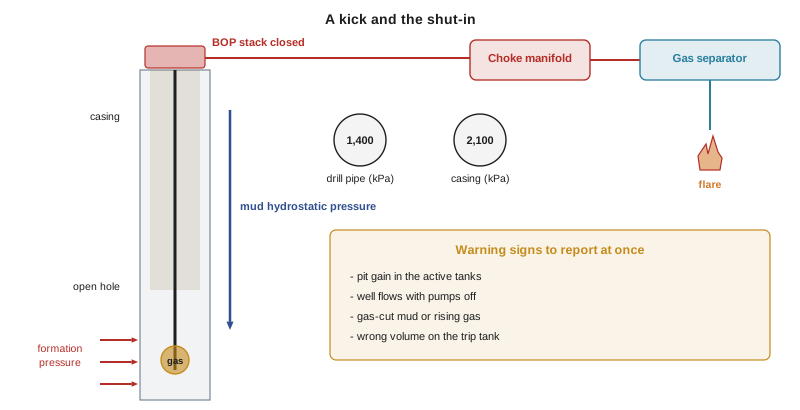
The accumulator
The blowout preventers are closed by hydraulic fluid from the accumulator unit. The accumulator must hold enough usable fluid to close the preventers and open the hydraulic choke line valve, with a safety margin, even if the pumps that recharge it fail. The usable volume depends on the nitrogen precharge pressure, the charged pressure and the minimum pressure needed to keep the preventers closed. The program below applies Boyle's law to an invented accumulator with illustrative pressures. It is a simplified teaching calculation; real sizing follows the energy regulator's requirements and API Standard 53 methods.
# Simplified accumulator usable volume using Boyle's law (P1 V1 = P2 V2).
# Pressures in kPa absolute (illustrative); volumes in L.
bottle_volume = 40.0            # L per bottle (nitrogen + fluid)
n_bottles = 16
precharge = 7_000 + 101         # nitrogen precharge, absolute
charged = 21_000 + 101          # fully charged operating pressure, absolute
minimum = 8_400 + 101           # minimum pressure to keep preventers closed, absolute

gas_at_charged = bottle_volume * precharge / charged
gas_at_minimum = bottle_volume * precharge / minimum
usable_per_bottle = gas_at_minimum - gas_at_charged
usable_total = usable_per_bottle * n_bottles

close_volume_needed = 150.0     # L to close annular + rams + open HCR (illustrative)
print(f"Usable fluid per bottle: {usable_per_bottle:.1f} L")
print(f"Usable fluid, {n_bottles} bottles: {usable_total:.0f} L")
print(f"Volume needed with 50 percent margin: {close_volume_needed * 1.5:.0f} L")
print("Adequate" if usable_total >= close_volume_needed * 1.5 else "Not adequate")Usable fluid per bottle: 20.0 L Usable fluid, 16 bottles: 319 L Volume needed with 50 percent margin: 225 L Adequate
Only a fraction of each bottle's volume is usable, because the nitrogen must stay above the minimum operating pressure. That is why accumulators have many bottles and why precharge pressures are checked regularly: a bottle with a low precharge delivers much less usable fluid. Accumulator checks and drawdown tests are part of the routine BOP testing that the energy regulator requires.
Drills and every worker's role
Rigs practise well control through drills: pit drills, trip drills, choke drills and, on sour wells, H2S drills combined with well control. A drill tests whether the crew recognizes the signs, the driller shuts in the well within the expected time and everyone else does their part. Regulators and operators set requirements for how often drills are done and recorded.
Every worker on the lease has a role even if they never touch the controls. Report any warning sign to the driller immediately, whether it is a gain in the tanks, gas at the shakers, mud flowing from the bell nipple when the pumps are off or the smell of gas. Know the alarm signals and what they mean. When the well control or H2S alarm sounds, stop work, put on breathing apparatus if trained and required, and go to the muster point or your assigned station as the emergency plan directs. Do not go towards the well to look. Service workers on the lease should be told at orientation what the alarms sound like and where to go.
Lessons from blowouts
The Lodgepole blowout in Alberta is a defining event for Canadian sour gas regulation. On 17 October 1982, an exploratory sour gas well owned by Amoco Canada, about 18 km west of the hamlet of Lodgepole, blew out. The well flowed for 68 days before it was capped on 23 December. Two workers were killed while trying to bring the well under control, others were hospitalized, residents were evacuated and odours were reported hundreds of kilometres away. The Energy Resources Conservation Board inquiry found poor drilling practices and inadequately maintained equipment, and its 39 recommendations on training, equipment, drilling rules and emergency planning shaped today's sour well requirements and well control training. Offshore, the 2010 Deepwater Horizon blowout in the US Gulf of Mexico killed 11 workers and showed how misread test results, normalized warning signs and failed barriers can combine; it led to new well control rules and safety management requirements in the United States and influenced practice worldwide.
Both events show that blowouts rarely have a single cause. Early signs are usually present, barriers usually degrade before they fail and people usually have the chance to stop. A crew that reports every sign, trusts its instruments and is willing to shut in and check is the most important well control equipment on any rig.
Worked problem
Gas at the shakers on Pinecrest Well 10
While drilling the horizontal section of Pinecrest Well 10, the derrickhand notices the gas detector at the shakers reading higher than usual and mud foaming over the screens. A few minutes later the H2S monitor on his chest alarms at the low set point. What should he do?
Show solution
- Move away from the shakers, upwind if possible, following the rig's H2S response procedure.
- Tell the driller immediately by radio or the agreed signal: rising gas, gas-cut mud and an H2S alarm at the shakers.
- The driller should treat this as a possible kick, stop drilling, flow check and, if the well flows, shut in according to the procedure.
- If the H2S level continues to rise or the evacuation alarm sounds, crew members put on breathing apparatus as trained and go to their assigned stations or the upwind muster point.
- Nobody returns to the shakers until the supervisor confirms that gas levels are safe.
Answer: The derrickhand protects himself, reports immediately and lets the driller act on the warning signs. Gas-cut mud with rising gas and H2S can be an early sign of a kick, and early reporting keeps it small.
Common mistakes
MistakeAssuming a small pit gain is just a measurement error.
InsteadReport every unexplained gain to the driller; let the driller flow check.
MistakePulling pipe as fast as possible to save time.
InsteadFollow trip speed limits; fast pulling can swab the well.
MistakeNot filling the hole during a trip out.
InsteadKeep the hole full and record volumes on the trip sheet.
MistakeWalking towards the well to see what is happening during a kick.
InsteadGo to your assigned station or muster point as the emergency plan directs.
MistakeThinking well control is only the driller's job.
InsteadKnow the warning signs and alarms, and report anything unusual immediately.
Summary and key terms
- Formation fluids are held in the rock by the hydrostatic pressure of the mud, which depends on density and true vertical depth.
- Mud weight must stay between formation pressure and fracture pressure.
- Kicks are caused by low mud weight, failing to fill the hole, swabbing, lost circulation, gas-cut mud and communication with other wells.
- Pit gains, flow with the pumps off, drilling breaks, pump pressure changes, gas-cut mud and incorrect trip volumes warn of kicks.
- The driller shuts in the well with the BOP stack, and certified supervisors direct the kill through the choke manifold.
- The accumulator must hold enough usable fluid to close the preventers, which depends on precharge and pressures.
- Drills, early reporting and a willingness to shut in and check are the most important defences; Lodgepole and Macondo show what happens when barriers fail.
- Blowout
- An uncontrolled flow of formation fluids from a well.
- Formation pressure
- The pressure of fluids in the pores of the rock.
- Hydrostatic pressure
- The pressure exerted by a column of fluid, set by its density and vertical height.
- Swabbing
- A reduction in bottom-hole pressure caused by pulling pipe upward.
- Pit gain
- An increase in the volume of drilling fluid in the active tanks.
- Trip tank
- A small, calibrated tank used to measure the volume of mud needed to keep the hole full during trips.
- Shut-in
- Closing the blowout preventers to stop flow from the well.
- Kill
- Circulating a kick out and replacing the mud with fluid heavy enough to balance formation pressure.
Practice problems
Work each problem on paper first, then reveal the answer to check.
What is the primary barrier of well control?
Show answer
The hydrostatic pressure of the drilling fluid.
Which two factors determine hydrostatic pressure?
Show answer
Fluid density and true vertical depth.
Why can mud that is too heavy cause a problem?
Show answer
It can fracture weak formations, causing lost circulation and a drop in the column.
Name three causes of kicks.
Show answer
Any three of: low mud weight, not filling the hole, swabbing, lost circulation, gas-cut mud, communication with other wells.
What is a pit gain?
Show answer
An increase in active tank volume, suggesting fluid is entering the well.
Why is the trip tank important?
Show answer
It measures whether the hole takes or returns the right volume of mud during trips.
What should a floorhand do if he sees mud flowing from the bell nipple with the pumps off?
Show answer
Tell the driller immediately.
Why is only part of an accumulator bottle's volume usable?
Show answer
The nitrogen must stay above the minimum pressure needed to keep the preventers closed.
How long did the Lodgepole well flow before it was capped?
Show answer
68 days.
What should workers not involved in a kill do?
Show answer
Stay clear of the choke manifold, separator and flare lines and follow the emergency plan.
Lesson quiz · 5 questions
Score 60% or more to complete this lesson.
Create a free account to save your progress, take quizzes and earn a certificate.