
HSE-331 · Lesson 5 of 12 · 25 min
Working at height and dropped objects
A drilling mast towers 30 to 50 m (100 to 165 ft) above the rig floor, and people work at many levels on it: the derrickhand on the monkeyboard during trips, crew members on the stabbing board when running casing, mechanics at the crown, and workers on the mud tanks, the pipe racks and the top of the substructure. Everything that goes up the mast can also come down: tools, bolts, pins, ice, a hand radio, a piece of a sheave guard. Falls from height and dropped objects are two sides of the same hazard. This lesson covers both on rigs and service units, building on the general fall protection principles taught in HSE-212.
Where rig crews work at height
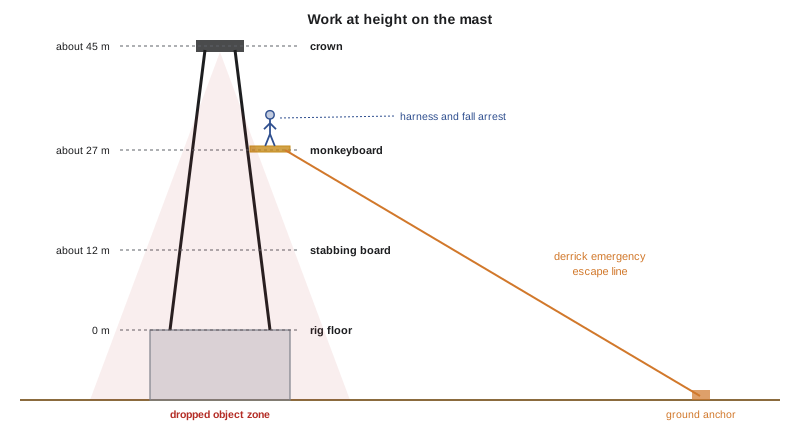
The monkeyboard, or racking board, is a platform partway up the mast, at the height of the top of a stand. During a trip out, the derrickhand leans out from the monkeyboard, unlatches the elevators from the top of each stand and guides the stand into the fingers of the racking board; during a trip in, the process runs in reverse. On a triple rig, the monkeyboard is about 27 m (90 ft) above the floor. The derrickhand may work there for hours at a stretch, in wind, rain, snow and darkness, leaning over open space while a heavy block moves within reach. It is one of the most exposed jobs in the industry.
Other elevated work positions include the stabbing board, which a casing crew member uses to guide casing joints into the elevators; the crown platform at the top of the mast, used for inspection and maintenance of the crown block; the top drive maintenance platforms; ladders and stairs to the floor and the mud tanks; the tops of mud tanks, pipe tubs and storage tanks; and the mast itself during rig-up and rig-down. On service rigs, the derrickhand works on a smaller board on a lower mast, and on snubbing units workers stand in a basket above the wellhead.
Fall protection on the mast
Fall protection on a rig follows the same hierarchy as anywhere else: eliminate the need to work at height where possible, use guardrails and enclosed platforms, use travel restraint so a worker cannot reach an edge, and use fall arrest only where the other controls are not practicable. On rigs, elimination has made real progress: pipe-handling systems and automated racking let some rigs trip without a derrickhand on the board at all. Where people still climb, the core equipment is the same as in HSE-212: a full-body harness, a connecting device and a suitable anchor, with a rescue plan.
Climbing the mast is done on a fixed ladder with a ladder climbing assist or a fall arrest system, usually a self-retracting lifeline or a rail or cable sleeve system that moves with the climber. Workers must be connected at all times while climbing. Climbing a mast ladder without fall protection, or with a lanyard hooked over a rung, is never acceptable. On the monkeyboard, the derrickhand is usually connected to a fall arrest line or a positioning system that holds them on the board while leaning out to work; the system must be adjusted so that a slip results in a short fall or no fall, not a long drop onto steel. At the crown and on other platforms, guardrails and anchor points provide protection.
Several hazards are specific to rig work. Fall arrest lines can be caught by the moving travelling block or the top drive. Wet, icy or mud-covered steel increases slip risk. A worker who falls and is caught by a harness must be rescued quickly, because suspension in a harness can cause serious harm within minutes, as HSE-212 explains. Rescue from a monkeyboard 27 m up is a difficult job, so rigs must have a written rescue plan, trained people and the equipment to carry it out, which may include a rescue descent device or a pre-rigged system.
Derrick emergency escape
If a fire, blowout or gas release reaches the rig floor while the derrickhand is on the monkeyboard, climbing down the ladder may mean climbing into the danger. Rigs therefore provide a derrick emergency escape device, often called a Geronimo line: a cable running from the monkeyboard at an angle to a ground anchor some distance from the rig, with a trolley and a controlled descent device that lets the derrickhand ride down the line, clear of the floor. The escape line must be installed and tensioned correctly at every rig-up, the ground anchor must be clear of equipment and traffic, the trolley and brake must be inspected, and the derrickhand must be trained in its use. In winter, ice and snow can affect the trolley, so inspection and testing before each trip matter. Some regulators specify requirements for derrick emergency escape devices, and drilling contractors follow manufacturer instructions and industry guidance for their installation and inspection.
Dropped objects
A dropped object is any object that falls from its previous position, either under gravity alone (a static drop, such as a bolt that vibrates loose) or because something moving strikes it (a dynamic drop, such as a sheave guard knocked off by the travelling block). Dropped objects are one of the leading causes of serious injuries and fatalities in drilling, onshore and offshore. Even small objects become dangerous from height: a 1 kg (2.2 lb) tool falling from the monkeyboard reaches the floor at roughly 23 m/s (51 mph).
Industry's response has been led by the DROPS workgroup, an international, cross-industry initiative that publishes free guidance, reliable securing practices and a widely used DROPS calculator. The calculator classifies the potential consequence of a dropped object by its mass and the height it could fall, from slight injury through medical treatment and lost time to a fatality. The program below shows the physics behind it: impact energy grows with both mass and height. The consequence bands in the program are illustrative teaching values only, not the published DROPS calculator chart, which should be used for real assessments.
import math

g = 9.81
def impact(mass_kg, height_m):
    energy_J = mass_kg * g * height_m
    speed = math.sqrt(2 * g * height_m)
    return energy_J, speed

# Illustrative teaching bands only (NOT the published DROPS chart).
def band(energy_J):
    if energy_J < 40:
        return "minor"
    if energy_J < 100:
        return "medical treatment"
    if energy_J < 300:
        return "lost time / serious"
    return "potentially fatal"

objects = [("Bolt",            0.10, 27), ("Hammer",          1.0, 27),
           ("Hand radio",      0.35, 45), ("Sheave guard pin", 0.5, 45),
           ("Ice chunk",       2.0, 30),  ("Slip insert",      0.8, 6)]
for name, m, h in objects:
    E, v = impact(m, h)
print(f"{name:17} {m:4.2f} kg from {h:2d} m: {E:6.0f} J at {v:4.1f} m/s -> {band(E)}")Bolt 0.10 kg from 27 m: 26 J at 23.0 m/s -> minor Hammer 1.00 kg from 27 m: 265 J at 23.0 m/s -> lost time / serious Hand radio 0.35 kg from 45 m: 155 J at 29.7 m/s -> lost time / serious Sheave guard pin 0.50 kg from 45 m: 221 J at 29.7 m/s -> lost time / serious Ice chunk 2.00 kg from 30 m: 589 J at 24.3 m/s -> potentially fatal Slip insert 0.80 kg from 6 m: 47 J at 10.8 m/s -> medical treatment
Even a 100 g (0.22 lb) bolt falling from the monkeyboard carries over 25 J, and a hammer from the same height carries over 250 J, enough to cause serious injury even to a worker wearing a hard hat. Hard hats are designed to reduce the effect of small impacts; they are not a substitute for preventing the drop.
Controlling dropped objects
Dropped object prevention combines engineering, inspection and behaviour.
| Control | Examples on a rig |
|---|---|
| Secondary retention | Safety slings and nets on lights, cameras, sheaves and guards; cotter pins and lock wire on fasteners; safety cables on the top drive and blocks |
| Tool tethering | Lanyards for hand tools used at height; tool bags and buckets with closures; tethered radios |
| Inspection | Regular dropped object surveys of the mast and top drive, especially after rig moves, high winds, collisions and jarring |
| Barricades and red zones | Keeping people out of the area under work at height and under the mast during raising, lowering and lifts |
| Design and housekeeping | Removing loose items from platforms, toe boards on elevated platforms, limiting what is taken up the mast |
| Winter controls | Removing ice and snow from the mast and equipment before people work beneath; heat tracing where practicable |
| Reporting | Reporting every dropped object, even with no injury, so that causes are found and fixed |
A dropped object survey is a systematic inspection of everything at height, often done by a trained person with a checklist, binoculars and access to the mast. Surveys are especially important after rig moves, because raising and lowering the mast, transport vibration and contact with power lines or other equipment can loosen fixtures. Collisions between the travelling block or top drive and other equipment in the mast, such as racking boards, are a common cause of dynamic drops, and many rigs use anti-collision systems that stop the blocks before contact.
Other falls on the lease
Not every fall is from the mast. Workers fall from the tops of mud tanks while mixing chemicals or checking levels, from pipe racks and tubs while handling pipe, from truck decks while loading and unloading, from ladders and stairs, and on the same level on mud, ice and uneven ground. Mud tanks should have guardrails and grating; pipe racks should be designed so workers do not need to walk on rolling pipe; and loading should use platforms or fall protection where workers must work on deck. The general controls from HSE-212, HSE-213 and HSE-106 apply.
Worked problem
Planning a derrick inspection after a windstorm
A windstorm with gusts above 80 km/h (50 mph) shuts down Rig 31 for a night. In the morning, the rig manager wants to resume tripping. What should happen first?
Show solution
- Keep people out of the area under the mast until it has been checked.
- Have a trained person carry out a dropped object survey of the mast, racking board, crown, top drive and lights, looking for loose, damaged or displaced items.
- Check the derrick emergency escape line, its tension, its ground anchor and the trolley, which may have been affected by the wind.
- Check fall arrest lines and anchors on the monkeyboard and ladder.
- Confirm that wind speeds are now within the rig's limits for work on the monkeyboard, and record the results before the derrickhand climbs.
Answer: Before tripping resumes, the area under the mast stays clear, a dropped object survey and checks of escape and fall arrest equipment are completed, and wind speed is confirmed to be within limits.
Common mistakes
MistakeClimbing the mast ladder unclipped for a quick job at the monkeyboard.
InsteadStay connected to a fall arrest system for every climb, however short the job.
MistakeTreating the derrick escape line as equipment that only matters in a blowout.
InsteadInspect and test it at every rig-up and before trips, especially in winter.
MistakeTaking loose tools up the mast in a pocket.
InsteadTether tools and use closed tool bags at height.
MistakeRelying on a hard hat to protect against objects falling from the mast.
InsteadPrevent drops with secondary retention and keep people out of the drop zone.
MistakeResuming work under the mast after a storm or rig move without checking it.
InsteadCarry out a dropped object survey first.
Summary and key terms
- The derrickhand on the monkeyboard, casing crews on the stabbing board and workers at the crown and on tanks all work at height.
- Fall protection uses guardrails, restraint and fall arrest with full-body harnesses, connected at all times while climbing.
- A rescue plan is essential because a worker suspended in a harness must be rescued quickly.
- The derrick emergency escape line lets the derrickhand leave the monkeyboard without climbing down into a fire or release.
- Dropped objects carry energy that grows with mass and height; even small items from the monkeyboard can cause serious injury.
- Secondary retention, tool tethering, surveys, barricades, winter controls and reporting prevent dropped objects.
- Falls from tanks, pipe racks, trucks and stairs, and slips on the same level, are common on leases.
- Monkeyboard
- The platform partway up the mast where the derrickhand racks stands during trips.
- Stabbing board
- An elevated platform used to guide casing joints during casing runs.
- Derrick emergency escape device
- A cable, trolley and brake that let the derrickhand descend from the monkeyboard to the ground away from the rig.
- Dropped object
- Any object that falls from its previous position, either statically or after being struck.
- Secondary retention
- A sling, net, cable or pin that prevents an item from falling if its primary fixing fails.
- Dropped object survey
- A systematic inspection of items at height for loose, damaged or poorly secured parts.
Practice problems
Work each problem on paper first, then reveal the answer to check.
Roughly how high is the monkeyboard on a triple rig?
Show answer
About 27 m (90 ft) above the floor.
What must a worker do while climbing the mast ladder?
Show answer
Stay connected to a fall arrest or climbing system at all times.
Why must a fallen worker in a harness be rescued quickly?
Show answer
Suspension in a harness can cause serious harm within minutes.
What is the purpose of a derrick emergency escape device?
Show answer
To let the derrickhand descend from the monkeyboard to a point away from the rig without climbing down through the floor.
What is the difference between a static and a dynamic drop?
Show answer
A static drop falls under gravity alone; a dynamic drop falls after being struck by something moving.
Using the program, about how much energy does a 1 kg hammer carry after falling 27 m?
Show answer
About 265 J.
Name three dropped object controls.
Show answer
Any three of: secondary retention, tool tethering, surveys, barricades, housekeeping, winter ice removal, reporting.
When should a dropped object survey be carried out?
Show answer
Regularly and after rig moves, high winds, collisions and jarring.
Why is a hard hat not enough protection against dropped objects from the mast?
Show answer
Objects from height can carry far more energy than a hard hat is designed to absorb.
Give two places on a lease other than the mast where falls occur.
Show answer
Mud tanks, pipe racks, truck decks, ladders and stairs, same-level slips (any two).
Lesson quiz · 5 questions
Score 60% or more to complete this lesson.
Create a free account to save your progress, take quizzes and earn a certificate.