
HSE-331 · Lesson 12 of 12 · 27 min
Capstone: contractors, bridging documents and a hazard review for an invented pad
Every hazard in this course plays out on a lease where several companies work side by side. The drilling contractor runs the rig, the operator owns the well, and dozens of service companies arrive and leave: mud, directional, cementing, casing, wireline, coiled tubing, fracturing, flowback, trucking, cranes and rentals. Each has its own safety program, its own procedures and its own ideas about how things should be done. When those programs conflict or leave gaps, people get hurt. This capstone lesson looks at how operators and contractors divide and coordinate responsibility on drilling and completion sites, then applies the whole course to a hazard review of the invented Pinecrest pad as it moves from drilling to completion.
Who is responsible for what
HSE-330, Lesson 10, explained Alberta's prime contractor requirement: on a work site with two or more employers, the person in control of the site, usually the licensee or operator, must designate a prime contractor in writing who coordinates health and safety among all employers. On many drilling leases the operator acts as prime contractor; on others, especially where the drilling contractor controls the rig site for long periods, the operator may designate the drilling contractor or a completions contractor as prime for a defined area and time. British Columbia and Saskatchewan have their own coordination requirements. Whatever the arrangement, each employer keeps its own duties to its workers; the prime contractor adds a duty to coordinate and to ensure that employers comply.
In practice, the most important question is not which legal label applies but whether everyone on the lease knows who is in charge of what, at each moment. When the rig is drilling, the drilling contractor's rig manager controls the rig floor and the operation of the rig, while the operator's well site supervisor controls the well program and coordinates other services. When the rig leaves and the frac crew arrives, control shifts. Moments of transition, such as rig release, the start of completions, and flowback, are when responsibility is most likely to fall through the gaps.
Bridging documents
A bridging document is a written agreement that connects two or more companies' safety management systems for a specific job or site. IADC's HSE case guidelines and many operators' contractor management programs use bridging documents to settle in advance which company's procedures apply to which activities, who approves what, and how communication and emergencies will work. A good bridging document is short enough to be read and specific enough to be useful.
| Topic | Questions the bridging document answers |
|---|---|
| Roles and authority | Who is in overall control of the site and each area? Who can stop work? Who is the prime or controlling party? |
| Procedures | Whose permit-to-work, lockout, lifting, H2S and well control procedures apply to each activity? Where they differ, which governs? |
| Communication | What meetings are held, when and with whom? Which radio channels and signals are used? |
| Emergency response | Whose emergency response plan applies? Who calls whom? Where are the muster points, and who does the headcount? |
| Simultaneous operations | Which activities may run at the same time? What triggers a stop? Who coordinates? |
| Training and competence | Which certificates are required for each role? How are short-service employees managed? |
| Incident reporting | Who reports to which regulator, and who leads investigations? |
| Change management | How are changes to the plan, equipment or people reviewed and approved? |
The program below models a simple test of a bridging document: every critical activity on the Pinecrest pad must have exactly one owning company and an agreed procedure. It flags activities with no owner, more than one owner or no procedure.
# Invented bridging matrix for the Pinecrest pad during the drilling-to-completion handover.
matrix = {
    "Rig floor operations":        {"owners": ["Northline"],             "procedure": "Northline rig manual"},
    "Well control while drilling": {"owners": ["Northline", "Larchwood"],"procedure": "Larchwood well control plan"},
    "H2S emergency response":      {"owners": ["Larchwood"],             "procedure": "Pinecrest ERP"},
    "Permit to work on pad":       {"owners": ["Larchwood"],             "procedure": "Larchwood permit system"},
    "Frac red zone control":       {"owners": ["Ridgeback"],             "procedure": "Ridgeback pumping manual"},
    "Crane lifts during rig-out":  {"owners": [],                        "procedure": ""},
    "Traffic management on pad":   {"owners": ["Larchwood"],             "procedure": ""},
    "SIMOPS coordination":         {"owners": ["Larchwood"],             "procedure": "Pinecrest SIMOPS plan"},
}
for activity, row in matrix.items():
    issues = []
    if not row["owners"]:
        issues.append("no owner")
    elif len(row["owners"]) > 1:
        issues.append("two owners: " + " and ".join(row["owners"]))
    if not row["procedure"]:
        issues.append("no procedure")
print(f"{activity:28} " + ("; ".join(issues) if issues else "ok"))Rig floor operations ok Well control while drilling two owners: Northline and Larchwood H2S emergency response ok Permit to work on pad ok Frac red zone control ok Crane lifts during rig-out no owner; no procedure Traffic management on pad no procedure SIMOPS coordination ok
Three activities need attention. Crane lifts during rig-out have no owner and no procedure, so nobody would plan or supervise them. Traffic management has an owner but no written plan. Well control while drilling lists two owners; that is not wrong in itself, because the operator owns the well control plan and the drilling contractor runs the equipment, but the bridging document should state clearly who decides what during a kick, so that nobody waits for someone else to act.
Coordination on the lease
Bridging documents set the framework; daily coordination makes it work. Effective practices on drilling and completion pads include a daily operations and safety meeting led by the operator's supervisor with all contractors present; a simple board or digital display showing who is on site, what work is under way and which permits are open; shared orientation for all workers on the lease, with contractor-specific additions; a single set of emergency signals and muster points; and a clear rule that any worker from any company can stop any job. When the plan changes, for example when a frac crew arrives early or a service rig is added, a management of change review brings the affected companies together before the change happens.
Contractor selection and oversight matter as much. Operators prequalify contractors on their safety performance and programs, often using third-party prequalification services, and then monitor performance during the job through site visits, audits, leading indicators such as hazard reports and near-miss reporting, and lagging indicators such as recordable injuries. HSE-330, Lesson 10, introduced common injury statistics. Good operators treat contractors as partners in safety rather than simply holding them to contract terms.
The Pinecrest hazard review
It is February at Pinecrest, about 60 km south of Grande Prairie. Rig 31 has drilled Wells 9 to 12 and is rigging out. Ridgeback Pressure Pumping is moving its frac spread onto the east side of the pad to begin zipper fracturing of Wells 9 and 10 while the rig is still being torn down on the west side. Wells 1 to 8 continue to produce sour gas to the battery. A pipeline crew is tying in a new flowline at the riser. Temperatures are around −25 °C at night, and the prevailing wind is from the west. Larchwood's well site supervisor asks for a hazard review of the pad for the next 72 hours.
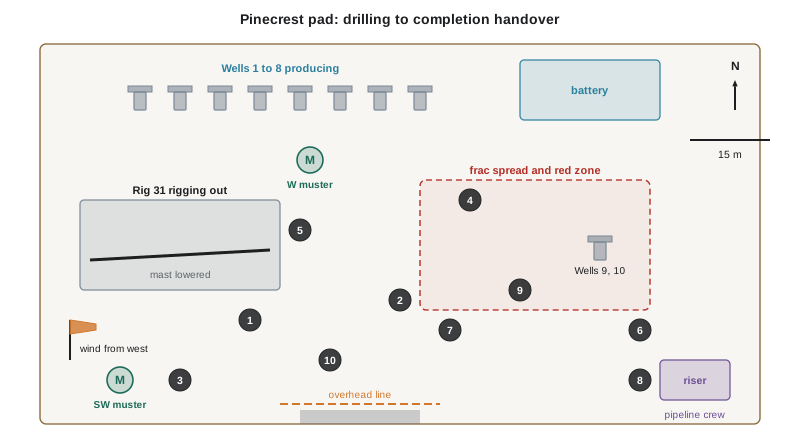
The review team, made up of the operator's supervisor, the rig manager, the frac supervisor, the production operator and the pipeline foreman, walks the pad and lists ten findings. The program below scores them on a simple five-by-five risk matrix (likelihood times severity) so that the most serious are addressed first. The scores are the team's judgment for teaching purposes.
# Pinecrest 72-hour hazard review: (finding, likelihood 1-5, severity 1-5)
findings = [
    (1, "Rig-out crane lifts with no lift plan or owner",            4, 5),
    (2, "Frac iron route crosses rig truck path",                    3, 5),
    (3, "South-west muster point beside frac truck route",          2, 4),
    (4, "Two SSEs on frac crew without named mentors",               3, 4),
    (5, "Escape line anchor removed before mast fully lowered",      2, 5),
    (6, "Flowback tanks planned as open-top with manual gauging",    3, 5),
    (7, "Sand mover dust collector not yet commissioned",            4, 3),
    (8, "Pipeline crew not included in daily meeting",               3, 4),
    (9, "Eyewash at chemical unit has no heat trace for cold nights", 4, 3),
    (10,"Overhead line at pad entrance; frac loads up to 4.6 m/15 ft",2, 5),
]
ranked = sorted(findings, key=lambda f: -(f[2] * f[3]))
for n, text, like, sev in ranked:
    score = like * sev
    level = "HIGH" if score >= 15 else ("MEDIUM" if score >= 8 else "LOW")
print(f"{score:2d} {level:6} #{n:<2} {text}")20 HIGH #1 Rig-out crane lifts with no lift plan or owner 15 HIGH #2 Frac iron route crosses rig truck path 15 HIGH #6 Flowback tanks planned as open-top with manual gauging 12 MEDIUM #4 Two SSEs on frac crew without named mentors 12 MEDIUM #7 Sand mover dust collector not yet commissioned 12 MEDIUM #8 Pipeline crew not included in daily meeting 12 MEDIUM #9 Eyewash at chemical unit has no heat trace for cold nights 10 MEDIUM #5 Escape line anchor removed before mast fully lowered 10 MEDIUM #10 Overhead line at pad entrance; frac loads up to 4.6 m/15 ft 8 MEDIUM #3 South-west muster point beside frac truck route
The ranking puts the crane lifts with no owner at the top, followed by the frac iron crossing the truck path and the open-top flowback tanks, all three rated high. Four medium findings follow closely, including the short-service workers without mentors and the uncommissioned dust collector. Every finding gets an action, an owner and a deadline before the related work starts, with the high-ranked ones first:
- Finding 1: Northline and Larchwood assign ownership of rig-out lifts to Northline in the bridging document, and the crane company prepares lift plans for the heavy loads before any lift.
- Finding 6: Larchwood and the flowback company switch to a closed flowback system with remote level monitoring, as Lesson 11 recommends.
- Finding 2: Ridgeback reroutes its iron or schedules rig-out traffic so that no truck crosses the red zone, with barriers and a spotter at the crossing point.
- Finding 7: no sand is moved until the dust collector is commissioned and tested; meanwhile, nobody works downwind of transfer points.
- Finding 9: the eyewash is heat-traced or replaced with a tempered unit before chemicals are handled.
- Finding 4: Ridgeback assigns named mentors to its two short-service employees and keeps them out of the red zone until signed off.
- Finding 8: the pipeline foreman joins the daily meeting and the pipeline crew receives the pad orientation update.
- Finding 5: Northline reinstates the escape line until the mast is fully lowered and the derrickhand no longer needs it.
- Findings 3 and 10: the team confirms muster points against the actual wind and frac layout, moving the south-west muster point away from the truck route if needed, and arranges a spotter and measured clearances for loads under the overhead line.
Note how many findings come from the handover itself: two companies' work overlapping, ownership unclear, crews not talking to each other. That is the typical pattern of multi-employer sites, and it is why the bridging document, the daily meeting and the hazard review exist.
Bringing the course together
The course began with the rig's five systems and the energy each holds. Every lesson since has followed the same logic: identify where energy is stored, who can be exposed to it and which controls keep the two apart. On the floor, that meant keeping hands out of pinch points and bodies out of the line of fire. At height, it meant fall protection, escape lines and preventing dropped objects. With iron, it meant matched components, pressure testing and red zones. In the mud system, it meant controlling chemicals and gas. In well control, it meant keeping the primary barrier intact and reporting warning signs early. In moves, servicing and completions, it meant planning, coordination and respecting exclusion zones. And across all of it, it meant new workers who are mentored, crews who can stop work, and companies that agree in advance on who does what.
HSE-332 continues the track with facility and pipeline safety, and HSE-333 covers permits to work and isolation in oil and gas, which tie many of these controls into a formal system.
Worked problem
Writing the 72-hour orientation update
The Pinecrest review is complete. The operator's supervisor asks the rig manager and frac supervisor to prepare a short orientation update for everyone arriving on the pad in the next 72 hours. What should it include?
Show solution
- The current layout: rig-out area on the west, frac spread on the east, producing wells and battery on the north and pipeline work at the riser, with walking routes and no-go areas.
- Who is in charge of each area and of the site as a whole, and how to reach them.
- The red zone around the frac iron and wellheads, the rule that nobody enters without authorization, and the fall zone and lifting areas during rig-out.
- Hazards of the week: sour gas from producing wells and flowback, silica at sand transfer points, cold temperatures, heavy traffic and overhead lines at the entrance.
- Alarms, muster points confirmed against the wind, the headcount procedure, and every worker's stop-work authority.
Answer: The update gives the current layout, who is in charge, the red zones and lifting areas, the week's main hazards, the emergency arrangements and stop-work authority, so that everyone arriving understands the pad as it is now, not as it was last week.
Common mistakes
MistakeAssuming the other company has a procedure for a shared activity.
InsteadConfirm in the bridging document that every critical activity has one owner and an agreed procedure.
MistakeLeaving a crew out of the daily meeting because it is only on site briefly.
InsteadInclude every crew whose work could affect or be affected by others.
MistakeTreating the drilling-to-completion handover as routine.
InsteadReview hazards specifically for handovers, when responsibility is most likely to fall through gaps.
MistakeRanking hazards and then not assigning actions.
InsteadGive every high-ranked finding an action, an owner and a deadline before the work starts.
MistakeReusing last week's orientation after the pad layout has changed.
InsteadUpdate orientation whenever the layout, work or hazards change.
Summary and key terms
- Alberta requires a designated prime contractor on multi-employer sites; other provinces have their own coordination rules.
- Each employer keeps its own duties; the coordinating party adds a duty to coordinate across the site.
- Handovers, such as rig release and the start of completions, are when responsibility is most likely to fall through gaps.
- Bridging documents settle roles, procedures, communication, emergency response, SIMOPS, training, reporting and change management.
- Daily meetings, shared orientation, common emergency signals and universal stop-work authority make coordination work.
- A hazard review ranks findings and assigns each an action, an owner and a deadline.
- Across the course, safety comes from identifying stored energy, who is exposed and which controls keep them apart.
- Bridging document
- A written agreement connecting two or more companies' safety systems for a specific job or site.
- Prime contractor
- In Alberta and some other provinces, the party designated to coordinate health and safety among employers on a multi-employer site.
- Controlling employer
- Under OSHA's multi-employer policy, the employer with general supervisory authority over a worksite.
- Handover
- The transfer of control of a site or activity from one crew or company to another.
- Management of change
- A process for reviewing and approving changes to plans, equipment or people before they happen.
- Risk matrix
- A table that combines likelihood and severity to rank hazards.
Practice problems
Work each problem on paper first, then reveal the answer to check.
Who designates the prime contractor on an Alberta work site?
Show answer
The person in control of the work site, usually the licensee or operator.
Why are handovers high-risk moments?
Show answer
Control shifts between companies and responsibility can fall through gaps.
Name four topics a bridging document should cover.
Show answer
Any four of: roles and authority, procedures, communication, emergency response, SIMOPS, training, incident reporting, change management.
In the bridging program, which activity had no owner?
Show answer
Crane lifts during rig-out.
Why can two owners for one activity be a problem?
Show answer
Each may wait for the other to act unless the document states who decides what.
Name three daily coordination practices on a pad.
Show answer
Daily meeting with all contractors, site status board, shared orientation, common emergency signals, universal stop-work authority (any three).
Which finding ranked highest in the Pinecrest review?
Show answer
Rig-out crane lifts with no lift plan or owner.
What three things should every high-ranked finding receive?
Show answer
An action, an owner and a deadline.
What should replace open-top flowback tanks with manual gauging?
Show answer
A closed flowback system with remote level monitoring.
What logic links all the lessons in this course?
Show answer
Identify stored energy, who can be exposed to it and which controls keep them apart.
Lesson quiz · 5 questions
Score 60% or more to complete this lesson.
Create a free account to save your progress, take quizzes and earn a certificate.