
HSE-331 · Lesson 1 of 12 · 31 min
The drilling rig and its systems
A drilling rig is a temporary factory that moves from location to location, builds a hole several kilometres long and then leaves. In a few weeks a crew raises a mast, makes up thousands of metres of pipe, circulates tonnes of drilling fluid, runs and cements casing, and hands the well over to a completion crew. Almost every serious hazard in the oil and gas industry is present on a rig at once: heavy suspended loads, rotating equipment, high-pressure fluid, work at height, flammable and toxic gas, power, noise, weather and a crowded deck where several companies work side by side. This course, the second in the oil and gas sites track, explains those hazards and the controls that keep rig and well site crews alive.
HSE-330 gave the orientation every worker needs before stepping onto a lease: the life cycle, the regulators, gas detection, hydrogen sulphide basics, pressure and stored energy, and emergency response plans. This course assumes that background and goes onto the rig floor, the derrick, the mud tanks, the service rig and the fracturing spread. HSE-332 follows with facilities and pipelines, and HSE-333 covers permits to work and isolation. Where another course already teaches a topic in depth, this course points to it rather than repeating it: HSE-212 for fall protection, HSE-219 for cranes and rigging, HSE-218 for mobile equipment, HSE-241 for noise, HSE-242 for silica and HSE-244 for hydrogen sulphide.
This first lesson walks through the rig itself. You do not need to be able to run a rig to work safely on one, but you do need to know what each system does, where its energy is stored and which parts of it can reach you. A floorhand who understands why the driller is watching the weight indicator, or why the derrickhand clips in before leaving the monkeyboard, makes better decisions than one who simply follows orders.
The five systems of a rotary rig
Every modern rotary rig, from a small single used for shallow wells to a large pad rig drilling long horizontal Montney or Bakken wells, has the same five systems. The hoisting system raises and lowers the drill string and casing. The rotating system turns the bit. The circulating system pumps drilling fluid down the pipe and back up the hole. The power system drives everything. The well control system closes in the well if formation fluids enter it. Understanding the five systems gives you a map of where the energy is.
| System | Main components | Stored or moving energy | Who is usually exposed |
|---|---|---|---|
| Hoisting | Mast or derrick, crown block, travelling block, drilling line, drawworks, deadline anchor, elevators | Suspended loads of hundreds of tonnes, wire rope under tension, gravity | Floorhands, derrickhand, driller |
| Rotating | Top drive or kelly and rotary table, slips, tongs, iron roughneck | High torque, spinning pipe, chains and cathead lines on older rigs | Floorhands |
| Circulating | Mud pumps, standpipe, rotary hose, shale shakers, mud tanks, mixing hopper | Fluid at pump pressure, chemicals, gas in returns | Motorhand, derrickhand, mud specialist |
| Power | Diesel or natural gas engines, generators, silicon controlled rectifier (SCR) or variable frequency drive (VFD) house, compressors | Electrical energy, hot surfaces, fuel, noise | Motorhand, electrician |
| Well control | Blowout preventer (BOP) stack, accumulator, choke manifold, gas buster, flare lines | Formation pressure, hydraulic pressure stored in accumulator bottles | Whole crew |
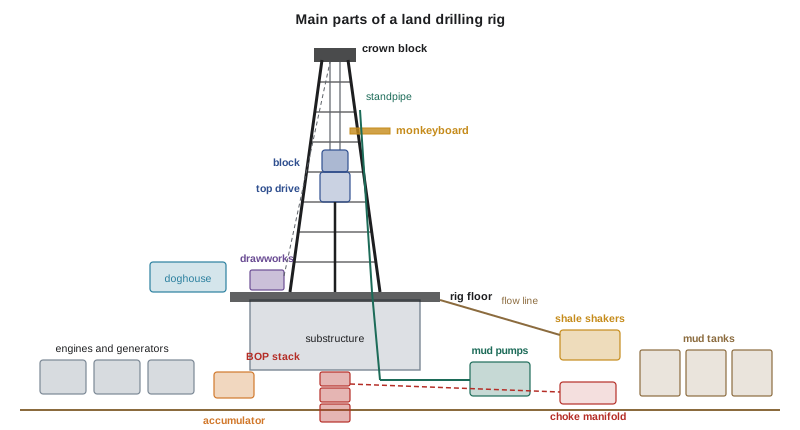
Hoisting: the heaviest loads on site
The hoisting system is a large block and tackle. Drilling line, a steel wire rope typically 29 to 38 mm (1-1/8 to 1-1/2 in) in diameter on land rigs, runs from a storage reel through a deadline anchor, up to the crown block sheaves at the top of the mast, down through the travelling block sheaves and back several times, and finally onto the drum of the drawworks. Spooling line onto the drum lifts the travelling block; letting it off lowers the block. Because the line is strung through many sheaves, the tension in the fast line is only a fraction of the hook load, but the hook load itself can exceed 200 tonnes on a large rig. Lesson 4 works through the arithmetic.
The hoisting system holds the most gravitational energy on site. A dropped string of pipe, a parted drilling line or a travelling block that runs into the crown can kill people instantly. Rigs therefore carry several layers of protection. A crown saver or crown-o-matic device stops the drawworks if the block travels too high, and modern rigs have electronic block position limits that also protect against running the block into the floor. The driller watches a weight indicator that shows the hook load, and a sudden change in weight warns of stuck pipe, a dropped string or a parted line. The drilling line is slipped and cut on a schedule based on the work it has done, measured in tonne-kilometres or ton-miles, so that no single section wears out at the sheaves. Inspection of the line, the sheaves, the deadline anchor and the mast itself follows the manufacturer's instructions and industry practice.
Masts and derricks are structures that are raised and lowered at every move. A conventional derrick is built up piece by piece; most land rigs today use a telescoping or folding mast that is raised in one lift by the drawworks or by hydraulic cylinders. Raising and lowering are among the most dangerous operations on a rig because the whole structure is under unusual loads and people may be tempted to stand where they should not. Lesson 9 covers rig moves, raising and lowering in detail.
Rotating: top drives, kellys and the rotary table
Older rigs turn the drill string with a rotary table set in the rig floor. A square or hexagonal pipe called the kelly passes through a kelly bushing in the table, and the table turns the kelly, which turns the pipe. Newer rigs, including nearly all pad rigs drilling horizontal wells, use a top drive: a large electric or hydraulic motor that hangs from the travelling block and screws directly into the top of the drill string. A top drive can rotate and circulate while pipe is moved up or down, which makes drilling faster and safer in many situations, but it also puts a heavy, rotating machine above the heads of the floor crew.
Whatever the drive, the floor crew handles pipe at the well centre. Slips are wedges that grip the pipe in the rotary table so that the string hangs from the floor while a connection is made or broken. Tongs are large wrenches used to make up and break out threaded connections to the right torque. On older rigs the crew used manual tongs pulled by a cathead or a hydraulic cylinder; many rigs now use an iron roughneck, a machine that spins and torques connections without workers holding tongs. Automation has greatly reduced the number of hands at well centre, but it has not removed people from the floor, and the energy in high-torque connections is still enough to throw a worker or crush a hand. Lesson 4 covers rig floor hazards in detail.
Circulating: the mud system
Drilling fluid, usually called mud, is pumped down the inside of the drill string, out through nozzles in the bit and back up the annulus between the pipe and the hole. It cools and lubricates the bit, carries cuttings to surface, supports the walls of the hole and, most importantly for safety, provides hydrostatic pressure that holds formation fluids in the rock. Mud pumps are large piston pumps that can deliver fluid at pressures of 20,000 to 35,000 kPa (3,000 to 5,000 psi) through the standpipe and a flexible rotary hose to the top drive.
At surface, returning mud passes over shale shakers, vibrating screens that remove cuttings, and then through degassers, desanders, desilters and sometimes centrifuges before returning to the mud tanks. The tanks hold the active volume of mud, and a pit volume totalizer measures it. A gain in pit volume is one of the clearest signs that formation fluid is entering the well, which is why the mud system is part of well control (Lesson 8). The mud system also brings chemical hazards to the rig: oil-based fluids, caustic additives, barite and other powders, hydrogen sulphide in returns from sour zones, and hydrocarbon vapours at the shakers. Lesson 7 covers those exposures.
Power
Most land rigs are powered by large diesel engines, increasingly with natural gas or dual-fuel engines and sometimes with grid power or battery storage where it is available. The engines drive generators, and an SCR or VFD house converts their output to run the drawworks, top drive, mud pumps and rotary table. Rigs also carry air compressors, hydraulic power units, boilers or steam generators for winter heating, and many electric motors. Power brings electrical hazards (HSE-214), hot exhaust surfaces, fuel handling, noise above 100 dBA near engines and generators (HSE-241) and, for gas-fuelled rigs, gas supply piping on the lease. The motorhand looks after the power system and is often the first to notice abnormal engine behaviour, which can be an early sign of gas reaching an engine air intake.
Well control equipment
The well control system is the last barrier between formation pressure and the people on the lease. The primary barrier is the hydrostatic pressure of the mud column. If that barrier fails and formation fluid enters the well, called a kick, the crew shuts the well in using the blowout preventer stack. A typical land stack has an annular preventer at the top, which seals around any shape of pipe, and two or more ram preventers below it: pipe rams that close around a specific size of pipe and blind or blind-shear rams that close the open hole or cut the pipe. An accumulator unit, often called a koomey after an early manufacturer, stores hydraulic fluid under nitrogen pressure so that the preventers can close even if rig power fails. A choke manifold lets the crew control the flow from the well while they circulate the kick out, and a mud-gas separator, or gas buster, separates gas from the returns and sends it to a flare.
The BOP stack and accumulator are pressure equipment in their own right. Accumulator bottles hold nitrogen precharged to around 7,000 kPa (1,000 psi) and charged with fluid to about 21,000 kPa (3,000 psi). Lines from the accumulator to the stack, from the stack to the choke manifold and from the manifold to the flare carry fluid at well pressure during a kick. Function tests and pressure tests of this equipment are frequent and are themselves hazardous operations that call for barricades and clear communication. Lesson 8 explains well control at the level every crew member needs.
Kinds of rigs
Not every rig drills new wells, and the hazards shift with the type of rig.
| Rig type | What it does | Hazards that stand out |
|---|---|---|
| Conventional land drilling rig | Drills vertical or directional wells from a single location; moved by truck between wells | Rig moves, pipe handling, work at height, well control |
| Pad or walking rig | Drills several wells from one pad; walks or skids between wells on hydraulic feet | Skidding near live wells, crowded pad, simultaneous operations with production |
| Service or workover rig | Pulls and runs tubing and rods, repairs and recompletes existing wells | Smaller crews, frequent rig-ups, swabbing, live wells with pressure |
| Coiled tubing unit | Runs a continuous steel tube into a live well from a reel | Stored energy in the reel and injector, pressure at surface, crane lifts |
| Snubbing unit | Forces jointed pipe into a well under pressure | Pipe ejection, high surface pressure, work at height in the basket |
| Wireline and slickline units | Lower tools on cable to log, perforate or set plugs | Pressure control equipment, explosives, line under tension |
Pad drilling has become the norm in the Montney, the Duvernay, the Bakken and the Permian. A walking rig can move from one well to the next on the same pad in hours rather than days, which reduces rig moves on the highway but adds a new hazard: drilling a new well a few metres from wells that may already be completed or producing. Simultaneous operations, often called SIMOPS, require careful planning between the drilling contractor, the operator and any production or completion crews on the same pad. HSE-333 covers the permit and isolation side of SIMOPS; this course points out where it appears on the rig.
Pinecrest: the rig arrives
The running example continues at the invented Pinecrest pad of the invented Larchwood Resources, about 60 km south of Grande Prairie, Alberta. In HSE-330 the pad held eight producing Montney wells and a battery. In this course Larchwood has contracted a pad rig, Rig 31 of the invented Northline Drilling, to drill four new horizontal wells, numbered 9 to 12, on an extension of the same pad. Each well reaches a true vertical depth of about 2,900 m and a measured depth of about 6,000 m. The raw gas still contains about 0.5 percent hydrogen sulphide, so the wells are drilled under a sour well licence and the rig crew holds current H2S training. After drilling, an invented completions company, Ridgeback Pressure Pumping, will fracture the wells, and an invented service rig company will run production tubing. All people, companies and incidents at Pinecrest are invented for teaching.
The program below lists the major pieces of Rig 31 by system, with invented but realistic ratings, and counts how many involve each of the energy forms from HSE-330's energy wheel. It is a simple way to see that the hoisting and well control systems carry the most severe energies.
# Invented equipment list for Rig 31 at Pinecrest, tagged by energy form.
equipment = [
    ("Mast and crown block",        "hoisting",     ["gravity"]),
    ("Drawworks and drilling line", "hoisting",     ["gravity", "mechanical"]),
    ("Block and top drive",         "hoisting",     ["gravity", "mechanical", "electrical"]),
    ("Iron roughneck",              "rotating",     ["mechanical", "pressure"]),
    ("Slips and manual tongs",      "rotating",     ["mechanical"]),
    ("Mud pumps and standpipe",     "circulating",  ["pressure", "mechanical", "sound"]),
    ("Shale shakers and tanks",     "circulating",  ["chemical", "sound"]),
    ("Engines and generators",      "power",        ["electrical", "temperature", "sound", "chemical"]),
    ("VFD house",                   "power",        ["electrical"]),
    ("BOP stack",                   "well control", ["pressure"]),
    ("Accumulator unit",            "well control", ["pressure"]),
    ("Choke manifold, gas buster",  "well control", ["pressure", "chemical"]),
]
count = {}
for name, system, forms in equipment:
    for f in forms:
        count[f] = count.get(f, 0) + 1
for f, n in sorted(count.items(), key=lambda kv: -kv[1]):
    print(f"{f:12} {n:2d} items  " + "#" * n)
systems = sorted({s for _, s, _ in equipment})
print("Systems:", ", ".join(systems))mechanical 5 items ##### pressure 5 items ##### gravity 3 items ### electrical 3 items ### sound 3 items ### chemical 3 items ### temperature 1 items # Systems: circulating, hoisting, power, rotating, well control
Counting is not the same as ranking risk, of course. A single parted drilling line can do more harm than a dozen noisy motors. The count simply reminds a new worker that the rig is full of energy of many kinds, and that the floor, where hoisting, rotating, circulating and well control all meet, is the place where those energies concentrate.
Worked problem
Reading a rig layout on arrival
A new leasehand arrives at Rig 31 for his first shift. The toolpush hands him a site plan showing the rig, the mud tanks, the pipe racks and catwalk, the doghouse, the engines, the accumulator, the choke manifold, the flare pit, the camp and two muster points. What should he note before he walks to the floor?
Show solution
- Where the muster points are and which one is upwind today, checked against the windsocks (HSE-330, Lesson 11).
- The walking routes from the parking area to the doghouse that avoid the pipe racks, the catwalk and the area under the mast during pipe handling.
- Where the accumulator unit and its remote panel are, and where the choke manifold and flare lines run, because those areas may be barricaded during tests and kicks.
- Where hydrogen sulphide detectors, the wind direction indicators, breathing air and the safety shower and eyewash are located.
- Who his supervisor is for the shift and how to contact the driller, because he must not climb to the floor without permission and an orientation.
Answer: Before going to the floor, the newcomer should know the muster points and wind direction, safe walking routes, the location of well control equipment, the life-safety equipment and who is in charge. Lesson 2 covers the orientation and mentoring he should receive.
Common mistakes
MistakeThinking of the rig as one machine run by the driller.
InsteadKnow the five systems and where each stores energy, so you can recognize which parts of the rig can reach you.
MistakeStanding under the travelling block or mast during pipe handling because the load looks secure.
InsteadKeep out of the drop zone and line of fire of suspended loads at all times.
MistakeTreating the BOP stack and accumulator as equipment that only matters in a blowout.
InsteadTreat them as pressure equipment with their own hazards during every function and pressure test.
MistakeAssuming automation such as an iron roughneck has removed the hazard at well centre.
InsteadRecognize that automation reduces exposure but high torque and moving pipe can still injure people near the machine.
MistakeIgnoring engine behaviour as a mechanical matter only.
InsteadReport engine surging or speeding up at once, because it can mean gas is reaching an air intake.
Summary and key terms
- A rotary rig has five systems: hoisting, rotating, circulating, power and well control.
- The hoisting system carries the largest gravitational energy, with hook loads that can exceed 200 tonnes on large rigs.
- Top drives have largely replaced kellys and rotary tables, and iron roughnecks have reduced the number of hands at well centre.
- Drilling mud provides the primary well control barrier through hydrostatic pressure, and a gain in pit volume is a key kick warning.
- The BOP stack, accumulator and choke manifold form the secondary barrier and are pressure equipment in their own right.
- Service rigs, coiled tubing, snubbing and wireline units each bring their own mix of pressure, stored energy and lifting hazards.
- Pad drilling reduces highway moves but creates simultaneous operations near live wells.
- Drawworks
- The winch on a rig floor that spools drilling line to raise and lower the travelling block.
- Travelling block
- The set of sheaves that moves up and down the mast and carries the top drive or hook.
- Top drive
- A motor hung from the travelling block that rotates the drill string from the top.
- Kelly
- A square or hexagonal pipe turned by the rotary table to rotate the drill string on older rigs.
- Slips
- Wedges that grip pipe in the rotary table so the string hangs from the floor.
- Iron roughneck
- A machine that spins and torques pipe connections at well centre.
- Blowout preventer
- A set of valves on the wellhead that can seal the well around pipe or across the open hole.
- Accumulator
- A unit that stores hydraulic fluid under nitrogen pressure to close the blowout preventers.
- Kick
- An unplanned flow of formation fluid into the well.
Practice problems
Work each problem on paper first, then reveal the answer to check.
Name the five systems of a rotary drilling rig.
Show answer
Hoisting, rotating, circulating, power and well control.
Which system holds the largest gravitational energy?
Show answer
The hoisting system.
What does a crown saver do?
Show answer
It stops the drawworks if the travelling block travels too close to the crown.
Why is drilling line slipped and cut on a schedule?
Show answer
So that wear at the sheaves is spread along the line and no section wears out.
What is the primary well control barrier while drilling?
Show answer
The hydrostatic pressure of the drilling fluid column.
What warning does a gain in pit volume give?
Show answer
That formation fluid may be entering the well (a kick).
Why can preventers close even if rig power fails?
Show answer
The accumulator stores hydraulic fluid under nitrogen pressure.
Give one hazard that stands out on a snubbing unit.
Show answer
Pipe ejection under well pressure, high surface pressure or work at height in the basket.
What new hazard does pad drilling add?
Show answer
Drilling close to wells that are completed or producing, which needs simultaneous operations planning.
What might engine surging on a rig signal?
Show answer
Gas reaching an engine air intake.
Lesson quiz · 5 questions
Score 60% or more to complete this lesson.
Create a free account to save your progress, take quizzes and earn a certificate.