
HSE-331 · Lesson 10 of 12 · 28 min
Well servicing, wireline and workovers
Once a well is drilled and completed, it still needs work throughout its life. Production tubing must be run and later pulled, rod pumps fail and must be repaired, sand and scale must be cleaned out, zones are added or isolated, and at the end of the well's life it must be plugged and abandoned. This work is done by well servicing crews using service rigs, wireline and slickline units, coiled tubing units, snubbing units, pump trucks and cranes. The NIOSH data discussed in HSE-330 found that about 60 percent of oil and gas extraction deaths in the United States from 2014 to 2019 were among workers of well servicing companies, far more than among drilling contractor employees. This lesson explains why servicing is so hazardous and how the main hazards are controlled.
What makes servicing different
Service rigs are smaller than drilling rigs, with a single truck-mounted mast and a crew of four or five, but they share many of the same hazards: hoisting, pipe and rod handling, work at height on the derrick board, high-pressure lines and well control. Several features make servicing especially risky. Crews rig up and rig down far more often, sometimes several times a week, so the high-risk steps of raising masts and guying them happen constantly. They work on wells that already contain hydrocarbons and often pressure, rather than on a new hole full of mud. They work on many different leases, each with its own layout, equipment and history. And the work is varied: pulling tubing one day, swabbing the next, fishing for a stuck tool the day after.
| Operation | What it involves | Main hazards |
|---|---|---|
| Pulling and running tubing | Tripping production tubing with the service rig | Pipe handling, pinch points, falls from the derrick board, well flowing during the trip |
| Pulling and running rods | Tripping sucker rods on pumping wells | Rod string parting or whipping, pinch points, hands on rod tongs, fluid spray |
| Swabbing | Lowering a swab cup on a line to lift fluid and start a well flowing | Well kicking off unexpectedly, gas and H2S at surface, line parting, swab tank vapours |
| Cleanouts and fishing | Removing sand or scale; retrieving lost tools | Pressure, jarring loads, stuck pipe, heavy pulls near mast limits |
| Wireline and slickline | Running tools on cable to log, perforate, set plugs or retrieve devices | Pressure control equipment, explosives, line under tension, crane lifts of lubricator |
| Coiled tubing | Running continuous tubing into a live well | Stored energy in the reel and injector, pressure at surface, crane lifts |
| Snubbing | Forcing jointed pipe into a well under pressure | Pipe ejection, high surface pressure, work at height in the basket |
| Abandonment | Plugging the well with cement and removing equipment | Residual pressure and gas, cutting and capping casing, NORM, ground disturbance |
Service rig masts and loads
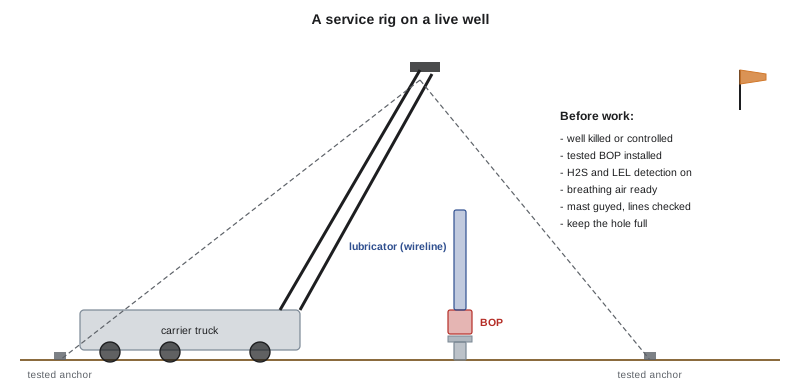
A service rig mast is usually raised hydraulically from the carrier truck and held by guy lines anchored to the ground. Before raising, the crew levels the carrier, checks that the ground can carry the loads, checks for overhead lines (Lesson 9) and confirms that guy line anchors have been installed and tested correctly. Anchors that pull out under load have caused masts to collapse. The mast's rated capacity depends on the number of lines strung, the guying and the wind, and the driller must know how close each pull is to that limit, particularly when pulling stuck tubing or jarring on a fish.
The program below checks invented pulls on a service rig at a Pinecrest well against an illustrative mast rating, applying a safety margin and a reduction for wind. Real limits come from the manufacturer's load chart and the rig's own procedures.
# Invented service rig check at a Pinecrest well. Loads in daN (1 daN = 10 N).
mast_rating = 54_000        # daN, illustrative rating with guys installed
wind_reduction = 0.85       # derate in strong wind (illustrative)
safety_margin = 0.80        # plan pulls at no more than 80 percent of rating

tubing_weight_per_m = 9.5   # kg/m for 73 mm tubing (illustrative)
length_m = 2900
g = 9.81
string_daN = tubing_weight_per_m * length_m * g / 10
blocks_daN = 900
for wind, label_ in ((False, "calm"), (True, "strong wind")):
    limit = mast_rating * (wind_reduction if wind else 1.0) * safety_margin
    for overpull in (0, 15_000, 25_000):
        load = string_daN + blocks_daN + overpull
        flag = "OK" if load <= limit else "STOP - exceeds planned limit"
print(f"{label_:11} overpull {overpull:6,} daN: load {load:7,.0f} of limit {limit:7,.0f} {flag}")calm overpull 0 daN: load 27,927 of limit 43,200 OK calm overpull 15,000 daN: load 42,927 of limit 43,200 OK calm overpull 25,000 daN: load 52,927 of limit 43,200 STOP - exceeds planned limit strong wind overpull 0 daN: load 27,927 of limit 36,720 OK strong wind overpull 15,000 daN: load 42,927 of limit 36,720 STOP - exceeds planned limit strong wind overpull 25,000 daN: load 52,927 of limit 36,720 STOP - exceeds planned limit
The string weight alone is well within the limit, but a large overpull to free stuck tubing approaches or exceeds the planned limit, especially in strong wind. When a pull approaches the limit, the right response is to stop and consult the well site supervisor about alternatives, such as a heavier rig, a different fishing method or cutting the tubing, rather than pulling harder.
Live wells and well control on service rigs
Unlike a drilling rig, which starts with a hole full of mud, a service rig often arrives at a well that has pressure at surface or can flow when disturbed. Before any work, the well is killed or controlled, usually by circulating or bullheading kill fluid, and a blowout preventer is installed on the wellhead. Service rig crews hold well service blowout prevention or well servicing well control certificates (Lesson 3), and service rigs practise drills just as drilling rigs do. Common causes of well control incidents on service rigs include not keeping the well full while pulling tubing, swabbing the well in by pulling too fast, gas migrating up the tubing or annulus during a shutdown, and unexpected pressure behind plugs or packers.
Sour wells add hydrogen sulphide exposure at surface whenever the well is opened. At Pinecrest, every servicing job on a well with 0.5 percent H2S in the gas is planned as sour work: fixed and personal detection, breathing air at the wellhead and in the work area, a safety watch where required, wind direction checks and an emergency plan. IRP 2 in Canada and API RP 49 in the United States set out recommended practices for servicing sour wells.
Rods and rod pumps
Many oil wells, including some in the Bakken, are produced with beam pumping units (pump jacks) that drive a string of sucker rods connected to a downhole pump. Pulling and running rods involves connecting and disconnecting the rod string at the polished rod, handling rods with elevators and rod tongs, and laying them down or standing them in the derrick. Rods are long and flexible and can whip if they part or are released under tension. Before any work, the pumping unit must be stopped, its brake set and its counterweights secured, and its power locked out, because a pumping unit that starts unexpectedly or a counterweight that rotates can kill. HSE-210 covers lockout; note that in the United States the OSHA lockout standard does not apply to oil and gas well drilling and servicing operations themselves, but employers must still control hazardous energy under the general duty clause and recognized practice.
Swabbing
Swabbing lowers a swab cup on a sand line or swab line into the tubing and pulls it up to lift fluid out of the well, reducing the hydrostatic pressure until the well starts to flow. It is a common way to bring a well on after a workover. Hazards include the well kicking off suddenly, gas and H2S arriving at surface with the fluid, the line parting under load, and vapours from the swab tank where fluid is collected. Controls include having the BOP and a lubricator in place, monitoring fluid levels, gas detection at the wellhead and tank, keeping people out of the line of fire of the swab line and stopping to reassess if the well begins to flow.
Wireline, slickline and perforating
Wireline and slickline units lower tools into a well on a cable from a truck-mounted drum. Slickline uses a single solid wire for mechanical work, such as setting and retrieving plugs and gauges; electric wireline carries conductors for logging tools and for firing perforating guns. Because tools are run into wells with pressure at surface, the crew assembles a lubricator, a tube that holds the tool above the wellhead valves, with pressure control equipment such as a wireline valve and a grease injection head to seal around the moving cable. The lubricator is lifted into position by a crane or the service rig, which brings lifting hazards and work at height to connect it.
Perforating guns use shaped explosive charges to punch holes through casing and cement into the formation. Explosives on a well site are handled only by qualified wireline personnel under the applicable explosives regulations, and everyone else needs only to understand and obey the controls: radio silence and the shutdown of other transmitters near the wellhead while guns are being armed or are near surface, where the plan requires it; staying out of the exclusion area during arming and disarming; and never handling perforating guns, detonators or explosive components. Stray electrical energy, including from radios, mobile phones, cathodic protection and lightning, can initiate some electric detonators, which is why explosives procedures control those sources. Modern systems use safer, less sensitive initiation, but the rules remain strict.
Coiled tubing and snubbing
Coiled tubing units run a continuous length of steel tubing, wound on a large reel, into a live well through an injector head and stripper. The reel and injector store large amounts of mechanical energy, and the tubing at surface may contain fluid at pressures up to the rating of the equipment. Snubbing units force jointed pipe into or out of a well against well pressure, using hydraulic jacks and slip bowls, with workers in a basket above the wellhead. If the slips fail or a connection parts, pipe can be ejected upward with great force. Both operations are specialized, use dedicated crews with their own training and have industry recommended practices in Canada and the United States. Other workers on the lease should stay clear of the reel, injector, jack and basket and follow the operation's exclusion zones.
Fatigue and hours of work
Service crews often drive to a new lease every day or two, work long days and then drive home. Combined with early starts and on-call work, this creates real fatigue risk on the road and at the well. Many companies set limits on daily hours, consecutive days worked and driving after long shifts, and commercial drivers moving rigs and equipment are subject to hours-of-service rules for commercial vehicles. The program below checks an invented two-week schedule for a service rig crew against illustrative fatigue rules.
# Invented 14-day schedule: (hours worked on lease, hours driving that day)
days = [(12, 2), (12, 1), (13, 1), (12, 1), (14, 3), (12, 1), (0, 0),
        (12, 2), (13, 1), (12, 1), (15, 2), (12, 1), (12, 1), (12, 3)]
MAX_DAY = 14          # illustrative maximum on-duty hours including driving
MAX_RUN = 6           # illustrative maximum consecutive working days
run = 0
flags = []
for i, (work, drive) in enumerate(days, start=1):
    duty = work + drive
    run = run + 1 if duty > 0 else 0
    issues = []
    if duty > MAX_DAY:
        issues.append(f"{duty} h on duty")
    if run > MAX_RUN:
        issues.append(f"day {run} in a row")
    if issues:
        flags.append(f"Day {i}: " + ", ".join(issues))
total = sum(w + d for w, d in days)
print(f"Total on-duty hours in 14 days: {total}")
print("\n".join(flags) if flags else "No issues")Total on-duty hours in 14 days: 183 Day 5: 17 h on duty Day 11: 17 h on duty Day 14: 15 h on duty, day 7 in a row
The schedule breaks the illustrative daily limit on several days, mostly because driving was not counted as work when the crew planned the hitch, and the second week runs past six consecutive days. Fixing it might mean moving long drives to a separate day, adding a crew member to share driving, or scheduling a rest day.
Worked problem
Pulling tubing on Pinecrest Well 3
A service rig arrives to pull and replace corroded tubing on Pinecrest Well 3, a producing sour well. The pumper says the well has about 2,000 kPa (290 psi) on the tubing and casing. What must be in place before the crew starts pulling tubing?
Show solution
- A site-specific orientation and hazard assessment, including the sour gas hazards, wind direction, muster points and the status of nearby wells and the battery.
- Fixed and personal H2S and LEL detection, breathing air available and a safety watch where the plan requires it.
- The well killed or controlled according to the program, with kill fluid volumes recorded, and a tested BOP installed on the wellhead.
- The mast raised and guyed with tested anchors, overhead lines checked and the derrick emergency escape line installed if a derrickhand will work on the board.
- A plan for keeping the well full during the trip, monitoring returns and shutting in if the well flows, with the crew briefed on their roles.
Answer: Before pulling tubing, the crew needs a site orientation, H2S controls, a killed or controlled well with a tested BOP, a properly raised and guyed mast and a plan for keeping the hole full and responding to flow.
Common mistakes
MistakeTreating a service rig job as lower risk than drilling.
InsteadRecognize that servicing crews have the highest fatality share and plan accordingly.
MistakeRaising a service rig mast on anchors nobody has tested.
InsteadConfirm anchors are installed and tested to specification before raising and guying.
MistakePulling harder on stuck tubing to save a trip.
InsteadStop near the planned limit and consult the supervisor about alternatives.
MistakeWorking on a pump jack with only the brake set.
InsteadStop the unit, set the brake, secure counterweights and lock out power.
MistakeUsing a radio near a wellhead while perforating guns are being armed.
InsteadFollow the explosives plan for radio silence and stay out of the exclusion area.
Summary and key terms
- Well servicing workers had the largest share of US oil and gas extraction deaths in 2014 to 2019.
- Frequent rig-ups, live wells, many different leases and varied tasks make servicing especially hazardous.
- Service rig masts depend on level carriers, tested anchors and guy lines; pulls must stay within planned limits.
- Wells are killed or controlled and fitted with BOPs before work, and sour wells need full H2S controls.
- Pump jacks must be stopped, braked, secured and locked out before rod work.
- Wireline uses lubricators and pressure control equipment; perforating explosives are handled only by qualified personnel under strict controls.
- Coiled tubing and snubbing store large energies; long hours and daily driving create fatigue risk.
- Service rig
- A truck-mounted rig used to pull and run tubing and rods and to repair and recomplete wells.
- Workover
- Major repair or modification of an existing well.
- Swabbing
- Lifting fluid from a well with a swab cup on a line to reduce pressure and start flow.
- Sucker rods
- Steel rods that connect a pumping unit at surface to a downhole pump.
- Lubricator
- A pressure-rated tube that holds wireline tools above the wellhead so they can enter a live well.
- Perforating gun
- A tool carrying shaped explosive charges that punch holes through casing into the formation.
- Snubbing
- Forcing pipe into or out of a well against well pressure.
- Overpull
- Force applied above the normal string weight, usually to free stuck pipe.
Practice problems
Work each problem on paper first, then reveal the answer to check.
Which kind of company employed the largest share of US oil and gas extraction workers who died in 2014 to 2019?
Show answer
Well servicing companies (about 60 percent).
Give three reasons servicing is hazardous.
Show answer
Frequent rig-ups, live wells with pressure, many different leases, varied tasks (any three).
Why must guy line anchors be tested?
Show answer
Anchors that pull out can let the mast collapse.
In the program, what pushes the load over the limit?
Show answer
A large overpull, especially combined with the wind derate.
What is installed on the wellhead before a service rig pulls tubing?
Show answer
A tested blowout preventer.
What must be done to a pump jack before rod work?
Show answer
Stop it, set the brake, secure counterweights and lock out power.
What hazards does swabbing create?
Show answer
Sudden flow, gas and H2S at surface, line parting, tank vapours.
What is a lubricator used for?
Show answer
To hold wireline tools above the wellhead so they can enter a live well.
Why are radios controlled near perforating guns?
Show answer
Stray electrical energy can initiate some electric detonators.
In the fatigue program, what caused most daily limit breaches?
Show answer
Driving time not being counted as work.
Lesson quiz · 5 questions
Score 60% or more to complete this lesson.
Create a free account to save your progress, take quizzes and earn a certificate.