
HSE-330 · Lesson 9 of 12 · 26 min
Ground disturbance, pipelines and buried hazards
Under the surface of most oil and gas leases is a web of buried lines: flowlines from wells to the battery, gathering lines to other facilities, fuel gas lines, water and chemical lines, electrical and communication cables, cathodic protection cables, and old lines that may or may not be abandoned. Beyond the lease, transmission pipelines carry gas and liquids at high pressure across farmland and forest. Striking any of these with a shovel, auger, excavator or post driver can release gas or liquid under pressure, start a fire or explosion, expose workers to hydrogen sulphide or electrocute the operator. This lesson explains how oil and gas sites control ground disturbance near buried facilities.
HSE-217, Ground Disturbance and Excavation Safety, is the full course on locates, hand exposure, soil classification, sloping, shoring and trench rescue. Its Lessons 3 and 4 cover locate requests, marks, tolerance zones and hand exposure in detail. This lesson does not repeat that material; it focuses on what is particular to oil and gas leases and pipeline rights-of-way. HSE-332 covers pipeline operations and maintenance.
Why oil and gas sites are different
Three features make ground disturbance on oil and gas sites especially hazardous. First, the density of buried lines is high: a multi-well pad and battery can have dozens of lines running in several directions, added over many years by different companies. Second, many of those lines are private facilities owned by the operator, which may not be registered with the provincial or state one-call centre, so a one-call request alone may not find them; the operator's own records and locators are needed as well. Third, the contents are hazardous: sour gas, condensate, produced water, high-pressure gas and chemicals, rather than the water and low-pressure gas found under most city streets.
Old and abandoned lines add uncertainty. Records from decades ago may be incomplete or wrong, lines may have been abandoned in place without being purged, and some old wells and lines have no solvent owner. Alberta's Orphan Well Association and similar programs in other jurisdictions deal with such sites, and reclamation crews regularly find unexpected lines. Treat every unexpected line as live and hazardous until proven otherwise.
What counts as ground disturbance
In western Canada, ground disturbance is defined broadly to include any work that disturbs the ground, such as excavating, trenching, drilling, augering, ploughing, grading, tunnelling, driving fence posts, stripping topsoil and even some vehicle crossings over shallow lines. Energy regulators and OHS rules require that anyone planning such work near a pipeline or other buried facility identify the facilities first, contact the owners and follow their requirements. Many operators require ground disturbance supervisor training, often called Level II or 201 training after the industry standard, for anyone who supervises ground disturbance on their sites. Near federally regulated pipelines, the Canada Energy Regulator's damage prevention rules apply within a prescribed area 30 m on either side of the pipe, where the pipeline company must authorize ground disturbance in advance; provincially regulated pipelines have similar controlled areas under provincial rules.
Locating buried facilities on a lease
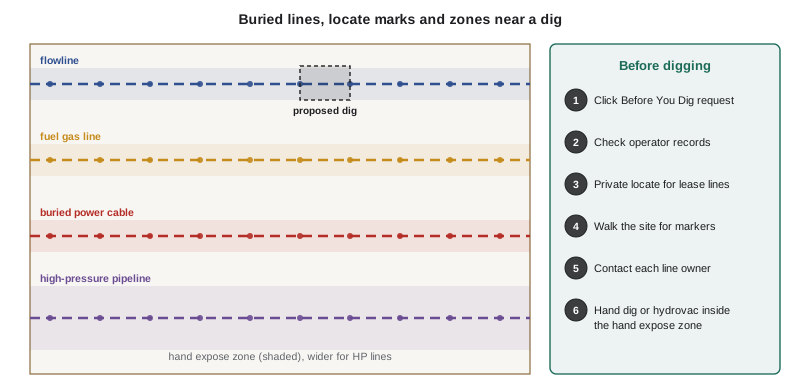
Finding buried lines on an oil and gas site takes several sources together:
- A locate request through the one-call centre: in Alberta, Saskatchewan and Manitoba this is Utility Safety Partners, using its ClickBeforeYouDig online service, which handled more than 430,000 Alberta locate requests in 2025; British Columbia has its own one-call service.
- The operator's records: plot plans, pipeline maps, as-built drawings and the regulator's licence records for the site.
- A private locate by a qualified locator for lines the one-call system does not cover, including flowlines, fuel gas lines, cables and abandoned lines.
- A site walk to look for evidence of buried lines: pipeline markers, risers, valve sets, test posts, warning signs, scars and depressions in the ground.
- Contact with each line owner to obtain their crossing or proximity requirements, which may include a representative on site.
Locate marks show the approximate horizontal position of a line, not its depth, and the line may lie anywhere within a tolerance zone on either side of the marks. Depth can vary because of grading, erosion and the way the line was laid. Inside the zone, lines must be exposed by hand digging or hydrovac (vacuum excavation) before mechanical equipment is used, and the exposed line must be protected and supported. HSE-217 explains the hand exposure rules and their distances.
Pipeline rights-of-way and markers
Pipelines outside the lease run in rights-of-way, strips of land where the pipeline company has rights to operate and maintain the line. Markers stand where pipelines cross roads, railways, fences and watercourses and at intervals along the right-of-way. They show the product, the company and an emergency telephone number. A marker shows that a pipeline is nearby, not exactly where it is or how deep; several lines may share a right-of-way, and lines do not always run straight between markers. Never remove or damage a marker, and report any that are missing.
Activities that seem minor can damage pipelines: driving heavy equipment across a right-of-way where the cover is shallow, storing materials or soil on it, deep tillage, installing fence posts and drainage tile, and blasting nearby. Pipeline companies and regulators usually require permission for crossings with heavy equipment and for any ground disturbance on or near the right-of-way.
Zones around buried facilities
The program below checks a list of proposed dig points against the nearest located line and classifies each as inside or outside the hand exposure or tolerance zone and, where relevant, the regulated area around a pipeline. The distances used are illustrative examples consistent with HSE-217; actual distances come from the applicable rules and the line owner's requirements.
# Proposed dig points: (name, distance in m from nearest located line, line type)
points = [("anchor A", 0.6, "flowline"), ("anchor B", 3.0, "flowline"),
          ("fence post", 4.0, "HP pipeline"), ("sump", 12.0, "HP pipeline"),
          ("sign post", 40.0, "HP pipeline")]
HAND = {"flowline": 1.0, "HP pipeline": 5.0}   # hand exposure zone each side (illustrative, per HSE-217)
PRESCRIBED = 30.0                                # federal pipeline prescribed area each side
for name, d, kind in points:
    if d <= HAND[kind]:
        rule = "inside hand exposure zone: hand dig or hydrovac only"
    elif kind == "HP pipeline" and d <= PRESCRIBED:
        rule = "inside prescribed area: owner authorization needed"
    else:
        rule = "outside zones: locates and normal care"
print(f"{name:10} {d:5.1f} m from {kind:11} -> {rule}")anchor A 0.6 m from flowline -> inside hand exposure zone: hand dig or hydrovac only anchor B 3.0 m from flowline -> outside zones: locates and normal care fence post 4.0 m from HP pipeline -> inside hand exposure zone: hand dig or hydrovac only sump 12.0 m from HP pipeline -> inside prescribed area: owner authorization needed sign post 40.0 m from HP pipeline -> outside zones: locates and normal care
Two of the five points need hand digging or vacuum excavation before any machine is used, and one more needs the pipeline owner's involvement even though it is outside the hand exposure zone. Only the last point can proceed with locates and normal care. A tool like this helps planning, but it does not replace the locate, the owner's requirements and careful exposure on the day.
Planning the work
Ground disturbance near buried lines should be planned in writing before the crew arrives. The plan pulls together the locate information, the owners' requirements and the method of exposure, and it is reviewed with the crew at the start of the job and whenever conditions change.
| Plan element | What it should say |
|---|---|
| Scope and location | What will be dug, where, how deep and with what equipment |
| Buried facilities | Every line and cable within the work area, its owner, contents and approximate depth, with locate ticket numbers and expiry dates |
| Owner requirements | Crossing or proximity agreements, notice periods and whether an owner representative must attend |
| Exposure method | Where hand digging or hydrovac is required and how exposed lines will be supported and protected |
| Other hazards | Excavation hazards such as cave-ins and water (HSE-217), overhead lines, traffic, gas in the excavation and sour lines nearby |
| Emergency response | What to do if a line is contacted, emergency numbers, muster point and the site ERP link |
| Supervision | The trained ground disturbance supervisor or competent person responsible and how work stops if conditions change |
Hydrovac excavation is the safest way to expose lines, but it has its own hazards. The high-pressure water wand can cut skin and inject water under it, and it can damage pipe coating or cables if held too close or too long. The truck's boom must be kept clear of overhead lines. The debris tank and the excavation can collect gas, including hydrogen sulphide when digging near sour lines or contaminated soil, so the crew should monitor the air at the hole and at the truck. Hydrovac slurry from contaminated sites may need special disposal. Exposed lines must be supported along their length so that they do not sag or crack when the soil beneath them is removed.
If a line is hit
Any contact with a buried line, even a scrape or dent that does not leak, must be reported to the line owner, because damage to the pipe or its coating can lead to corrosion and failure later. If a line is struck and is leaking:
- Stop work immediately and shut off equipment engines if you can do so safely; do not try to move the equipment if gas is escaping.
- Get everyone away, upwind and uphill, and keep others out, including vehicles and the public.
- Do not try to stop or plug the leak, and do not operate valves unless you are the owner's authorized person.
- Eliminate ignition sources from a safe position: no starting vehicles, smoking or phones near the release.
- Call 911 or the local emergency number if there is any danger to people, and call the line owner's emergency number on the nearest marker or in the site plan.
- On sour sites, treat any release as an H2S release: monitors on, upwind, follow the site emergency plan (Lesson 11).
- Report to the regulators as required, and preserve the scene for investigation.
Worked problem
A new anchor near the flowline
A maintenance crew at Pinecrest needs to install a new guy-wire anchor for the flare stack. The planned position is 0.6 m (2 ft) from a located flowline and 4 m (13 ft) from a high-pressure gathering pipeline owned by another company that crosses the edge of the lease. What should the plan include?
Show solution
- Confirm locates are current for all lines, including a private locate for the operator's flowlines and cables, and check the plot plan for any lines the locate might miss.
- Contact the gathering pipeline owner, because the anchor is close to their line, and obtain their requirements, which may include a crossing or proximity agreement and their representative on site.
- Hand dig or hydrovac to expose the flowline and confirm its exact position and depth before any mechanical work. Consider moving the anchor position away from both lines if the design allows.
- Brief the crew on what to do if a line is contacted, with the site's emergency numbers and the H2S response, because the flowline carries sour fluid.
Answer: Current locates plus private locates and records, the other owner's requirements, exposure by hand or hydrovac, consider relocating the anchor, and a briefing on strike response.
Common mistakes
MistakeRelying on a one-call request to find all lines on a lease.
InsteadAdd the operator's records and a private locate; many lease lines are not in the one-call system.
MistakeAssuming locate marks show the line's exact position and depth.
InsteadTreat the line as anywhere within the tolerance zone and expose it by hand or hydrovac.
MistakeTreating an unexpected old line as abandoned.
InsteadTreat it as live and hazardous until the owner confirms otherwise.
MistakeBackfilling over a scraped pipe without telling anyone.
InsteadReport any contact to the owner so the pipe and coating can be inspected.
MistakeTrying to stop a leak after striking a line.
InsteadShut down, evacuate upwind, eliminate ignition sources from a distance and call for help.
Summary and key terms
- Leases have dense networks of buried flowlines, gathering lines, cables and old lines with hazardous contents.
- Many lease lines are private and not registered with one-call centres, so operator records and private locates are needed.
- Ground disturbance is defined broadly; CER rules protect a 30 m prescribed area either side of federal pipelines, and provincial rules set similar controlled areas.
- Locate marks give approximate position only; expose lines by hand or hydrovac within the tolerance or hand exposure zone.
- Pipeline markers show that a line is nearby, not its exact location or depth; several lines may share a right-of-way.
- Any contact with a line must be reported, even without a leak.
- After a strike: stop, evacuate upwind, do not plug the leak, control ignition sources from a distance and call 911 and the owner.
- Ground disturbance
- Any work that disturbs the ground, such as digging, augering, grading or driving posts.
- Locate
- Marking the approximate position of a buried facility on the ground with paint or flags.
- Tolerance zone
- The strip on each side of locate marks within which the line may actually lie; called the hand expose zone in Alberta.
- Hydrovac
- Vacuum excavation using water or air to expose buried lines without mechanical digging.
- Right-of-way
- A strip of land in which a pipeline company has rights to operate and maintain its line.
- Pipeline marker
- A sign showing that a pipeline is nearby, with its product, owner and emergency number.
- Private facility
- A buried line owned by the site operator that may not be registered with the one-call centre.
Practice problems
Work each problem on paper first, then reveal the answer to check.
Why may a one-call locate not find all lines on an oil and gas lease?
Show answer
Many lease lines are private facilities not registered with the one-call centre.
What is the CER prescribed area around a federally regulated pipeline?
Show answer
30 m on either side of the pipeline.
Do locate marks show the depth of a line?
Show answer
No; they show approximate horizontal position only.
How should a line be exposed inside the tolerance zone?
Show answer
By hand digging or hydrovac (vacuum excavation).
What information does a pipeline marker give?
Show answer
That a pipeline is nearby, the product, the company and an emergency number.
List four sources of information for locating lines on a lease.
Show answer
One-call request, operator records, private locate, site walk, contact with owners (any four).
Why must a scrape on a pipe be reported?
Show answer
Damage to the pipe or coating can cause corrosion and failure later.
What should you not do after striking a leaking line?
Show answer
Try to stop or plug the leak, operate valves, or start vehicles near the release.
How should an unexpected old line be treated?
Show answer
As live and hazardous until the owner confirms otherwise.
In the program, which points needed hand digging or vacuum excavation?
Show answer
Anchor A and the fence post.
Lesson quiz · 5 questions
Score 60% or more to complete this lesson.
Create a free account to save your progress, take quizzes and earn a certificate.